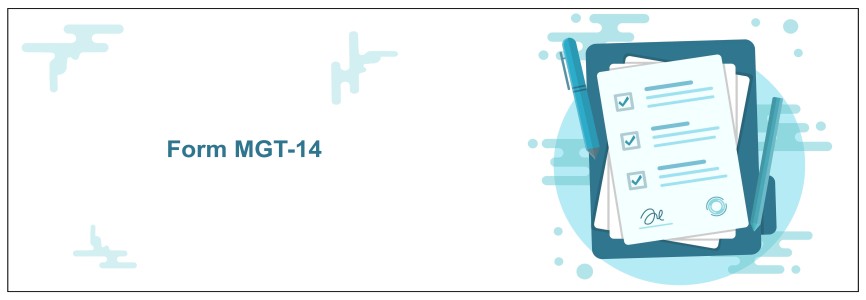



Running a company in India, whether a private limited company, public company, or a Section 8 entity requires complying with several statutory filings under the Companies Act, 2013 and the Companies (Management and Administration) Rules, 2014. Whenever a company alters its Memorandum or Articles, passes significant Board or shareholder resolutions, or enters into specific agreements that require statutory disclosure, the law mandates filing these decisions with the Registrar of Companies (ROC) through Form MGT-14, which allow transparency, creates an official public record of corporate actions, and forms an integral part of ongoing MCA compliance for every company.
Moreover, MGT-14 is one of the most important compliance filings under the Companies Act, 2013. Whenever a company passes a resolution or enters into an agreement on matters prescribed under the Act, a certified copy of such resolution/agreement must be filed with the Registrar of Companies (ROC) through Form MGT-14.
What is Form MGT-14?
Form MGT-14 is a statutory form used to file with the Registrar a copy of:
-
Board Resolutions /BOD resolution
-
Special Resolutions (SR)
-
Certain Ordinary Resolutions (OR)
-
Agreements entered into by the company
-
Explanatory statements under Section 102
MGT-14 applies to resolutions passed in both Board Meetings and General Meetings. However, certain exemptions have been granted particularly to Private Companies and Section 8 Companies pursuant to the MCA exemption notification dated 15.06.2015, reduce the requirement to file specific Board resolutions that would otherwise fall under Section 179(3), unless expressly stated otherwise in the Act or subsequent notifications.
Why is MGT-14 Filing mandatory ?
MGT-14 filing:
-
Acts as official proof of corporate decisions
-
Ensures transparency and corporate governance
-
Maintains statutory records
-
Protects directors from future disputes or allegations of irregular approvals
-
Aligns the company with legal and regulatory expectations under MCA V3
Failure to file MGT-14 may result in:
-
Additional fees
-
Penalties under Section 117(2)
-
Questions during ROC scrutiny, due diligence, or corporate actions such as mergers, fundraising, or FEMA filings
When is MGT-14 Mandatory to file ?
MGT-14 is required for resolutions falling into four categories:
-
Matters under Section 117(3)
-
Board Powers under Section 179(3)
-
Matters prescribed in Rule 8(5)
-
Miscellaneous resolutions requiring filing under various sections
Special Resolutions – Always Require MGT-14
|
Section |
Purpose of Resolution |
|
5 |
Adding entrenchment in AOA |
|
12 |
Shifting registered office within city limits requiring members’ approval |
|
13 |
Alteration of Memorandum of Association |
|
14 |
Alteration of Articles of Association |
|
27 |
Change in objects/terms of prospectus |
|
41A |
Issue of Depository Receipts abroad |
|
48 |
Variation of class rights |
|
54 |
Issue of Sweat Equity Shares |
|
62(1)(c) |
Preferential allotment of shares |
|
66 |
Reduction of share capital |
|
68 |
Buy-back approval, wherever SR is required |
|
71 |
Issue of debentures convertible into shares |
|
94 |
Keeping statutory registers at a place other than registered office |
|
140 |
Removal of auditor before expiry of term |
|
149(1) / (10) |
Increasing number of directors beyond 15; reappointment of Independent Director |
|
165(2) |
Restricting number of directorships |
|
180(1)(a)-(d) |
Powers of Board requiring shareholder approval |
|
186(3) |
Loan/Guarantee/Security/Investment exceeding limits |
|
188 |
Related Party Transactions beyond prescribed thresholds |
|
196 |
Appointment of MD/WTD/Manager above 70 years |
|
197 |
Approving remuneration beyond limits |
|
210, 212 |
Investigation of affairs of the company |
|
248, 271, 304 |
Winding up / striking off approvals |
|
Other notified sections |
Any matter requiring SR under the Act |
Ordinary Resolutions Requiring MGT-14 (Where Specified)
|
Section |
Purpose |
|
4(5)(ii) |
Change of name when directed by ROC |
|
16 |
Rectification of name directed by Central Government |
|
61 |
Alteration of share capital clause (increase/consolidation/sub-division, etc.) |
|
63 |
Capitalisation of profits (Bonus Shares) |
|
73, 76 |
Acceptance of deposits (members/public) |
|
139, 140, 142 |
Auditor appointments, casual vacancy, remuneration |
|
152, 169 |
Appointment and removal of director |
|
181 |
Charitable contributions above 5% of average net profits |
|
197(1) |
Managerial remuneration within limits requiring OR |
|
304, 310, 311, 315, 318 |
Matters relating to voluntary winding up |
Board Resolutions Requiring MGT-14 (Under Section 179(3))
(Exemption available for private companies, except where specifically withdrawn)
|
Section 179(3) |
Power of Board |
|
(a) |
Making calls on shares |
|
(b) |
Authorising buy-back |
|
(c) |
Issue of securities/debentures |
|
(d) |
Borrowing money |
|
(e) |
Investing company funds |
|
(f) |
Granting loans / providing guarantees / security |
|
(g) |
Approving financial statements and Board’s Report |
|
(h) |
Diversifying business |
|
(i) |
Approving amalgamation / merger / reconstruction |
|
(j) |
Acquiring another company or control |
|
(k) |
Any matter prescribed in rules |
Rule 8(5) Resolutions Requiring MGT-14
|
Rule 8(5) |
Purpose |
|
(a) |
Political contributions |
|
(b) |
Appointment or removal of KMP |
|
(c) |
Appointment of internal auditor / secretarial auditor |
(Several earlier items removed by 18.03.2015 notification.)
Documents Required for Filing MGT-14
A standard MGT-14 submission requires the following attachments:
-
Certified true copy of the resolution (Board/Special/Ordinary)
-
Explanatory statement under Section 102
-
Altered physical draft MOA along with INC-33, if applicable
-
Altered physical draft AOA along with INC-34, if applicable
-
Copy of agreement if any, if MGT-14 is filed for an agreement
-
Optional supporting documents, if required
Note: Documents must be digitally signed by an authorised director/KMP and certified by a PCS, except for small companies and OPCs where certification is optional.
Timeline for Filing MGT-14
The form must be filed within 30 days from:
-
Date of passing the resolution, or
-
Date of entering into agreement
If this deadline is missed, condonation of delay through Form INC-28 becomes mandatory.
MGT-14 Filing Fees (Based on Nominal Share Capital)
|
Nominal Share Capital |
MCA Fee |
|
Less than Rs.1,00,000 |
Rs.200 per form |
|
Rs.1,00,000–Rs.4,99,999 |
Rs.300 per form |
|
Rs.5,00,000–Rs.24,99,999 |
Rs.400 per form |
|
Rs.25,00,000–Rs.99,99,999 |
Rs.500 per form |
|
Rs.1 crore or more |
Rs.600 per form |
Note: Additional fees upto 12 times shall be applicable for delayed filing.
Practical Points to Remember before MGT-14 Filing
1. Multiple Event Dates
If the resolution date, postal ballot date, or agreement date differ but all fall within 30 days, they may be filed in a single form. If any date exceeds 30 days, separate forms must be filed.
2. Condonation of Delay (INC-28)
If filing is delayed beyond:
-
30 days → Additional fees upto 12 times of normal fees
-
300 days → Mandatory condonation through INC-28
Without condonation, the system will not accept MGT-14.
3. PCS Certification
Mandatory for all companies except:
4. One Form per Agreement
Every agreement requiring filing must be filed through a separate MGT-14.
Why MGT-14 Compliance Matters for Corporate Law, MCA Filings & Due Diligence
MGT-14 forms an essential part of:
-
MCA-ROC compliance
-
Secretarial audit u/s 203
-
Lender/Investor due diligence
-
Merger/Acquisition documentation
-
FEMA filings such as FC-GPR and FC-TRS at FIRMS Portal
-
Corporate governance reviews
Any missing MGT-14 often becomes a red flag during due diligence, leading to compliance regularisation and penalties including MCA Adjudication orders.
Therefore, MGT-14 filing is not merely an administrative task, it is a statutory obligation that safeguards corporate transparency and validates major decisions taken by companies. Understanding which resolutions require filing, adhering to timelines, attaching correct documents, and ensuring accurate certification helps companies remain fully compliant with MCA requirements under Sections 117, 94, 179, and related rules under the Companies Act 2013 and we at Compliance Calendar LLP.


![Why Most People Fail at [Topic] — And How You Can Succeed](https://compliancecalendar.s3.ap-south-1.amazonaws.com/assets/blogimagemain/Valuation_of_Shares_in_NBFC_learn_crop10_thumb.jpg)



_crop10_thumb.jpg)