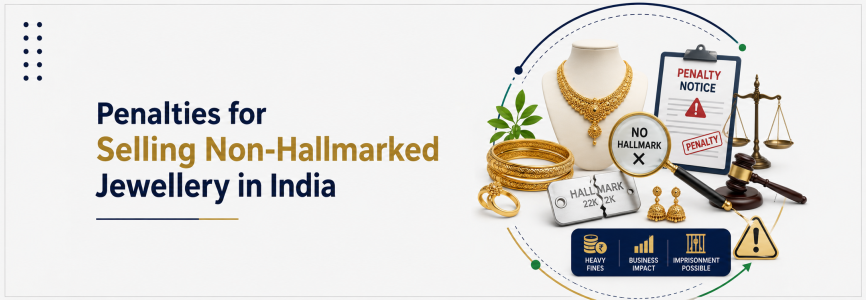



Hallmarking is one of the most important legal requirements in the Indian jewellery sector. It protects consumers from purity fraud and helps genuine jewellers build trust in the market. In India, the Bureau of Indian Standards, commonly known as BIS, is the authority responsible for hallmarking standards. BIS hallmarking certifies the purity of gold jewellery and gold artefacts and confirms that the article has been tested as per prescribed standards.
Selling non-hallmarked jewellery in areas and categories where hallmarking is mandatory can lead to serious legal consequences. These consequences may include seizure of goods, monetary penalties, prosecution and even imprisonment in certain cases. The purpose of these penalties is not only to punish defaulting jewellers but also to maintain transparency in the jewellery trade.
Meaning of Hallmarked Jewellery
Hallmarked jewellery means jewellery that carries the official BIS hallmark. At present, hallmarking generally includes three important signs: the BIS standard mark, purity/fineness mark and the Hallmark Unique Identification number, commonly called HUID. The HUID is a unique code that helps verify the authenticity of hallmarked jewellery through the BIS Care App. The BIS hallmark gives assurance to the buyer that the jewellery has been tested by a recognised Assaying and Hallmarking Centre. It also helps in reducing disputes between jewellers and consumers regarding purity and weight.
Why Hallmarking Is Mandatory
Gold jewellery is a high-value product, and even a small difference in purity can cause financial loss to the consumer. Mandatory hallmarking was introduced to bring uniformity, accountability and consumer protection in the jewellery market. BIS states that jewellers having annual turnover up to ?40 lakh are exempt from mandatory hallmarking, but registered jewellers may sell hallmarked jewellery even in non-mandatory districts. The hallmarking requirement applies to notified categories and notified districts as per government orders and BIS directions. BIS has also been expanding the coverage of mandatory hallmarking districts over time, and its hallmarking overview page notes updates and amendments relating to additional districts.
Legal Framework for Hallmarking
The main law governing hallmarking and penalties is the Bureau of Indian Standards Act, 2016. The Hallmarking of Gold Jewellery and Gold Artefacts Order, 2020 also plays an important role in making hallmarking compulsory for specified gold jewellery and artefacts. Certain articles are exempted, such as articles meant for export, articles weighing less than two grams, articles meant for medical, dental, veterinary, scientific or industrial use and certain other notified categories. This means every case should be checked carefully. A jeweller may not be liable merely because an article is non-hallmarked if it falls under an exempted category. However, if a jeweller sells a covered article in violation of the mandatory hallmarking rules, penalties may apply.
Penalty for Selling Non-Hallmarked Jewellery
Under Section 29 of the BIS Act, 2016, violation relating to use of Standard Mark including Hallmark can attract imprisonment up to one year, or fine of not less than ?1,00,000. The fine may extend up to five times the value of goods or articles produced, sold, offered for sale or marked with the Standard Mark, or both imprisonment and fine. In simple words, if a jeweller sells non-hallmarked jewellery where hallmarking is mandatory, or misuses the BIS hallmark, the financial penalty can be very heavy. The penalty is not limited to a small fixed amount. It can be calculated based on the value of the goods involved.
Seizure and Enforcement Action
BIS has the power to conduct inspection and enforcement action against jewellers who violate hallmarking rules. In recent enforcement actions, BIS has conducted raids on jewellery shops and hallmarking centres for selling or marking jewellery without proper BIS hallmarking or without valid HUID. In one PIB-reported case, BIS stated that the offence is punishable with imprisonment up to one year or fine not less than ?1,00,000, which may extend up to five times the value of goods, or both, under Section 29 of the BIS Act, 2016. Goods, machines, records and documents may also be seized during enforcement action if BIS finds misuse of hallmark, fake hallmarking or sale of non-compliant jewellery. Such action can damage the reputation of the jewellery business and may also lead to consumer complaints.
Fake Hallmarking Is a Serious Offence
Selling non-hallmarked jewellery is one issue, but putting a fake hallmark or using hallmark symbols without proper authorisation is even more serious. Fake hallmarking misleads customers and directly affects consumer trust. Reports have noted cases where BIS seized jewellery, laser marking machines and related records from unauthorised hallmarking operations. Legal proceedings were initiated under Section 29 of the BIS Act in such cases. Jewellers should never mark jewellery with fake HUID numbers or unofficial hallmark symbols. Only BIS-recognised Assaying and Hallmarking Centres can carry out hallmarking as per the prescribed procedure.
Liability of Jewellers
Jewellers are responsible for ensuring that jewellery sold by them complies with hallmarking requirements. If they sell jewellery in a notified category without hallmarking, they may face prosecution. If the business is operated through a company, LLP, partnership or firm, the persons responsible for the conduct of business may also face legal consequences depending on the facts of the case. Therefore, jewellery businesses should maintain proper invoices, hallmarking records, HUID details, stock records and BIS registration documents. These records can help prove compliance during inspection.
Consumer Rights in Case of Non-Hallmarked Jewellery
Consumers have the right to receive correct information about purity and hallmarking. BIS provides consumer protection mechanisms, and consumers can get jewellery tested from BIS-recognised Assaying and Hallmarking Centres on a chargeable basis. The centre is required to issue an assay report after testing. If a consumer finds that the jewellery sold was not as represented, they may also raise complaints before BIS or consumer forums, depending on the facts. In case of purity fraud, the jeweller may face both regulatory and consumer-law consequences.
Compliance Checklist for Jewellers
Every jeweller should first check whether hallmarking is mandatory in the district where the business is operating. They should also check whether the jewellery category and purity level are covered under mandatory hallmarking. After that, they must obtain BIS registration where applicable and sell only properly hallmarked jewellery with valid HUID. Jewellers should purchase stock only from reliable sources, verify HUID details, maintain hallmarking records and train staff to explain hallmarking details to customers. They should also avoid selling old non-hallmarked stock unless it is legally permitted under applicable rules or exemptions.
Conclusion
Selling non-hallmarked jewellery in violation of mandatory hallmarking rules can result in serious penalties under the BIS Act, 2016. The penalty may include imprisonment up to one year, fine starting from ?1,00,000 and extending up to five times the value of goods, or both. Apart from legal punishment, non-compliance can also result in seizure, prosecution, customer complaints and loss of market reputation.
For jewellers, hallmarking compliance is not just a legal formality. It is a business necessity. A compliant jeweller earns consumer trust, avoids enforcement risk and builds long-term credibility in the jewellery market.
FAQs
Q1. Is selling non-hallmarked jewellery illegal in India?
Ans. Yes, if the jewellery falls under mandatory hallmarking rules and is sold in a notified area, selling it without hallmarking can be illegal.
Q2. What is the penalty for selling non-hallmarked jewellery?
Ans. The penalty may include imprisonment up to one year or fine of at least ?1,00,000, which may extend up to five times the value of goods, or both.
Q3. Which law provides penalties for hallmarking violations?
Ans. The Bureau of Indian Standards Act, 2016 provides penalties for misuse of hallmark and violation of BIS requirements.
Q4. Can BIS seize non-hallmarked jewellery?
Ans. Yes, BIS can conduct inspections and seize goods, documents or equipment if violation is found.
Q5. Is fake hallmarking punishable?
Ans. Yes, fake hallmarking or using BIS hallmark without authority is a serious offence and may lead to prosecution.
Q6. Are small jewellers exempt from hallmarking?
Ans. Jewellers with annual turnover up to ?40 lakh are generally exempt from mandatory hallmarking, subject to applicable BIS rules.
Q7. Can old non-hallmarked jewellery be sold by consumers?
Ans. Consumers can usually sell old gold jewellery to jewellers. The restriction mainly applies to jewellers selling covered jewellery to consumers.
Q8. What is HUID in gold jewellery?
Ans. HUID means Hallmark Unique Identification number. It is a unique code used to verify hallmarked jewellery.
Q9. How can consumers verify hallmarked jewellery?
Ans. Consumers can verify HUID details through the BIS Care App or get jewellery tested at BIS-recognised centres.
Q10. Why should jewellers follow hallmarking rules?
Ans. Hallmarking protects consumers, avoids penalties, improves trust and helps jewellers run a legally compliant business.


![Why Most People Fail at [Topic] — And How You Can Succeed](https://compliancecalendar.s3.ap-south-1.amazonaws.com/assets/blogimagemain/Valuation_of_Shares_in_NBFC_learn_crop10_thumb.jpg)




_crop10_thumb.jpg)