


The private security sector in India has grown rapidly due to the increasing need for trained guards, supervisors, security management teams, cash transportation support, event security, corporate security, residential security and industrial protection services. Businesses, housing societies, malls, hospitals, banks, warehouses, factories, educational institutions and event organisers now prefer professional security agencies instead of informal manpower providers. This growth has also made regulation necessary because security services directly involve public safety, property protection and trust. To regulate this sector, the Government introduced the Private Security Agencies (Regulation) Act, 2005, commonly known as the PSARA Act.
Under this law, no person or business can run a private security agency without obtaining a valid PSARA licence from the concerned Controlling Authority. The licence gives legal permission to operate a private security agency in a particular State or Union Territory. PSARA Licence Registration is not only a legal requirement but also a trust-building certification. It shows that the agency follows statutory rules, employs eligible persons, provides proper training and maintains records as required under law. For any entrepreneur planning to start a security agency in India, understanding the PSARA licence process is the first step towards lawful business operations.
What is PSARA Licence?
PSARA Licence is the permission granted to a private security agency under the Private Security Agencies (Regulation) Act, 2005. The licence authorises an agency to provide private security services, deploy security guards, appoint supervisors and offer security-related manpower services to clients. A private security agency means a person or body of persons, other than a government agency, engaged in the business of providing private security services. These services may include providing security guards, armed or unarmed guards, supervisors, bouncers, personal security staff, industrial security teams, event security personnel and similar services. The licence is issued by the Controlling Authority appointed by the State Government. Since law and order is mainly handled at the State level, the licensing process may slightly differ from one State to another. However, the basic legal framework comes from the PSARA Act, 2005 and the rules made under it.
Why PSARA Licence is Mandatory
PSARA licence is mandatory because private security agencies handle sensitive duties. Security guards may be deployed at residential buildings, banks, offices, hospitals, schools, commercial complexes, factories and public-facing locations. If such agencies operate without regulation, there may be risks relating to public safety, misuse of uniforms, lack of background verification, poor training and unorganised manpower deployment. The PSARA Act ensures that only eligible persons can run private security agencies. It also ensures that guards and supervisors meet basic requirements relating to character, antecedents, physical fitness, training and conduct. The law also requires agencies to maintain proper records, follow prescribed conditions and cooperate with the authorities. Running a private security agency without a valid licence can invite legal consequences. It may also affect business credibility, client contracts, tender eligibility and future expansion. Many corporate clients, government departments, hospitals, banks and industrial units ask for PSARA licence before awarding security service contracts.
Legal Framework Governing PSARA Licence
The main law for PSARA licence is the Private Security Agencies (Regulation) Act, 2005. The Act provides the structure for licensing, eligibility, application procedure, cancellation, renewal, duties, penalties and appeal. In addition to the Act, States have their own rules, and the Central Government has also issued model rules to bring uniformity in the process.
The important legal framework includes:
- Private Security Agencies (Regulation) Act, 2005
- Private Security Agencies Central Model Rules, 2020
- State-specific PSARA Rules
- Rules relating to training of guards and supervisors
- Rules relating to private security for cash transportation activities, wherever applicable
- Police verification and antecedent verification requirements
- Conditions imposed by the respective Controlling Authority
The licensing authority may also issue instructions, circulars or procedural updates from time to time. Therefore, applicants should check the current requirements of the State where they want to operate.
Important Definitions under PSARA
The PSARA Act contains important definitions that help understand the scope of the law. A private security agency means any person or body of persons engaged in providing private security services, including training of private security guards or supervisors. A private security guard means a person providing private security with or without arms to another person, property or both. A supervisor means a person engaged by a private security agency to supervise the work of security guards. The term Controlling Authority refers to the officer appointed by the State Government to regulate private security agencies. This authority receives applications, conducts scrutiny, grants licences, renews licences, suspends licences, cancels licences and monitors compliance.
Key Sections and Provisions of the PSARA Act
Section 3: Appointment of Controlling Authority
Section 3 empowers the State Government to appoint a Controlling Authority. This officer is generally responsible for the implementation of the PSARA Act in the State. The Controlling Authority is the main licensing authority for private security agencies. The applicant has to submit the PSARA licence application to this authority. The authority examines the application, checks eligibility, seeks police verification, reviews documents and grants or rejects the licence.
Section 4: No Agency to Operate Without Licence
Section 4 is one of the most important provisions. It states that no person can carry on or commence the business of a private security agency unless he holds a licence issued under the Act. This means that even if a company, LLP, partnership firm or proprietorship is already registered, it cannot start private security agency operations without PSARA licence. Business registration and PSARA licence are separate requirements. Company incorporation gives legal existence to the entity, but PSARA licence gives permission to operate as a private security agency.
Section 5: Eligibility for Licence
Section 5 deals with the eligibility for obtaining a licence. The applicant must satisfy the conditions prescribed under the Act and rules. The person applying should be suitable to run a security agency and must not fall under the disqualification criteria. The law aims to ensure that persons with doubtful background, criminal records, insolvency issues or links with banned organisations do not enter the private security business.
Section 6: Persons Not Eligible for Licence
Section 6 specifies disqualifications. A person may not be eligible if he has been convicted for certain offences, dismissed from government service on grounds of misconduct, declared insolvent, or found to have links with organisations banned under law. The purpose is to protect public interest and ensure that only responsible persons operate security agencies. Where the applicant is a company, firm or association of persons, the disqualification may be checked in relation to directors, partners, majority shareholders, principal officers and key managerial persons, depending on the applicable State rules.
Section 7: Application for Grant of Licence
Section 7 provides for filing the application for licence. The application must be made to the Controlling Authority in the prescribed form and manner along with the required fee and documents. The applicant has to mention the area of operation. The licence may be sought for one district, more than one district or the entire State, depending on the State rules and business plan.
Section 8: Grant of Licence
Section 8 deals with the grant of licence. After receiving the application, the Controlling Authority conducts verification and may call for additional information. Police verification is generally an important part of the process. If the authority is satisfied that the applicant meets all conditions, it grants the licence. If the application is rejected, the authority must generally record reasons for rejection.
Section 9: Conditions of Licence
Section 9 provides that every licence is subject to prescribed conditions. These conditions may relate to training, uniform, identity cards, records, employee verification, appointment of supervisors, compliance with labour laws and submission of information to the authority. The agency must follow these conditions throughout the licence period. Non-compliance may lead to suspension or cancellation.
Section 10: Renewal of Licence
Section 10 deals with renewal. The licence holder must apply for renewal before the expiry of the licence. The application should be filed within the prescribed timeline along with renewal fee and documents. Delay in renewal can affect the validity of the licence and may create legal issues for ongoing contracts. Therefore, agencies should track licence validity and start renewal preparation in advance.
Section 11: Cancellation and Suspension of Licence
Section 11 empowers the Controlling Authority to cancel or suspend a licence in certain cases. Cancellation may happen if the licence was obtained through misrepresentation, if the agency violates licence conditions, if the agency fails to comply with the Act, or if the agency becomes ineligible. Before cancellation, the agency is generally given an opportunity of being heard. However, serious violations may lead to strict action.
Section 12: Appeal
Section 12 provides a remedy against refusal, suspension or cancellation of licence. The aggrieved person can file an appeal before the prescribed appellate authority within the specified time. This provision is important because it ensures that the applicant or licence holder gets a chance to challenge an adverse order.
Section 13: Register to be Maintained by Agency
Section 13 requires every private security agency to maintain a register containing details such as names and addresses of persons managing the agency, security guards and supervisors employed, clients served and other required information. Record maintenance is an important compliance obligation. It helps authorities verify whether the agency is operating lawfully and deploying verified personnel.
Section 14: Photo Identity Card
Section 14 requires private security guards to carry photo identity cards issued by the private security agency. The identity card helps clients, police authorities and the public identify the guard and the agency. The agency must ensure that identity cards are issued properly and withdrawn when the employee leaves the agency.
Section 15: Disclosure of Information to Unauthorised Person
Section 15 restricts unauthorised disclosure of information obtained during the course of security duty. Since guards may have access to sensitive premises, documents, visitors, cash movement or operational data, confidentiality is important.
Section 16: Uniform
Section 16 deals with the uniform of private security guards. The uniform should not resemble the uniform of armed forces, police or other government forces. This prevents confusion and misuse. The agency must ensure proper uniform standards, badges, nameplates and identity display as per applicable rules.
Section 20: Penalty
Section 20 provides punishment for operating a private security agency without a valid licence. Violation may lead to imprisonment, fine or both. This provision makes it clear that PSARA compliance is not optional.
Eligibility Criteria for PSARA Licence
The eligibility requirements should be checked carefully before filing the application. In a short and simple manner, the applicant should ensure the following:
- Applicant may be an individual, proprietorship, partnership firm, LLP, company or other recognised business entity.
- Applicant must be an Indian citizen or an entity registered in India.
- Directors, partners or key persons should have a clean background.
- Applicant should not have been convicted of serious offences.
- Applicant should not be linked with any banned organisation.
- Applicant should not have been dismissed from government service for misconduct.
- Applicant should have proper office address.
- Applicant should have financial capacity to run the agency.
- Applicant should have arrangements for training of security guards.
- Applicant should comply with State-specific PSARA rules.
- Applicant should be willing to maintain records and follow licence conditions.
Documents Required for PSARA Licence
The documents may vary from State to State. However, the common documents are:
- PAN card of applicant/entity
- Aadhaar card of proprietor/directors/partners
- Business registration certificate
- Certificate of incorporation, LLP agreement or partnership deed
- GST registration, if available
- Shops and Establishment registration, if applicable
- Registered office address proof
- Rent agreement or ownership proof
- Utility bill of office premises
- Passport-size photographs of directors/partners/proprietor
- Police verification documents
- Character and antecedent verification forms
- Affidavit as prescribed
- Memorandum of Understanding with training institute, if required
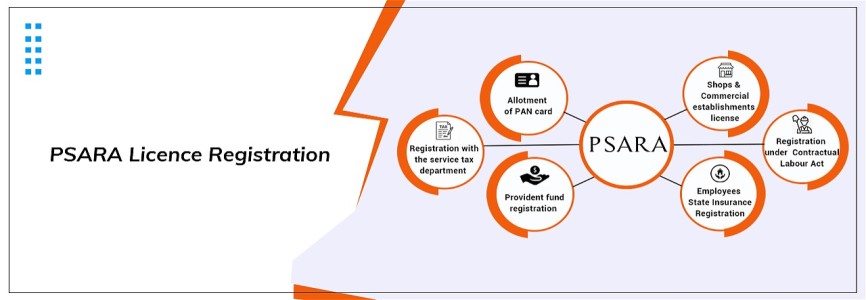
- Employee State Insurance and Provident Fund registration, if applicable
- Income tax return or financial proof, if required
- Logo, uniform details and identity card format, if required
- Application form and government fee challan
Complete Process for PSARA Licence Registration
Step 1: Select Business Structure
The first step is to decide the business structure. A security agency can be started as a proprietorship, partnership firm, LLP or company. Many growing agencies prefer LLP or private limited company because these structures provide better credibility, limited liability and easier expansion. The business object clause should clearly allow security services, manpower supply, facility management or related activities. If the object clause does not cover security services, the entity may need to amend it before applying.
Step 2: Arrange Basic Registrations
Before filing the PSARA application, the applicant should arrange basic business registrations and documents. These may include PAN, TAN, GST registration, Shops and Establishment registration, professional tax registration and labour law registrations, depending on the State and business model. Although all registrations may not be mandatory at the initial stage in every State, having proper business documents improves the application and helps avoid objections.
Step 3: Prepare Office Proof and Local Details
The agency must have a proper office address in the State where the licence is being applied. The address proof may include rent agreement, ownership documents, electricity bill, NOC from owner and other supporting papers. The office address is important because the Controlling Authority and police authorities may verify the location during the application process.
Step 4: Sign MoU with Training Institute
Training is an important part of PSARA compliance. The agency must ensure that guards and supervisors are properly trained. In many States, the applicant is required to enter into an MoU with a recognised or approved training institute. The training generally covers physical fitness, security duties, fire safety, emergency response, identification of documents, behaviour with the public, legal awareness and reporting procedures.
Step 5: Prepare Application and Affidavits
The applicant must prepare the prescribed application form along with affidavits, declarations and supporting documents. Details of directors, partners, authorised signatory, office address, proposed area of operation, training arrangement and agency information must be filled correctly. Any mismatch in name, address, identity proof or business documents can lead to delay. Therefore, document consistency is very important.
Step 6: Police Verification
Police verification is one of the key stages in PSARA licence registration. The antecedents of the applicant, directors, partners or key managerial persons are verified. The police may check criminal records, address details, identity proof and background information. In some States, police verification is completed online through integrated portals. In others, physical verification or local police station verification may be involved.
Step 7: File Application with Controlling Authority
After preparing the documents, the application is submitted to the Controlling Authority through the prescribed online or offline process. Many States now support online filing through the national PSARA portal or State-specific portals. The applicant must select the correct jurisdiction and pay the applicable government fee. Fee may depend on whether the licence is required for one district, multiple districts or the entire State.
Step 8: Scrutiny by Department
The department reviews the application and documents. If the application is complete and police verification is satisfactory, the authority proceeds further. If any deficiency is found, the applicant may receive a query or objection. Common reasons for objection include incomplete documents, unclear office proof, mismatch in details, pending police verification, missing training MoU, incorrect affidavit or wrong fee payment.
Step 9: Grant of PSARA Licence
If the Controlling Authority is satisfied, it grants the PSARA licence. The licence mentions the name of the agency, area of operation, licence number, validity and conditions. After receiving the licence, the agency can legally start operations in the approved area. However, the agency must continue to follow all conditions attached to the licence.
Step 10: Post-Licence Compliance
Getting the licence is not the end of compliance. The agency must maintain employee records, client records, identity cards, training records, police verification details and other registers. It must ensure that guards wear proper uniforms and do not misuse identity cards. The agency should also ensure compliance with labour laws, minimum wages, PF, ESI, bonus, gratuity, professional tax and other applicable employment laws.
Validity and Renewal of PSARA Licence
The validity of PSARA licence depends on the Act, rules and State-specific provisions. The licence is generally granted for a fixed period and must be renewed before expiry. Renewal should not be delayed. A security agency with an expired licence may face difficulty in continuing contracts, participating in tenders or deploying guards. Many clients check the validity of the licence before signing or renewing service agreements. For renewal, the agency may have to submit the renewal form, existing licence copy, compliance records, updated police verification, training details, government fee and other documents as required by the State.
Recent Updates and Practical Compliance Points
The PSARA licensing system has moved towards more digital processing in several States. The national PSARA portal has made online application and licence tracking easier for applicants in many jurisdictions. Applicants should check whether their State accepts applications through the central portal or through a separate State portal. The Private Security Agencies Central Model Rules, 2020 brought more structured requirements for training, verification, records and operational standards. These model rules support better uniformity across States and help improve professionalism in the private security industry.
Police verification and staff documentation have become stricter in practice. Agencies are expected to maintain proper employee records, Aadhaar details, photographs, bank account details, address proof, training certificates and antecedent verification records. In some areas, local police authorities also conduct inspections and coordination meetings with private security agencies. Cash transportation security services are also subject to additional rules. Agencies involved in ATM cash vans, cash logistics or high-value movement must follow special requirements relating to trained staff, GPS-enabled vehicles, weapons, route planning, emergency procedures and security protocol, as applicable.
Common Mistakes During PSARA Registration
Many applicants make mistakes by starting operations before receiving the licence. This can create legal risk and may affect future approval. Some applicants file the application without proper office proof or without checking State-specific rules. Others submit incomplete affidavits or fail to complete police verification. Another common mistake is treating PSARA as a one-time registration. In reality, PSARA compliance continues after licence approval. Every guard must be properly verified, trained and recorded. Uniforms and identity cards must be used correctly. Client records must be updated. Renewal must be tracked before expiry. Agencies should also avoid deploying untrained guards or persons with doubtful background. Since security services are sensitive, negligence can result in cancellation, penalties and loss of reputation.
Benefits of PSARA Licence
A PSARA licence gives legal recognition to a private security agency. It helps the agency work with corporates, housing societies, institutions, hospitals, warehouses, banks, factories and government-related clients. Many tenders and contracts require a valid PSARA licence as a basic eligibility condition. It also improves client confidence because the agency is operating under a regulated framework. The licence shows that the agency follows background verification, training, record maintenance and compliance requirements. For the business owner, PSARA licence supports expansion. Once the agency builds proper systems, it can apply for licences in other States and grow its security services business legally.
Why Professional Assistance is Important
PSARA licence registration involves legal documents, police verification, State rules, affidavits, training arrangements and portal filing. A small error in documentation can delay approval. Professional assistance helps in checking eligibility, preparing documents, drafting affidavits, filing the application and responding to department queries. Compliance Calendar LLP can assist businesses in understanding the PSARA licence process, preparing the required documents, coordinating application filing and guiding on post-licence compliance. This helps applicants save time and reduce the risk of rejection or delay.
Conclusion
PSARA Licence Registration is mandatory for anyone planning to start or run a private security agency in India. The licence is governed by the Private Security Agencies (Regulation) Act, 2005 and applicable rules. It ensures that private security agencies operate in a legal, organised and responsible manner. The process involves business registration, document preparation, training arrangement, police verification, application filing, scrutiny and approval by the Controlling Authority. After receiving the licence, the agency must continue to comply with record maintenance, training, uniform, identity card, employee verification and renewal requirements. For security businesses, PSARA licence is not just a regulatory formality. It is a foundation for trust, credibility and long-term growth. A properly licensed agency can approach better clients, participate in tenders and build a professional security service brand in India.
FAQs
Q1. What is PSARA Licence?
Ans. PSARA Licence is a legal permission required to run a private security agency in India. It is issued under the Private Security Agencies (Regulation) Act, 2005 by the concerned State Controlling Authority.
Q2. Is PSARA Licence mandatory?
Ans. Yes, PSARA Licence is mandatory before starting or running a private security agency. No person or entity can provide private security services without a valid licence.
Q3. Who issues PSARA Licence?
Ans. PSARA Licence is issued by the Controlling Authority appointed by the State Government. The application process may be online or offline depending on the State.
Q4. Can a private limited company apply for PSARA Licence?
Ans. Yes, a private limited company can apply for PSARA Licence. LLPs, partnership firms, proprietorships and other eligible business entities may also apply, subject to State rules.
Q5. Is police verification required for PSARA Licence?
Ans. Yes, police verification is generally required. The background and antecedents of the applicant, directors, partners or key persons are verified before licence approval.
Q6. Is training mandatory for security guards?
Ans. Yes, training is an important requirement under PSARA. Security guards and supervisors must be trained as per the prescribed standards and State-specific rules.
Q7. What is the validity of PSARA Licence?
Ans. The validity depends on the applicable law and State rules. The licence is granted for a fixed period and must be renewed before expiry.
Q8. Can a PSARA Licence be used in all States?
Ans. Generally, a PSARA Licence is valid only for the State or area for which it is issued. For operating in another State, a separate licence may be required.
Q9. What happens if an agency works without PSARA Licence?
Ans. Operating without PSARA Licence is illegal and may lead to penalty, prosecution, cancellation of contracts and business restrictions.
Q10. How long does PSARA Licence registration take?
Ans. The timeline depends on the State, document readiness, police verification and department scrutiny. Proper documentation and timely response to queries can help reduce delays.


![Why Most People Fail at [Topic] — And How You Can Succeed](https://compliancecalendar.s3.ap-south-1.amazonaws.com/assets/blogimagemain/Valuation_of_Shares_in_NBFC_learn_crop10_thumb.jpg)




_crop10_thumb.jpg)