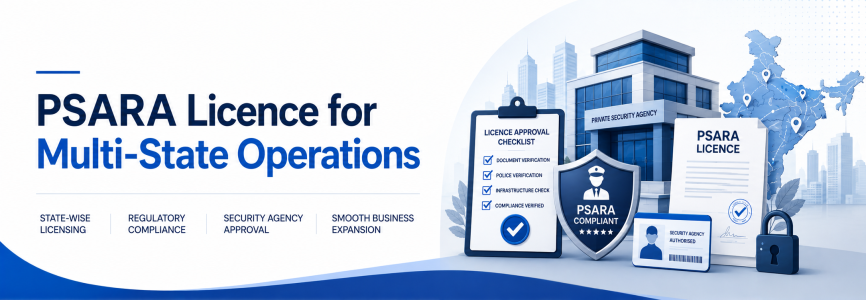



Private security has become an important part of business operations in India, especially for companies managing offices, factories, warehouses, hospitals, hotels, malls, housing societies, banks, events and logistics networks across different states. However, running a private security agency is not an ordinary commercial activity. It involves manpower deployment, public safety, verification, training, supervision and legal accountability. For this reason, private security agencies in India are regulated under the Private Security Agencies (Regulation) Act, 2005, commonly known as the PSARA Act. The Act was enacted to regulate private security agencies and is administered under the Ministry of Home Affairs framework. India Code records the Act as Act No. 29 of 2005, enforced from 14 March 2006, with the Ministry of Home Affairs as the concerned ministry.
A PSARA Licence is mandatory for any person, company, LLP, partnership firm or body of persons that wants to carry on the business of providing private security guards, supervisors or security services. Section 4 of the PSARA Act provides that no person shall carry on or commence the business of a private security agency unless he holds a licence issued under the Act. The same provision also restricts providing private security abroad without permission of the Controlling Authority, which has to consult the Central Government before allowing such permission.
For businesses planning multi-state operations, the most important point is that PSARA is not a single all-India licence. The Act is central, but the licence is issued through the State Controlling Authority. India Code lists Section 3 as the provision for appointment of the Controlling Authority, Section 7 for application for grant of licence and Section 8 for renewal of licence. Therefore, if a private security agency wants to operate in Delhi, Uttar Pradesh, Haryana, Rajasthan and Maharashtra, it generally needs to apply separately in each concerned state or union territory as per the applicable state process, prescribed forms, police verification requirements and local rules.
Multi-state PSARA compliance is more complex than a single-state licence because each state may have its own portal, document format, affidavit requirement, training institute requirements, police verification procedure and timeline. A licence may be taken for one district, more than one district or the whole state, depending on the operational requirement. Under Section 7, the licence fee structure under the Act includes ?5,000 for one district of a state, ?10,000 for more than one but up to five districts of a state and ?25,000 for the whole state. For companies working with national clients, taking a whole-state licence is usually more practical because clients may require deployment across multiple cities in the same state.
The legal framework for PSARA is supported by the Private Security Agencies Central Model Rules. The Ministry of Home Affairs lists the Private Security Agencies Central Model Rules, 2006 and the Private Security Agencies Central Model Rules, 2020, along with the PSARA Act and the rules relating to private security for cash transportation activities. These rules guide states in relation to application procedure, verification, training, forms, conditions and compliance requirements. For multi-state operations, agencies should not assume that approval in one state will automatically be accepted in another. Each state authority may examine the antecedents of directors or partners, registered office details, financial and legal documents, training arrangements and police verification separately.
Before applying for a PSARA Licence in multiple states, the applicant must ensure that the business entity is properly incorporated and compliant. The applicant may be a private limited company, LLP, partnership firm, sole proprietorship or other eligible entity, depending on the state’s rules and internal requirements. The entity should have a clear business object relating to security services, manpower supply, security guard services or allied activities. The owners, directors, partners and key managerial persons should not be disqualified under the Act. The authority may examine criminal background, financial standing, past conduct, government service history, pending cases and other factors relevant to public safety.
The standard documents required for PSARA Licence generally include certificate of incorporation or registration proof, PAN, GST registration if applicable, office address proof, rent agreement or ownership proof, identity and address proofs of directors or partners, photographs, affidavit and declaration, Memorandum and Articles of Association or LLP agreement or partnership deed, details of employees and supervisors, training arrangement or MOU with an approved training institute, security training syllabus details, logo or uniform details, character verification forms and proof of payment of government fee. In multi-state applications, the same base documents are usually required repeatedly, but state-specific affidavits, police verification forms and portal formats may differ.
Training is one of the most important compliance requirements under PSARA. A private security agency cannot simply recruit guards and deploy them without proper training and verification. Security guards must be trained in basic security duties, public conduct, physical fitness, fire safety, emergency response, identification of threats, maintenance of records and legal responsibilities. Supervisors are also important, especially where a large number of guards are deployed at industrial sites, commercial properties or public-facing locations. Section 9 of the Act deals with conditions for commencement of operation and engagement of supervisors. For multi-state agencies, maintaining a uniform training and verification system across all branches becomes essential.
After obtaining the licence, the agency must follow ongoing compliance requirements. It must display the licence where required, maintain registers, issue photo identity cards to guards, ensure verification of personnel, follow the approved uniform pattern, maintain employment records, comply with labour laws, ensure wages and statutory benefits where applicable, and cooperate with inspection by authorities. India Code lists Section 12 for exhibition of licence, Section 15 for maintaining registers, Section 16 for inspection and Section 17 for issue of photo identity cards. These obligations become even more important for multi-state operations because non-compliance in one state may affect the credibility of the agency in other states also.
PSARA Licence is generally valid for five years unless cancelled earlier, and it may be renewed for further periods of five years on payment of the prescribed fee and fulfilment of conditions. Renewal should not be left until the last moment because police verification, document updates, portal issues and authority scrutiny can take time. Some authorities may expect renewal applications to be filed in advance, and operational continuity is important for agencies that have active client contracts.
The consequences of operating without a valid PSARA Licence can be serious. Section 13 of the Act deals with cancellation and suspension of licence, while Section 20 deals with punishment for contravention of certain provisions. India Code also lists Section 22 for offences by companies, meaning company-level violations may involve responsibility of persons in charge, depending on facts. In practice, non-compliance can lead to rejection of applications, suspension, cancellation, penalties, client contract termination, reputational loss and difficulty in expanding to other states.
For multi-state operations, the best approach is to plan PSARA compliance state-wise before signing client contracts. Agencies should identify the states and districts where deployment is required, check whether a whole-state licence is needed, prepare a central document set, arrange training tie-ups, complete police verification, appoint responsible compliance coordinators for each state and maintain a renewal calendar. A business expanding from one state to another should not deploy guards first and apply later. The licence should be obtained before commencing operations in the concerned jurisdiction.
A well-managed PSARA compliance structure helps private security agencies build trust with corporate clients, government contractors, residential societies, banks, hospitals and industrial establishments. Clients today prefer licensed agencies because they reduce legal and operational risk. For a security agency, PSARA Licence is not just a legal permission; it is a credibility document that proves the agency is regulated, verified and accountable.
In conclusion, PSARA Licence for multi-state operations requires careful legal planning. Since every state has its own Controlling Authority and process, agencies must treat each state as a separate compliance project. A single licence in one state does not automatically permit business across India. Proper documentation, police verification, training compliance, renewal management and post-licence records are essential for smooth operations. Businesses planning to expand their private security services across India should obtain expert assistance to avoid delay, rejection and future compliance risk.
FAQs
Q1. What is a PSARA Licence?
Ans. A PSARA Licence is a legal approval required to run a private security agency in India. It allows an eligible business entity to provide private security guards, supervisors and related security services.
Q2. Is PSARA Licence mandatory for security agencies?
Ans. Yes. Under Section 4 of the PSARA Act, no person can start or carry on the business of a private security agency without a licence issued under the Act.
Q3. Can one PSARA Licence be used across India?
Ans. No. PSARA is a central law, but the licence is issued state-wise by the concerned State Controlling Authority. A separate licence is generally required for each state where the agency wants to operate.
Q4. Can a PSARA Licence cover the whole state?
Ans. Yes. An agency may apply for a licence for one district, more than one district or the whole state, depending on business needs and prescribed fee structure.
Q5. What is the government fee for PSARA Licence?
Ans. As per the Act, the fee is ?5,000 for one district, ?10,000 for more than one but up to five districts and ?25,000 for the whole state.
Q6. What documents are required for PSARA Licence?
Ans. Common documents include entity registration proof, PAN, address proof, director or partner KYC, photographs, affidavits, police verification forms, training arrangement details, office proof and fee payment proof.
Q7. Is training mandatory for security guards?
Ans. Yes. Security guards and supervisors must undergo proper training as prescribed under the Act, Rules and state requirements before deployment.
Q8. What is the validity of PSARA Licence?
Ans. A PSARA Licence is generally valid for five years unless cancelled earlier. It can be renewed for further periods, subject to compliance and payment of prescribed fees.
Q9. Can a PSARA Licence be cancelled?
Ans. Yes. The licence may be suspended or cancelled if the agency violates the Act, provides false information, fails to comply with licence conditions or becomes ineligible.
Q10. Why is professional assistance useful for multi-state PSARA Licence?
Ans. Multi-state PSARA applications involve different state portals, police verification, affidavits, training documents and local requirements. Professional assistance helps reduce errors, delays and rejection risk.


![Why Most People Fail at [Topic] — And How You Can Succeed](https://compliancecalendar.s3.ap-south-1.amazonaws.com/assets/blogimagemain/Valuation_of_Shares_in_NBFC_learn_crop10_thumb.jpg)




_crop10_thumb.jpg)