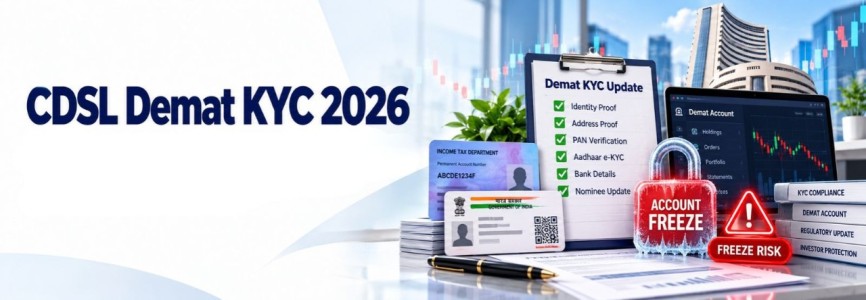



Central Depository Services (India) Limited (CDSL) has issued an important update regarding demat accounts with invalid KYC records. Under CDSL Communiqué No. CDSL/OPS/DP/POLCY/2026/734, dated 19 October 2026, certain demat accounts that have not completed the required KYC validation will be frozen on 7 November 2026. The freeze will apply to both debit and credit transactions. This means affected investors may face restrictions when transferring securities out of their demat accounts or receiving securities into them.
CDSL has asked Depository Participants (DPs) to follow up with account holders whose Know Your Customer (KYC) records have not been found valid by KYC Registration Agencies (KRAs). The latest update is important for investors who have pending KYC corrections, invalid PAN records, or other issues affecting their KRA validation status.
What Is the Latest CDSL KYC Update of October 2026?
On 19 October 2026, CDSL issued Communiqué No. DP-734 regarding the validation of KYC records with KRAs. The circular continues the instructions issued through CDSL Communiqué No. DP-650 dated 18 September 2026. According to the latest update, KRAs provided information about PAN records whose KYC details were not found valid. This information also covered relevant PAN records updated between 1 September 2026 and 30 September 2026.
Based on these records, CDSL identified demat accounts linked to the non-validated PANs. The details were shared with the concerned Depository Participants so they could contact affected account holders and help them complete the required corrections. CDSL has stated that the identified accounts will be frozen on 7 November 2026 if the KYC issues remain unresolved after considering updated KRA data available as of 5 November 2026.
Important Dates Under CDSL Communiqué DP-734
The latest circular specifies the dates for KYC data review and account freezing.
|
Particulars |
Details |
|
Circular Number |
CDSL/OPS/DP/POLCY/2026/734 |
|
Circular Date |
19 October 2026 |
|
Previous Circular |
DP-650 dated 18 September 2026 |
|
PAN Update Period |
1–30 September 2026 |
|
KRA Data Cut-off |
5 November 2026 |
|
Account Freezing Date |
7 November 2026 |
|
Type of Freeze |
Debit and Credit |
|
Freeze Reason Code |
27 – Account holder related–KYC non-compliant |
The 5 November date is the cut-off for updated KRA information used in this freezing exercise. Investors should complete their corrections early enough for the changes to be processed and reflected in the relevant records. The deadline does not apply to every demat account. It concerns the accounts identified through the KRA validation process.
Which Demat Accounts Will Be Frozen?
CDSL has identified existing demat accounts linked to PAN records that KRAs reported as not valid after the KYC validation process. These records may include PANs considered invalid for different reasons. The latest exercise also considers the relevant PAN updates received for September 2026. CDSL has prepared separate lists for Depository Participants. These lists help DPs identify the affected Beneficial Owners (BOs), meaning the investors who hold securities in demat accounts.
Accounts That May Be Affected
-
Demat accounts linked to PAN records not found valid by KRAs.
-
Accounts included in CDSL's list of KYC-deficient beneficial owners.
-
Accounts whose required KYC corrections remain incomplete.
-
Identified accounts whose KRA records remain deficient after the 5 November data cut-off.
Investors whose KYC records are already valid should not assume that their accounts will be frozen simply because CDSL has issued this circular. The correct way to confirm whether an account is affected is to contact the relevant Depository Participant.
What Is KYC Validation With KRA?
Know Your Customer, commonly called KYC, is the process used to check an investor's identity and required personal details. A KYC Registration Agency, or KRA, maintains and validates KYC information received through registered financial market intermediaries. When an investor opens a demat account, the relevant intermediary collects the required KYC information. This information is then processed according to the applicable KRA requirements. KRA validation helps ensure that investor details are accurate and that the securities market uses reliable identity records.
Why Does KRA Validation Matter?
KRA validation is important because demat accounts are used to hold and transfer financial securities. Incorrect or invalid identity details can create regulatory and operational problems. CDSL's October 2026 communiqué focuses on accounts whose KYC records have not been found valid by KRAs. These identified accounts may face restrictions unless the relevant deficiencies are corrected.
What Does Debit and Credit Freezing Mean?
The latest CDSL update states that affected demat accounts will be frozen for both debit and credit transactions. A debit transaction generally means securities are moved out of a demat account. A credit transaction generally means securities are received into the account. When both types of transactions are frozen, the investor cannot normally carry out the covered securities movements until the restriction is removed.
Effect of Demat Account Freezing
|
Transaction |
Effect of Freeze |
|
Transfer of securities out |
Restricted |
|
Receipt of securities |
Restricted |
|
Securities debit |
Restricted |
|
Securities credit |
Restricted |
|
Existing securities holdings |
Ownership is not automatically cancelled |
|
Account unfreezing |
Subject to prescribed KYC correction and DP procedures |
For example, if an investor wants to transfer shares from a frozen demat account to another account, the debit restriction may prevent the transaction. Similarly, securities that would otherwise be credited to the affected account may face restrictions. The exact effect on pending transactions or corporate actions should be checked with the Depository Participant.
Does Account Freezing Mean Losing Shares?
No. A KYC-related demat account freeze does not automatically mean that the investor loses ownership of existing shares. It restricts specified transactions in the account. Investors must complete the required process before the restriction can be removed.
Why Is CDSL Freezing Accounts With Invalid KYC?
CDSL is taking this action to implement the KYC validation requirements applicable to demat accounts. The circular explains that KRAs have provided information about PAN records whose KYC details were not found valid. CDSL has used this information to identify affected accounts and notify the relevant DPs. The purpose of the freezing exercise is to restrict transactions in accounts that remain KYC non-compliant under the applicable depository instructions. The latest circular does not state that all account holders must submit a fresh KYC application. Instead, it focuses on identified accounts with unresolved validation issues. Investors should therefore check their individual KYC status before taking further action.
What Is Freeze Reason Code 27?
CDSL has specified freeze reason code 27, described as "Account holder related–KYC non-compliant", for the accounts covered by the latest exercise. This code identifies the reason for the account restriction in the depository system. It tells the Depository Participant that the freeze relates to the account holder's KYC compliance status. The code is important because different account restrictions may require different correction procedures. An investor whose account has been frozen under reason code 27 should ask the DP about the applicable KYC validation and unfreezing requirements. The latest communiqué specifically directs DPs to use this reason code for the identified accounts scheduled for freezing on 7 November 2026.
What Should Demat Account Holders Do Before 5 November 2026?
Investors who receive a KYC-related message from their Depository Participant should act promptly. They should first confirm whether their demat account appears in the list of accounts identified for KYC correction. If the account is affected, the investor should ask the DP to explain the issue and the steps required to complete KYC validation.
Steps Investors Should Follow
Step 1: Contact Your Depository Participant
Contact the bank, broker, or Depository Participant (DP) where your demat account is maintained. Ask whether your account has been identified for KYC non-compliance. Confirm if any restrictions are pending.
Step 2: Check the KRA Status
Ask your DP to check your KYC status with the KYC Registration Agency (KRA). Find out whether your record is validated or requires correction. Request details of any pending verification issues.
Step 3: Identify the Required Correction
Check whether the KYC issue relates to your PAN, name, address, or identity documents. Ask your DP which details need correction. Make sure the updated information matches your official records.
Step 4: Submit the Required Documents
Submit the correct documents or updated details through your DP's official process. Complete any additional identity verification if required. Keep the submission acknowledgement for future reference.
Step 5: Confirm KYC Validation
After submitting the documents, ask your DP to confirm whether your KYC information has been processed. Ensure the corrected details are reflected in the KRA records. Check that no validation issue remains unresolved.
Step 6: Verify Demat Account Status
Contact your DP to confirm whether your demat account is compliant and free from KYC-related restrictions. If the account is already frozen, ask about the unfreezing process. Ensure the required verification and account updates are completed.
What Are the Responsibilities of Depository Participants?
The latest CDSL communiqué is addressed to Depository Participants. It requires their attention because DPs directly maintain relationships with demat account holders. CDSL has provided DP-wise information about the accounts identified through the KRA validation exercise. The lists were placed in the respective DPs' billing folders using the specified file naming convention.
The file name mentioned in the circular is:
BLNG<>_KRA_DEFICIENT_BO_08102026.tar
These files help DPs identify the affected beneficial owners and follow up with them.
Main Actions for Depository Participants
-
Review the list of identified KYC-deficient accounts.
-
Follow up with the affected beneficial owners.
-
Guide investors on the required KYC corrections.
-
Consider the relevant KRA validation information.
-
Follow CDSL's prescribed freezing and unfreezing procedures.
-
Maintain compliance with the applicable operational instructions.
CDSL has asked DPs to take note of the instructions and ensure compliance. The circular does not provide a separate penalty amount for DPs in this specific communication. It mainly sets out the identified accounts, the freezing date, and the procedure reference.
How Can Investors Unfreeze Their Demat Accounts?
CDSL's latest communiqué also refers to the procedure that Depository Participants must follow when removing the relevant account restrictions. For unfreezing, CDSL has directed DPs to follow Communiqué No. CDSL/OPS/DP/SYSTM/2023/525 dated 5 September 2023.
This means that an investor whose account is frozen because of KYC non-compliance must complete the required correction process through the DP. The DP must then follow the applicable operational procedure before the account can be unfrozen.
Steps to Request Demat Account Unfreezing
-
Contact the Depository Participant.
-
Ask for the exact KYC deficiency.
-
Submit the required corrections or documents.
-
Complete the prescribed KYC validation process.
-
Request confirmation of the updated KRA status.
-
Follow up with the DP regarding removal of the freeze.
The October 2026 communiqué does not specify a universal number of days within which every account must be unfrozen. The time needed can depend on the correction, KRA processing, and completion of the prescribed DP procedure. Investors should keep copies of submission acknowledgements and communication with the DP.
Is There Any Monetary Penalty for Missing the Deadline?
The 19 October 2026 CDSL communiqué specifies freezing of identified demat accounts for both debit and credit transactions. It does not announce a separate fixed monetary penalty for every investor whose KYC remains invalid on the specified date. The immediate consequence mentioned in the circular is an account-level transaction restriction.
However, a frozen account may create difficulties for investors who need to transfer or receive securities. The restriction can remain in place until the required KYC and unfreezing conditions are completed. Investors should avoid assuming that payment of a fee will automatically remove the freeze. The applicable correction and verification process must be followed.
How Is the October 2026 Circular Connected to the Previous Update?
The latest communiqué is a continuation of earlier CDSL instructions on KRA validation. The circular specifically refers to Communiqué No. DP-650 dated 18 September 2026. That earlier update also dealt with demat accounts whose KYC records were not found valid by KRAs. The September communiqué provided for freezing identified deficient accounts on 3 October 2026, based on the updated KRA records available as of 30 September 2026. The October communiqué covers the subsequent validation exercise and sets a new freezing date of 7 November 2026 for the identified accounts covered by that exercise.
Comparison of the Two Updates
|
Particulars |
September Circular |
October Circular |
|
Circular Number |
DP-650 |
DP-734 |
|
Circular Date |
18 September 2026 |
19 October 2026 |
|
KRA Update Period |
August 2026 |
September 2026 |
|
KRA Data Cut-off |
30 September 2026 |
5 November 2026 |
|
Scheduled Freeze Date |
3 October 2026 |
7 November 2026 |
|
Type of Freeze |
Debit and Credit |
Debit and Credit |
Both circulars address the validation of KYC records with KRAs. The latest circular should therefore be understood as part of CDSL's continuing process for dealing with identified KYC-deficient demat accounts, rather than a new requirement for every investor to open or register a demat account again.
Important Points Investors Should Remember
The latest CDSL circular is relevant mainly to investors whose demat accounts have been identified through the KRA validation process.
The most important facts are:
-
CDSL issued Communiqué DP-734 on 19 October 2026.
-
The circular concerns identified accounts with KYC records not found valid by KRAs.
-
The relevant PAN update period was September 2026.
-
Updated KRA information as of 5 November 2026 will be considered.
-
The scheduled account freezing date is 7 November 2026.
-
Affected accounts will be frozen for both debit and credit transactions.
-
Freeze reason code 27 will be used.
-
DPs must follow up with the identified account holders.
-
Unfreezing must follow the prescribed CDSL procedure.
Investors should use official communication channels when checking their account status. They should not share passwords, OTPs, or confidential account information with unknown persons claiming to offer KYC correction services.
Conclusion
CDSL's latest KYC update is an important reminder for investors to keep their demat account records accurate and properly validated. Through Communiqué No. CDSL/OPS/DP/POLCY/2026/734 dated 19 October 2026, CDSL has informed Depository Participants that identified demat accounts with unresolved KRA validation issues are scheduled to be frozen for both debit and credit transactions on 7 November 2026.
The restriction will be based on updated KRA information available as of 5 November 2026. Investors whose accounts are identified as KYC deficient should contact their Depository Participants and complete the required corrections before the cut-off. A KYC-related account freeze does not automatically cancel ownership of securities, but it can restrict important account transactions.
Frequently Asked Question (FAQ)
Q1. What is the CDSL Demat KYC deadline in 2026?
Ans. CDSL will consider updated KRA records as of 5 November 2026. Identified non-compliant demat accounts are scheduled to be frozen on 7 November 2026.
Q2. Which demat accounts will be frozen on 7 November 2026?
Ans. CDSL will freeze identified demat accounts whose KYC records remain invalid or deficient according to the relevant KRA validation information.
Q3. How can I check my CDSL Demat KYC status?
Ans. Contact your Depository Participant (DP) or stockbroker to check your KRA validation status and identify any pending KYC issues.
Q4. What happens if my demat account is frozen due to KYC?
Ans. A debit and credit freeze restricts securities transfers and receipts. Your existing share ownership is not automatically cancelled.
Q5. How can I update my CDSL Demat KYC online?
Ans. Contact your DP, submit the required information through its official process, complete verification, and confirm that your KRA records are updated.
Q6. What is KYC freeze reason code 27 in CDSL?
Ans. Reason code 27 means Account holder related–KYC non-compliant. It identifies demat accounts restricted because of KYC compliance issues.
Q7. Can I sell shares if my demat account is frozen?
Ans. A debit freeze generally prevents shares from being transferred out of your demat account, which may affect the settlement of share sales.
Q8. How can I unfreeze my CDSL Demat Account?
Ans. Complete the required KYC corrections through your DP. The account can be unfrozen after successful validation and completion of CDSL procedures.
Q9. Is there a penalty for missing the CDSL KYC deadline?
Ans. CDSL's October 2026 circular specifies account freezing but does not announce a separate fixed monetary penalty for affected investors.
Q10. Does the CDSL KYC deadline apply to every demat account holder?
Ans. No. The November 2026 freezing exercise applies to identified accounts with unresolved KYC deficiencies, not every CDSL demat account.
Article last updated on : 02 Nov 2026.