
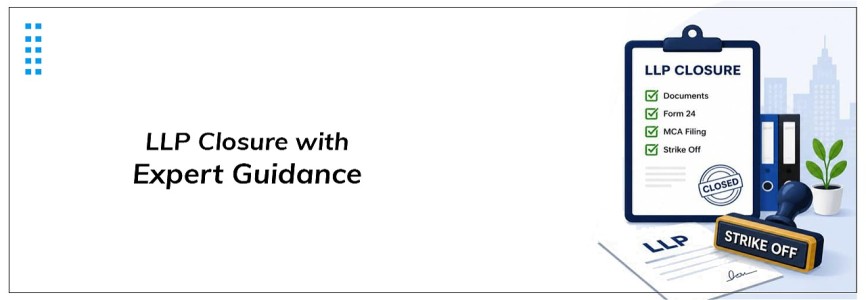



LLP Closure is the legal process of closing a Limited Liability Partnership when the partners no longer want to continue the business. Many LLPs are formed with a business plan, but later they become inactive due to lack of operations, change in business model, dispute between partners, financial issues, or shifting the business to another entity. In such cases, keeping an inactive LLP alive can create unnecessary compliance burden, annual filing cost, penalty risk, and MCA records issues.
An LLP is a separate legal entity. Therefore, it cannot be closed only by stopping business operations or closing the bank account. The partners must follow the proper legal process under the Limited Liability Partnership Act, 2008 and applicable LLP Rules. If the LLP is not properly closed, it continues to exist in MCA records, and annual compliance obligations may continue.
Expert guidance becomes important because LLP closure involves checking pending filings, preparing partner consent, closing liabilities, preparing statement of accounts, filing the correct form, and responding to any MCA clarification. A properly handled closure protects partners from future notices, penalties, and unnecessary legal complications.
Meaning of LLP Closure
LLP Closure means legally removing the name of the LLP from the records of the Registrar of Companies. Once the LLP is closed, it ceases to exist as an active legal entity. The process is commonly used for LLPs that are inactive or have stopped business operations.
The most common route for closure of an inactive LLP is filing an application for striking off the name of the LLP. This is generally done through Form 24. The Registrar may strike off the name if the LLP is not carrying on business or operations and the legal requirements are satisfied.
Closure is different from simply making the LLP inactive. If an LLP has not carried on business for a long time but still exists on MCA records, it may still be required to complete pending annual filings unless properly closed. Therefore, partners should close the LLP legally instead of ignoring compliance.
Legal Provisions for LLP Closure
The Limited Liability Partnership Act, 2008 provides the legal base for winding up, dissolution, and striking off an LLP. Section 63 states that winding up of an LLP may be voluntary or by the Tribunal, and an LLP so wound up may be dissolved. Section 64 provides circumstances where an LLP may be wound up by the Tribunal, including cases where the LLP has defaulted in filing the Statement of Account and Solvency or annual return for five consecutive financial years.
Section 75 gives power to the Registrar to strike off the name of a defunct LLP. It states that where the Registrar has reasonable cause to believe that an LLP is not carrying on business or operation, the name of the LLP may be struck off from the register in the prescribed manner. The Registrar must also give the LLP a reasonable opportunity of being heard before striking off its name.
Apart from closure provisions, LLPs must also consider annual compliance provisions before applying for closure. Section 34 requires LLPs to maintain books of account and prepare a Statement of Account and Solvency within six months from the end of each financial year. Section 35 requires every LLP to file its annual return within sixty days from the closure of the financial year.
Why LLP Closure is Important
Closing an LLP legally is important because an LLP continues to remain visible on MCA records until its name is struck off. Even if there is no business, no revenue, and no bank transaction, the LLP may still be treated as an existing entity unless closure is completed.
If partners ignore the LLP after stopping business, pending filings may attract additional fees and penalties. MCA notices may also be issued for non-compliance. This can create unnecessary stress for designated partners, especially when they want to start a new business, apply for loans, join another venture, or clean up their compliance history.
LLP closure also helps partners avoid future disputes. Once assets, liabilities, tax matters, bank accounts, and partner settlements are properly handled, the partners get a clean exit from the entity. This is why professional support is useful, especially where the LLP has pending filings, bank transactions, GST registration, tax dues, or unresolved partner contribution issues.
When Should Partners Close an LLP?
Partners should consider LLP closure when the LLP has stopped business operations and there is no intention to restart the same entity. Closure is also suitable where the LLP was incorporated for a project, but the project did not start or was discontinued.
Many LLPs are formed for consulting, trading, professional services, digital business, investment planning, or small business operations. If the business has shifted to a private limited company, proprietorship, partnership firm, or another LLP, the old LLP should be closed to avoid duplicate compliance.
Closure is also advisable where the LLP has no assets, no liabilities, no employees, no revenue, no ongoing contracts, and no pending legal matters. However, if the LLP has loans, creditors, assets, disputes, tax demand, or ongoing litigation, the partners must settle these matters before applying for closure.
Main Conditions for LLP Closure
For smooth LLP closure, the LLP should generally not be carrying on any business or operations. The partners should confirm that there are no active business transactions, no pending contracts, and no continuing commercial activity.
The LLP should clear its debts and liabilities before filing the closure application. If there are creditors, loans, advances, statutory dues, employee dues, or vendor dues, these should be settled first. The partners must also check GST, income tax, TDS, professional tax, shop registration, or any other applicable registration linked with the LLP.
The LLP should also complete necessary filings, where required. If Form 8 or Form 11 is pending, professionals usually check the date of business cessation, filing history, and MCA status before deciding the best closure approach. This step is important because wrong filing can lead to resubmission, rejection, or delay.
LLP Closure Through Form 24
Form 24 is generally used for applying to strike off the name of an LLP that is not carrying on business or operations. It is filed with the Registrar through the MCA portal. The form is supported by declarations, consent of partners, statement of accounts, and other relevant documents.
Before filing Form 24, the LLP must ensure that its business activity has been stopped and liabilities have been cleared. The bank account should also be closed if it was opened in the name of the LLP. If the LLP never opened a bank account, a declaration may be prepared accordingly.
Form 24 should be carefully prepared because the Registrar examines whether the LLP is genuinely eligible for closure. If there is a mismatch in documents, pending filings, old transactions, unclear cessation date, or incomplete declarations, the form may be sent for resubmission.
Step-by-Step Process for LLP Closure
- Check LLP Master Data
First, check the LLP details on the MCA portal. This helps confirm the LLPIN, registered office, partner details, incorporation date, and current filing status. - Review Pending Compliance
Before closure, check whether Form 8, Form 11, income tax return, or any other filing is pending. Pending compliance may create issues during the closure process. - Stop Business Operations
The LLP should not carry on any business activity before applying for closure. All commercial transactions should be stopped properly. - Settle Assets and Liabilities
Partners should recover receivables, pay creditors, clear loans, settle partner balances, and close all financial dues before filing the application. - Close Bank Account
If the LLP has a bank account, it should be closed before filing Form 24. Bank closure proof may be required with the application. - Cancel Other Registrations
GST, professional tax, shop registration, or other licenses should be reviewed and cancelled if applicable. MCA closure does not automatically cancel these registrations. - Prepare Closure Documents
Prepare partner consent, affidavit, indemnity bond, statement of accounts, authority letter, and other supporting documents. - File Form 24 on MCA Portal
After preparing all documents, Form 24 is filed with the Registrar through the MCA portal for striking off the LLP name. - Reply to MCA Clarification
If the Registrar raises any query, a proper reply must be submitted within the given time. Correct documents help avoid rejection.
Documents Required for LLP Closure
- Consent of All Partners
Written consent of all partners is required to confirm that they agree to close the LLP. - Affidavit from Designated Partners
The affidavit confirms that the LLP has stopped business and has no pending liabilities. - Indemnity Bond
Designated partners may need to give an indemnity bond for any future liability that may arise after closure. - Statement of Accounts
A statement showing nil assets and nil liabilities is required. It should be properly prepared and certified by a practicing professional. - Bank Account Closure Proof
If the LLP had a bank account, closure proof from the bank may be required. If no bank account was opened, a declaration can be given. - Latest Income Tax Return Acknowledgement
If the LLP filed income tax returns, the latest ITR acknowledgement may be attached. - LLP Agreement
A copy of the LLP agreement may be required to verify partner rights and internal terms. - PAN of LLP
PAN of the LLP is required for identification and tax record verification. - KYC of Partners
PAN, Aadhaar, address proof, and identity proof of partners or designated partners may be required. - Authorization Letter or Partner Resolution
This authorizes a partner or professional to file the LLP closure application.
Additional Documents, If Required
The Registrar may ask for extra documents depending on the LLP’s compliance history, filings, or business activity.
Role of Partners in LLP Closure
The partners play a very important role in LLP closure. They must agree to close the LLP and provide their consent. If all partners are not cooperating, the process may become difficult because closure documents usually require proper authorization and partner declarations.
Designated partners are responsible for signing documents, confirming that the LLP has no liability, and ensuring that the information filed with MCA is correct. They may also have to provide affidavits and indemnity bonds stating that they will be responsible if any future liability arises after closure.
Partners should also make internal settlement before filing the closure application. Capital contribution, profit sharing, reimbursement, assets, loans, and advances should be settled clearly. This avoids future disputes after the LLP name is struck off.
Importance of Statement of Accounts
The statement of accounts is one of the most important documents in LLP closure. It shows the financial position of the LLP at the time of closure. The Registrar checks whether the LLP has any assets or liabilities before approving the application.
If the LLP has bank balance, debtors, fixed assets, creditors, loans, statutory dues, or partner balances, these must be properly adjusted before filing. A closure application should not be filed casually when financial entries are still pending.
A professional can review the books and prepare a clean statement of accounts. This helps avoid MCA objections and makes the closure application more reliable. A properly prepared statement also protects partners if any question arises later.
Tax and GST Considerations Before LLP Closure
Before closing an LLP, partners should check whether the LLP has filed its income tax returns. If the LLP has PAN, bank transactions, income, expenses, or TDS entries, income tax compliance should be reviewed. If any tax demand is pending, it should be resolved before closure.
If the LLP has GST registration, GST cancellation should also be handled properly. Pending GST returns, tax liability, input tax credit reversal, e-way bill issues, and GST notices should be checked before closure. Closing the LLP on MCA does not automatically close GST registration.
The LLP should also check TDS, professional tax, PF, ESI, import-export code, shop and establishment registration, and other licenses. Any active registration in the name of the LLP should either be cancelled or properly closed as per the applicable law.
Common Mistakes in LLP Closure
One common mistake is assuming that an LLP is automatically closed if business is stopped. This is incorrect. The LLP remains legally active until the Registrar strikes off its name or it is dissolved through the proper legal process.
Another mistake is filing Form 24 without checking pending MCA filings. If the LLP has old defaults or mismatched documents, the closure application may face objections. Partners should first check Form 8, Form 11, partner details, and previous compliance status.
Many LLPs also ignore tax registrations. GST, income tax, TDS, bank account, and other licenses should be reviewed before closure. If these are not handled properly, partners may receive notices even after the LLP closure application is filed.
LLP Closure with Expert Guidance
Expert guidance makes LLP closure smoother because the process involves legal, financial, tax, and MCA-related checks. A professional first studies the LLP status, incorporation date, business activity, filing history, bank position, tax records, and partner details.
After review, the expert prepares the right closure strategy. If filings are pending, they suggest whether those filings should be completed first. If the LLP has no business activity, they prepare documents for strike off. If the LLP has liabilities or disputes, they guide partners on settlement before filing.
Professional support also helps in drafting affidavits, indemnity bonds, partner consent, accounts statement, and MCA forms. If the Registrar raises a query, experts prepare the reply and supporting documents. This reduces delay and improves approval chances.
Consequences of Not Closing an Inactive LLP
If an inactive LLP is not closed, annual compliance requirements may continue. Pending filing of Statement of Account and Solvency and annual return can lead to penalties under the LLP Act. Section 35 provides penalty for failure to file annual return, and the LLP and designated partners may be liable for daily penalties subject to prescribed limits.
In serious cases, if an LLP fails to file the Statement of Account and Solvency or annual return for five consecutive financial years, it may become a ground for winding up by the Tribunal under Section 64. This shows why partners should not leave an LLP unattended for years.
Non-closure may also affect the compliance reputation of designated partners. When partners are associated with defaulting entities, it may create issues in future business filings, professional due diligence, investor checks, bank documentation, or regulatory records.
Timeline for LLP Closure
The timeline for LLP closure depends on the status of the LLP. If the LLP has no business activity, no bank account, no liabilities, and no pending compliance issues, the process can move faster. However, if records are incomplete, old filings are pending, or the Registrar raises a query, it may take longer.
The preparation stage includes checking MCA records, collecting documents, preparing statement of accounts, taking partner consent, closing bank account, and preparing declarations. The filing stage starts once Form 24 is submitted on the MCA portal.
After filing, the Registrar reviews the application. If satisfied, the Registrar proceeds with strike off. If any clarification is required, the applicant must reply properly. Timely professional handling can reduce unnecessary back-and-forth with the department.
Difference Between LLP Closure and Winding Up
LLP closure through strike off is generally suitable for inactive LLPs that are not carrying on business and have no liabilities. It is a simpler route where the LLP requests removal of its name from the register. Winding up is a more detailed process and may be voluntary or by Tribunal. It is relevant where the LLP has assets, liabilities, creditors, disputes, or other matters requiring a formal closure process. Section 63 of the LLP Act recognizes winding up and dissolution of LLPs.Therefore, the correct route depends on the condition of the LLP. A dormant or inactive LLP may apply for strike off, while an LLP with complex financial or legal issues may require a different route.
Conclusion
LLP Closure with expert guidance is the safest way to legally close an inactive or non-operational LLP. Since an LLP is a separate legal entity, it must be closed through the proper legal process. Simply stopping business, closing the office, or not using the bank account does not close the LLP.
The LLP Act provides provisions for winding up, dissolution, and striking off defunct LLPs. Partners should carefully review business activity, liabilities, annual filings, tax records, GST registration, bank account, and partner settlement before applying for closure.
With professional support, the closure process becomes more structured and less stressful. It helps partners avoid penalties, MCA objections, tax issues, and future compliance problems. For any LLP that is no longer required, timely legal closure is a smart and responsible decision.
Frequently Asked Questions (FAQs)
1. What is LLP closure?
LLP closure is the legal process of removing an inactive or non-operational LLP from MCA records.
It is done when partners do not want to continue the business.
After closure, the LLP ceases to exist as an active legal entity.
2. Which form is used for LLP closure?
Form 24 is generally used for closing an inactive LLP through the MCA portal.
It is filed with partner consent, affidavit, indemnity bond, and statement of accounts.
The Registrar reviews the form before approving the strike-off.
3. Can an LLP be closed without business activity?
Yes, an LLP with no business activity can be closed legally.
The partners must confirm that there are no pending liabilities or operations.
Proper documents are required before filing the closure application.
4. Is partner consent required for LLP closure?
Yes, consent of all partners is generally required for LLP closure.
The partners must agree to close the LLP and authorize the filing.
This helps avoid disputes during and after the closure process.
5. Can LLP closure be done if annual filing is pending?
Pending annual filings may create issues during LLP closure.
The filing status should be checked before submitting Form 24.
Expert guidance helps decide the correct compliance approach.
6. Is bank account closure required for LLP closure?
Yes, if the LLP has a bank account, it should generally be closed first.
Bank closure proof may be required with the application.
If no bank account was opened, a declaration can be prepared.
7. Can GST registration remain active after LLP closure?
No, GST registration should be separately cancelled if the LLP has GSTIN.
MCA closure does not automatically cancel GST registration.
Pending GST returns and dues should be cleared before cancellation.
8. How long does LLP closure take?
The timeline depends on MCA approval, documents, and pending compliance status.
If records are clear, the process becomes faster and smoother.
Any MCA clarification may increase the overall time.
9. What documents are required for LLP closure?
Common documents include partner consent, affidavit, indemnity bond, and statement of accounts.
Bank closure proof, ITR acknowledgement, and LLP details may also be required.
The exact list depends on the LLP’s compliance and transaction history.
10. Why take expert guidance for LLP closure?
Expert guidance helps check eligibility, prepare documents, and file the correct form.
It reduces the chances of MCA resubmission, rejection, or delay.
It also helps partners close the LLP legally and safely.





_crop10_thumb.png)
_crop10_thumb.png)
_crop10_thumb.jpg)
