




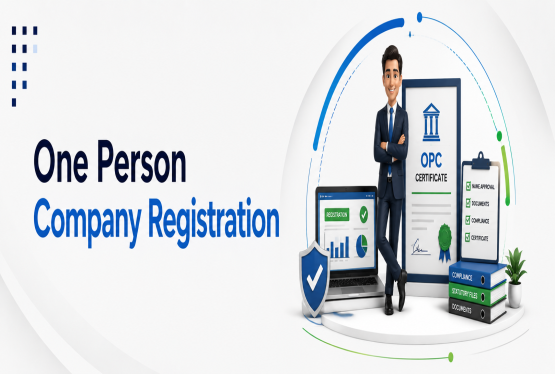
Starting a business alone is no longer limited to operating as a sole proprietorship. Many solo entrepreneurs today want legal recognition, limited liability, business credibility, and a professional structure without adding another partner only for registration purposes. This is where One Person Company Registration, commonly known as OPC Registration, becomes a practical choice.
An OPC allows a single person to start and operate a company with corporate benefits. It gives the entrepreneur the freedom of sole ownership along with the legal identity of a company. For consultants, freelancers, online sellers, service providers, small manufacturers, creators, professionals, and startup founders, OPC Registration can be a strong first step toward formal business growth.
Unlike a sole proprietorship, an OPC is a separate legal entity. This means the business and the owner are legally different. The OPC can own assets, enter into contracts, open a bank account, borrow money, and operate in its own name. At the same time, the liability of the member is generally limited to the unpaid amount on shares held by him or her.
What is One Person Company?
A One Person Company is a company that has only one person as its member. It was introduced under the Companies Act, 2013 to support individual entrepreneurs who want to enjoy the benefits of a company structure without needing two or more members.
In simple words, OPC is a bridge between sole proprietorship and private limited company. It gives a single owner control over the business while providing limited liability and a separate legal identity. The owner can act as both shareholder and director, making business control simple and direct.
OPC is treated as a private company under the Companies Act. However, it enjoys certain compliance relaxations because it has only one member. This makes it suitable for solo entrepreneurs who want a formal business structure but do not want the complexity of a full private limited company in the beginning.
Legal Meaning of OPC Under Companies Act, 2013
Section 2(62): Definition of OPC
Section 2(62) of the Companies Act, 2013 defines a One Person Company as a company which has only one person as a member. This is the basic legal foundation of OPC Registration in India. This provision allows a single individual to form a company and hold complete ownership. Earlier, a company structure required at least two members for a private limited company, but OPC created a separate route for individual entrepreneurs. The legal recognition of OPC has helped many small businesses enter the organized corporate sector. It allows solo founders to work with a proper company name, corporate bank account, statutory records, and legal identity.
Section 3: Formation of OPC
Section 3 of the Companies Act, 2013 deals with formation of companies. It provides that a company may be formed for any lawful purpose by one person where the company to be formed is a One Person Company. This means a single person can subscribe to the Memorandum of Association and incorporate an OPC. The company must comply with registration requirements under the Act and rules made thereunder. An OPC must be formed for a lawful business purpose. It cannot be used for illegal, fraudulent, or prohibited activities. The object clause in the Memorandum should clearly describe the business activities of the company.
Eligibility for OPC Registration
Natural Person Requirement
Only a natural person can incorporate an OPC. This means a company, LLP, partnership firm, trust, society, or any other artificial legal entity cannot become the sole member of an OPC. The purpose of OPC is to support individual entrepreneurs. Therefore, ownership is restricted to a real individual and not to another organization. The member can also act as the director of the OPC. This gives complete control to the owner and makes decision-making simple.
Indian Citizen Requirement
The person incorporating an OPC must be an Indian citizen. After the 2021 changes, both resident Indian citizens and non-resident Indian citizens can incorporate an OPC, subject to applicable rules. This update is important for NRIs who want to start or structure their business in India. They can now use the OPC model if they meet the eligibility conditions. However, foreign citizens who are not Indian citizens cannot incorporate an OPC as sole members. They may consider other business structures depending on their investment and business plans.
One OPC Restriction
A person cannot incorporate more than one OPC at the same time. Similarly, a person cannot become a nominee in more than one OPC. This restriction prevents misuse of the OPC structure. Since OPC is designed for individual entrepreneurship, the law limits multiple OPC registrations by the same person. Before incorporation, the applicant should confirm that he or she is not already a member or nominee in another OPC.
Nominee Requirement in OPC
Why Nominee is Mandatory
A nominee is mandatory in OPC Registration because the company has only one member. If the sole member dies or becomes incapable of entering into contracts, the nominee steps in to ensure continuity of the company. This feature protects the legal existence of the OPC. Without a nominee, the company may face uncertainty after the death or incapacity of the sole member. The nominee must give written consent before incorporation. This consent is filed with the incorporation documents.
Rights and Role of Nominee
The nominee does not become the owner immediately. The nominee’s role becomes active only if the sole member dies or becomes incapable of managing the company. Once such a situation arises, the nominee may become the member of the OPC. This ensures that the company does not automatically come to an end due to the death of the sole owner. The nominee can also withdraw consent, and the member can change the nominee by following the prescribed process.
Minimum Requirements for OPC Registration
One Member and One Director
An OPC requires only one member. The same person can also become the sole director of the company. However, an OPC may have more than one director, subject to the maximum limit under the Companies Act. Many solo entrepreneurs appoint only one director in the beginning and add more later if required. Having one member and one director makes OPC a simple structure for individual entrepreneurs who want full control over business decisions.
Registered Office Address
Every OPC must have a registered office address in India. This address is used for official communication from the Ministry of Corporate Affairs, Income Tax Department, GST Department, banks, and other authorities. The registered office may be a residential or commercial property. If the premises are rented, rent agreement and No Objection Certificate from the owner are usually required. A proper registered office proof is important because incorrect address details may lead to resubmission or future compliance issues.
Name of the OPC
The name of the OPC must be unique and should not be identical or too similar to an existing company, LLP, or registered trademark. The name must also comply with the company name availability rules. The words “One Person Company” must be mentioned in brackets below the name of the company wherever the name is printed, affixed, or engraved. A proper MCA name search and trademark search should be done before finalizing the name. This helps avoid rejection and future brand disputes.
Documents Required for OPC Registration
Documents of Member and Director
The proposed member and director must provide identity and address documents. Common documents include PAN card, Aadhaar card, passport-size photograph, mobile number, email ID, and address proof. Address proof may include bank statement, electricity bill, mobile bill, or other accepted documents. The details should be clear and updated. If the member is an NRI, additional documents such as passport and overseas address proof may be required. Some documents may need notarization or apostille depending on the case.
Documents of Nominee
The nominee must also provide identity proof, address proof, PAN, Aadhaar, photograph, mobile number, and email ID. The nominee must sign the consent form for acting as nominee of the OPC. The nominee’s documents should be carefully checked before filing. Any mismatch in name, address, or identity details may lead to resubmission. Since nominee details form an important part of OPC structure, they should not be treated casually.
Registered Office Documents
The OPC must provide registered office proof. This may include electricity bill, water bill, gas bill, property tax receipt, rent agreement, and No Objection Certificate from the owner. The utility bill should generally be recent and should clearly show the address. If the property belongs to the member, ownership proof may be submitted. Proper office documents help establish that the company has a valid place of business for official communication.
Step-by-Step Process for OPC Registration
Step 1: Obtain Digital Signature Certificate
The first step is to obtain Digital Signature Certificate for the proposed director. Since MCA filing is done online, DSC is required to sign incorporation forms electronically. The applicant must complete identity verification and submit documents for DSC issuance. Once DSC is ready, the incorporation process can begin. DSC is also useful for future ROC filings, tax filings, and other digital compliance requirements.
Step 2: Apply for Name Approval
The next step is to apply for name approval through the MCA system. The proposed name should be unique, meaningful, and aligned with the business activity. The name should not be too similar to an existing company or trademark. If the name is generic or misleading, it may be rejected. A well-researched name improves approval chances and helps build a strong brand identity.
Step 3: Prepare MOA and AOA
The Memorandum of Association contains the main objects of the company. It describes the business activities the OPC is allowed to undertake. The Articles of Association contain internal rules for management, decision-making, shareholding, meetings, and governance of the company. For solo entrepreneurs, the object clause should be drafted carefully to cover current and future business activities.
Step 4: File Incorporation Application
The incorporation application is filed online through the MCA portal using the applicable incorporation forms. The application includes details of the member, director, nominee, registered office, capital, and business activity. Linked forms may also be used for PAN, TAN, EPFO, ESIC, GST, professional tax, and bank account, depending on applicability. The forms must be certified and submitted with proper documents. Incorrect details may lead to resubmission or rejection.
Step 5: Certificate of Incorporation
After approval, the Registrar of Companies issues the Certificate of Incorporation. This certificate confirms that the OPC is legally registered. The company receives Corporate Identification Number, PAN, and TAN. After incorporation, the company can open a current bank account and begin operations, subject to post-incorporation compliance. The date mentioned on the Certificate of Incorporation becomes the legal date of birth of the OPC.
Important Legal Provisions Applicable to OPC
Section 12: Registered Office
Every OPC must maintain a registered office capable of receiving official communication. The company must display its name and registered office details as required under law. Any change in registered office must be reported to the Registrar within the prescribed timeline. Maintaining correct registered office details is important because legal notices and government communication are sent to this address.
Section 92: Annual Return
An OPC must file an annual return with the Registrar of Companies. However, an OPC gets certain relaxations compared to other companies. The annual return of an OPC can be signed by the company secretary. If there is no company secretary, it can be signed by the director. This makes annual compliance easier for solo entrepreneurs.
Section 134: Financial Statements
An OPC must prepare financial statements as per the Companies Act. The financial statements should reflect the true financial position of the company. OPC enjoys relaxation from preparing cash flow statement as part of financial statements. This reduces compliance burden for small solo businesses. However, the company must still maintain proper accounts and file financial statements with ROC.
Section 173: Board Meetings
OPCs have certain relaxations in board meeting requirements. If an OPC has only one director, board meeting requirements are practically not applicable in the same manner as other companies. Where there is more than one director, at least one board meeting must be conducted in each half of the calendar year, and the gap between two meetings should not be less than ninety days. This relaxation makes OPC easier to manage compared to a regular private limited company.
Section 193: Contracts by OPC
Section 193 deals with contracts by One Person Company. Where an OPC enters into a contract with the sole member who is also a director, and the contract is not in the ordinary course of business, the company must record the contract in the memorandum or minutes. The company may also need to inform the Registrar about such contract within the prescribed time. This provision helps maintain transparency in related-party-style transactions between the OPC and its sole owner.
Post-Incorporation Compliance for OPC
Opening Bank Account
After incorporation, the OPC should open a current bank account in the company’s name. The member should deposit subscription money as mentioned in the incorporation documents. A separate bank account helps maintain a clear difference between personal money and company money. Mixing personal and business funds can create accounting, tax, and legal issues.
Filing Commencement of Business
If the OPC has share capital, it is generally required to file declaration for commencement of business in Form INC-20A. This confirms that the subscriber has paid the agreed share subscription amount. The company should not commence business or borrow money before completing this filing where applicable. Timely filing helps maintain a clean compliance record from the beginning.
Maintaining Books of Account
An OPC must maintain books of account, invoices, bank records, expense vouchers, statutory registers, tax records, and financial statements. Proper accounting helps in ROC filing, income tax filing, GST filing, audit, and business decision-making. Solo entrepreneurs should maintain records professionally from day one.
Annual ROC Filing
An OPC must file annual financial statements and annual return with the Registrar of Companies. These filings are mandatory even if the OPC has not started business or has no revenue. Failure to file annual forms may lead to additional fees and penalties. Regular compliance protects the company’s legal status and builds credibility.
Advantages of OPC Registration for Solo Entrepreneurs
Limited Liability Protection
One of the biggest advantages of OPC Registration is limited liability. The personal assets of the member are generally protected from business liabilities. This allows solo entrepreneurs to take business decisions with more confidence. However, limited liability protection does not apply in cases of fraud, personal guarantee, or unlawful conduct.
Separate Legal Identity
An OPC has a separate legal identity from its owner. It can own assets, enter contracts, borrow money, and sue or be sued in its own name. This gives the business a professional identity and improves credibility. For service providers, freelancers, consultants, and online sellers, separate legal identity can improve client trust.
Better Business Credibility
An OPC appears more professional than an unregistered business or sole proprietorship. Banks, vendors, clients, and government departments may prefer dealing with a registered company. The company name, CIN, PAN, TAN, and statutory records give the business a formal identity. This credibility can help in tenders, contracts, online marketplace onboarding, and corporate vendor registration.
Complete Control
Unlike partnership or private limited company, OPC allows one person to control the business fully. The owner does not need to share decision-making power with another shareholder. This is useful for solo entrepreneurs who want independence but still want corporate benefits.
Limitations of OPC Registration
Not Suitable for Multiple Founders
OPC is designed for one owner. If two or more founders want ownership, a private limited company or LLP may be more suitable. Adding another member is not possible without conversion into another company structure. Therefore, business planning should be done before choosing OPC.
Investment Limitations
Although OPC has a company structure, it may not be the first preference for equity investors because there is only one member. Startups planning venture capital funding may prefer private limited company registration. OPC is better for solo-owned businesses rather than investor-led startups.
Conversion May Be Needed Later
If the business grows and needs multiple shareholders, investors, or co-founders, conversion into a private limited company may be required. The current rules have made conversion more flexible, but legal filing is still required. Solo entrepreneurs should consider future growth plans before registering as OPC.
OPC Conversion into Private Limited Company
An OPC can be converted into a private limited company by increasing the number of members and directors as required under law. For conversion into a private company, the company must have at least two members and two directors. Necessary alterations must be made in the Memorandum and Articles of Association. Conversion is useful when the business wants to bring in investors, co-founders, or additional shareholders.
OPC vs Sole Proprietorship
A sole proprietorship is easy to start, but it does not have a separate legal identity. The owner and business are considered the same. In OPC, the company is separate from the owner. This gives limited liability, better credibility, and a formal structure. For small informal businesses, proprietorship may be simple. But for entrepreneurs who want brand value, legal protection, and future growth, OPC is a better option.
OPC vs Private Limited Company
An OPC has one member, while a private limited company requires at least two members. OPC is suitable for solo entrepreneurs, while private limited company is better for multiple founders and fundraising. Private limited companies are generally preferred by investors because shareholding can be distributed among multiple persons. OPC is simpler in ownership and control, while private limited company offers more flexibility for expansion and investment.
Conclusion
OPC Registration is a strong business structure for solo entrepreneurs who want legal recognition, limited liability, separate legal identity, and professional credibility. It allows one person to start a company without depending on another shareholder only for incorporation.
The Companies Act, 2013 has created a clear legal framework for OPCs through provisions such as Section 2(62), Section 3, Section 12, Section 92, Section 134, Section 173, and Section 193. The MCA’s 2021 changes have made OPC more flexible by allowing NRIs to incorporate OPCs, reducing the residency requirement, and removing earlier restrictions on mandatory conversion based on capital and turnover.
For consultants, freelancers, small business owners, online sellers, creators, professionals, and solo startup founders, OPC can be a practical and growth-friendly option. However, founders must carefully evaluate eligibility, nominee requirements, documents, compliance obligations, and future business plans before incorporation.
Compliance Calendar LLP can assist with OPC Registration, name approval, documentation, DSC, MCA filing, nominee documentation, post-incorporation compliance, ROC filing, and conversion support. For professional assistance, contact Compliance Calendar LLP at info@ccoffice.in or call/WhatsApp 9988424211.
Frequently Asked Questions (FAQs)
1. What is OPC Registration?
Ans: OPC Registration is the process of registering a One Person Company with the Ministry of Corporate Affairs.
It allows a single person to start a company with limited liability protection.
It is suitable for solo entrepreneurs who want a formal business structure.
2. Who can register an OPC in India?
Ans: An Indian citizen can register an OPC in India, subject to eligibility conditions.
The person may be resident in India or an NRI Indian citizen.
Only a natural person can become the sole member of an OPC.
3. Can an NRI register an OPC in India?
Ans: Yes, an NRI who is an Indian citizen can register an OPC in India.
This was allowed after MCA’s 2021 amendment to OPC rules.
It gives Indian entrepreneurs living abroad a formal business structure in India.
4. Is nominee mandatory for OPC Registration?
Ans: Yes, appointing a nominee is mandatory for OPC Registration.
The nominee becomes important if the sole member dies or becomes incapable of managing the company.
This ensures business continuity and avoids legal uncertainty.
5. Can one person register more than one OPC?
Ans: No, one person cannot register more than one OPC in India.
The same person also cannot be a nominee in more than one OPC.
This restriction prevents misuse of the One Person Company structure.
6. Is OPC better than sole proprietorship?
Ans: OPC is better when the entrepreneur wants limited liability and separate legal identity.
A sole proprietorship is simple but does not separate the owner from the business.
OPC gives better credibility for banking, contracts, and business growth.
7. Is GST mandatory for OPC?
Ans: GST is not mandatory for every OPC by default.
It depends on turnover, type of business, interstate supply, and e-commerce activities.
If GST provisions apply, the OPC must obtain GST registration.
8. Does OPC need annual filing?
Ans: Yes, every OPC must complete annual ROC filing.
It must file financial statements and annual returns with the Registrar of Companies.
This filing is mandatory even if the OPC has no revenue or business activity.
9. Can OPC be converted into a private limited company?
Ans: Yes, an OPC can be converted into a private limited company.
This is useful when the business wants to add shareholders, investors, or co-founders.
The company must complete the required MCA filing and legal formalities.
10. Why choose Compliance Calendar LLP for OPC Registration?
Ans: Compliance Calendar LLP helps with OPC name approval, documentation, DSC, MCA filing, and incorporation support.
The team also assists with nominee documents and post-registration compliance.
This helps solo entrepreneurs start their company smoothly and legally.









_crop10_thumb.png)
_crop10_thumb.png)
_crop10_thumb.jpg)
