




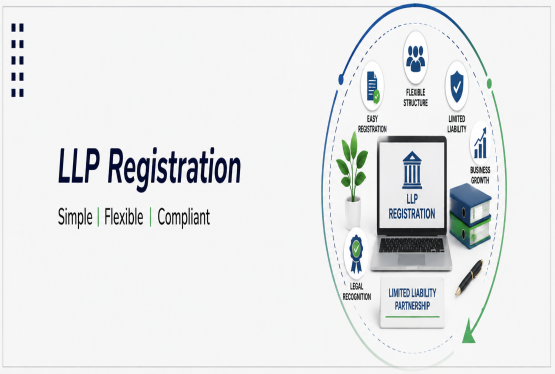
LLP Registration is one of the most practical business structure options for entrepreneurs, professionals, startups, consultants, service providers and small business owners who want flexibility along with limited liability protection. LLP stands for Limited Liability Partnership. It combines the operational flexibility of a partnership firm with the legal protection of a separate business entity. For growing businesses, LLP Registration is not just a legal formality; it is a smart step toward building credibility, protecting personal assets, managing partners professionally and creating a legally recognized business structure.
In India, LLPs are governed by the Limited Liability Partnership Act, 2008 and the Limited Liability Partnership Rules, 2009. An LLP is treated as a body corporate and has a legal identity separate from its partners. This means the LLP can own property, open a bank account, enter contracts, sue and be sued in its own name. The partners are not personally liable for the debts of the LLP beyond their agreed contribution, except in cases involving fraud, wrongful acts or personal guarantees.
For business growth, this structure is useful because it allows partners to work together without the heavy compliance burden of a private limited company. At the same time, it gives more legal recognition than a traditional partnership firm. Many businesses choose LLP Registration when they want a professional structure but do not want complex shareholding, board meetings, high statutory compliance or frequent ROC filings applicable to companies.
Meaning of LLP Registration
LLP Registration means incorporating a Limited Liability Partnership with the Ministry of Corporate Affairs through the Registrar of Companies. Once registered, the LLP receives a Certificate of Incorporation and a unique LLP Identification Number. After incorporation, the LLP becomes a separate legal entity and can start business activities as per its agreed objects and LLP Agreement.
An LLP is formed by two or more partners who agree to contribute capital, share profits, manage business responsibilities and follow the terms mentioned in the LLP Agreement. The LLP Agreement is the most important internal document of an LLP. It defines the rights, duties, profit-sharing ratio, capital contribution, decision-making process, admission of new partners, retirement of partners, dispute resolution and other internal rules.
For business owners, LLP Registration brings clarity. Instead of running a business informally, the partners get a written legal structure. This helps in avoiding confusion, maintaining accountability and improving trust among partners, clients, vendors, banks and investors.
Legal Requirements for LLP Registration in India
The primary law governing LLP Registration in India is the Limited Liability Partnership Act, 2008. This Act provides the legal foundation for incorporation, management, rights and duties of partners, filing requirements, conversion, penalties, investigation and winding up of LLPs. It gives LLPs the status of a separate legal entity while allowing partners to manage the business with flexibility.
The Limited Liability Partnership Rules, 2009 prescribe the procedural requirements for incorporation, forms, fees, filings, name approval, LLP Agreement filing, partner changes, registered office changes and other compliance matters. These rules are important because LLP Registration is completed through online forms filed on the MCA portal.
The LLP framework has also been updated over the years to improve transparency and ease of doing business. Recent amendments have introduced additional requirements such as maintaining a register of partners and disclosures relating to beneficial interest. These changes show that while LLPs are simpler than companies, they are still expected to maintain proper records and comply with legal requirements.
Why LLP Registration Supports Business Growth
LLP Registration supports business growth because it gives a formal legal identity to the business. When a business is registered as an LLP, it becomes easier to deal with customers, corporate clients, government departments, banks, payment gateways and vendors. A registered business appears more reliable than an unregistered setup.
Another major advantage is limited liability protection. In a normal partnership firm, partners may be personally liable for business debts. In an LLP, liability is generally limited to the agreed contribution of the partners. This gives business owners confidence to expand operations without exposing personal assets to routine business risks.
LLP Registration also helps in professional management. Since the LLP Agreement defines partner roles and profit-sharing terms, the business can operate with clarity. This is useful when multiple founders, consultants, professionals or investors are involved. A written agreement reduces internal disputes and helps the business run smoothly.
For growing businesses, an LLP structure also creates better compliance discipline. Bank accounts, invoices, tax records, contracts and business licenses can be maintained in the name of the LLP. This improves financial tracking and makes the business more organized.
Key Features of an LLP
An LLP has a separate legal identity from its partners. This means the LLP continues to exist even if partners change. The death, retirement, resignation or insolvency of a partner does not automatically end the LLP. This feature is known as perpetual succession and is useful for long-term business continuity.
The liability of partners is limited. A partner is not personally liable for the independent or unauthorized acts of another partner. However, if a partner is involved in fraud or wrongful conduct, protection may not be available. Therefore, partners should act responsibly and maintain proper records.
There is no maximum limit on the number of partners in an LLP. At least two partners are required to start an LLP, and at least two designated partners are required for compliance responsibility. At least one designated partner should be resident in India as per applicable legal requirements.
An LLP has flexible internal management. Unlike companies, LLPs are not required to follow a board structure. The rights and duties of partners are mainly governed by the LLP Agreement. This makes it suitable for professionals, consultants, agencies, service providers and businesses that prefer operational flexibility.
Who Can Register an LLP?
LLP Registration is suitable for individuals, professionals, startups, small businesses, service providers, consultants, agencies and family businesses. It is also useful for businesses that do not need external equity funding in the same way as private limited companies.
Chartered accountants, company secretaries, lawyers, architects, consultants, designers, digital marketing agencies, IT service providers, financial advisors, trading businesses, education service providers, HR consultants, compliance firms and small manufacturers often prefer LLP Registration because it offers a balance between flexibility and legal protection.
Individuals, body corporates and foreign entities may become partners in an LLP, subject to applicable laws. However, every LLP must meet the minimum requirement of partners and designated partners. Designated partners are responsible for statutory compliance and filings.
Documents Required for LLP Registration
Partners / Designated Partners
- PAN Card
- Aadhaar Card or valid ID proof
- Address proof (Bank Statement, Utility Bill, Passport, Voter ID, or Driving Licence)
- Passport-size photograph
- Email ID and mobile number
- Digital Signature Certificate (DSC)
Foreign Nationals
- Passport
- Overseas address proof
- Passport-size photograph
- Notarized/Apostilled documents, as applicable
Registered Office
- Recent utility bill (Electricity/Water/Gas)
- Rent/Lease Agreement (if rented)
- Ownership proof (if owned)
- No Objection Certificate (NOC) from the owner
If a Body Corporate is a Partner
- Certificate of Incorporation
- Board Resolution authorizing participation in the LLP
- Authorization Letter for the representative
- Identity and address proof of the authorized representative
LLP Registration Process in India
The LLP Registration process in India is completed online through the MCA portal. The major steps are as follows:
Obtain Digital Signature Certificate
- The first step is to obtain Digital Signature Certificates for the proposed designated partners.
- DSC is required because LLP incorporation forms are filed electronically.
- The designated partners use DSC to sign and submit the incorporation forms online.
Name Approval
- The next step is to select and apply for approval of the proposed LLP name.
- The name should be unique and should not be identical or too similar to an existing company, LLP or registered trademark.
- The name should comply with MCA naming guidelines and should not include restricted, prohibited or misleading words.
Filing of Form FiLLiP
- After name selection, the incorporation application is filed through Form FiLLiP.
- This form contains details of proposed partners, designated partners, registered office, contribution and business activity.
- Required documents are attached with the form and submitted online along with the prescribed government fee.
Approval by Registrar
- After submission, the Registrar verifies the application and attached documents.
- If the details are correct and complete, the Registrar approves the incorporation application.
- In case of any issue, the Registrar may ask for resubmission or clarification.
Certificate of Incorporation
- Once the application is approved, the Certificate of Incorporation is issued.
- The LLP also receives its LLP Identification Number, known as LLPIN.
- From this stage, the LLP becomes a legally recognized business entity.
LLP Agreement
- After incorporation, the partners must prepare and execute the LLP Agreement.
- The LLP Agreement defines the internal structure, rights, duties, profit-sharing ratio and responsibilities of partners.
- It is an important legal document for managing the LLP.
Filing of Form 3
- The LLP Agreement must be filed with the Registrar in Form 3 within the prescribed time.
- This filing records the agreement officially with the MCA.
- Delay in filing Form 3 may attract additional fees and compliance issues.
Post-Registration Compliance
- After registration, the LLP should apply for PAN and TAN, if not already generated.
- The LLP should open a bank account in its own name and maintain proper books of account.
- It should also complete applicable registrations such as GST, MSME, Import Export Code or professional licenses, depending on the business activity.
LLP Agreement and Its Importance
The LLP Agreement is the backbone of an LLP. It defines how the LLP will function and how partners will manage their responsibilities. A well-drafted LLP Agreement reduces disputes and supports smooth business growth.
The agreement usually covers the name of the LLP, business objects, capital contribution, profit-sharing ratio, duties of partners, rights of partners, decision-making process, admission of new partners, resignation or retirement of partners, bank operation rules, dispute resolution, accounting method and other internal matters.
If an LLP Agreement is not properly drafted, disputes may arise between partners. For example, confusion may occur regarding profit sharing, withdrawal rights, decision-making authority, responsibility for losses or exit terms. Therefore, every LLP should have a clear and practical agreement suited to its business model.
Government Fees and Cost of LLP Registration
The government fee for LLP Registration depends on the contribution amount and applicable MCA fee structure. Apart from government fees, professional charges may apply if the applicant takes help from a consultant, chartered accountant, company secretary or legal professional.
The total cost may also depend on the number of partners, registered office documents, DSC requirement, stamp duty on LLP Agreement and additional registrations such as GST or MSME. Although LLP Registration is generally cost-effective compared to private limited company registration, applicants should keep all documents ready to avoid delays and corrections.
Post-Registration Compliance for LLPs
After LLP Registration, the business must follow annual compliance requirements. The LLP has to maintain proper books of account and prepare financial records. Even if there is no business activity, annual filings may still be required.
Every LLP is required to file an annual return in Form 11 and a statement of account and solvency in Form 8 within prescribed timelines. If the LLP Agreement is executed or changed, Form 3 must be filed. If partners are added, removed or their details change, relevant forms must be filed with the Registrar.
Income tax return filing is also mandatory for LLPs. If turnover, contribution or other conditions cross prescribed limits, audit requirements may apply. GST returns, TDS returns, professional tax, labour law compliances or other registrations may apply depending on business activity and location.
Recent Updates and Compliance Changes
One important recent update is the requirement for LLPs to maintain a register of partners in Form 4A. This requirement was introduced through LLP rule amendments and is aimed at improving transparency in partner records. LLPs should maintain updated records of partners, contribution, changes and relevant details at the registered office.
Another important compliance development relates to declarations of beneficial interest and significant beneficial ownership. LLPs are now expected to be more transparent about persons who hold beneficial interest in contribution. This is especially important where the registered partner and the real beneficial owner are not the same person.
These updates show that LLPs are no longer treated as informal or lightly monitored entities. While LLP compliance is still simpler than company compliance, partners must maintain proper records, file forms on time and disclose information where required.
Difference Between LLP and Partnership Firm
A partnership firm is governed by the Indian Partnership Act, 1932, while an LLP is governed by the LLP Act, 2008. A partnership firm does not have the same separate legal identity as an LLP. In a traditional partnership, partners may be personally liable for business debts.
In an LLP, the liability of partners is limited, and the LLP has separate legal existence. This makes LLP more suitable for growing businesses that want protection and credibility. However, LLP Registration and annual compliance are more structured than a simple partnership firm.
For businesses that want to remain small and informal, a partnership may seem easier. But for businesses planning to grow, sign contracts, hire teams, build a brand or work with corporate clients, LLP Registration is often a better option.
Difference Between LLP and Private Limited Company
A private limited company is suitable for businesses that want to raise equity funding, issue shares, create ESOPs or bring investors in a structured shareholding format. An LLP does not have share capital in the same way as a company. It works through partner contribution and profit-sharing.
LLP is generally easier to manage than a private limited company. It has fewer corporate governance requirements and more flexibility in internal management. However, for venture-funded startups, private limited company structure is usually preferred because investors are more comfortable with shares and equity rights.
For service-based businesses, consulting firms, family businesses, professional firms and businesses that do not require equity funding, LLP can be an excellent structure. The choice between LLP and private limited company should be made based on business goals, funding plans, compliance capacity and long-term strategy.
Penalties for Non-Compliance
LLPs must take compliance seriously. Delay in filing MCA forms may attract additional fees and penalties. Non-filing of annual returns, statement of account and solvency, LLP Agreement or partner change forms can create legal and financial problems.
Non-compliance may also affect business credibility. Banks, clients, investors and government departments may review MCA records before dealing with an LLP. If filings are pending for several years, the LLP may face difficulties in obtaining loans, registrations, tenders or business approvals.
In serious cases, the Registrar may take action against the LLP and its designated partners. Therefore, LLPs should maintain a compliance calendar and complete filings on time every year.
Conversion into LLP
Existing partnership firms, private limited companies and unlisted public companies may be converted into LLPs subject to prescribed conditions. Conversion is useful when a business wants limited liability protection and flexible management.
However, conversion should be planned carefully. The business must check tax implications, asset transfer issues, contracts, licenses, liabilities, creditor approvals and regulatory requirements. Professional advice is recommended before conversion because incorrect conversion planning may create legal or tax complications.
LLP Registration for Business Growth
LLP Registration can support business growth in many ways. It helps entrepreneurs create a legally recognized structure, protect personal assets, define partner responsibilities, improve client trust and maintain financial discipline. It is suitable for businesses that want flexibility but also need credibility.
A growing business should not operate only on informal arrangements. As revenue increases, responsibilities, risks and expectations also increase. LLP Registration gives the business a legal foundation for growth. It helps partners focus on operations while the legal structure supports stability.
For startups and service providers, LLP Registration can also help in building a professional brand. Clients often prefer dealing with registered entities because it gives confidence that the business is legally established and accountable.
Conclusion
LLP Registration is a practical and growth-friendly business structure in India. It offers limited liability, separate legal identity, flexible management and comparatively easier compliance. For entrepreneurs, professionals, startups and growing businesses, LLP can be a strong alternative to traditional partnership firms and private limited companies.
The legal framework under the LLP Act, 2008 and LLP Rules, 2009 provides a structured process for incorporation, management and compliance. Recent updates such as partner register maintenance and beneficial interest disclosures have made LLP governance more transparent and accountable.
For any business planning long-term growth, LLP Registration can be a smart choice. It helps build credibility, protects partners, supports professional operations and creates a strong legal base for future expansion. With proper documentation, a well-drafted LLP Agreement and timely compliance, an LLP can become a reliable and scalable business structure.
Frequently Asked Questions (FAQs)
Q1. What is LLP Registration?
Ans: LLP Registration means registering a Limited Liability Partnership with the Ministry of Corporate Affairs.
It gives the business a separate legal identity from its partners.
An LLP can own property, open a bank account and enter contracts in its own name.
It is suitable for startups, professionals, consultants and small businesses.
Q2. Which law governs LLP Registration in India?
Ans: LLP Registration in India is governed by the Limited Liability Partnership Act, 2008.
The procedural rules are provided under the LLP Rules, 2009.
These laws cover incorporation, partner duties, filings, compliance and penalties.
Every LLP must follow MCA requirements after registration.
Q3. Who can register an LLP in India?
Ans: Any two or more persons can register an LLP in India.
There must be at least two designated partners.
At least one designated partner should be resident in India.
Individuals and body corporates may become partners, subject to applicable rules.
Q4. What documents are required for LLP Registration?
Ans: Documents generally include PAN, Aadhaar, address proof and photographs of partners.
Registered office proof, rent agreement and NOC may also be required.
DSC of designated partners is needed for online filing.
Additional documents may apply for foreign partners or body corporates.
Q5. What is an LLP Agreement?
Ans: An LLP Agreement is the main internal document of an LLP.
It defines partner rights, duties, contribution and profit-sharing ratio.
It also covers management rules, decision-making and exit terms.
It must be filed with MCA after LLP incorporation.
Q6. Is LLP better than a partnership firm?
Ans: LLP offers limited liability protection, unlike a normal partnership firm.
It also has a separate legal identity from its partners.
A partnership firm is simpler but partners may face personal liability.
For growing businesses, LLP is usually more professional and secure.
Q7. Is LLP suitable for startups?
Ans: Yes, LLP is suitable for startups that want flexibility and lower compliance.
It works well for service businesses, consultants and professional firms.
However, startups planning equity funding may prefer a private limited company.
The choice depends on business goals and funding plans.
Q8. What are the annual compliances for LLP?
Ans: An LLP must file Form 11 as annual return.
It must also file Form 8 for statement of account and solvency.
Income tax return filing is also required every year.
Other compliances may apply based on GST, TDS or business activity.
Q9. Can partners be changed after LLP Registration?
Ans: Yes, partners can be added or removed after LLP Registration.
The LLP Agreement may also need amendment.
Relevant forms must be filed with MCA within the prescribed time.
Proper documentation helps avoid penalties and disputes.
Q10. What happens if LLP compliance is not done?
Ans: Non-compliance may lead to additional fees and penalties.
Pending filings can affect the LLP’s legal status and credibility.
Banks, clients and authorities may check MCA records before dealing.
Timely filing helps keep the LLP active and legally compliant.









_crop10_thumb.png)
_crop10_thumb.png)
_crop10_thumb.jpg)
