



Starting a business with a partner often begins with a simple understanding: one person may bring capital, another may bring technical expertise, and both may agree to share profits. However, as the business grows, verbal commitments and informal arrangements may become difficult to manage.
This is where Limited Liability Partnership Registration, commonly known as LLP Registration, becomes relevant. An LLP combines the operational flexibility of a partnership with a separate legal identity and limited-liability protection.
Before choosing this structure, new business owners should understand the legal requirements for incorporation, the importance of the LLP Agreement, the liability of partners, annual filing obligations and the recent beneficial-ownership compliance framework.
What Is a Limited Liability Partnership?
A Limited Liability Partnership is a body corporate incorporated under the Limited Liability Partnership Act, 2008. It has a legal identity separate from its partners and continues to exist despite changes in its ownership or management. The Indian Partnership Act, 1932 does not generally apply to an LLP unless the LLP Act specifically provides otherwise.
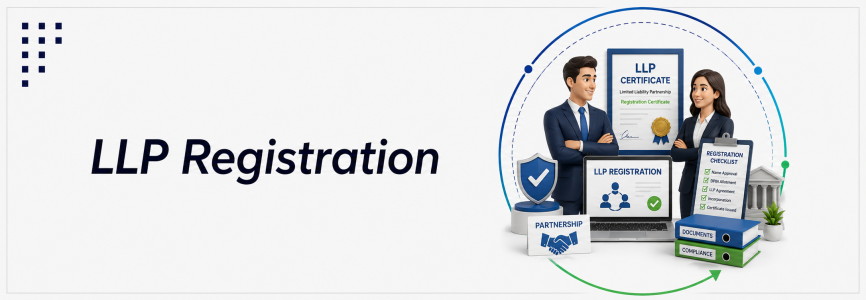
llp-registration-checklist-for-new-business-owners
Section 3 of the LLP Act provides that an LLP is a body corporate and a legal entity separate from its partners. It can own property, enter contracts, open bank accounts, borrow money and initiate or defend legal proceedings in its own name. A change in partners does not ordinarily affect its continued existence.
Perpetual Succession
An LLP continues to exist even if a partner resigns, dies, becomes insolvent or transfers an economic interest. Its existence is not automatically terminated by a change in partnership. This gives the business greater continuity than an informal or traditional partnership arrangement.
Limited Liability Protection
The obligations of an LLP are generally treated as the obligations of the LLP itself. Its liabilities are ordinarily met from its own property, and a partner is not personally liable merely because that person is a partner. However, a partner remains personally liable for their own wrongful act or omission.
Is LLP Registration Suitable for Your Business?
LLP Registration is often suitable for professional firms, consultants, agencies, family businesses and service-oriented ventures involving two or more persons. It allows partners to define their rights and responsibilities through a contract rather than adopting a rigid shareholder-and-board structure. However, it still requires regular accounting, statutory filings and proper legal documentation.
Businesses with Two or More Founders
An LLP must have at least two partners at all times. There is no general statutory maximum number of partners under the LLP Act. If the number falls below two and the business continues for more than six months, the sole remaining partner may become personally liable for obligations incurred after that period.
Professional and Service Firms
The definition of business under the LLP Act includes trade, profession, service and occupation, except activities specifically excluded by the Central Government. LLPs are therefore commonly used by consultants, architects, technology professionals, marketing firms and other service businesses. Sector-specific professional rules must still be checked before selecting this structure.
Businesses Not Seeking Public Equity
An LLP does not issue equity shares like a private limited company. Ownership and profit-sharing rights are governed by contribution and the LLP Agreement. Businesses planning to raise venture capital through multiple rounds of equity investment may find a private company structure more convenient.
Legal Provisions Governing LLP Registration
LLPs in India are primarily regulated by the Limited Liability Partnership Act, 2008 and the Limited Liability Partnership Rules, 2009. Incorporation, partner appointments, financial disclosures, conversion, investigation, winding up and penalties are governed through these provisions. The Ministry of Corporate Affairs and the Registrar of Companies administer the electronic filing system.
Section 11: Incorporation Document
Section 11 requires two or more persons associated for carrying on a lawful business with a view to profit to subscribe to the incorporation document. The document must be filed with the Registrar having jurisdiction over the proposed registered office. A professional engaged in the formation and a subscriber must certify compliance with the incorporation requirements.
Section 12: Incorporation by Registration
The Registrar examines whether the incorporation requirements have been satisfied. On registration, a Certificate of Incorporation is issued, which serves as conclusive evidence that the LLP has been incorporated under the stated name. The Act contemplates registration within 14 days where the statutory requirements have been complied with, although practical timelines depend on scrutiny and resubmission.
Section 23: LLP Agreement
Section 23 provides that the mutual rights and duties of the partners, and the rights and duties between the LLP and its partners, are governed by the LLP Agreement. The agreement and every subsequent change must be filed with the Registrar in the prescribed form. If there is no agreement on a matter, the default provisions contained in the First Schedule may apply.
Minimum Requirements for LLP Registration
Before starting the application, the founders should confirm their proposed partners, designated partners, business activity, contribution, registered office and profit-sharing arrangement. These decisions directly affect the incorporation form and the LLP Agreement. Changes made after incorporation can require additional filings and stamp duty.
Minimum Two Partners
Section 6 requires every LLP to have at least two partners. A partner may be an eligible individual or body corporate. An individual cannot become a partner if declared of unsound mind by a competent court, if the individual is an undischarged insolvent or if an insolvency application is pending.
Minimum Two Designated Partners
Every LLP must have at least two designated partners who are individuals. At least one designated partner must be resident in India. Where a body corporate is a partner, an eligible individual nominee of that body corporate may act as a designated partner.
Resident Designated Partner
For Section 7, a resident in India means an individual who has stayed in India for at least 120 days during the financial year. The 120-day threshold was introduced through the LLP Amendment Act, 2021 and became effective from 1 April 2022. New business owners involving overseas partners should review this condition carefully.
Designated Partner Identification Number
Every designated partner must obtain a Designated Partner Identification Number, or DPIN. The provisions concerning DIN under the Companies Act apply to DPIN with necessary modifications. The designated partner must also provide prior consent to act in that capacity.
Registered Office in India
Every LLP must maintain a registered office where official communications and notices can be received. A change in the registered office becomes effective only after the prescribed filing is completed with the Registrar. Continuing default can attract daily penalties subject to statutory maximum limits.
LLP Registration Document Checklist
Proper documentation is essential because information entered in the incorporation form must match the identity, address and legal records of the applicants. Differences in names, outdated addresses, unclear scans and incomplete foreign documents commonly result in resubmission. Documents should be valid and readable on the filing date.
Identity Proof of Partners
Indian partners and designated partners generally provide their PAN and an accepted identity document. The name, father’s name and date of birth should remain consistent across PAN, identity proof, DSC and the MCA profile. Any difference should be corrected or properly explained before filing.
Residential Address Proof
A recent bank statement, utility bill or another accepted address document may be required as residential proof. The document should contain the partner’s full name and current address. Where a permanent address and present residential address differ, both may need to be disclosed.
Foreign National Documents
A foreign national may generally become a partner or designated partner, subject to the resident-designated-partner requirement and applicable foreign-investment rules. Passport and overseas address documents may need notarisation, apostille or consular authentication depending on the country of execution. Translation may also be required where documents are not in English.
Registered Office Proof
Where the premises are owned by a partner or another person, ownership proof and a no-objection certificate may be required. For rented premises, a rent or lease agreement, owner’s consent and a recent utility bill should be kept ready. The address entered in FiLLiP must match the supporting documents.
Body Corporate Documents
Where a company or another eligible body corporate becomes a partner, its incorporation document, registered-office details and authorising resolution may be required. The body corporate must nominate an individual to act on its behalf. The nominee’s identity, consent and DPIN details should also be provided.
Digital Signature Certificate
The incorporation application and linked documents are signed electronically. Every proposed designated partner who must sign the form should hold a valid Digital Signature Certificate associated with the correct MCA user profile. An expired, unregistered or incorrectly mapped DSC can prevent successful submission.
Choosing and Reserving the LLP Name
The proposed name plays an important legal and commercial role. It should be distinctive, connected with the business and free from conflicts with existing companies, LLPs and registered trademarks. A name approval does not itself grant trademark ownership.
Mandatory LLP Suffix
Section 15 requires the name to end with “Limited Liability Partnership” or “LLP.” A person who is not incorporated as an LLP cannot improperly use these words to represent the business as an LLP. Improper use can attract a fine ranging from ?50,000 to ?5 lakh.
Avoid Identical or Similar Names
A proposed name should not be undesirable, identical with or too closely resemble an existing LLP, company or registered trademark. Even after incorporation, the Central Government may direct an LLP to change a conflicting name. A trademark proprietor can seek rectification within the period prescribed under Section 17.
Conduct a Trademark Search
MCA name availability and trademark availability are separate legal checks. Founders should search relevant trademark classes before finalising the brand name. Registration of an LLP under a particular name does not prevent a trademark owner from initiating legal proceedings.
Online LLP Incorporation Process
LLP incorporation is completed electronically through the MCA portal. The principal incorporation form is FiLLiP, which stands for Form for Incorporation of Limited Liability Partnership. The current web-based process combines name reservation, incorporation details, partner information and DPIN-related services.
Step 1: Create MCA User Accounts
The proposed applicants and professional filing the form should have the appropriate MCA accounts. Designated partners must associate their DSCs with their profiles. PAN, contact information and digital-signature details should be verified before the incorporation form is prepared.
Step 2: Reserve the Proposed Name
The name may be applied for through the name-reservation facility or as part of the FiLLiP process, depending on the chosen filing route. The applicant should provide the proposed business activity and explain the significance of coined or abbreviated words. A trademark owner’s consent or supporting approval may be required where relevant.
Step 3: File Form FiLLiP
FiLLiP captures the proposed name, registered-office address, business activity, contribution, partner details and designated-partner particulars. The subscribers’ sheet, consent and prescribed supporting documents are uploaded with the form. The incorporation form must be digitally signed and professionally certified where required.
Step 4: Respond to Resubmission
The Registrar may seek clarification where documents are incomplete, the name is objectionable or information is inconsistent. The applicant should answer every observation directly and upload corrected documents. Refiling the same defective document without addressing the objection may result in rejection.
Step 5: Receive the Certificate of Incorporation
Once approved, the Registrar issues the Certificate of Incorporation containing the LLP Identification Number. The LLP legally comes into existence from the date shown on that certificate. It may then open a bank account, execute its final agreement and begin operational registrations.
Drafting and Filing the LLP Agreement
The LLP Agreement is the most important internal legal document of an LLP. It determines how the partners contribute capital, share profits, take decisions and resolve disputes. A generic agreement may fail to address the actual commercial arrangement between the founders.
Essential Clauses
The agreement should cover the nature of business, capital contribution, profit-sharing ratio, management rights, voting, partner remuneration, drawings and banking authority. It should also address admission, resignation, retirement, expulsion, death, incapacity and insolvency of a partner. Confidentiality, non-compete, intellectual-property ownership and dispute-resolution provisions should be considered.
Form and Value of Contribution
Under Section 32, contribution may consist of money, movable or immovable property, intangible property, promissory obligations, other benefits or contracts for services. The monetary value of every partner’s contribution must be recorded and disclosed. The obligation to contribute is governed by the LLP Agreement.
Stamp Duty
Stamp duty on the LLP Agreement is governed by the applicable state stamp law. The payable amount may depend on the state of the registered office and the amount of contribution. The agreement should be executed on the proper stamp paper or through the applicable electronic-stamping system.
Filing Form 3
The particulars of the LLP Agreement must be filed through LLP Form No. 3 under Section 23 and Rule 21. Form 3 is ordinarily required within 30 days of incorporation, and later amendments must also be reported through the same form. Where a change relates to appointment or cessation of a partner, Form 3 may be linked with Form 4.
Liability of the LLP and Its Partners
Limited liability is a major advantage, but it is not absolute immunity. Partners must understand when the LLP is responsible, when an individual partner is responsible and when the protection can be lifted. The conduct and authority of each partner should be clearly regulated through the agreement.
Partner as Agent of LLP
Section 26 provides that every partner is an agent of the LLP for the purposes of its business, but not an agent of the other partners. The LLP may therefore become bound by authorised business acts of a partner. Internal restrictions should be documented and communicated where necessary.
Liability for Own Wrongful Acts
A partner is not personally liable solely because of being a partner. However, limited liability does not protect a person from liability arising from that person’s own wrongful act or omission. One partner is generally not personally liable for the independent wrongful act of another partner.
Unlimited Liability in Case of Fraud
Section 30 removes limited-liability protection where business is carried on with an intent to defraud creditors or for a fraudulent purpose. The liability of persons knowingly involved may become unlimited. The provision also permits imprisonment, fines and compensation for losses caused by fraudulent conduct.
Post-Registration Checklist
Incorporation does not complete the compliance process. New business owners must execute the agreement, deposit contribution, open the bank account and obtain applicable tax and sectoral registrations. Internal accounting and compliance systems should begin from the first transaction.
Open an LLP Bank Account
The bank account should be opened in the legal name appearing on the incorporation certificate. Partner contributions, receipts and expenses should be routed through this account. Personal and LLP funds should not be mixed without proper accounting records.
Obtain PAN and Tax Registrations
The LLP requires a Permanent Account Number and may need a Tax Deduction Account Number. GST registration depends on turnover, location, nature of supplies and compulsory-registration provisions. Professional tax, Shops and Establishments, EPFO, ESIC and sector-specific licences should be assessed separately.
Maintain Books of Account
Section 34 requires an LLP to maintain proper books for every year on a cash or accrual basis and according to the double-entry system. The records must be maintained at the registered office for the prescribed period. The LLP must also prepare a Statement of Account and Solvency within six months from the end of each financial year.
Annual Compliance Checklist
Every LLP must complete annual MCA filings even when it has not carried on substantial business. Nil turnover or inactivity does not automatically remove the annual-return and Statement of Account and Solvency requirements. Delayed filing can attract additional fees and statutory penalties.
LLP Form 11: Annual Return
Section 35 requires every LLP to file its annual return within 60 days from the closure of the financial year. For an LLP following the normal financial year ending on 31 March, the usual due date is 30 May. The return contains partner, contribution and other prescribed particulars.
LLP Form 8: Account and Solvency Statement
Form 8 is used to file the Statement of Account and Solvency under Section 34 and Rule 24. The normal filing period ends 30 days after the completion of six months from the financial-year end, making 30 October the usual due date for a 31 March year-end. The form includes declarations regarding financial position, contribution and turnover.
Audit Requirement
Rule 24 provides an audit exemption by reference to turnover of ?40 lakh and contribution of ?25 lakh. LLPs falling outside the prescribed exemption should arrange an audit by an eligible chartered accountant. LLPs near either threshold should review the rule carefully with their professional adviser before concluding that audit is unnecessary.
Income-Tax Return
An LLP is required to file its income-tax return in the prescribed form within the applicable due date. The tax deadline can differ depending on whether accounts are required to be audited or international and specified domestic transactions are involved. Income-tax filing is separate from MCA Forms 8 and 11.
Changes in Partners and the LLP Agreement
Changes in ownership must be formally documented rather than managed through internal messages or accounting entries alone. The LLP Agreement, register of partners and MCA records should remain consistent. Delayed reporting can expose the LLP and designated partners to penalties.
Appointment or Cessation of a Partner
Section 25 requires the LLP to notify the Registrar within 30 days where a person becomes or ceases to be a partner. Changes in a partner’s name or address must also be reported. Incoming partners must provide consent in the prescribed manner.
Vacancy of a Designated Partner
Where a vacancy arises, a new designated partner should be appointed within 30 days. Designated partners are responsible for statutory filings and compliance under the Act. They may also be personally exposed to penalties imposed for specified defaults.
Update the LLP Agreement
An admission, retirement, change in contribution or revision of profit-sharing terms usually requires an amended or supplementary LLP Agreement. The change must be properly stamped and reported through Form 3. The corresponding Form 4 should also be filed where partner particulars change.
Recent LLP Compliance Updates
The LLP compliance framework has undergone substantial changes since the LLP Amendment Act, 2021. Recent reforms have introduced the Small LLP concept, revised penalties, expanded web-based filing and introduced beneficial-ownership registers. New business owners should not rely on old incorporation guides that omit these developments.
Introduction of Small LLP
The LLP Amendment Act, 2021 introduced the concept of a Small LLP. The statutory framework currently refers to contribution not exceeding ?25 lakh and turnover not exceeding ?40 lakh, while permitting the government to prescribe higher limits within specified ceilings. Small LLPs receive reduced additional-fee treatment for delayed filings.
Decriminalisation and Monetary Penalties
Several procedural defaults were converted from criminal offences into monetary penalties through the 2021 amendment effective from 1 April 2022. The Act now provides an adjudication mechanism for specified defaults. However, serious matters such as fraud continue to carry criminal and civil consequences.
MCA Web-Based LLP Forms
MCA migrated major LLP services to web-based forms on the MCA portal. FiLLiP, Form 3, Form 8, Form 11 and related forms now operate through the updated electronic workflow. Applicants must ensure that user accounts, DSC associations and partner master data are correctly maintained.
Register of Partners and Beneficial Interest
The Limited Liability Partnership (Third Amendment) Rules, 2023 introduced detailed requirements concerning the register of partners and beneficial interest in contribution. LLPs must maintain prescribed partner information and record relevant changes. This development makes accurate ownership records a continuing legal obligation, not merely an incorporation formality.
Filing of Form 4D
Where a registered partner and the person holding the beneficial interest in contribution are different, declarations may be required under Rule 22B. The LLP must file a return with the Registrar through Form 4D after receiving the relevant beneficial-interest declaration. The form also applies where the beneficial interest undergoes a change.
Significant Beneficial Ownership Rules
The LLP Significant Beneficial Owners Rules, 2023 introduced a framework for identifying individuals who indirectly hold or exercise significant economic or control rights in a reporting LLP. The framework generally examines thresholds of at least 10% in contribution, voting rights or distributable profits, along with significant influence or control. Reporting LLPs should identify applicable individuals, obtain declarations and complete the prescribed filings.
Consequences of Non-Compliance
Delayed filings can lead to additional filing fees as well as statutory penalties. Under Sections 34 and 35, failure to file the Statement of Account and Solvency or annual return may attract a daily penalty, subject to maximum amounts for the LLP and designated partners. Filing after the due date does not automatically remove liability for the original default.
Repeated non-filing can have more serious consequences. An LLP may be wound up by the Tribunal if it fails to file its Statement of Account and Solvency or annual return for five consecutive financial years. A defunct LLP may also be struck off through the prescribed process.
Conclusion
LLP Registration can provide a strong legal structure for two or more people who want to operate a business with contractual flexibility and limited-liability protection. It is particularly suitable for professional firms, consulting businesses, service providers and closely held ventures that do not require a conventional equity-share structure.
A complete LLP Registration checklist should cover the proposed name, lawful business activity, two partners, two individual designated partners, resident-designated-partner requirement, registered office, DSC, DPIN, identity records, contribution and profit-sharing arrangement.
The work does not end with the Certificate of Incorporation. The LLP Agreement must be executed and filed, contribution records must be maintained, annual Forms 8 and 11 must be submitted and changes in partners must be reported promptly.
New LLPs must also consider the 2023 beneficial-interest, register-of-partners and significant-beneficial-ownership requirements. Building these compliances into the LLP’s internal system from the beginning is far easier than correcting incomplete ownership records later.
Frequently Asked Questions (FAQs)
Q1. What is LLP Registration?
Ans: LLP Registration is the process of incorporating a Limited Liability Partnership under the LLP Act, 2008.
It creates a separate legal entity distinct from its partners.
The partners generally enjoy limited liability for the debts of the LLP.
Q2. How many partners are required to register an LLP?
Ans: A minimum of two partners is required to incorporate an LLP in India.
There is no general maximum limit on the number of partners.
At least two partners must act as designated partners.
Q3. Is a resident designated partner mandatory?
Ans: Yes, at least one designated partner must be resident in India.
A resident designated partner must satisfy the prescribed stay requirement during the financial year.
The condition should be checked carefully where foreign nationals are involved.
Q4. Is there any minimum capital requirement for LLP Registration?
Ans: No statutory minimum contribution is prescribed for incorporating an LLP.
Partners may decide their contribution according to the business requirements.
The amount and form of contribution must be recorded in the LLP Agreement.
Q5. What documents are required for LLP Registration?
Ans: Common documents include PAN, identity proof and address proof of the partners.
Registered-office proof, owner’s NOC and a recent utility bill are also required.
Foreign documents may need notarisation, apostille or consular authentication.
Q6. Is an LLP Agreement compulsory?
Ans: Yes, the LLP Agreement defines the rights, duties and obligations of the partners.
It should cover contribution, profit sharing, management, retirement and dispute resolution.
Its particulars must generally be filed with the Registrar through Form 3.
Q7. What is the deadline for filing the LLP Agreement?
Ans: The LLP Agreement should generally be filed within 30 days of incorporation.
The filing is completed through LLP Form No. 3 on the MCA portal.
Delayed filing may attract additional fees and statutory consequences.
Q8. Is audit mandatory for every LLP?
Ans: Audit is not mandatory for every LLP under the LLP Rules.
An exemption is generally available where turnover and contribution remain within the prescribed limits.
Income-tax audit requirements should be examined separately.
Q9. What are the annual filing requirements of an LLP?
Ans: Every LLP must ordinarily file Form 11 as its annual return.
It must also file Form 8 containing the Statement of Account and Solvency.
These filings remain applicable even when the LLP has no business or turnover.
Q10. What happens if LLP annual returns are not filed?
Ans: Delayed filings may attract additional filing fees and monetary penalties.
Prolonged non-compliance can affect the LLP’s legal status and designated partners.
Continuous default may also lead to strike-off or winding-up proceedings.









_crop10_thumb.png)
_crop10_thumb.png)
_crop10_thumb.jpg)
