
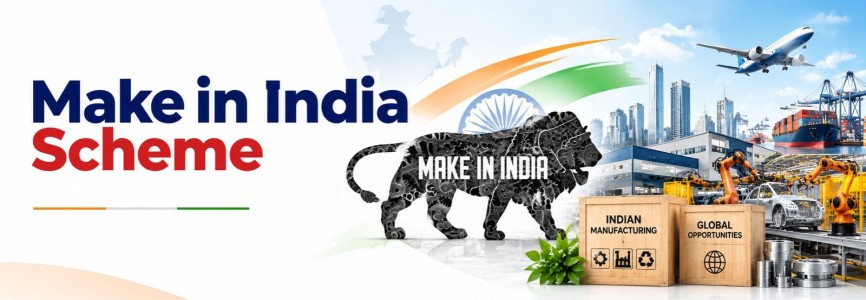



The Make in India initiative is one of the Government of India’s flagship programmes for promoting domestic manufacturing, attracting investment, encouraging innovation, generating employment and positioning India as a competitive global manufacturing hub. It was launched on 25 September 2014 and has gradually expanded from a promotional investment initiative into a broader policy ecosystem consisting of Foreign Direct Investment reforms, Production Linked Incentive Schemes, infrastructure development, public procurement preferences, digital approvals, quality-control measures and ease-of-doing-business reforms.
Make in India should not be understood as a single statutory “scheme” governed by one Act. There is generally no separate Make in India registration certificate or licence that every manufacturer must obtain merely because goods are manufactured in India. Instead, businesses operating under the Make in India ecosystem must comply with several Central and State laws depending upon their legal structure, product, manufacturing activity, investment source, location and industry.
Under Make in India 2.0, the Government presently focuses on 27 sectors, including 15 manufacturing sectors and 12 service sectors. The manufacturing sectors include aerospace and defence, automobiles and auto components, pharmaceuticals and medical devices, biotechnology, capital goods, textiles and apparel, chemicals and petrochemicals, electronics system design and manufacturing, leather and footwear, food processing, gems and jewellery, shipping, railways, construction, and new and renewable energy.
Objectives of the Make in India Initiative
The central objective of Make in India is to create an environment in which businesses can establish and expand manufacturing operations in India with improved infrastructure, greater access to capital, simplified regulation and access to domestic as well as international markets.
The initiative focuses on facilitating investment, encouraging innovation, developing world-class manufacturing infrastructure, improving skill development and strengthening protection of intellectual property. Over time, Make in India has also become closely associated with initiatives such as Startup India, Digital India, PM Gati Shakti, National Industrial Corridor Development Programme, National Single Window System, Production Linked Incentive Schemes and public procurement preference for locally manufactured products.
Is Make in India Registration Mandatory?
There is no universal statutory registration known as “Make in India Registration” applicable to all manufacturers. A company cannot obtain a generic Make in India licence and treat that as a substitute for sector-specific licences.
A manufacturing business must instead obtain registrations and approvals applicable to its activity. These may include incorporation under the Companies Act, GST registration, Udyam Registration, factory or establishment registration, pollution control approvals, environmental clearance, industrial licence, BIS certification, FSSAI licence, drug manufacturing licence, Legal Metrology registration, import-export registrations or other sector-specific authorisations.
Therefore, compliance must be determined according to the actual product and manufacturing process rather than merely by reference to the Make in India initiative.
Business Incorporation and Companies Act Compliance
Businesses intending to manufacture in India may operate as companies, limited liability partnerships, partnerships, sole proprietorships or other legally recognised entities.
A company is incorporated primarily under Sections 3 and 7 of the Companies Act, 2013. Section 3 deals with formation of companies, while Section 7 prescribes requirements relating to incorporation. A registered office must be maintained in accordance with Section 12 of the Companies Act.
Companies incorporated for manufacturing activities must thereafter comply with requirements relating to maintenance of statutory registers, board meetings, annual filings, financial statements, statutory audit and other corporate governance obligations.
Where applicable, Section 135 of the Companies Act, 2013 requires qualifying companies to comply with Corporate Social Responsibility requirements.
The SPICe+ incorporation framework has considerably streamlined company formation by integrating services such as name reservation, incorporation, DIN, PAN, TAN and certain labour and tax registrations. Government data released in 2026 highlights SPICe+ as an important component of India's ease-of-doing-business reforms.
Foreign Direct Investment under Make in India
Foreign Direct Investment is an important pillar of the Make in India framework. Foreign investment is governed principally by the Foreign Exchange Management Act, 1999, the Foreign Exchange Management (Non-Debt Instruments) Rules, 2019, and the FDI policy administered by DPIIT.
Section 6 of FEMA, 1999 provides the statutory framework relating to capital account transactions, while foreign investment into Indian entities must additionally comply with the applicable NDI Rules, sectoral caps, entry routes, pricing requirements, reporting requirements and beneficial ownership restrictions.
As a general principle, 100% FDI is permitted in manufacturing under the automatic route, subject to applicable sector-specific restrictions.
However, manufacturing businesses operating in sensitive sectors such as defence, telecommunications, pharmaceuticals, broadcasting, financial services or other regulated sectors must separately examine their applicable FDI caps and entry routes.
Where foreign investment is received, reporting requirements may arise through the RBI's FIRMS portal, including filings such as FC-GPR upon issue of equity instruments and FC-TRS in applicable transfers between residents and non-residents.
Industrial Licensing Requirements
Manufacturing activities in India are also influenced by the Industries (Development and Regulation) Act, 1951. While industrial licensing has been substantially liberalised, certain industries may continue to require industrial licences because of security, strategic, environmental or other regulatory concerns. Businesses should therefore determine whether their proposed manufacturing activity is exempt from industrial licensing or requires approval before commercial operations begin.
For industries not requiring an industrial licence, an Industrial Entrepreneur Memorandum (IEM) may apply depending on the nature and size of the enterprise. The National Single Window System now facilitates online filing of IEM Part A and Part B.
National Single Window System
An important reform associated with Make in India is the National Single Window System (NSWS). The platform helps investors identify applicable approvals through its Know Your Approvals functionality and facilitates applications for several Central and State approvals. As updated on 1 October 2026, NSWS hosts applications for approvals from 32 Central Departments and 34 State Governments, while its Know Your Approvals module provides guidance covering 35 States. However, using NSWS does not remove the legal obligation to obtain a particular approval. Businesses remain responsible for identifying and maintaining all approvals required under the relevant Central, State and local laws.
GST Compliance for Manufacturing Businesses
Manufacturers must comply with the Central Goods and Services Tax Act, 2017, relevant State GST legislation and Integrated GST provisions. Under Section 22 of the CGST Act, registration becomes mandatory where the prescribed conditions and turnover thresholds are met, subject to specific provisions and exceptions. Certain persons may also require compulsory registration under Section 24.
A registered manufacturer can claim eligible Input Tax Credit under Section 16, provided statutory conditions are fulfilled. Restrictions and blocked credits are governed principally by Section 17. Manufacturers must also ensure correct classification of products under applicable HSN codes, proper tax invoicing, e-invoicing wherever applicable, e-way bill compliance, maintenance of records and timely filing of GST returns.
Customs and Import Compliance
Manufacturers importing machinery, components or raw materials must comply with the Customs Act, 1962, Customs Tariff Act, 1975, Foreign Trade Policy and applicable DGFT regulations.
Businesses engaged in import or export normally require an Importer Exporter Code (IEC) from the Directorate General of Foreign Trade. Depending upon the transaction, manufacturers may also benefit from duty exemption, export promotion or bonded manufacturing mechanisms, subject to fulfilment of applicable legal requirements.
Compliance with Rules of Origin becomes particularly important where preferential tariff benefits under free trade agreements are claimed.
MSME and Udyam Registration
Micro, Small and Medium Enterprises manufacturing goods in India can seek Udyam Registration under the MSME framework.
Registration provides access to several benefits available to eligible MSMEs, including easier access to credit schemes, delayed-payment protections, participation advantages in government procurement and benefits available under specific Central or State programmes.
Sections 15 and 16 of the Micro, Small and Medium Enterprises Development Act, 2006 provide important protection against delayed payments. Where the parties agree upon a payment period, it cannot exceed the statutory outer limit of 45 days contemplated under Section 15. Delay beyond the permissible period may trigger liability for statutory interest under Section 16.
Businesses purchasing goods or services from eligible micro or small enterprises should also consider the tax implications under Section 43B(h) of the Income-tax Act, 1961, which affects deduction where payments to qualifying MSMEs are not made within the prescribed MSMED Act timelines.
Income-Tax Compliance
Manufacturers are subject to the Income-tax Act, 1961 and must maintain appropriate books, compute taxable income, deduct tax at source where applicable and comply with transfer pricing requirements for specified transactions.
Section 115BAB historically provided a concessional tax regime for qualifying new domestic manufacturing companies subject to stringent conditions, including specified incorporation and commencement-of-manufacturing timelines. Since the commencement deadline applicable to that provision has already expired, a company being newly established in 2026 should not assume that it can automatically claim the Section 115BAB regime.
Businesses should instead determine their applicable tax regime based on their current facts and the law applicable to the relevant financial year.
Labour Law Compliance and the Major 2025 Reform
One of the most significant recent changes affecting Make in India manufacturers is implementation of India's four Labour Codes with effect from 21 November 2025. These are the Code on Wages, 2019; Industrial Relations Code, 2020; Code on Social Security, 2020; and Occupational Safety, Health and Working Conditions Code, 2020. They rationalised 29 earlier Central labour laws.
Manufacturing employers must therefore review employment documentation, wages, working conditions, safety obligations, social security coverage, appointment letters, industrial relations procedures and occupational health requirements under the new framework together with applicable rules and State-level implementation requirements.
The reforms include minimum-wage protection, requirements relating to timely wage payment, broader social-security coverage and updated occupational safety requirements. Government clarification issued in February 2026 also highlighted mandatory ESIC coverage for establishments with more than ten employees and special coverage in hazardous processes, subject to the applicable legal framework.
Environmental Laws and Pollution Control Approvals
Industrial development under Make in India does not exempt manufacturers from environmental regulation.
Manufacturers may have obligations under the Environment (Protection) Act, 1986, Water (Prevention and Control of Pollution) Act, 1974, Air (Prevention and Control of Pollution) Act, 1981, EIA Notification, 2006, Hazardous and Other Wastes Rules, Plastic Waste Management Rules, E-Waste Management Rules, Battery Waste Management Rules and other product- or activity-specific environmental regulations.
Under Section 25 of the Water Act, specified establishments require prior consent for certain outlets and discharges. Section 21 of the Air Act similarly regulates operation of industrial plants in declared air pollution control areas.
Depending upon the industry, businesses may require Consent to Establish before establishing the plant and Consent to Operate before starting commercial production.
Certain projects also require prior Environmental Clearance under the EIA Notification, 2006.
PARIVESH has been developed as a digital single-window platform for environmental, forest, wildlife and related clearances and subsequent compliance monitoring. Government data indicates significant digitalisation and reductions in processing timelines under the environmental approval system.
BIS Certification and Quality Control Orders
A major compliance area for manufacturers is the Bureau of Indian Standards Act, 2016 and the increasing use of Quality Control Orders or QCOs.
BIS certification is generally voluntary unless a product has been brought under compulsory certification by the Central Government. For products covered by a QCO, conformity with the specified Indian Standard and use of the prescribed Standard Mark or conformity-assessment mechanism becomes mandatory.Businesses must therefore verify whether their product falls under Scheme-I, Scheme-II, Scheme-X or another applicable BIS conformity-assessment framework.
This area has been particularly active in 2026. BIS maintains an evolving list of upcoming QCOs, with numerous product standards reaching implementation dates during 2026. For example, several tools and utensils were scheduled for mandatory implementation from 1 October 2026.Manufacturers should check QCO applicability before establishing production lines, importing covered products or placing goods in the Indian market.
Product-Specific Regulatory Compliance
Depending upon the product, additional licences may apply. Food businesses may require registration or licensing under the Food Safety and Standards Act, 2006. Drugs and medical devices may require approvals under the applicable drugs and medical-device regulatory framework. Packaged commodities may attract obligations under the Legal Metrology Act, 2009 and Legal Metrology (Packaged Commodities) Rules.
Electronics may require BIS registration or other technical approvals. Wireless products may require WPC approvals. Certain telecom products may require applicable testing and certification. Batteries, plastics and electrical or electronic products may also trigger Extended Producer Responsibility requirements. Accordingly, a manufacturer's compliance matrix should always be product-specific.
Public Procurement Preference for Make in India
Government procurement is another major benefit associated with domestic manufacturing. The Public Procurement (Preference to Make in India) Order, 2017, as amended from time to time, provides preference to suppliers based on local content.
Under the revised framework, a Class-I local supplier generally requires more than 50% local content, while a Class-II local supplier generally has local content between 20% and 50%, subject to sector-specific higher requirements. The general margin of purchase preference is 20%.
The 2024 revision further strengthened the local-content methodology, including treatment of imported items obtained through local resellers and certain overseas licence, royalty and technical charges. These provisions can create significant opportunities for genuine domestic manufacturers participating in Central Government and public-sector procurement.
Production Linked Incentive Schemes
Production Linked Incentive schemes have become one of the most significant financial-policy instruments supporting the Make in India programme. PLI Schemes currently cover 14 strategic sectors with an approved financial outlay of approximately ?1.91 lakh crore.
The schemes generally provide incentives linked to incremental production, sales, investment or other prescribed performance criteria. Eligibility differs substantially among sectors, and merely manufacturing goods in India does not automatically entitle an enterprise to PLI benefits.
As of 31 March 2026, the Government reported that PLI schemes had attracted investment exceeding ?2.40 lakh crore and generated more than 14.15 lakh direct and indirect jobs, demonstrating the increasing role of performance-linked incentives in India's manufacturing strategy.
Intellectual Property Protection
Innovation-focused manufacturers should protect their intellectual property through India's statutory IP framework.
Brand names, logos and product marks may be protected under the Trade Marks Act, 1999. Innovative products and manufacturing processes may qualify for patent protection under the Patents Act, 1970. Product appearance and aesthetic features may qualify for protection under the Designs Act, 2000, while original technical drawings, software and other copyrightable works may receive protection under the Copyright Act, 1957.
IP registration can be particularly important for manufacturers entering export markets, technology collaborations, licensing arrangements and joint ventures.
Key Benefits of Make in India
Make in India provides benefits through a combination of investment facilitation, liberalised FDI rules, improved industrial infrastructure, digital approvals, PLI incentives, government procurement preference, MSME support and sector-specific incentives rather than through one universal subsidy.
Manufacturers may benefit from easier foreign investment, industrial corridors, logistics infrastructure, Central and State incentives, employment generation schemes, export support, public procurement opportunities and production-linked incentives where prescribed conditions are satisfied.
States also provide separate industrial policies containing benefits such as capital subsidies, electricity duty exemptions, stamp-duty concessions, SGST-linked incentives and employment incentives. These vary considerably between States and should be evaluated before selecting the location of a manufacturing facility.
Recent Make in India Updates in 2026
The Make in India ecosystem continued to expand during 2026. Government data published in March 2026 confirmed that Make in India 2.0 focuses on 27 sectors, while PLI schemes continue to support manufacturing across 14 strategic sectors. The implementation of the four Labour Codes from 21 November 2025 has substantially changed the labour-compliance framework applicable to manufacturing businesses.
NSWS has also continued expanding digital regulatory access. As of October 2026, applications from 32 Central Departments and 34 State Governments are available through the platform. Product regulation has simultaneously become more significant, with new and amended BIS Quality Control Orders continuing to bring additional manufactured products under mandatory Indian Standards during 2026.
The combined effect of these reforms indicates that Make in India is increasingly moving beyond investment promotion toward a model based on domestic value addition, quality standardisation, local manufacturing, digital approvals and integration into global supply chains.
Compliance Checklist for Manufacturers
Before commencing manufacturing operations, a business should determine its legal structure and complete incorporation, tax and commercial registrations. It should identify whether industrial licensing or an IEM is required, verify land-use and building permissions, obtain pollution-control and environmental approvals, register under applicable labour and social-security regulations and review product-specific licensing requirements.
The business should separately check BIS and QCO applicability, Legal Metrology requirements, EPR obligations, factory and occupational-safety requirements, customs and IEC compliance where imports or exports are involved, and sector-specific regulatory permissions.
Where foreign investment is involved, FEMA, NDI Rules and RBI reporting must be reviewed. Businesses seeking government contracts should analyse local-content requirements under the Public Procurement (Preference to Make in India) Order. Enterprises expecting financial incentives must additionally verify eligibility under the applicable PLI scheme, State industrial policy or other incentive programme.
Conclusion
The Make in India Scheme has evolved into a broad regulatory and economic framework designed to strengthen domestic production and make India a globally competitive manufacturing destination. However, Make in India does not replace India's existing legal and regulatory requirements. A manufacturer must comply with the Companies Act, FEMA and FDI regulations, GST laws, Income-tax Act, labour codes, environmental legislation, BIS requirements, intellectual property laws, MSME provisions and applicable sector-specific regulations.
The benefits can be substantial, including 100% FDI under the automatic route in ordinary manufacturing activities, PLI incentives in eligible sectors, government procurement preference, MSME benefits, infrastructure support, digital approvals and State-level manufacturing incentives. At the same time, increasing emphasis on BIS standards, environmental responsibility, local content and labour compliance means businesses must plan their regulatory strategy before commencing production.
With Make in India 2.0 covering 27 sectors, PLI-driven investment continuing to expand, the four Labour Codes now in force and NSWS simplifying approvals, 2026 represents a significant stage in India's transition toward a larger, more integrated and compliance-driven manufacturing economy. Businesses that combine manufacturing strategy with proper legal compliance are likely to be best placed to benefit from India's continuing industrial expansion.
Frequently Asked Questions (FAQs)
Q1. What is the Make in India Scheme?
Ans: Make in India is a Government of India initiative launched to promote domestic manufacturing, attract investment, create employment and improve India’s manufacturing ecosystem. It covers multiple sectors and works through policy reforms, incentives, infrastructure support and regulatory simplification.
Q2. Is there any separate registration for Make in India?
Ans: No universal Make in India registration is required for every business. A manufacturer must obtain the licences and registrations applicable to its activity, such as company incorporation, GST, Udyam, BIS, pollution approvals and sector-specific licences.
Q3. What are the main benefits of Make in India?
Ans: The initiative provides benefits through FDI liberalisation, PLI incentives, MSME support, government procurement preference, industrial infrastructure and State-level incentives. Actual benefits depend on the sector, location and eligibility conditions of the business.
Q4. Is 100% FDI allowed in manufacturing under Make in India?
Ans: In general, 100% FDI is permitted under the automatic route in manufacturing, subject to applicable sector-specific restrictions. Businesses receiving foreign investment must also comply with FEMA, NDI Rules and RBI reporting requirements.
Q5. What compliances are required for a manufacturing company?
Ans: A manufacturing company may need to comply with the Companies Act, GST laws, labour codes, environmental laws, factory requirements, BIS standards and sector-specific regulations. Additional approvals may apply depending on the product and manufacturing process.
Q6. Is BIS certification compulsory for Make in India products?
Ans: BIS certification is compulsory only where the product is covered by mandatory certification requirements or a Quality Control Order. Manufacturers should check the applicable Indian Standard and BIS scheme before manufacturing or selling regulated products.
Q7. Can MSMEs benefit from the Make in India initiative?
Ans: Yes, eligible MSMEs may benefit from Udyam Registration, credit support, government procurement opportunities, delayed-payment protections and various Central and State incentive schemes. The exact benefits depend on the enterprise category and applicable scheme.
Q8. What is the role of PLI Schemes in Make in India?
Ans: Production Linked Incentive Schemes encourage eligible manufacturers to increase domestic production and investment. Incentives are available in selected sectors and are generally linked to prescribed investment, production, sales or performance conditions.
Q9. What is the Public Procurement Preference under Make in India?
Ans: The Public Procurement (Preference to Make in India) framework gives preference to eligible local suppliers in certain government procurements. The benefit is generally linked to the percentage of local content in the goods or services supplied.
Q10. Are environmental approvals required for Make in India projects?
Ans: Yes, manufacturers must obtain applicable environmental and pollution-control approvals before starting operations. Depending on the activity, this may include Consent to Establish, Consent to Operate, Environmental Clearance and waste-management authorisations.








_crop10_thumb.png)
_crop10_thumb.png)
_crop10_thumb.jpg)
