




Starting a business with friends or family can be exciting. Everyone has a different role, and in the beginning, founders usually divide company shares based on their investment, skills, and responsibilities. However, things become more complicated when the startup begins growing. New investors may want ownership, employees may receive shares, or one founder may decide to leave. These decisions are not just about dividing company ownership because they can also affect taxes, voting rights, and future business opportunities.
Understanding startup shareholding changes and tax benefits is important for every founder planning to raise money or restructure a business. Indian tax laws provide certain benefits to eligible startups, but some of these benefits depend on how the company is structured and who owns its shares. A small mistake during a funding round can sometimes affect the company's ability to use previous losses or claim tax deductions. This article explains these issues through practical examples and simple explanations.
A Startup Story: When a Rs 50 Lakh Investment Changed Everything
Imagine two college friends, Aarav and Rohan, starting BrightPath Technologies Private Limited in 2022. Aarav develops the company's software, while Rohan manages sales and customer relationships. They initially divide ownership into 60% and 40% because Aarav invests more money into the business. During the first two years, the company struggles financially because most of its earnings go towards product development, marketing, and employee salaries. Despite these difficulties, both founders believe their business will eventually grow.
In 2025, an investor named Meera offers Rs 50 lakh in exchange for 25% ownership through a fresh issue of shares. The founders are excited because the investment will help them hire more employees and expand into different cities. However, accepting the investment means their ownership percentages will decrease. Before signing the agreement, their accountant explains that shareholding changes may affect certain tax benefits and accumulated business losses. This makes the founders realise that raising investment involves more than simply receiving money.
|
Shareholder |
Before Investment |
After Investment |
|---|---|---|
|
Aarav |
60% |
45% |
|
Rohan |
40% |
30% |
|
Meera |
0% |
25% |
|
Total |
100% |
100% |
This example shows why founders should understand shareholding changes before completing an investment transaction.
What Are Startup Shareholding Changes?
A startup shareholding change happens when the ownership of a company changes because shares are issued, transferred, sold, or acquired. Initially, founders may own the entire company, but as the business grows, investors and employees may also become shareholders. These changes can help the company raise funds, reward employees, or introduce new business partners. However, each transaction has different legal and financial consequences, depending on how the shares are transferred and who receives them.
For example, suppose a founder sells existing shares worth Rs 10 lakh to an investor. In this situation, the founder generally receives the money, not the company. However, when the company issues fresh shares worth Rs 10 lakh, the investment amount goes into the company's bank account. Both transactions change the ownership structure, but their accounting, taxation, and compliance requirements can be different. Understanding this distinction helps startups choose a suitable funding arrangement.
Founders planning to establish their businesses can explore Compliance Calendar LLP's Private Limited Company Registration guide.
For a better understanding of share transfers, legal requirements and shareholder rights, read our detailed guide on Compliance of Transfer and Transmission of Shares
Types of Shareholding Changes in Startups
Startups change their ownership structures for different reasons, including fundraising, employee incentives, founder exits, and business expansion. Some changes bring fresh money into the company, while others simply transfer existing ownership between shareholders. The tax treatment may depend on the nature of the transaction, share valuation, and holding period. Understanding these differences helps founders plan transactions without creating unnecessary financial or compliance problems.
|
Type |
Meaning |
Possible Tax Impact |
|---|---|---|
|
Fresh share allotment |
Company issues new shares |
Changes dilution and may affect loss continuity |
|
Share transfer |
Shareholder sells existing shares |
Capital gains tax may apply |
|
ESOP allotment |
Employees acquire company shares |
Perquisite and capital gains taxation |
|
Founder exit |
Founder sells or transfers ownership |
May affect taxes and accumulated losses |
|
Rights issue |
Existing shareholders receive subscription rights |
Ownership may change |
|
Merger or takeover |
Business ownership is reorganised |
Depends on the transaction structure |
Tax Benefits Available to Eligible Startups in India
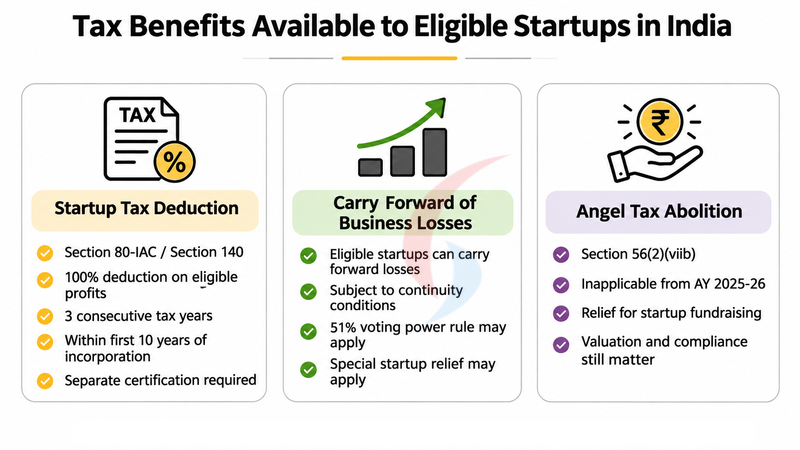
Startup Tax Deduction Under Section 80-IAC
One of the important tax incentives for eligible Indian startups was provided under Section 80-IAC of the Income-tax Act, 1961. With the Income-tax Act, 2025 taking effect from 1 April 2026, the corresponding deduction is covered under Section 140. Eligible startups may claim a deduction equal to 100% of qualifying business profits for three consecutive tax years selected within their first ten years of incorporation. This benefit can be valuable because many startups begin earning significant profits only after spending several years developing their products and customer base.
For example, suppose GreenSpark Technologies earns Rs 25 lakh in eligible business profits during a qualifying year. If the startup satisfies the legal conditions and obtains the required certification, it may claim a deduction against those qualifying profits. However, founders should understand that DPIIT recognition does not automatically provide this tax benefit. The startup must separately satisfy the requirements for the profit deduction, including the prescribed Inter-Ministerial Board certification and applicable turnover conditions. For guidance on government recognition, startups can explore Compliance Calendar LLP's Startup India Registration service.
Carry-Forward of Business Losses
Many successful startups experience financial losses during their initial years. This happens because businesses spend heavily on technology, marketing, office expenses, and salaries before generating sufficient revenue. Indian income-tax law allows qualifying business losses to be carried forward and adjusted against future eligible income, subject to specific conditions. However, significant shareholding changes can affect this benefit, particularly for closely held private companies where ownership continuity is important.
Under Section 119 of the Income-tax Act, 2025, the general rule for certain closely held companies involves continuity of shareholders holding at least 51% of voting power. Eligible startups have an additional option where the relevant shareholders from the loss year continue holding their shares in the year the loss is adjusted. For example, if a startup has accumulated losses of Rs 20 lakh and later issues fresh shares to investors, it may still satisfy the special continuity condition even though the founders' ownership percentages decrease. The company must also satisfy the applicable loss carry-forward rules and time limits.
Angel Tax Abolition
Earlier, startups raising investment at high valuations sometimes faced concerns about angel tax. This tax was associated with Section 56(2)(viib) of the Income-tax Act, 1961 and could apply when certain companies issued shares at prices exceeding their prescribed fair market value. However, these provisions were made inapplicable from Assessment Year 2025–26. This was an important development for startups seeking investment from angel investors and venture capital firms.
Imagine a startup issuing shares with a face value of Rs 10 at Rs 500 per share because investors believe the business has strong future potential. Earlier, the difference between the issue price and prescribed valuation could create tax concerns where the provision applied. Following the abolition of angel tax, that particular tax charge no longer applies to share issuances from the relevant assessment year. Nevertheless, businesses must continue following applicable company law, valuation, FEMA, and reporting requirements.
Startups seeking government recognition and applicable incentives can explore our article on Startup India Registration for Growing Businesses
How Shareholding Changes Affect Startup Tax Losses
Shareholding changes become especially important when a startup has accumulated business losses. Suppose a company spends its first three years developing software and records significant losses during that period. When an investor offers funding, the founders may focus mainly on receiving the money without examining how ownership changes will affect these losses. However, the ability to use earlier business losses can depend on the applicable shareholder-continuity conditions. This makes tax review an important part of investment planning.
Consider two companies. Startup A issues fresh shares to investors, but all relevant original shareholders continue holding their shares. If the company qualifies under the special startup provision, it may still be able to carry forward eligible losses. Startup B has a founder who sells all their shares and leaves the business. In that situation, the company may no longer satisfy the special continuity requirement, making the general voting-power test particularly important.
|
Situation |
Possible Tax Impact |
|---|---|
|
At least 51% voting-power continuity |
General continuity condition may be satisfied |
|
Major change in voting ownership |
Earlier losses require careful examination |
|
Original relevant shareholders retain shares |
Startup-specific continuity relief may apply |
|
Founder completely exits |
Special continuity condition may be affected |
|
Fresh investment reduces ownership percentages |
Tax eligibility depends on relevant conditions |
What Happens When a Founder Leaves the Startup?
Founder exits are common in growing businesses because people's goals and responsibilities can change over time. Sometimes one founder wants to start another business, while another may prefer to continue managing the existing company. Although these situations are normal, transferring ownership requires proper planning. A founder's exit may involve capital gains tax, changes in voting control, shareholder agreements, and possible effects on the company's accumulated losses.
For example, Neha and Priya start an online education company, with each holding 50% ownership. After four years, Neha decides to leave, and Priya agrees to purchase her shares. Before completing the transfer, they must review the share valuation, applicable taxes, transfer restrictions, and necessary documentation. They should also check whether the transaction affects any tax benefit claimed by the company. Proper planning can help both founders separate professionally without creating future disputes.
ESOPs and Tax Benefits for Startup Employees
Startups often struggle to compete with large companies when offering high salaries. To attract talented employees, many businesses introduce Employee Stock Option Plans, commonly known as ESOPs. These plans allow eligible employees to acquire company shares under specified conditions. Employees may benefit financially if the company's valuation increases over time, while the startup can encourage long-term commitment and employee participation in business growth.
Imagine a startup offering its software developer options to purchase 1,000 shares at a predetermined price. After several years, the company's valuation increases significantly, making those shares more valuable. Generally, an ESOP may create a taxable employment-related perquisite when the option is exercised, followed by capital gains taxation when the acquired shares are sold. Certain eligible startup employees may receive a deferral of tax payment or deduction on the perquisite, subject to legal conditions. This is a postponement of taxation, not a complete exemption.
To understand how employee stock options are taxed and what benefits eligible startups can claim, read our detailed guide on ESOP Taxation for Employees and Startups in India.
Capital Gains Tax on Startup Share Transfers
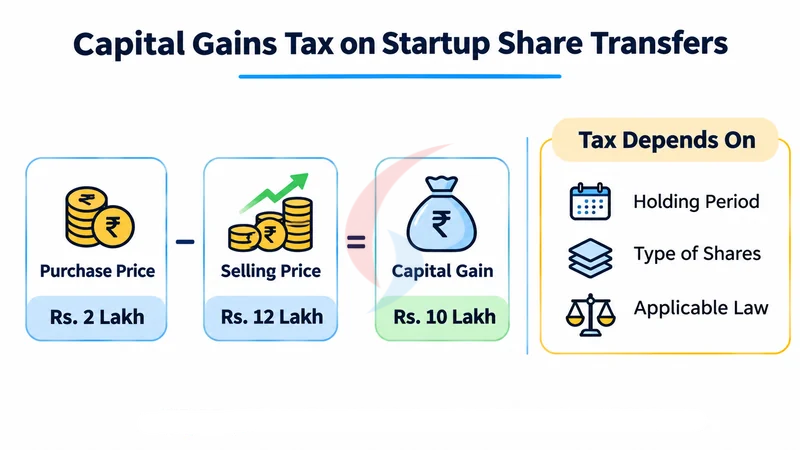
When founders or investors sell company shares for more than their acquisition cost, capital gains tax may apply. The tax calculation depends on several factors, including the purchase price, selling price, holding period, type of shares, and applicable law. Founders sometimes assume that receiving Startup India recognition means they can sell shares without paying tax. However, DPIIT recognition does not automatically exempt shareholders from capital gains taxation.
For example, suppose a founder originally purchases shares for Rs. 2 lakh and later sells them for Rs. 12 lakh. The basic gain is Rs 10 lakh before considering applicable adjustments and expenses. Whether the gain qualifies as short-term or long-term depends on the relevant holding-period rules. The seller should calculate the tax liability before finalising the transaction, particularly when a large funding round or business acquisition is involved.
Founders selling their shares should understand the difference between short-term and long-term capital gains. Learn more in our article on Capital Gains Tax: Short-Term vs. Long-Term
Can Foreign Investment Affect Startup Tax Benefits?
Foreign investment can help Indian startups expand internationally, improve technology, and access larger markets. However, overseas investment also brings additional responsibilities under FEMA, company law, and applicable foreign investment regulations. Before issuing shares to a foreign investor, a startup should examine sectoral restrictions, pricing guidelines, reporting requirements, and the resulting ownership structure. It should also review whether the transaction affects any conditions attached to Startup India recognition.
For example, an Indian startup plans to issue 40% of its shares to an overseas investor. Although the investment may provide sufficient funds for expansion, the founders must understand its effect on voting control and regulatory eligibility. They should also complete applicable FEMA reporting and maintain supporting documents.
Documents Required for Startup Shareholding Changes
Proper documentation is necessary whenever a startup changes its ownership structure. Documents help establish who owns the company, how the transaction was approved, and whether applicable statutory requirements were followed. They also become important during future investment rounds, audits, due diligence, and business acquisitions. Missing or incorrect records can delay transactions and create unnecessary disputes between founders and investors.
|
Document |
Purpose |
|---|---|
|
Updated shareholding pattern |
Shows ownership before and after the transaction |
|
Share purchase or subscription agreement |
Records transaction terms |
|
Board and shareholder resolutions |
Documents corporate approvals |
|
Valuation report |
Supports applicable share pricing requirements |
|
Share transfer documents |
Records transfer of existing shares |
|
PAS-3, where applicable |
Reports fresh share allotments |
|
Updated statutory registers |
Maintains shareholder information |
|
FEMA documents, where applicable |
Supports foreign investment compliance |
Step-by-Step Process for Changing Startup Shareholding
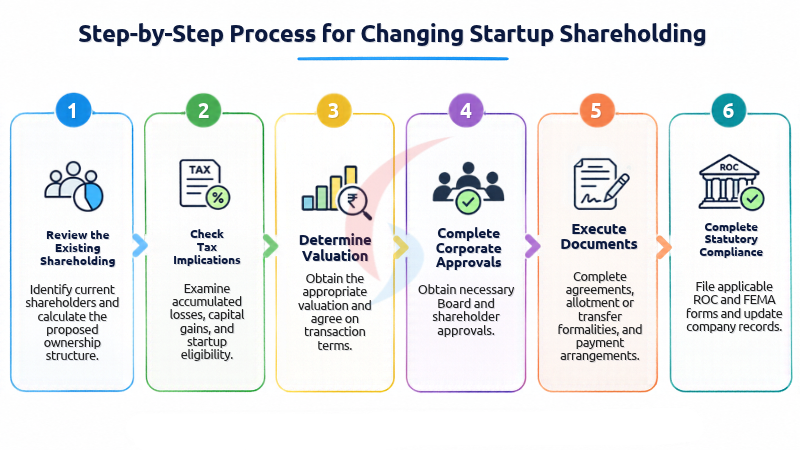
Changing a company's shareholding requires more than signing an agreement. The startup should first understand whether the transaction involves fresh allotment, transfer of existing shares, or employee ownership. It must then examine the current cap table, valuation, shareholder rights, and tax implications. Once the commercial terms are clear, the company can complete the necessary approvals, agreements, and statutory procedures.
-
Review the existing shareholding: Identify current shareholders and calculate the proposed ownership structure.
-
Check tax implications: Examine accumulated losses, capital gains, and startup eligibility.
-
Determine valuation: Obtain the appropriate valuation and agree on transaction terms.
-
Complete corporate approvals: Obtain necessary Board and shareholder approvals.
-
Execute documents: Complete agreements, allotment or transfer formalities, and payment arrangements.
-
Complete statutory compliance: File applicable ROC and FEMA forms and update company records.
When a startup issues fresh shares to investors, applicable ROC filing requirements must be completed. Read our guide on MCA Form PAS-3: Return of Allotment to understand the filing process and documentation.
Common Mistakes Startups Should Avoid
Many founders focus entirely on raising investment without understanding how their ownership will change afterward. One common mistake is accepting multiple funding rounds without calculating the combined dilution of founder shares. Another is assuming that DPIIT recognition automatically guarantees every startup tax benefit. Some deductions require separate certification, while the ability to use accumulated losses depends on specific shareholder-continuity rules.
Startups also face problems when they issue employee shares without proper documentation or transfer ownership without reviewing applicable valuation and tax provisions. Foreign investment transactions can create additional complications if FEMA requirements are ignored. These problems are usually easier to prevent through proper planning than to correct after the transaction has been completed. Maintaining accurate records and obtaining professional advice before major ownership changes can save considerable time and expense.
How Compliance Calendar LLP Can Help Startups
Managing startup shareholding changes can be complicated, especially when founders are already busy developing products, hiring employees, and raising investment. At Compliance Calendar LLP, we understand that growing businesses need practical support with corporate documentation and statutory compliance. Whether a company is bringing in a new investor, transferring founder shares, or introducing an employee stock option plan, proper records and timely filings are important. Our team can assist with relevant procedures and coordinate professional support based on the transaction.
Compliance Calendar LLP provides assistance with Startup India Registration, Private Limited Company Registration, share transfer and allotment documentation, ESOP compliance, FEMA reporting, and ROC filings. We help businesses understand the applicable documentation and compliance requirements so founders can focus on their operations and growth. Because every company's ownership history is different, the necessary steps should be reviewed according to the specific transaction rather than using the same approach for every startup.
If you are planning to change your startup's shareholding structure, transfer shares, bring in new investors, or need assistance with tax benefits and related compliance requirements, you can contact Compliance Calendar on +91 9988424211 or info@ccoffice.in
Why Choose Compliance Calendar LLp?
Startup shareholding changes are a natural part of business growth. Whether a company raises funds from investors, rewards employees with shares, or allows a founder to exit, each decision can influence ownership, business control, and tax obligations. India provides important benefits to eligible startups, including profit deductions and special provisions for carrying forward business losses. However, these benefits depend on specific legal conditions that founders should understand before completing major transactions.
The experience of Aarav and Rohan shows why careful planning matters. Their investment created opportunities for expansion, but understanding the financial and tax consequences helped them approach the decision responsibly. By reviewing ownership structures, maintaining proper records, and completing necessary compliance, startups can reduce avoidable risks while preparing for long-term growth.
Frequently Asked Questions (FAQs)
Q1. What is a startup shareholding change?
Ans. A startup shareholding change occurs when the ownership structure changes through the issue, sale, transfer, or acquisition of shares. This commonly happens during funding rounds, founder exits, employee share allotments, and business restructuring. Such transactions may also change voting rights and management control. Proper documentation is important because ownership records are used during audits, tax assessments, and future investment transactions.
Q2. Do shareholding changes affect startup tax benefits?
Ans. Yes, certain shareholding changes can affect tax benefits, particularly the ability to carry forward previous business losses. The impact depends on the transaction structure, shareholder continuity, and the company's eligibility under applicable law. However, every change in ownership does not automatically cancel all startup tax benefits. Founders should review the relevant conditions before finalising a major investment or share transfer.
Q3. Can startups claim a 100% income-tax deduction?
Ans. Eligible startups may claim a deduction equal to 100% of qualifying business profits for three consecutive tax years within the prescribed ten-year period. This benefit is subject to statutory conditions, including relevant incorporation requirements, turnover limits, and certification. DPIIT recognition alone does not automatically provide the deduction. The company must establish eligibility and comply with the applicable income-tax provisions.
Q4. Can startups carry forward losses after receiving investment?
Ans. Yes, qualifying startups may continue carrying forward eligible business losses after receiving investment. The result depends on shareholder-continuity conditions and other legal requirements governing loss utilisation. Certain eligible startups receive additional flexibility where the relevant shareholders continue holding their original shares. Therefore, founders should review previous losses and ownership records before completing a funding round.
Q5. What happens if a founder leaves the startup?
Ans. A founder's exit may involve the transfer or sale of shares to another founder, investor, or third party. The transaction can create capital gains tax implications and may affect voting rights or shareholder agreements. In some circumstances, it can also influence the company's ability to use accumulated losses. Appropriate valuation, documentation, and statutory record updates are important before the exit is completed.
Q6. Is angel tax applicable to startups in 2026?
Ans. The earlier angel tax provisions under Section 56(2)(viib) were made inapplicable from Assessment Year 2025–26. This removed the specific angel tax concern associated with qualifying share issuances at a premium. However, businesses must still comply with applicable valuation, company law, and regulatory requirements. Foreign investment transactions may also require additional FEMA compliance.
Q7. Are ESOPs taxable in India?
Ans. Yes, ESOPs can create tax liabilities for employees at different stages. Generally, an employment-related perquisite may arise when an employee exercises options, and capital gains tax may apply when the shares are sold. Certain eligible startup employees may qualify for deferred tax payment or deduction on the perquisite. The exact treatment depends on the employee's circumstances and applicable statutory conditions.
Q8. Is capital gains tax applicable when startup founders sell shares?
Ans. Capital gains tax may apply when founders sell company shares at a profit. The tax liability depends on the acquisition cost, selling price, holding period, and other applicable provisions. Startup India recognition does not automatically exempt these transactions from taxation. Founders should calculate their potential tax liability before agreeing to an exit or share sale.
Q9. Can foreign investors acquire shares in Indian startups?
Ans. Yes, foreign investors can acquire shares in Indian startups, subject to applicable foreign investment rules. Companies must review sectoral restrictions, pricing requirements, reporting obligations, and other relevant FEMA provisions. Foreign investment may also affect the startup's ownership structure and regulatory eligibility. Proper due diligence is important before completing the investment.
Q10. Does DPIIT recognition automatically provide income-tax exemption?
Ans. No, DPIIT recognition does not automatically guarantee an income-tax deduction. Startups seeking the eligible business profit deduction must satisfy additional requirements and obtain the necessary certification. The conditions for government recognition and income-tax deductions are not identical. Businesses should review both sets of requirements before claiming benefits.
Q11. What is the difference between share transfer and share allotment?
Ans. A share transfer involves existing shares moving from one shareholder to another. A share allotment occurs when the company issues new shares to investors, employees, or other eligible persons. In a typical sale of existing shares, the selling shareholder receives the consideration, while fresh allotments generally bring capital into the company. The applicable documentation and tax implications can therefore differ.
Q12. Can a founder sell all their shares to an investor?
Ans. A founder may sell all their shares, subject to applicable contractual restrictions, company law, and regulatory requirements. However, a complete exit may affect company control, accumulated losses, and existing shareholder arrangements. The selling founder may also face capital gains tax. Reviewing these matters before executing the transfer helps reduce future complications.
Q13. Does every share transfer require Form PAS-3?
Ans. No, Form PAS-3 generally relates to the allotment of shares rather than ordinary transfers of existing shares. Share transfers have separate documentation and record-maintenance requirements, depending on the nature of the securities and applicable law. Companies may also need to comply with dematerialisation requirements. Founders should identify the correct procedure before submitting statutory filings.
Q14. Can a startup lose tax benefits after a takeover?
Ans. A takeover may affect certain tax benefits if the transaction changes the company's eligibility or violates relevant shareholder-continuity requirements. However, the consequences depend on the particular benefit, transaction structure, and applicable law. Some ownership changes may be permitted without affecting specific tax deductions. A detailed review should therefore be completed before a takeover is finalised.
Q15. How can Compliance Calendar LLP help with startup shareholding changes?
Ans. Compliance Calendar LLP assists businesses with relevant corporate documentation, share transfers, fresh share allotments, ROC filings, and startup registration-related requirements. The firm can also support businesses with ESOP documentation and applicable FEMA compliance. These services help founders manage regulatory responsibilities during investment and ownership changes. Businesses can contact the team to discuss the requirements applicable to their proposed transaction.
Article last updated on : 13 Nov 2026.