


When a new company is registered in India, it needs a Board of Directors to manage its business and take important decisions. The people who take up these positions at the time of incorporation are known as the first directors of the company. They are responsible for looking after the company's affairs and ensuring that it follows the requirements of the Companies Act, 2013.
The appointment of first directors is generally decided during the incorporation process. Their names may be mentioned in the Articles of Association (AOA). If the Articles do not name anyone, the Companies Act provides a default rule to identify the first directors. The company must also meet the minimum director requirement and complete the necessary declarations and MCA filings.
This article explains how first directors are appointed, who can become a director, what documents are needed and what responsibilities they have after incorporation.
Who Are the First Directors of a Company?
First directors are the individuals who become the initial members of a company's Board of Directors. They take responsibility for managing the company after incorporation and making decisions about its business, finances and daily operations. Their names are usually decided by the promoters while preparing the company's incorporation documents.
For example, three people may come together to start a private limited company. They may decide that two of them will manage the business as directors, while all three hold shares in the company. The people appointed as directors will be responsible for the company's management, while the shareholders will own the shares. One person can hold both positions, but being a shareholder does not automatically make someone a director.
Which Section of the Companies Act Deals With First Directors?
Section 152(1) of the Companies Act, 2013 deals with the appointment of first directors. It says that the Articles of Association should provide for the appointment of the first directors. If the Articles do not contain any such provision, the individual subscribers to the Memorandum of Association (MOA) become the first directors until directors are properly appointed under the Act.
There is a separate arrangement for a One Person Company (OPC). If its Articles do not provide for the appointment of the first director, the individual who is the member of the OPC is treated as its first director. This means that a newly incorporated company does not remain without a first director simply because the promoters have not separately named one in the Articles.
Rules For Appointing First Directors in a New Company
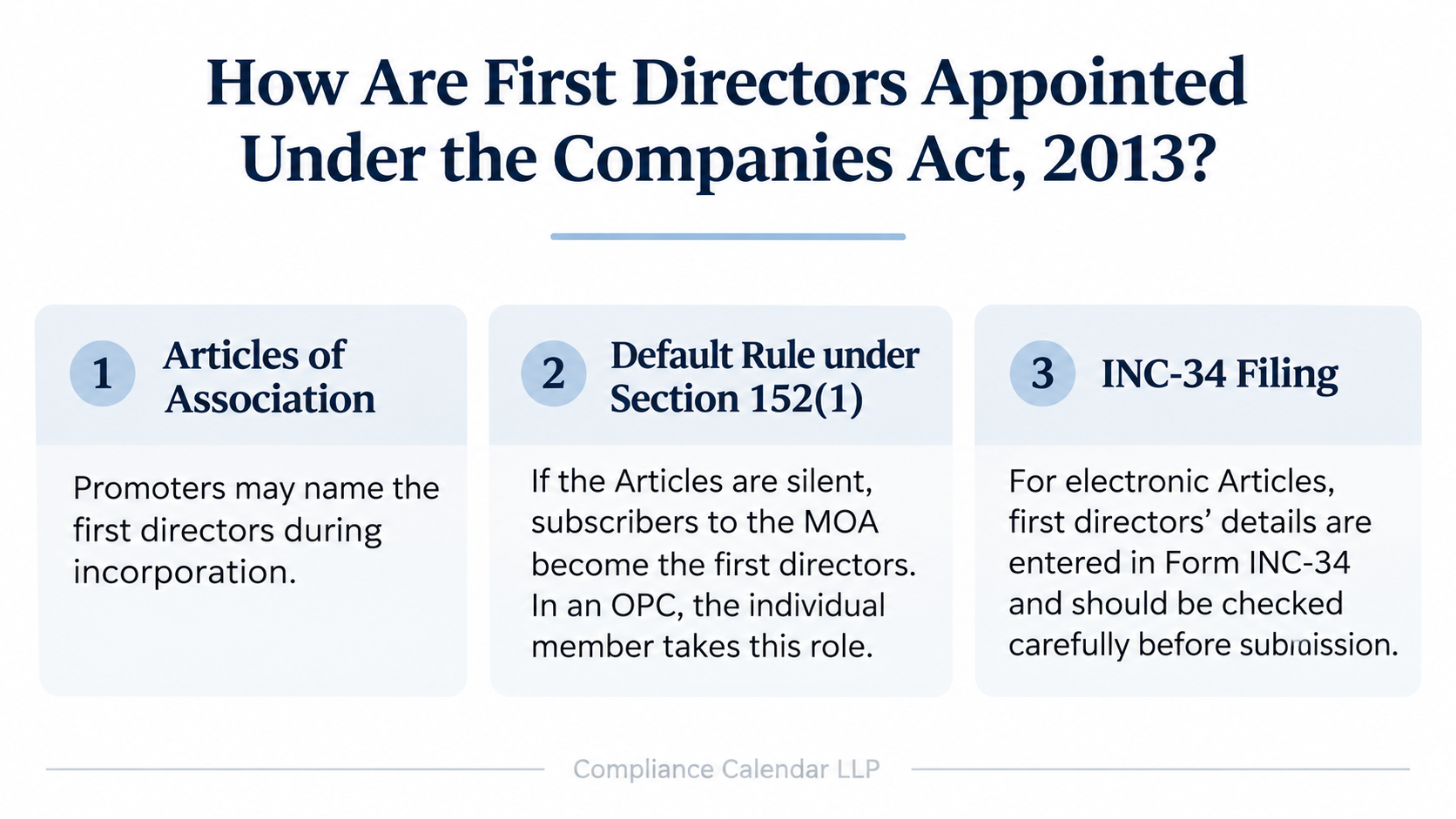
The appointment depends mainly on what is written in the Articles of Association. During incorporation, the promoters can name the proposed first directors in the Articles. Their details are then included in the relevant incorporation documents filed with the MCA.
If the Articles do not name the first directors, the default rule under Section 152(1) applies. In an ordinary company, the individual subscribers to the MOA become the first directors. In an OPC, the individual member takes this position. The company can later appoint or change directors by following the appointment procedure under the Companies Act and its Articles.
For companies using electronic Articles of Association, the first directors' details can be entered in the relevant section of Form INC-34. The promoters should check these details carefully before submitting the incorporation application.
What Is the Minimum Number of First Directors Required?
The minimum number of directors depends on the type of company being incorporated. Section 149(1) of the Companies Act, 2013 sets out the following requirements:
|
Type of Company |
Minimum Number of Directors |
|
Private Limited Company |
2 |
|
3 |
|
|
One Person Company (OPC) |
1 |
A company can generally have a maximum of 15 directors. It can appoint more than 15 directors if its shareholders pass a special resolution.
The company must also check whether any additional Board requirements apply to it. For example, certain prescribed classes of companies must appoint at least one woman director. Listed public companies and certain other prescribed public companies also have to meet independent director requirements. These additional requirements depend on the company's category and applicable rules.
Who Can Become the First Director of a Company?
An individual who meets the requirements of the Companies Act, 2013 can become a first director. The person does not have to be a shareholder or promoter of the company. A company can also appoint an experienced professional or another eligible individual who is not involved in its ownership.
The proposed director must have the required DIN or identification number, must not be disqualified under Section 164 and must provide the required consent to act as a director. The company should also check that at least one director meets the resident director requirement under Section 149(3).
A body corporate cannot itself become a director because the Board must consist of individuals. A foreign national can become a director of an Indian company if the applicable legal requirements are met. The important point is that the person must be legally eligible and properly appointed.
Can a First Director Be a Shareholder or a Non-Shareholder?
Yes. A first director can be a shareholder or a person who does not own any shares in the company. The Companies Act, 2013 does not make share ownership compulsory for an ordinary director.
Consider a company started by two founders who invest money and hold shares. They may appoint a third person with business experience as a director, even if that person does not own any shares. The third person can take part in the company's management after being properly appointed.
The difference is simple: shareholders own the company through their shares, while directors are responsible for managing its affairs. The same individual may be both a shareholder and a director, but the two positions have different rights and responsibilities.
What Is the DIN Requirement for First Directors?
A Director Identification Number (DIN) is a unique number allotted to an individual who intends to become a director of a company. It helps the Ministry of Corporate Affairs identify directors and maintain their appointment records. Under Section 152(3), a person cannot be appointed as a director unless the required DIN or another identification number permitted under the Act has been allotted.
When a new company is incorporated, eligible proposed directors who do not already have a DIN can apply for it through SPICe+ Part B. A person who already has a DIN should use the same number rather than applying for another one. The company should check the DIN and personal details carefully because incorrect information can create problems during incorporation or later MCA filings.
What Documents Are Required for Appointment of First Directors?
The company should collect the identity, address and consent documents of its proposed directors before filing the incorporation application. The exact documents depend on whether the proposed director is an Indian national or a foreign national and on the applicable incorporation requirements.
|
Document |
Why It Is Required |
|
PAN Card |
Identity and tax identification of an Indian applicant |
|
Aadhaar Card, Passport or other accepted identity proof |
Verification of identity |
|
Residential address proof |
Confirmation of the director's address |
|
Photograph |
Identification of the proposed director, where required |
|
DIN details |
Director identification |
|
Consent to act as director |
Written confirmation that the person agrees to become a director |
|
Digital Signature Certificate (DSC) |
Signing the electronic incorporation documents |
The proposed directors must also provide the declarations required under the incorporation rules. Form INC-9 contains declarations by subscribers and first directors, as applicable. Consent to act as a director is governed by Section 152(5) and the relevant rules, including Form DIR-2 where applicable.
If a proposed director is a foreign national, additional documents and certification may be required. These can include a passport, overseas address proof and documents that meet the applicable notarisation, apostille or consular requirements. The company should check the current MCA instructions before preparing the final set of documents.
Steps to Appoint First Directors on the MCA Portal
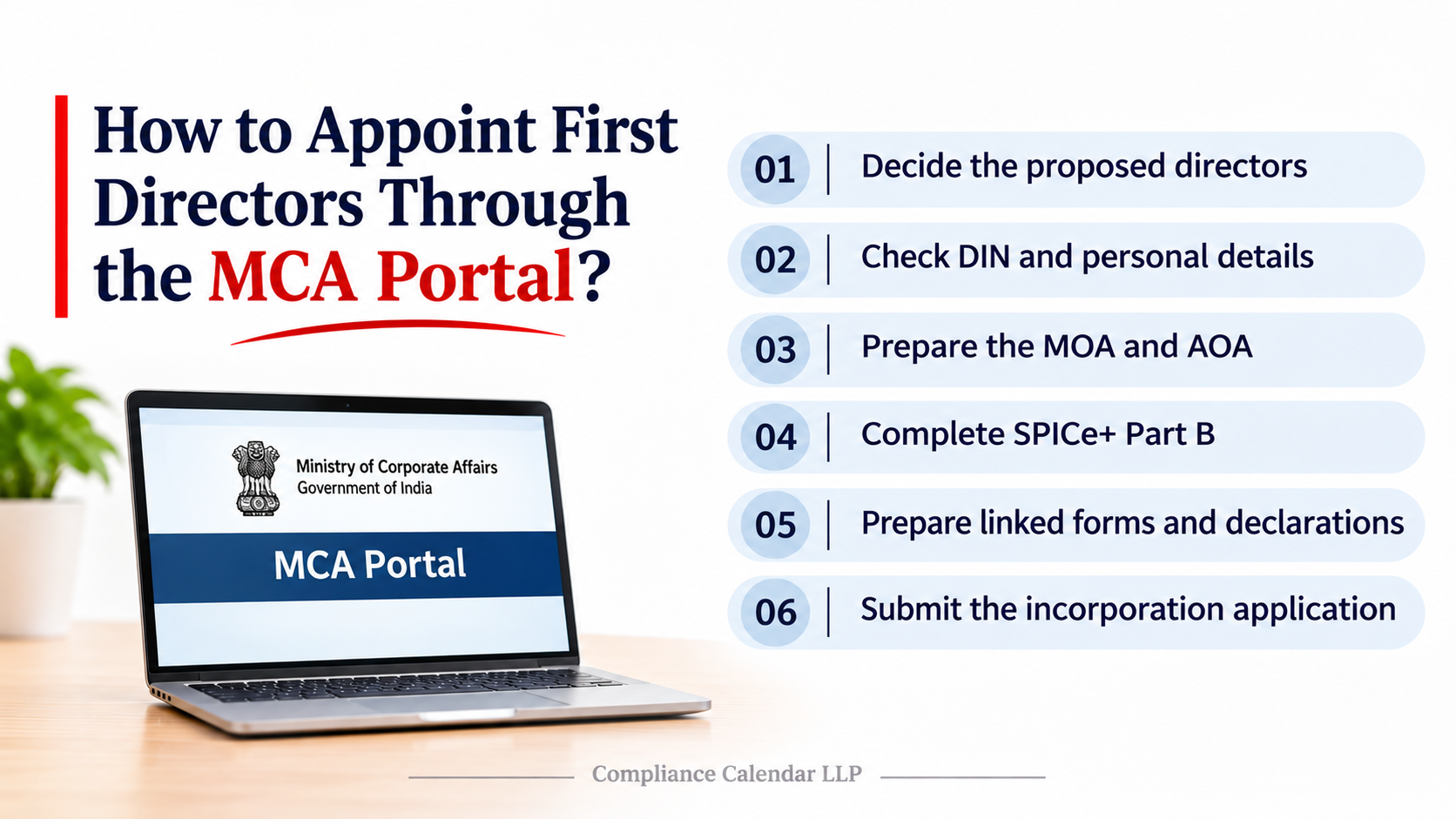
The first directors' details are normally submitted as part of the company incorporation process through the MCA portal. The promoters should decide who will manage the company and collect their documents before starting the application.
Step 1: Decide who will become the first directors
The promoters should select the individuals who will take responsibility for managing the company. The number of proposed directors must meet the minimum requirement for the type of company being registered. For example, a private limited company needs at least two directors, while an OPC needs at least one.
Step 2: Check DIN and personal details
Check whether each proposed director already has a DIN. If someone does not have one, an application for DIN allotment can be made through the applicable SPICe+ process. Collect the PAN, identity proof, residential address and other required details before moving ahead.
Step 3: Prepare the MOA and AOA
The promoters must prepare the Memorandum of Association and Articles of Association. The MOA contains the company's main objectives, while the AOA sets out the rules for its internal management. If the promoters want to name the first directors in the Articles, their details should be entered correctly in the relevant section.
Step 4: Complete SPICe+ Part B
Open the MCA portal and complete SPICe+ Part B with the proposed company's incorporation details. This includes information about the company, subscribers and proposed directors. Eligible proposed directors who do not already have a DIN can also apply for one through this form.
Step 5: Complete the linked forms and declarations
Prepare the linked incorporation forms, including the electronic MOA and AOA, along with the applicable declarations and supporting documents. Check the names, addresses, DINs and other details before signing the forms digitally.
Step 6: Submit the incorporation application
Submit the completed application on the MCA portal and pay the applicable fees and stamp duty. Once the Registrar of Companies approves the application, the company receives its Certificate of Incorporation. The first directors can then carry out their responsibilities in accordance with the Companies Act, 2013.
Is Form DIR-12 Required for Appointment of First Directors?
Form DIR-12 is used to report the appointment, resignation or changes in the designation of directors and key managerial personnel to the Registrar of Companies. However, the initial appointment of first directors is generally reported through the company's incorporation application using SPICe+ and the linked documents.
If the company appoints another director separately after incorporation, it generally needs to file Form DIR-12 within 30 days of the appointment. The required consent and supporting documents must also be provided as applicable. This is why companies should understand the difference between naming first directors during incorporation and appointing an additional director later.
For more details, read our guide on MCA Form DIR-12: Particulars of Appointment of Directors and KMP.
What Are the Duties of First Directors After Incorporation?
After incorporation, the first directors become responsible for managing the company's affairs and ensuring that it follows the Companies Act, 2013. Their work includes taking business decisions, maintaining company records, arranging Board meetings and ensuring that required filings are completed on time. They must also disclose their interests in other companies or entities wherever required.
Section 166 of the Companies Act, 2013 explains the duties of directors. They must act in good faith, use reasonable care and skill, work in the interests of the company and avoid situations where their personal interests conflict with the company's interests.
For a newly incorporated company, the directors should also pay attention to the initial compliance work. This includes opening the company bank account, ensuring that subscribers pay their share subscription money, holding the first Board meeting and filing Form INC-20A where applicable.
You can read our article on Post Incorporation Compliance of Private Limited Companies for more information.
What Happens If a Company Does Not Have the Required Number of Directors?
Every company must maintain the minimum number of directors required under Section 149 of the Companies Act, 2013. If a private limited company has only one director, for example, it does not meet the minimum requirement of two directors. The same applies to a public company that has fewer than three directors.
The company should check its Articles of Association and appoint the required director by following the applicable procedure. It should also complete the necessary MCA filing. Leaving the Board below the required strength can create compliance difficulties and affect the company's ability to carry out certain Board-related activities.
Things to Keep in Mind When Appointing First Directors
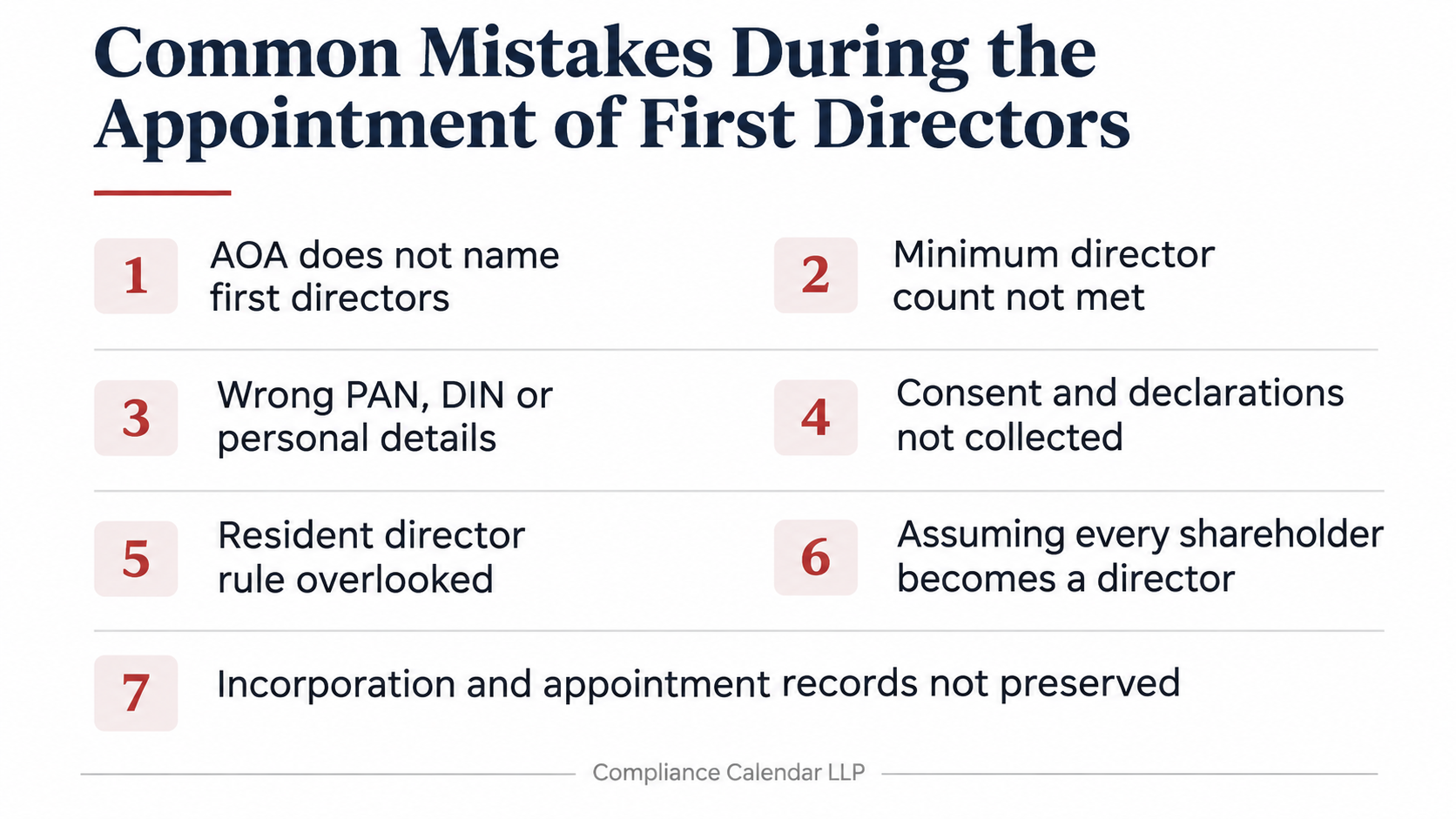
Problems often arise when promoters focus only on completing the company registration and do not check the director-related details properly. The following are some mistakes worth avoiding:
- Not checking whether the Articles of Association name the first directors.
- Failing to meet the minimum number of directors required for the company.
- Entering incorrect PAN, DIN or personal details in the incorporation forms.
- Not obtaining the required consent and declarations from proposed directors.
- Overlooking the resident director requirement.
- Assuming that every shareholder automatically becomes a director.
- Not keeping copies of the incorporation documents and appointment records.
A careful review of the MOA, AOA and director details before submission can prevent many of these problems. The proposed directors should also understand their responsibilities before accepting the position.
How Can Compliance Calendar LLP Help With First Director Appointment?
Appointing first directors requires the promoters to check the Companies Act, 2013, prepare the correct documents and submit accurate information through the MCA portal. Any mistake in the director details or incorporation documents can create difficulties during the registration process or later compliance work.
Compliance Calendar LLP assists businesses with company incorporation, director appointment and related MCA compliance requirements. Our team can help with document preparation, checking director details, organising the required forms and supporting the filing process.
If you are planning to register a private limited company, OPC or public limited company and need help with the appointment of first directors, you can contact our team on +91 9988424211 or info@ccoffice.in
Frequently Asked Questions (FAQs)
1. Who are the first directors of a company?
First directors are the individuals who become the initial members of the company's Board of Directors at the time of incorporation. Their names may be mentioned in the Articles of Association. If the Articles do not provide for their appointment, the individual subscribers to the MOA are treated as first directors under Section 152(1).
2. Which section deals with the appointment of first directors?
Section 152(1) of the Companies Act, 2013 deals with the appointment of first directors. It explains who becomes the first director when the Articles of Association do not contain a provision for their appointment.
3. Is it compulsory to mention first directors in the Articles of Association?
No. If the Articles do not name the first directors, the default rule under Section 152(1) applies. Individual subscribers to the MOA become the first directors, while the individual member takes this position in an OPC.
4. Can a non-shareholder become a first director?
Yes. A person does not need to own shares to become a director. A non-shareholder can become a first director if the appointment follows the Articles of Association and the Companies Act, 2013.
5. What is the minimum number of directors required in a private limited company?
A private limited company must have at least two directors. A public limited company needs at least three, while an OPC needs at least one director.
6. Is DIN compulsory for first directors?
Yes. A person proposed to become a director must have a DIN or another identification number permitted under the Companies Act, 2013. Eligible proposed directors can apply for DIN allotment through the SPICe+ incorporation process.
7. Is Form DIR-2 required for first directors?
A proposed director must provide written consent to act as a director under Section 152(5) and the applicable rules. Form DIR-2 is the prescribed consent format. The company should follow the applicable incorporation and filing instructions for submitting the consent.
8. Is Form DIR-12 required for first directors?
The initial particulars of first directors are generally included in the SPICe+ incorporation application. For a separate appointment after incorporation, Form DIR-12 is generally required within 30 days of the appointment.
9. Can a foreign national become a first director of an Indian company?
Yes. A foreign national can become a director of an Indian company if the person meets the requirements of the Companies Act, 2013 and obtains the required DIN. The company must also ensure that at least one director meets the resident director requirement under Section 149(3).
10. Can first directors be changed after incorporation?
Yes. A company can change its Board after incorporation by following the Companies Act, 2013 and its Articles of Association. The company must complete the required appointment procedure and file Form DIR-12 with the Registrar within the prescribed time.