


Indian companies receiving foreign investment or making investments in overseas entities are required to report their foreign assets and liabilities to the Reserve Bank of India (RBI). The Foreign Liabilities and Assets (FLA) Return is an important annual reporting requirement under the Foreign Exchange Management Act, 1999 (FEMA). It enables the RBI to collect information regarding cross-border investments and the financial position of Indian entities.
Although many companies focus on submitting their FLA Returns before the prescribed deadline, ensuring the accuracy of reported information is equally important. Incorrect foreign shareholding details, inaccurate investment valuations, omission of foreign liabilities or incorrect financial figures may result in regulatory non-compliance.
Wrong disclosures in FLA Returns can expose businesses to penalties under FEMA, regulatory scrutiny and complications during future investment transactions. However, not every genuine reporting error automatically attracts a monetary penalty. Companies should understand the nature of the discrepancy and take appropriate corrective action.
What are Wrong Disclosures in FLA Returns?
Wrong disclosures in FLA Returns refer to incorrect, incomplete, misleading or inaccurate financial and investment information submitted to the RBI through the Foreign Liabilities and Assets Information Reporting (FLAIR) portal. Such discrepancies may arise due to accounting errors, incorrect interpretation of RBI reporting instructions, inadequate documentation or deliberate concealment of foreign investment information. Companies must ensure that their disclosures are consistent with their financial statements, statutory records and applicable FEMA reporting requirements.
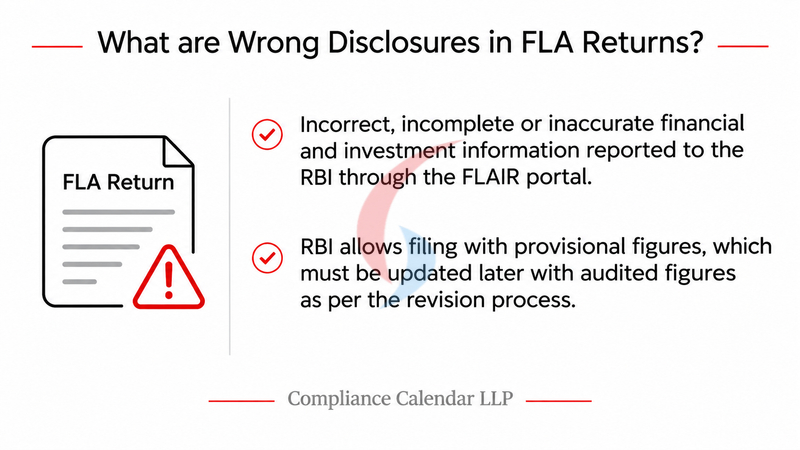
The RBI permits entities to file returns using provisional financial figures where audited accounts are unavailable by the annual filing deadline. However, these figures must subsequently be updated in accordance with the applicable revision procedure.
Indian entities having reportable foreign investments must comply with annual RBI reporting requirements. Understanding FLA Return applicability helps businesses avoid incorrect or incomplete disclosures. Read more about the Applicability of FLA Returns under FEMA Laws in India
Legal Provisions Governing Wrong Disclosures in FLA Returns
Wrong disclosures and reporting defaults are governed by FEMA and relevant regulations, circulars and instructions issued by the RBI. Companies must understand these provisions to determine their compliance obligations and potential regulatory consequences.
| Legal provision | Applicability |
|---|---|
| Foreign Exchange Management Act, 1999 | Governs foreign exchange transactions and reporting obligations. |
| Section 13 of FEMA, 1999 | Prescribes penalties for contraventions. |
| Section 15 of FEMA, 1999 | Provides for compounding of eligible contraventions. |
| Section 42 of FEMA, 1999 | Governs liability for contraventions by companies. |
| FEMA Reporting Regulations, 2019 | Prescribes relevant foreign investment reporting obligations. |
| RBI Circular dated 28 June 2019 | Introduced online FLA reporting through the FLAIR portal. |
| RBI Circular dated 30 September 2022 | Prescribes Late Submission Fees for eligible reporting delays. |
| Foreign Exchange (Compounding Proceedings) Rules, 2024 | Governs compounding of eligible FEMA contraventions. |
| RBI FLA FAQs | Provides guidance on filing, reporting and revision of returns. |
Companies can refer to the Foreign Exchange Management Act, 1999 and the official RBI FLA FAQs for detailed regulatory provisions.
Indian companies involved in cross-border transactions must remain updated with applicable foreign exchange regulations. Understanding regulatory amendments helps businesses identify reporting obligations and avoid compliance violations. Read more about FEMA Compliance 2026: Latest Rules & Updates
Common Types of Wrong Disclosures in FLA Returns
Incorrect disclosures may arise at different stages of return preparation. Companies should carefully review their financial and investment records before submitting information to the RBI.
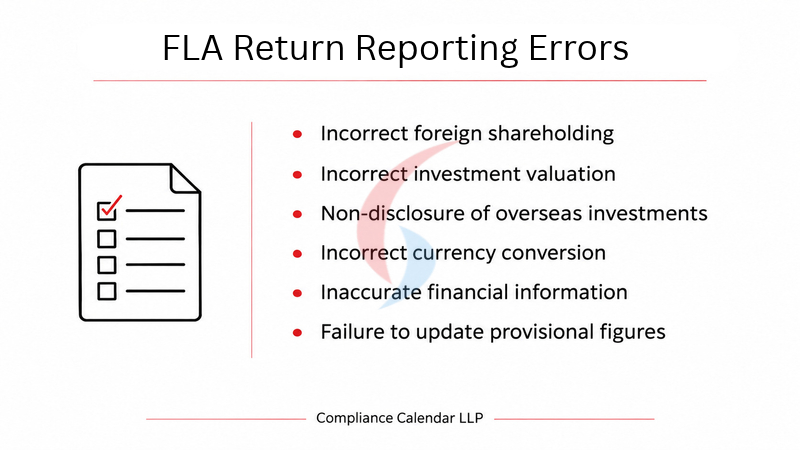
| Type of Incorrect Disclosure | Description |
|---|---|
| Incorrect Foreign Shareholding Details | Incorrect reporting of the number of shares, foreign ownership percentages or investor details. |
| Incorrect Valuation of Foreign Investments | Incorrect calculation of equity capital, reserves, investment values or net worth against RBI reporting requirements. |
| Non-Disclosure of Overseas Investments | Failure to disclose investments or outstanding balances relating to overseas subsidiaries or joint ventures. |
| Incorrect Foreign Currency Conversion | Applying incorrect exchange rates or currency conversion methods for the relevant reporting period. |
| Incorrect Financial Information | Reporting inaccurate share capital, reserves, accumulated losses, profits or liabilities. |
| Failure to Update Provisional Financial Figures | Failure to replace unaudited financial figures with audited figures after completion of the statutory audit. |
| Deliberate Concealment of Foreign Investments | Intentionally withholding reportable foreign investment information, which may attract regulatory investigation and proceedings under FEMA. |
Companies having accumulated losses or negative net worth must carefully disclose their financial position in FLA Returns. Incorrect calculation of financial figures may result in inaccurate foreign investment reporting. Refer to FLA Return for Companies with Negative Net Worth for further guidance.
Penalty for Wrong Disclosures in FLA Returns under FEMA
There is no separate fixed penalty prescribed specifically for every incorrect disclosure in an FLA Return. Where inaccurate reporting constitutes a FEMA contravention, penalties may be imposed under Section 13 of FEMA, 1999, following adjudication. The applicable penalty depends on the nature of the contravention, the amount involved and whether the non-compliance is continuing.
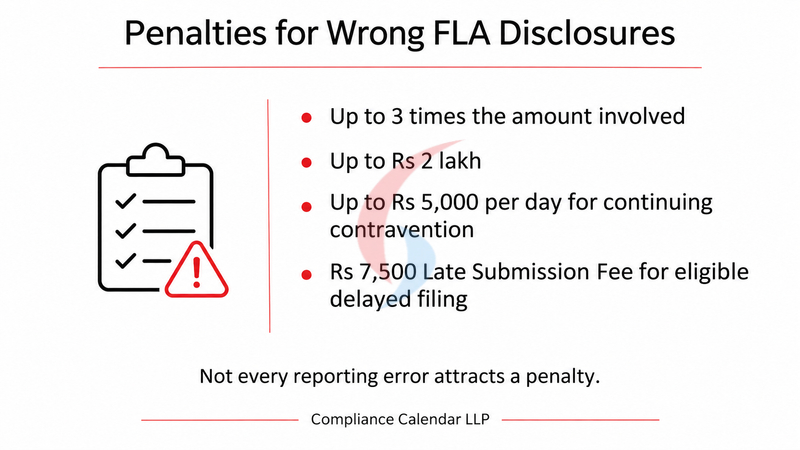
| Nature of contravention | Applicable penalty |
|---|---|
| Contravention involving a quantifiable amount | Up to three times the amount involved |
| Contravention involving a non-quantifiable amount | Up to Rs 2 lakh |
| Continuing contravention | Additional penalty of up to Rs 5,000 per day after the first day |
| Eligible delayed FLA Return filing | Late Submission Fee of Rs 7,500 per return |
| Deliberate concealment of information | Regulatory proceedings under applicable FEMA provisions |
The penalties prescribed under Section 13 represent statutory maximum limits and are not automatically imposed for every reporting discrepancy. The competent authority determines the applicable penalty based on the facts and circumstances of the case.
Companies receiving foreign investment must comply with transaction-based and annual reporting requirements. Incorrect or delayed reporting may expose businesses to regulatory consequences under FEMA. Learn more about FC-GPR and FLA Return: Filing Rules and Penalties
Difference Between Wrong Disclosure and Delayed FLA Return Filing
Many businesses assume that paying a Late Submission Fee can resolve all FLA reporting violations. However, incorrect disclosures and delayed submissions are different types of compliance issues and may require different corrective measures.
| Particulars | Wrong disclosure | Delayed filing |
|---|---|---|
| Meaning | Incorrect or incomplete information | Failure to file within the prescribed deadline |
| Nature of default | Reporting inaccuracy | Reporting delay |
| Applicable charges | Depends on the nature of contravention | Rs 7,500 LSF for eligible delays |
| Corrective action | Revision and regulatory regularisation, if required | Submission of overdue return and applicable LSF |
| FEMA compounding | May be required | May be required where LSF is unavailable |
| RBI approval | Required for revision | Required for filing previous years' returns |
The RBI's circular dated 30 September 2022 provides the Late Submission Fee facility for eligible reporting delays within three years of the prescribed reporting deadline. This facility does not automatically regularise substantive FEMA violations or misleading disclosures.
Maintaining a reporting checklist helps companies complete their annual FLA compliance within the prescribed timeline. Timely preparation of financial documents can also minimise reporting errors. Read more about FLA Return Filing and Due Dates with the Checklist
Storytelling: How an Incorrect FLA Disclosure Created Problems During Fundraising
Consider an illustrative example of Aarav Technologies Private Limited, a growing software company based in Pune. The company received Rs 4 crore from a foreign investor to expand its operations and develop new technology solutions.
While preparing its annual FLA Return, the accounts team mistakenly reported foreign investment of Rs 40 lakh instead of Rs 4 crore. The return was submitted before the deadline, and the management assumed that all FEMA compliance requirements had been completed.
Several months later, the company started preparing for another funding round. During the investor's legal and financial due diligence, the discrepancies between the FLA Return, audited financial statements and Form FC-GPR were identified.
The management approached a FEMA compliance professional to examine the matter. After reviewing the relevant documents, the company requested RBI approval to revise its FLA Return and submitted corrected investment information. The professionals also assessed whether any additional regulatory regularisation was necessary.
This example demonstrates how a simple data entry error can create complications during fundraising. Timely filing alone does not ensure complete compliance unless the information reported is accurate.
Consequences of Wrong Disclosures in FLA Returns
Incorrect reporting may affect a company beyond monetary penalties. Businesses with foreign investments should understand the broader commercial and regulatory consequences of inaccurate disclosures.
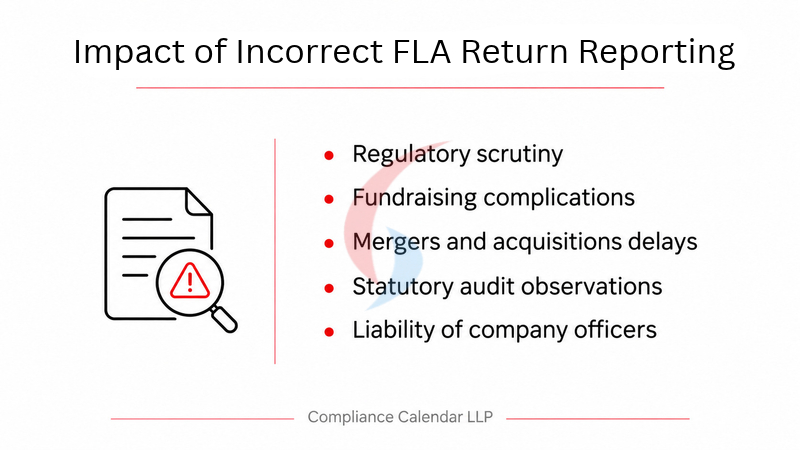
1. Regulatory Scrutiny
Material discrepancies may result in queries from regulatory authorities seeking explanations and supporting documents. Companies may need to provide detailed financial records to establish the correctness of their foreign investment transactions.
2. Complications During Fundraising
Foreign investors generally conduct financial and legal due diligence before investing in Indian companies. Incorrect FLA disclosures may raise concerns regarding the company's compliance practices and delay investment decisions.
3. Difficulties During Mergers and Acquisitions
Potential buyers examine historical FEMA filings during acquisitions and restructuring transactions. Unresolved reporting discrepancies may affect transaction timelines and require corrective action before completion.
4. Statutory Audit Observations
Auditors may identify inconsistencies between financial statements and foreign investment reporting records. Such discrepancies may require further investigation and appropriate reporting, depending on their materiality.
5. Liability of Company Officers
Under Section 42 of FEMA, persons responsible for conducting the company's business may also face liability for contraventions, subject to statutory conditions and available defences. Management should therefore establish appropriate internal compliance controls.
A detailed FEMA compliance review can help companies identify historical foreign investment reporting discrepancies. Regular verification of financial records also reduces complications during fundraising and business acquisitions. Explore FEMA Due Diligence: Process, Checklist & Compliance
Documents Required to Correct Wrong Disclosures in FLA Returns
Companies should collect relevant financial and regulatory documents before initiating the correction process. These documents help establish the reason for incorrect reporting and support the revised information.
-
Previously submitted FLA Return and acknowledgement.
-
Audited balance sheet and profit and loss account.
-
Latest shareholding pattern and statutory registers.
-
Form FC-GPR and FC-TRS records.
-
Overseas investment documents.
-
Foreign inward remittance records.
-
Investment valuation calculations.
-
Overseas subsidiary financial statements, wherever applicable.
-
Reconciliation statement explaining the discrepancies.
-
Supporting correspondence with RBI, if any.
Procedure to Correct Wrong Disclosures in FLA Returns
Companies identifying inaccurate information in their previously submitted FLA Returns should initiate corrective action without unnecessary delay. The following procedure helps businesses address reporting discrepancies systematically.
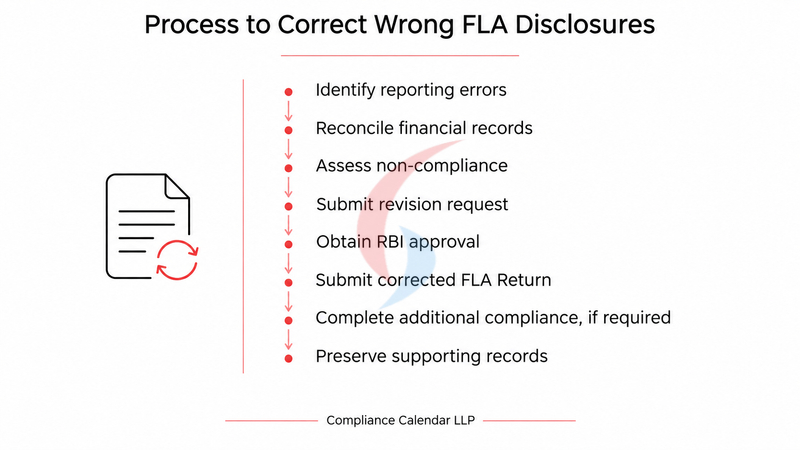
Step 1: Identify the Reporting Error
Review the previously submitted FLA Return and identify incorrect or incomplete information. Determine whether the discrepancy relates to financial figures, foreign investment, shareholding or valuation.
Step 2: Reconcile Financial and Investment Records
Compare the reported information with audited financial statements, statutory registers and relevant FEMA filings. Prepare a reconciliation statement explaining the differences and reasons for incorrect disclosure.
Step 3: Assess the Nature of Non-Compliance
Examine whether the discrepancy is a routine reporting error or involves a substantive FEMA contravention. Determine whether revision alone is sufficient or additional regulatory regularisation may be necessary.
Step 4: Submit a Revision Request to RBI
Log in to the RBI FLAIR portal and navigate to the Multiple Year CIN Enable Screen under the Menu section. Select the relevant financial year and submit the request for revision approval.
Step 5: Obtain RBI Approval
Monitor the request and obtain RBI permission before modifying the submitted return. If technical difficulties arise while raising the request, contact the RBI FLA team at flareturn@rbi.org.in.
Step 6: Submit the Corrected FLA Return
Update the relevant financial and foreign investment information after receiving RBI approval. Validate the revised details against supporting documents before submitting the corrected return.
Step 7: Complete Additional Regulatory Compliance
Where the error involves an actual FEMA contravention, examine the applicability of compounding or other regulatory measures. Coordinate with the relevant authorities to complete any additional compliance requirements.
Step 8: Maintain Supporting Records
Download the revised return and submission acknowledgement from the FLAIR portal. Preserve reconciliation statements, approval records and supporting documents for future audits and regulatory verification.
Companies must understand the online FLA reporting procedure to avoid incorrect financial disclosures. Proper verification of information before submission helps reduce unnecessary revision requests. Refer to FLA Return Filing Online 2026: RBI FLAIR Guide
Compounding of FEMA Contraventions for Wrong FLA Disclosures
Compounding is a statutory mechanism through which eligible FEMA contraventions can be resolved by paying an amount determined by the competent authority. Section 15 of FEMA provides the legal basis for this mechanism. The Foreign Exchange (Compounding Proceedings) Rules, 2024 and RBI Master Directions on Compounding of Contraventions under FEMA, updated on 23 October 2026, prescribe the applicable requirements. Companies must examine the eligibility of their contravention before submitting a compounding application. However, compounding is not mandatory for every incorrect FLA disclosure. Genuine reporting errors may be addressed through revision, while substantive violations may require additional regulatory proceedings.
Eligible FEMA contraventions may be regularised through the prescribed compounding procedure. Companies must understand the applicable legal provisions before submitting a compounding application. Read more about FEMA Compounding Rules 2024: Key Amendments
How to Avoid Penalties for Wrong Disclosures in FLA Returns?
Companies can reduce the possibility of reporting errors by establishing appropriate internal review procedures. Regular reconciliation of financial and foreign investment records helps identify discrepancies before submitting annual returns.
| Preventive measure | Importance |
|---|---|
| Verify foreign shareholding | Prevents incorrect ownership disclosures |
| Reconcile financial statements | Ensures accuracy of financial information |
| Review FC-GPR and FC-TRS filings | Maintains consistency in foreign investment records |
| Verify overseas investments | Prevents omission of foreign assets |
| Apply correct exchange rates | Ensures accurate investment valuation |
| Revise provisional returns | Updates reporting with audited information |
| Conduct FEMA due diligence | Identifies historical compliance discrepancies |
| Maintain submission records | Supports future audits and regulatory reviews |
Businesses should also assign responsibility for reviewing FLA Returns to qualified personnel and ensure that financial information is independently verified before submission.
Why Choose Compliance Calendar LLP?
Compliance Calendar LLP provides professional assistance to businesses in identifying and correcting wrong disclosures in FLA Returns. Our professionals assist with FLA Return revision, RBI approval, financial data reconciliation, historical FEMA compliance reviews and correction of foreign investment reporting discrepancies. We also help companies understand applicable penalties, Late Submission Fees and regulatory requirements.
From identifying reporting errors to submitting revised FLA Returns, Compliance Calendar LLP provides end-to-end compliance support. Our team also assists with FEMA due diligence, compounding of eligible contraventions and ongoing RBI reporting obligations, helping businesses minimise regulatory risks and maintain accurate financial disclosures.
For professional assistance, contact +91 9988424211 or email info@ccoffice.in
Frequently Asked Questions (FAQs)
Q1. What is the penalty for wrong disclosures in FLA Returns?
Ans. Under Section 13 of FEMA, penalties may extend to three times the quantifiable amount involved or Rs 2 lakh for non-quantifiable contraventions. The actual penalty depends on the nature of the violation and adjudication.
Q2. Can an incorrect FLA Return be revised?
Ans. Yes, companies can revise previously submitted FLA Returns after obtaining RBI approval. The corrected information must be submitted through the FLAIR portal.
Q3. Does every incorrect FLA disclosure attract a penalty?
Ans. No, genuine reporting errors do not automatically attract monetary penalties. The nature, seriousness and circumstances of the discrepancy determine the applicable regulatory consequences.
Q4. What is the Late Submission Fee for FLA Returns?
Ans. The prescribed Late Submission Fee is Rs 7,500 per return for eligible reporting delays. This fee does not automatically regularise incorrect disclosures or substantive FEMA violations.
Q5. Is RBI approval mandatory for correcting FLA Returns?
Ans. Yes, prior RBI permission is required to modify previously submitted FLA Returns. Companies can raise a revision request through the FLAIR portal.
Q6. Can directors be held responsible for incorrect FLA disclosures?
Ans. Directors and responsible company officers may face liability under Section 42 of FEMA, subject to applicable statutory conditions. Liability depends on their involvement, responsibilities and available legal defences.
Q7. Can FLA Returns for previous years be corrected?
Ans. Yes, companies can revise FLA Returns for previous financial years after obtaining RBI approval. Supporting financial records should be reviewed before submitting revised information.
Q8. Is FEMA compounding mandatory for incorrect FLA Returns?
Ans. No, compounding is not mandatory for every reporting error. It may be required where the incorrect disclosure constitutes an eligible FEMA contravention requiring regularisation.
Q9. Can incorrect FLA disclosures affect foreign investment?
Ans. Yes, unresolved reporting discrepancies may create concerns during investor due diligence and delay fundraising transactions. Accurate FEMA reporting helps businesses maintain investor confidence.
Q10. How can companies avoid penalties for incorrect FLA Returns?
Ans. Companies should reconcile financial statements, verify foreign investment records and review all disclosures before submission. Timely revision and professional FEMA compliance assistance can help reduce regulatory risks.
Article last updated on : 24 Nov 2026.