


Imagine a Bengaluru-based startup that receives Rs 5 crore from a foreign investor. The investment is properly credited to its bank account, shares are allotted, and the founders begin expanding their business. Several months later, while preparing documents for another funding round, the Company Secretary discovers that an important RBI reporting requirement was not completed within the prescribed timeline.
The investment itself may have been permitted, but the reporting failure creates a Foreign Exchange Management Act (FEMA) compliance issue. The founders now want to know whether the delay can be regularised, whether a penalty will apply and whether the company can proceed with its next funding round.
This is where the FEMA Compounding Rules 2024 become important. Compounding provides a statutory mechanism through which eligible foreign exchange contraventions can be resolved by voluntarily admitting the violation and paying the amount determined by the competent authority.
What Is FEMA Compounding Under the Foreign Exchange Management Act, 1999?
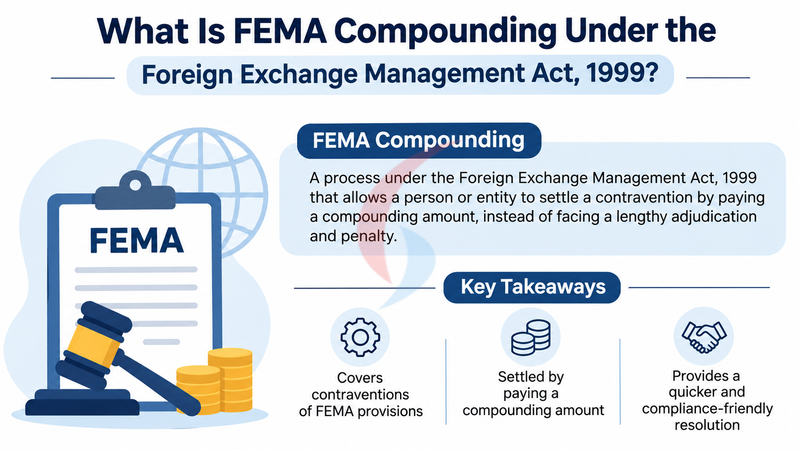
FEMA Compounding is a legal process that allows a person or company to voluntarily admit an eligible contravention of the Foreign Exchange Management Act, 1999, and seek its resolution before the competent authority.
Under Section 15 of FEMA, 1999, specified contraventions covered by Section 13 may be compounded in accordance with the prescribed rules. Compounding provides an alternative to undergoing ordinary adjudication for the same eligible violation, subject to fulfilment of the statutory conditions.
For example, suppose an Indian company receives foreign investment but fails to submit a prescribed RBI return within the applicable deadline. Depending on the nature of the default, the company may be eligible to regularise it through the Late Submission Fee (LSF) mechanism or apply for compounding.
However, every delay does not automatically require a compounding application. The company should first identify the applicable regulation, reporting requirement and available regularisation procedure.
Businesses can refer to Compounding Procedures for Form FC-GPR Violations under FEMA for additional information about foreign investment reporting defaults.
Legal Framework Governing FEMA Compounding in India
The FEMA Compounding Rules, 2024, issued under the Foreign Exchange Management Act, 1999, provide the legal framework for resolving eligible foreign exchange contraventions. Section 13 deals with penalties, Section 15 permits compounding, while Section 16 governs adjudication proceedings. Section 37A contains special provisions relating to specified foreign assets.
Under the FEMA Compounding Rules, 2024, Rules 3 to 5 define the powers of compounding authorities, Rules 6 to 8 cover procedural requirements, and Rules 9 and 10 address excluded contraventions and payment obligations.
The RBI Master Direction, updated in October 2026, provides further guidance on application procedures, compounding amounts and jurisdiction. Companies can refer to the Ministry of Finance Notification, 2024 and the RBI Master Direction on Compounding for official requirements.
Key Amendments Introduced Under FEMA Compounding Rules 2024
The FEMA Compounding Rules, 2024 introduced important changes to simplify compounding procedures, revise monetary limits, enable electronic payments and clarify eligibility requirements.
|
Key Amendment |
Relevant Rule |
Major Changes |
|---|---|---|
|
Replacement of 2000 Rules |
FEMA Compounding Rules, 2024 |
Replaced the earlier 2000 Rules with revised procedures, authorities and eligibility conditions, subject to saving provisions. |
|
Revised Monetary Limits |
Rule 4 |
Increased the monetary limits determining the minimum rank of RBI compounding officers. |
|
Electronic Payment and Filing |
Rule 4 and RBI Directions |
Permits application fee payments through DD, NEFT and approved electronic modes. Applications may also be submitted through RBI PRAVAAH. |
|
Repeated Contraventions |
Rules 4(2) and 5(2) |
Similar contraventions committed within three years of an earlier compounding are not eligible for compounding under these provisions. |
|
Non-Compoundable Contraventions |
Rule 9 |
Excludes specified cases involving unquantifiable amounts, Section 37A, serious violations and certain adjudicated matters. |
Revised Monetary Limits for RBI Compounding Authorities
|
Amount Involved in Contravention |
Minimum RBI Officer Rank |
|---|---|
|
Up to Rs 60 lakh |
Assistant General Manager |
|
Above Rs 60 lakh to Rs 2.5 crore |
Deputy General Manager |
|
Above Rs 2.5 crore to Rs 5 crore |
General Manager |
|
Above Rs 5 crore |
Chief General Manager |
Important Note: These monetary limits determine the minimum rank of the RBI officer authorised to compound a contravention, not the compounding amount payable. The Directorate of Enforcement has separate authority thresholds.
Which FEMA Contraventions Can Be Compounded?
Eligible contraventions may arise from foreign investment, overseas investment, external commercial borrowing, authorised transactions and other activities regulated under FEMA.
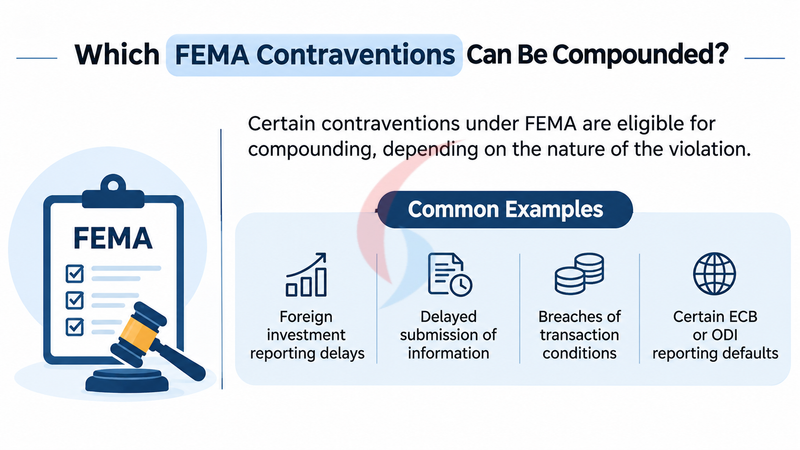
Common examples include non-compliance with foreign investment reporting requirements, delayed submission of prescribed information and certain breaches of transaction conditions.
However, eligibility must be examined individually. Some reporting delays may be addressed through the applicable LSF mechanism without proceeding directly to compounding.
|
Nature of Contravention |
Possible Treatment |
|
Delayed FC-GPR reporting |
LSF or compounding, as applicable |
|
Delayed FC-TRS reporting |
Applicable regularisation procedure |
|
Certain ODI reporting defaults |
LSF or compounding, depending on the violation |
|
Non-compliance with FDI pricing rules |
Corrective action and possible compounding |
|
Certain ECB-related contraventions |
Compounding subject to eligibility |
|
Unauthorised or restricted transactions |
Requires separate legal examination; may be ineligible |
The existence of a foreign exchange violation does not itself establish that RBI will accept a compounding application. The company must first examine the relevant statutory provisions and complete any necessary corrective actions.
Non-Compoundable Contraventions Under FEMA Compounding Rules 2024
Under Rule 9 of the FEMA Compounding Rules, 2024, certain contraventions cannot be compounded. These include cases where the amount involved cannot be quantified, matters covered under Section 37A of FEMA, and suspected violations involving money laundering, terror financing or threats to national sovereignty and integrity.
Compounding is also unavailable where an Adjudicating Authority has already imposed a penalty under Section 13 of FEMA, or where further investigation by the Directorate of Enforcement is required to determine the contravention amount. Additionally, Rules 4(2) and 5(2) restrict compounding of similar contraventions committed within three years of an earlier compounding.
However, Section 3(a) contraventions are not universally non-compoundable. Although RBI cannot compound them under Rule 4, designated officers of the Directorate of Enforcement may compound eligible cases under Rule 5, subject to applicable conditions.
FEMA Compounding Application Fees and Charges
Under Rule 4(4), an application submitted to RBI must be accompanied by the prescribed application fee of Rs 10,000 plus applicable GST.
At the GST rate of 18% stated in RBI's published guidance, the total application fee is Rs 11,800.
This fee is different from the amount that may subsequently be imposed under the compounding order.
|
Particulars |
Amount / Requirement |
|
Application Fee |
Rs 10,000 |
|
GST at 18% |
Rs 1,800 |
|
Total Application Fee |
Rs 11,800 |
|
Compounding Amount |
Determined by the competent authority |
|
Payment of Compounding Amount |
Within 15 days from the compounding order |
The applicant may pay the prescribed fee through the permitted payment modes. Where electronic payment is made to RBI, the applicable directions require prompt payment intimation and submission of the relevant payment details.
The application fee is generally not refunded if the application is returned. However, the RBI directions provide that a fresh fee need not be paid when such an application is resubmitted.
Step-by-Step FEMA Compounding Procedure in India
The FEMA compounding procedure involves identifying the contravention, checking eligibility, submitting an application to RBI and paying the prescribed compounding amount.
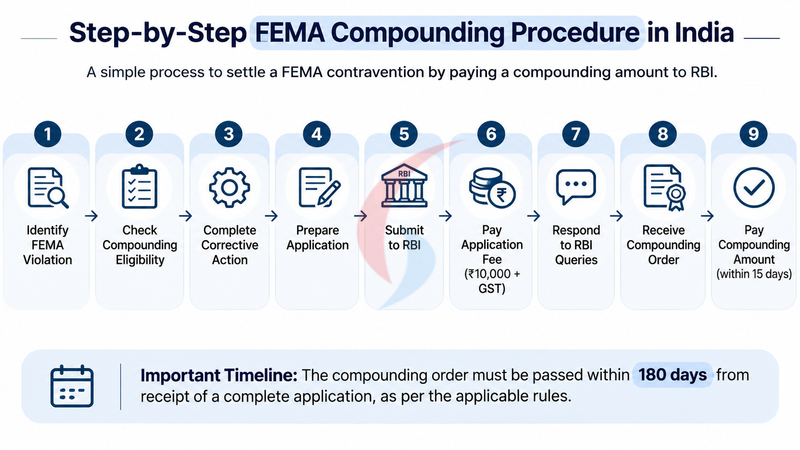
|
Step |
Procedure |
Key Requirements |
|---|---|---|
|
Step 1 |
Identify FEMA Violation |
Determine the contravened FEMA provision through internal review, AD Bank or RBI communication. |
|
Step 2 |
Check Compounding Eligibility |
Verify whether the violation is compoundable or eligible for the Late Submission Fee (LSF) mechanism. |
|
Step 3 |
Complete Corrective Action |
Complete pending reporting, approvals and other necessary administrative requirements. |
|
Step 4 |
Prepare Application |
Submit the prescribed form with transaction details, explanations and supporting documents. |
|
Step 5 |
Submit to RBI |
File physically or through the RBI PRAVAAH Portal with the appropriate authority. |
|
Step 6 |
Pay Application Fee |
Pay Rs 10,000 plus applicable GST through an approved payment mode. |
|
Step 7 |
Respond to RBI Queries |
Provide clarifications and documents. Applicants may opt out of the personal hearing. |
|
Step 8 |
Receive Compounding Order |
The competent authority issues an order specifying the contravention and amount payable. |
|
Step 9 |
Pay Compounding Amount |
Pay within 15 days of the order. RBI issues the compliance certificate after payment realisation. |
Important Timeline: The competent authority must pass the compounding order within 180 days from receipt of a complete application, as prescribed under the applicable rules.
Documents Required for FEMA Compounding
The supporting documents depend on the nature of the transaction. For example, an FDI reporting matter may require different evidence from an ODI or External Commercial Borrowing contravention.
|
Document |
Purpose |
|
Prescribed Compounding Application |
Details of applicant and contravention |
|
Company Incorporation Documents |
Establish legal identity |
|
FDI / ODI / ECB Records |
Verify the underlying transaction |
|
RBI Reporting Acknowledgements |
Establish reporting history |
|
AD Bank Documents |
Support inward or outward remittance details |
|
Valuation and Allotment Records |
Verify transaction compliance |
|
Directorate of Enforcement Undertaking |
Disclose the relevant investigation status |
|
Application Fee Proof |
Establish payment of prescribed fee |
RBI's Master Direction also prescribes applicable annexures for different transaction categories. Applicants should use the current formats instead of relying on older templates.
Latest RBI Amendments to FEMA Compounding Rules Applicable in 2026
The FEMA Compounding Rules, 2024 remain the statutory foundation, while RBI's updated directions in 2025 and 2026 introduced important changes to application procedures and the jurisdiction of Regional Offices.
|
RBI Update |
Key Changes |
Practical Impact |
|---|---|---|
|
RBI Master Direction, April 22, 2025 |
Consolidated compounding procedures, eligibility conditions, payment requirements and computation guidance. |
Provides clearer instructions for filing FEMA compounding applications. |
|
Regional Office Delegation, October 23, 2026 |
Delegated certain overseas investment, borrowing, lending and guarantee-related contraventions to designated RBI Regional Offices. |
Applicants must identify the correct RBI office before filing. |
|
Overseas Investment Cases |
Jurisdiction depends on the Unique Identification Number (UIN) allotted to the foreign entity. |
Determines the relevant Regional Office for eligible ODI contraventions. |
|
Borrowing, Lending and Guarantee Cases |
Jurisdiction generally depends on the applicant's registered office or domicile, subject to RBI directions. |
Simplifies identification of the appropriate compounding authority. |
|
Multiple or Undelegated Contraventions |
Cases involving different jurisdictions or undelegated matters may require submission to CEFA, RBI Central Office, Mumbai. |
Helps ensure applications reach the competent authority. |
Important Note: Companies should verify the applicable RBI jurisdiction and complete the necessary documentation before submitting a compounding application.
How Is the FEMA Compounding Amount Calculated?
RBI's Master Direction provides a computation matrix for determining compounding amounts based on the nature, amount and duration of the FEMA contravention.
|
Factors |
Basis of Calculation |
|---|---|
|
Nature of Contravention |
Different calculation methods apply to reporting delays, delayed allotment, guarantee-related defaults and other violations. |
|
Fixed Component |
Certain reporting violations attract a fixed component under RBI's computation matrix. |
|
Variable Component |
May depend on the transaction amount and duration of non-compliance. |
|
Duration of Default |
Longer delays may result in higher compounding amounts. |
|
Compliance History |
Previous violations and repeated defaults may influence eligibility and assessment. |
|
Other Relevant Factors |
Disclosure of facts, economic benefit obtained and circumstances of the contravention may be considered. |
|
Final Compounding Amount |
Determined by the competent authority in accordance with applicable RBI directions. |
Important Note: The transaction amount alone does not determine the final compounding amount. RBI considers the applicable computation method and relevant circumstances.
How Compliance Calendar LLP Can Help with FEMA Compounding
FEMA compounding requires a careful understanding of foreign exchange regulations, reporting obligations, RBI procedures and the facts of the underlying transaction.
Compliance Calendar LLP provides professional assistance relating to FEMA advisory, RBI reporting, FDI and ODI compliance, and regulatory documentation.
Businesses can seek help in identifying relevant FEMA provisions, reviewing reporting defaults, collecting supporting records and understanding the appropriate regularisation procedure.
For further information, contact Compliance Calendar LLP at 9988424211 or email info@ccoffice.in
Frequently Asked Questions (FAQ’S)
Q1. What are the FEMA Compounding Rules 2024?
Ans. The Foreign Exchange (Compounding Proceedings) Rules, 2024 prescribe the procedure for compounding eligible contraventions under FEMA, 1999. They were notified on September 12, 2024, replacing the earlier 2000 Rules.
Q2. What is the legal provision for FEMA compounding?
Ans. Section 15 of FEMA, 1999 permits eligible contraventions under Section 13 to be compounded in accordance with the prescribed rules. The relevant authority depends on the nature of the violation.
Q3. What is the FEMA compounding application fee?
Ans. The prescribed application fee is Rs 10,000 plus applicable GST. At 18% GST, the total is Rs 11,800. This amount is separate from the compounding amount determined by the competent authority.
Q4. Can delayed FC-GPR reporting be compounded?
Ans. Eligible FC-GPR reporting contraventions may be addressed through the applicable regularisation mechanism. Companies should first determine whether the delay qualifies for LSF or requires compounding.
Q5. Which FEMA contraventions cannot be compounded?
Ans. Rule 9 excludes specified cases involving unquantifiable amounts, Section 37A, serious suspected violations, existing adjudication penalties and matters requiring further Enforcement Directorate investigation.
Q6. Can Section 3(a) FEMA contraventions be compounded?
Ans. They cannot be compounded by RBI under Rule 4. However, Rule 5 provides a separate mechanism through authorised Directorate of Enforcement officers, subject to the applicable conditions.
Q7. How long does FEMA compounding take?
Ans. The competent authority is required to pass the compounding order within 180 days from receipt of an application complete in all respects, subject to the applicable procedural requirements.
Q8. Is a personal hearing compulsory for FEMA compounding?
Ans. An opportunity for personal hearing is available, but RBI permits applicants to opt out. The matter may then be decided on the basis of the documents and submissions available.
Q9. What happens if the compounding amount is not paid?
Ans. The applicant must pay the compounding amount within 15 days of the order. Failure to pay can result in the matter being treated as not compounded, with further action under FEMA.
Q10. What is the latest RBI update on FEMA compounding in 2026?
Ans. On October 23, 2026, RBI delegated the compounding of certain overseas investment, borrowing, lending and guarantee-related contraventions to designated Regional Offices, changing where affected applications should be submitted.
Article last updated on : 23 Nov 2026.


































































_learn_crop10_thumb.jpg)