


Employee Stock Option Plans (ESOPs) have become an important part of employee compensation in Indian startups and growing companies. Instead of offering only salaries and bonuses, businesses use ESOPs to reward employees who contribute to their long-term success. For employees, ESOPs create an opportunity to become shareholders and benefit from the increasing value of the company. However, owning shares in a private company does not always mean that employees can easily convert them into cash.
This is where ESOP Buyback in India becomes important. An ESOP buyback allows a company to purchase eligible shares or securities associated with its employee stock option scheme, subject to applicable legal requirements. It can provide employees with liquidity without requiring the company to list its shares on a stock exchange or undergo an acquisition. However, the process involves company law restrictions, valuation requirements, shareholder approvals and tax implications that must be understood before proceeding.
For startups planning an employee liquidity programme, proper ESOP Scheme Compliance is essential. Companies must examine their ESOP agreements, the status of employee share ownership and the applicable Companies Act provisions before deciding how a buyback should be structured.
Understanding ESOP Buyback Through a Practical Example
Imagine a Bengaluru-based technology startup called XYZ Technologies Private Limited. The company started with just eight employees and gradually expanded into a successful software business. During its early years, the founders could not afford salaries comparable to those offered by larger companies. Instead, they granted ESOPs to employees who were willing to contribute to the company's growth.
One employee, Rohan, joined as a software developer and received 2,000 stock options. Over the next four years, these options vested, and Rohan exercised them by paying the agreed exercise price. He became a shareholder of the company. Meanwhile, XYZ continued growing, secured investment and significantly increased its business valuation.
Rohan now wanted to use part of his wealth to purchase a house. However, XYZ was not listed on a stock exchange, and there was no readily available market for selling his shares. The company therefore considered an ESOP-related share buyback programme, allowing eligible employees to receive cash for a portion of their shareholdings. The company had to examine whether it had sufficient financial resources, whether the proposed buyback complied with the Companies Act, 2013, how the shares should be valued and what taxes employees would pay. Rohan also needed to understand that the tax consequences of exercising ESOPs and subsequently selling the shares could arise at different stages.
This example highlights why an ESOP buyback is not simply a financial reward. It is a corporate transaction involving employee compensation, ownership rights and statutory compliance.
To understand how employee stock options work and how employees benefit from company ownership, read our detailed article on ESOPs: Full Form, Meaning, Benefits, and Taxation.
Understanding ESOP Buyback in India: Meaning and Legal Requirements
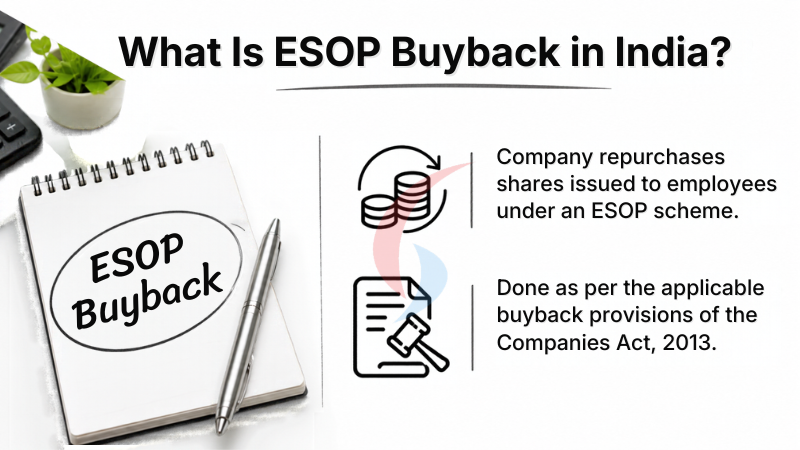
An ESOP buyback generally refers to a transaction in which a company repurchases shares issued to employees under an employee stock option scheme. The term is also sometimes used commercially for broader employee liquidity programmes, including purchases of employee shares by investors. Legally, these arrangements are not necessarily the same. When a company purchases its own securities, the transaction must satisfy the applicable buyback provisions. When an existing investor or another eligible purchaser acquires employee shares, the arrangement is ordinarily a share transfer rather than a company buyback.
It is also important to distinguish between stock options and equity shares. An employee who has received an ESOP grant may not immediately own shares. Ownership ordinarily arises after the options have vested, the employee has exercised them and shares have been allotted or transferred under the scheme. Section 68 of the Companies Act, 2013 also recognises employee stock options within the definition of specified securities for the purposes of Sections 68 and 70. Nevertheless, a company must identify the particular instrument involved and its legal treatment before implementing a transaction. Ordinary buyback programmes involving shares typically concern shares that have already been issued and are fully paid-up.
Why Do Startups Offer ESOP Buyback Opportunities?
One of the biggest challenges for employees holding equity in an unlisted company is limited liquidity. Even if the company becomes financially successful, employees may not receive cash benefits until a suitable exit opportunity becomes available. A planned buyback can provide employees with an opportunity to realise some of the value they have helped create.
For employers, ESOP liquidity can also support employee retention. When employees see that their stock options have a realistic financial value, they may feel more connected to the company's long-term growth. Such programmes can strengthen confidence in employee ownership arrangements and encourage experienced professionals to continue working with the business.
A buyback may also be considered during restructuring, after a profitable period or when a company wishes to reorganise its capital structure. However, the board must evaluate the company's financial position carefully because using significant cash for employee liquidity may affect business expansion, working capital and future investments. Companies should assess these decisions alongside professional Valuation Services, particularly where the business is unlisted and its shares do not have an observable market price.
To learn how startups use employee stock options to attract talent and encourage business growth, explore our article on Startup Funding and ESOPs: Employee Stock Options for Growth.
Legal Provisions Governing ESOP Buyback in India
ESOP-related buyback transactions are primarily regulated under the Companies Act, 2013, the Companies (Share Capital and Debentures) Rules, 2014 and, where applicable, SEBI regulations.
Section 62(1)(b): Employee Stock Option Schemes
Section 62(1)(b) allows companies to issue shares to employees under an employee stock option scheme, subject to applicable approvals and conditions. Rule 12 of the Companies (Share Capital and Debentures) Rules, 2014 prescribes requirements relating to eligibility, vesting, disclosures, approvals and record maintenance for relevant unlisted companies.
The original ESOP scheme is important because it determines employees' rights and obligations. Before planning a buyback, companies should examine their ESOP policy, grant letters, exercise conditions, shareholder agreements and any restrictions affecting the transfer or disposal of employee shares.
For a better understanding of ESOP eligibility, approvals, vesting conditions and statutory requirements, read our article on ESOPs Compliance Checklist and Procedure under the Companies Act, 2013.
Section 68: Buyback of Shares and Securities
Section 68 is the principal provision governing a company's purchase of its own shares and specified securities. It permits buybacks from prescribed sources, including free reserves, securities premium accounts and proceeds of qualifying issues, subject to statutory restrictions.
The company must also ensure that its Articles of Association authorise the proposed buyback. Depending on the size of the transaction, approval may be required from the board of directors or shareholders through a special resolution.
Section 69: Capital Redemption Reserve
Section 69 deals with the creation of a Capital Redemption Reserve when a company purchases its own shares out of free reserves or the securities premium account. The applicable amount relating to the nominal value of shares bought back must be transferred to the reserve.
This requirement helps preserve the company's capital structure and must be considered during accounting and financial planning.
Section 70: Restrictions on Buyback
Section 70 prohibits certain buyback arrangements, including purchasing shares through subsidiary companies or investment companies in specified circumstances. It also imposes restrictions where the company has committed certain defaults.
Therefore, even a financially successful startup cannot proceed with a buyback merely because it has available cash. Its compliance history and the statutory conditions must also be examined.
Important Conditions for ESOP Buyback
Before an unlisted company undertakes a buyback under Section 68, it must satisfy several conditions.
|
Requirement |
Applicable rule |
|---|---|
|
Authorisation |
Buyback must be authorised by the Articles of Association. |
|
Board approval |
Permitted for qualifying buybacks of 10% or less of paid-up equity capital and free reserves. |
|
Shareholder approval |
Special resolution generally required for larger buybacks. |
|
Maximum buyback |
Generally limited to 25% of aggregate paid-up capital and free reserves. |
|
Equity share limit |
Maximum 25% of total paid-up equity capital in a financial year. |
|
Debt-equity condition |
Post-buyback debt generally cannot exceed twice paid-up capital and free reserves, subject to exceptions. |
|
Payment status |
Shares or securities being bought back must be fully paid-up. |
|
Completion |
Buyback generally must be completed within one year of the approving resolution. |
These are statutory limits, not automatic permissions. A company must separately check the prescribed procedural requirements, available funding sources and any restrictions applicable to its particular securities. The detailed conditions under Section 68 and Rule 17 make professional Company Law Advisory particularly relevant when implementing an employee liquidity programme.
Process for ESOP Buyback in India
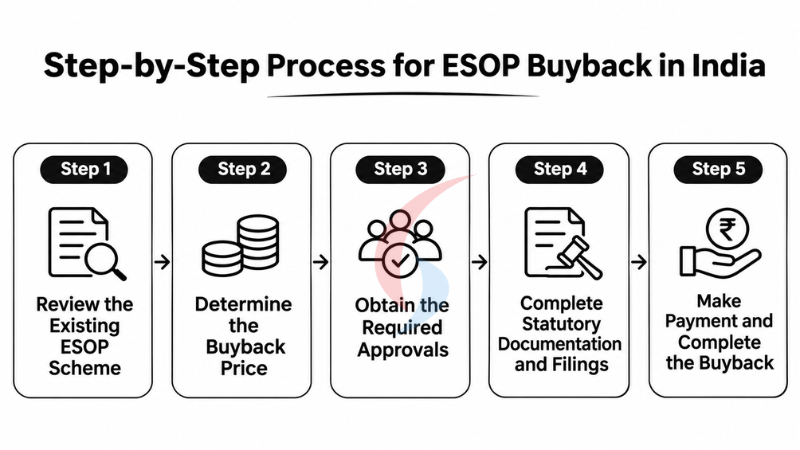
Step 1: Review the Existing ESOP Scheme
The company should begin by examining its existing ESOP documentation and employee shareholding records. It must identify which employees hold vested options, which have exercised their options and which already possess shares eligible for the proposed transaction.
This examination helps avoid confusion between purchasing shares and settling or cancelling unexercised stock options. It also establishes whether employees are subject to lock-in periods, transfer restrictions or other contractual conditions.
Step 2: Determine the Buyback Price
The next step involves determining the proposed buyback price. In an unlisted company, this requires careful consideration because there may be no publicly quoted share price. Management should evaluate the company's financial performance, recent funding rounds, business prospects and valuation reports. The board must be able to explain the basis on which the purchase price has been determined.
To understand how fair market value is determined and why proper valuation matters for employee stock options, read our article on ESOP Valuation in India: Methods and Compliance.
Step 3: Obtain the Required Approvals
The board must examine the proposed transaction and approve it in accordance with Section 68 and other applicable provisions. Where shareholder approval is required, the company must convene the appropriate meeting or follow another permitted approval procedure.
Relevant notices and explanatory statements should contain the prescribed information, including the purpose of the buyback, securities involved, proposed price, funding sources and financial implications.
Step 4: Complete Statutory Documentation and Filings
For an applicable unlisted-company buyback, Rule 17 requires prescribed documentation, disclosures and filings. These may include Form SH-8 for the letter of offer, Form SH-9 for the declaration of solvency and the subsequent return of buyback in Form SH-11, together with associated requirements.
Applicable exemptions must be checked before filing. The company must also follow the prescribed offer, acceptance and payment procedures rather than transferring money to employees without the necessary corporate documentation.
Companies planning a share buyback should also understand the documentation and valuation requirements. For more information, refer to our article on Valuation of Shares by Merchant Bankers & Registered Valuers.
Step 5: Make Payment and Complete the Buyback
Once the offer and acceptance process has been completed, the company makes payment in accordance with the statutory timelines. The securities bought back must be extinguished or otherwise dealt with as required by the applicable law.
The company must update its statutory registers, accounting records and shareholding information. It should also ensure that the transaction is correctly reflected in its subsequent financial statements and applicable ROC filings.
Tax Implications of ESOP Buyback in India in 2026
Taxation is one of the most important aspects of an ESOP buyback because employees may face tax obligations at two different stages. The first generally arises when employees exercise their stock options and acquire shares at a concessional price. The second arises when those shares are subsequently sold or bought back.
An important change took effect on 1 April 2026, when the Income-tax Act, 2025, as amended by the Finance Act, 2026, introduced capital gains treatment for share buybacks. This replaced the deemed-dividend treatment that had applied to buybacks from 1 October 2024 to 31 March 2026.
Taxation at the Time of ESOP Exercise
When an employee exercises stock options and receives shares at a discount, the difference between the prescribed fair market value and the exercise price is generally treated as a taxable salary perquisite.
For example, suppose an employee exercises 1,000 options at Rs 100 per share when the prescribed fair market value is Rs 400 per share.
|
Particulars |
Amount |
|---|---|
|
Number of shares |
Rs.1,000 |
|
Exercise price per share |
Rs 100 |
|
Fair market value per share |
Rs 400 |
|
Total amount paid |
Rs 1,00,000 |
|
Taxable salary perquisite |
Rs 3,00,000 |
The employee generally pays income tax on the Rs 3,00,000 perquisite according to the applicable salary tax provisions. For eligible startups satisfying the statutory conditions, special ESOP tax-deferral provisions may apply.
For a detailed explanation of ESOP taxation at the time of exercise and subsequent sale of shares, read our article on ESOP Taxation for Employees and Startups in India.
Taxation When ESOP Shares Are Bought Back
For buybacks taking place from 1 April 2026, the resulting gain is generally taxable as capital gains in the shareholder's hands under Section 69 of the Income-tax Act, 2025. Consider the same employee. Suppose the company later buys back all 1,000 shares for Rs 700 each. Assuming the prescribed fair market value of Rs 400 per share at exercise is also the applicable tax cost of acquisition, the calculation would be:
|
Particulars |
Amount |
|---|---|
|
Buyback price per share |
Rs 700 |
|
Total buyback consideration |
Rs 7,00,000 |
|
Cost of acquisition |
Rs 4,00,000 |
|
Capital gain |
Rs 3,00,000 |
The employee's capital gain would be Rs 3,00,000, subject to applicable tax rules and valuation adjustments. Whether it qualifies as short-term or long-term capital gain depends on the relevant holding period and nature of the shares. For ordinary unlisted equity shares, a holding period exceeding 24 months generally qualifies for long-term treatment. The long-term capital gains rate is generally 12.5%, subject to applicable provisions, surcharge and cess.
To understand how the holding period affects capital gains taxation, explore our article on Capital Gains Tax: Short-Term vs. Long-Term.
Special Tax Rules for Promoters
The Finance Act, 2026 also introduced additional taxation for certain promoter shareholders participating in company buybacks. The combined base tax on relevant gains is generally structured at 30% for non-corporate promoters and 22% for domestic corporate promoters, before applicable surcharge and cess considerations. An ordinary employee does not automatically become a promoter merely because shares were acquired under an ESOP. However, employees who also fall within the statutory promoter definition or relevant ownership criteria require a separate tax examination.
ESOP Buyback vs Share Transfer: Key Legal and Tax Differences
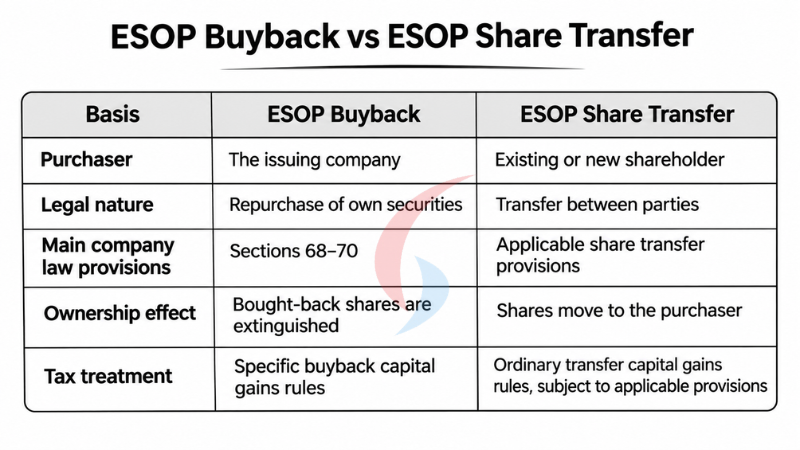
Employees sometimes assume that a company buyback and a sale to an investor are identical. Although both transactions can provide liquidity, they involve different legal arrangements.
|
Basis |
ESOP Buyback |
ESOP Share Transfer |
|---|---|---|
|
Purchaser |
The issuing company |
Existing or new shareholder |
|
Legal nature |
Repurchase of own securities |
Transfer between parties |
|
Main company law provisions |
Sections 68–70 |
Applicable share transfer provisions |
|
Ownership effect |
Bought-back shares are extinguished |
Shares move to the purchaser |
|
Tax treatment |
Specific buyback capital gains rules |
Ordinary transfer capital gains rules, subject to applicable provisions |
A company planning employee liquidity should compare both arrangements before deciding which route is legally available and commercially suitable.
To understand the difference between holding employee stock options and owning actual company shares, read our detailed article on ESOP vs Shares: The Key Differences in Company Ownership.
Common Mistakes During ESOP Buyback
One frequent mistake is announcing an employee buyback without first checking whether the company satisfies the statutory financial limits. A business may have raised substantial investment but still be unable to use those funds for a particular buyback. Available cash, permitted funding sources and the company's financial position must be considered separately. Another mistake is failing to obtain a defensible valuation. Employees may be offered a price based solely on the latest funding round without considering the rights attached to different classes of shares or other relevant valuation factors. Companies should document the pricing basis and assess whether any additional tax valuation provisions apply.
Tax planning is another common concern. Employees sometimes calculate their gain by subtracting only the original exercise price from the buyback amount, overlooking the prescribed fair market value used for ESOP perquisite taxation. Maintaining exercise records, valuation reports and tax statements is therefore important. Companies should also ensure that their ESOP records, statutory registers and annual disclosures remain consistent. Professional Annual Filings of Company support can help businesses maintain accurate corporate records following changes in share capital.
Why Choose Compliance Calendar LLP?
ESOP buyback in India can provide a meaningful opportunity for employees to realise the financial value of their contribution to a growing business. For startups, it can also strengthen employee confidence and support long-term retention. However, an employee liquidity programme must be designed carefully because the legal requirements for a company buyback are different from those governing ordinary share transfers.
The tax changes effective from 1 April 2026 are especially important. Companies and employees must now examine capital gains treatment, the applicable cost of acquisition and any promoter-specific provisions while also considering ESOP exercise-stage taxation.
For businesses planning an ESOP liquidity programme, Compliance Calendar LLP provides assistance relating to ESOP Scheme Compliance, Buy Back of Shares, valuation and related corporate compliance requirements.
If you are planning an ESOP buyback and need assistance with legal compliance, valuation, documentation, and tax implications, you can contact Compliance Calendar LLP at +91 9988424211 or info@ccoffice.in
Frequently Asked Questions About ESOP Buyback in India
Q1. Is ESOP buyback legal in India?
Ans. Yes. A company can undertake a legally compliant buyback of eligible shares or specified securities associated with employee stock option arrangements. The transaction must satisfy applicable provisions of the Companies Act, 2013 and relevant rules. A company cannot bypass statutory buyback requirements simply because the shareholders are employees.
Q2. Can employees sell unvested ESOPs?
Ans. Unvested options ordinarily cannot be sold like equity shares. Their treatment depends on the ESOP scheme and the applicable law. Employees should distinguish between unvested options, vested options and allotted equity shares before participating in any liquidity programme.
Q3. Is ESOP buyback taxable in 2026?
Ans. Yes. For buybacks undertaken from 1 April 2026, gains are generally taxable under capital gains provisions. Employees may also have a separate salary perquisite tax liability when exercising their options. The tax calculation depends on the acquisition cost, holding period, shareholder classification and applicable statutory rules.
Q4. Can a private limited company buy back ESOP shares?
Ans. Yes, a private limited company can buy back eligible employee-held shares when the required conditions are satisfied. These include authorisation under its Articles of Association, applicable approvals, financial limits, prescribed documentation and statutory filings.
Q5. Is ESOP buyback compulsory for startups?
Ans. No. Indian company law does not generally require every startup to provide periodic ESOP buyback opportunities. Liquidity rights depend on the scheme documentation, contractual arrangements and the company's decisions, subject to applicable laws.
Q6. What happens to ESOP shares after a company buyback?
Ans. Shares repurchased under a statutory buyback are required to be extinguished in accordance with the applicable provisions. This differs from an ordinary share transfer, where ownership passes from the employee to another purchaser.
Q7. Can an employee refuse to participate in an ESOP buyback?
Ans. Yes, employees can generally refuse to participate in a voluntary ESOP buyback. They may choose to retain their shares if they expect better returns in the future. However, their rights depend on the ESOP scheme, shareholder agreements and applicable legal conditions.
Q8. What happens to ESOP shares if an employee leaves the company before the buyback?
Ans. When an employee leaves the company, unvested ESOPs generally lapse, while vested options may remain exercisable for a limited period. Employees who already own shares may retain them, subject to scheme conditions. Their eligibility for a future buyback depends on the company's policies and agreements.
Q9. How is the buyback price of ESOP shares determined in India?
Ans. The ESOP buyback price is generally determined by considering the company's valuation, financial performance, recent funding rounds and future growth potential. For unlisted companies, an independent valuation can help establish a reasonable price and maintain transparency.
Q10. Can a company conduct an ESOP buyback every year?
Ans. Yes, a company can conduct ESOP-related share buybacks periodically, subject to legal requirements. Under Section 68 of the Companies Act, 2013, generally, at least one year must pass after the closure of the previous buyback offer before another offer can be made.
Article last updated on : 20 Nov 2026.













































































_learn_crop10_thumb.jpg)