



Selling shares in an overseas subsidiary can look straightforward. The Indian parent finds a buyer, agrees on a price and signs a share purchase agreement. Then its bank asks a question the deal team overlooked. Does the foreign subsidiary still owe the Indian parent money on a shareholder loan?
That question can change the closing timetable. An Indian resident making a full exit through a sale generally needs to clear investment-related dues receivable from the foreign entity before disinvestment. After the sale, the investor has separate deadlines for bringing the proceeds to India and reporting the disinvestment. If the overseas business is being liquidated, the bank will look for different documents and the repatriation clock starts at a different point. This guide covers exits from Overseas Direct Investment (ODI) by persons resident in India under the FEMA (Overseas Investment) Rules, 2022, the RBI’s Overseas Investment Regulations, 2022 and its Master Direction on Overseas Investment, updated on 1 April 2026.
What Counts as Disinvestment Under FEMA?
Disinvestment occurs when an Indian resident gives up all or part of its rights in equity capital acquired under the Overseas Investment Rules. An exit can happen through a share sale, buyback, liquidation or corporate reorganisation that extinguishes or transfers the holding. Repaying a shareholder loan recovers the debt. If the investor still owns the shares, the equity exit remains pending.
An overseas holding originally classified as ODI continues to be treated as ODI even if the stake later falls below 10% or the investor loses control. After a partial sale, check which reporting obligations and financial commitments continue.
|
Exit route |
What happens |
Main compliance question |
|
Full share sale |
The Indian investor transfers its entire equity holding |
Have investment-related dues been settled before exit? |
|
Partial share sale |
The investor sells part of its equity |
What reporting and financial commitments remain? |
|
Buyback |
The foreign entity buys back some or all of the investor’s equity |
Are the required approvals in place, and how is the price supported? |
|
Liquidation |
The foreign entity is wound up under local law |
When did the official liquidator distribute assets, and what did the investor receive? |
|
Merger, demerger or amalgamation |
The holding is transferred, cancelled or exchanged |
Does the Rule 17 exception apply, and does the replacement holding need separate reporting? |
|
Balance-sheet restructuring |
The foreign entity reduces the value of amounts owed to the Indian investor under a qualifying restructuring |
Do the losses, certification and reporting satisfy Rule 18? |
Check the One-Year Holding Period
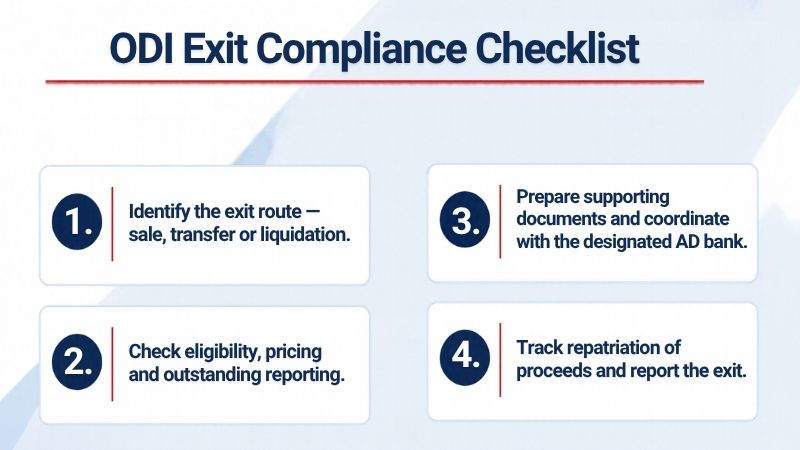
Rule 17 generally requires the investor to stay invested for at least one year from the date of making ODI before disinvesting. This applies to full and partial disinvestment. If the investor acquired shares in several tranches, give the bank the full acquisition history and confirm how the rule applies to the shares being transferred.
Rule 17 provides an exception to both the one-year holding requirement and the outstanding-dues condition for specified mergers, demergers or amalgamations. It covers reorganisations between two or more foreign entities wholly owned, directly or indirectly, by the Indian entity, or reorganisations where its aggregate equity holding in the resulting entity is neither changed nor diluted. Compare the ownership charts before and after the transaction to establish whether the exception applies.
Settle Investment-Related Dues Before a Full Exit
For full disinvestment other than liquidation, the Indian transferor must have no outstanding dues it is entitled to receive from the foreign entity as an equity or debt investor. Check shareholder loan principal, accrued interest and dividends already payable. RBI clarifies that ordinary commercial dues, such as export invoices, fall outside this specific pre-exit condition. Those receivables remain subject to their own rules.
Suppose an Indian company agrees to sell its entire stake in a Singapore subsidiary for USD 300,000. The subsidiary still owes it USD 50,000 under a shareholder loan. The buyer’s payment settles the share purchase price, and the loan requires separate treatment. The Indian company should agree on recovery or another compliant way to address the loan with its designated Authorised Dealer Category-I bank (AD bank) before transferring the shares.
Check guarantees, pledges and charges as well. If the Indian parent guaranteed the subsidiary’s borrowing, obtain a written release from the lender or evidence of another approved arrangement. Reconcile the remaining financial commitment with the AD bank. If the subsidiary cannot repay the loan, check whether a permitted restructuring is available or whether the case needs specific regulatory treatment before closing.
Verify the Buyer, Pricing and Required Approvals
An Indian resident can sell overseas equity capital to a person resident outside India or to another Indian resident eligible to make the investment. If the buyer is an Indian resident, review the buyer’s overseas investment eligibility and reporting separately. For a buyback, merger, demerger, amalgamation or liquidation, obtain the approval of the competent authority under the applicable Indian or host-jurisdiction law, as the case may be.
Transfers of foreign equity capital must meet arm’s-length pricing requirements. The designated AD bank checks the price under its board-approved policy. It may ask for a valuation prepared using an internationally accepted method, audited financial statements or additional evidence where the exit involves a write-off. The bank’s policy may allow it to dispense with a separate valuation in certain cases, such as when the price is available on a recognised stock exchange or has been approved by a competent court or tribunal.
A transaction can proceed under general permission if it meets the applicable conditions. An investor whose account is classified as a non-performing asset (NPA), who is classified as a wilful defaulter, or who is under a covered investigation must check the prior no-objection certificate (NOC) requirement under Rule 10. Route any required regulatory approval through the designated AD bank before closing. Rule 17 also restricts transfer if the original investment was impermissible under FEMA.
Before closing the sale, use a FEMA due diligence checklist to review the original investment, past filings and outstanding guarantees.
Track Repatriation and Form FC Reporting Separately
The date you sign the agreement, the date the shares transfer and the date you receive the proceeds can differ. Record all three and use the correct date for each deadline.
|
Obligation |
Deadline |
When the clock starts |
|
Repatriate investment-related dues |
Within 90 days |
When the receivables fall due |
|
Realise and repatriate ODI sale or transfer proceeds |
Within 90 days under the general rule |
Date of transfer or disinvestment |
|
Repatriate the net realisable value of assets on liquidation |
Within 90 days |
Actual distribution of assets by the official liquidator |
|
Report disinvestment through the designated AD bank using Form FC, Section G |
Within 30 days |
Receipt of disinvestment proceeds |
|
Report a qualifying restructuring through the designated AD bank |
Within 30 days |
Date of restructuring |
For example, if a company transfers its shares on 10 January and receives payment in India on 5 February, it tracks the repatriation period from 10 January and the Form FC reporting period from 5 February.
If the agreement includes deferred consideration, an earn-out, escrow or instalments, have the AD bank review the structure before signing. Regulation 7 provides a deferred-payment framework for eligible transfers of foreign equity capital between a person resident in India and a person resident outside India. Confirm whether the framework applies and agree with the bank on how to handle payment, repatriation and reporting.
Document Liquidation and Zero-Proceeds Exits
When a foreign company is liquidated, collect the host-jurisdiction approvals, the liquidator’s final statement, evidence of any distribution and proof of dissolution or closure. The 90-day repatriation period starts when the official liquidator actually distributes the assets. Reconcile the amount distributed with the amount received in India and document any difference.
If the liquidator confirms that nothing remains for shareholders, obtain a final statement showing nil distribution. Ask the designated AD bank how it will record the disinvestment, which evidence it needs and when it expects the documents. The ordinary 30-day reporting rule is tied to receipt of proceeds. In a zero-proceeds case, contact the bank once you have the liquidation evidence so it can record the exit.
The regulations exempt a foreign entity under liquidation from Annual Performance Report (APR) filing. An inactive or dormant entity can still have an APR obligation. Check earlier reporting periods separately and resolve overdue filings with the bank.
If the company is dormant, check the rules on APR filing for inactive foreign companies before closing the compliance file.
Distinguish a Sale at a Loss From a Rule 18 Restructuring
If you sell shares below their original cost, retain evidence that supports the agreed price. A Rule 18 restructuring applies when the foreign entity restructures its balance sheet after incurring losses for the previous two years, as shown in its last audited balance sheets. The reduction in the total value of outstanding equity and debt dues to the Indian investor must stay within its proportionate share of accumulated losses. If the restructuring affects only equity, RBI allows the calculation to be based on equity alone.
An arm’s-length certificate from a qualified valuer or an eligible host-jurisdiction professional is required if either of these thresholds is crossed.
-
The corresponding original investment exceeds USD 10 million.
-
The reduction exceeds 20% of total outstanding dues to the Indian investor.
The certificate submitted to the designated AD bank must be dated no more than six months before the transaction. A revaluation recorded solely in the Indian investor’s books does not qualify as a restructuring under Rule 18.
Clear Old ODI Reporting Defaults Before Closing
Ask the designated AD bank to reconcile the foreign entity’s Unique Identification Number (UIN) record with your books. Check past Form FC filings, APRs where required, evidence of investment, shareholder loans, guarantees and prior changes in shareholding. Under the Overseas Investment Regulations, an applicable reporting default restricts further financial commitment or transfer until the default is regularised.
If you find a mistake in an earlier filing, see how to fix ODI reporting errors before completing the exit.
Eligible reporting delays can be addressed through the Late Submission Fee (LSF) mechanism, generally within three years from the filing due date under the 2022 Regulations. If the delay falls outside that window, discuss the applicable regulatory process with the AD bank. A pricing breach, impermissible investment or delayed repatriation requires separate assessment.
While reviewing past filings, check whether any applicable FLA return filing is still pending.
Documents to Keep Ready for the AD Bank
|
Document |
What it helps establish |
|
UIN, historical filings and original investment evidence |
How the investment was made and recorded |
|
Board or equivalent approval and ownership charts |
Who authorised the exit and what changes at closing |
|
Share purchase agreement, buyback papers or merger order |
Transaction terms, price, transfer date and payment schedule |
|
Valuation support and foreign entity financial statements |
The basis for the agreed price or any loss on the investment |
|
Loan ledger, repayment evidence and lender releases |
Treatment of investment-related dues, guarantees and security |
|
Liquidator’s statement and dissolution evidence |
Actual distribution, nil proceeds or formal closure, where applicable |
|
Inward remittance evidence and completed Form FC |
Receipt of proceeds and reporting of the disinvestment |
After filing, ask the bank to confirm that it recorded the disinvestment against the correct UIN and clarify which obligations remain. If another Indian investor still holds shares in the same foreign entity, your exit may leave the foreign entity’s UIN record active.
For help with exit documents and disinvestment filing, explore our ODI compliance services.
Conclusion
Start the exit review before agreeing to a closing date. Confirm the holding period, identify any loans or dividends still due, check the buyer’s eligibility and prepare the pricing evidence. For a liquidation, obtain the official liquidator’s documents and record the date of each actual distribution. For a merger or other reorganisation, check whether any replacement holding creates a separate overseas investment reporting obligation.
Give the finance team two separate dates to track. The first is the deadline to bring the proceeds to India. The second is the deadline to report the disinvestment through the designated AD bank. Close the file after the bank confirms that it has recorded the exit and you have accounted for any remaining loans, guarantees or reporting obligations.
Frequently Asked Questions (FAQ’s)
Q1. Can an Indian company sell ODI shares at a loss?
Ans. Yes, subject to arm’s-length pricing and the applicable disinvestment conditions. Keep evidence supporting the sale price and check the designated AD bank’s documentation requirements.
Q2. Can a full exit go ahead while a shareholder loan remains unpaid?
Ans. For full disinvestment other than liquidation, the seller generally must have no outstanding dues receivable as an equity or debt investor. Resolve the shareholder loan with the designated AD bank before closing.
Q3. Does a partial sale end ODI reporting?
Ans. The remaining investment continues to be treated as ODI. Review any ongoing APR obligations and outstanding loans, guarantees or other commitments.
Q4. Does a dormant overseas company qualify for the liquidation exemption from APR filing?
Ans. The liquidation exemption applies when the foreign entity is under liquidation. For a dormant company, check whether APR is still required or whether another exemption applies.
Q5. Does FEMA reporting cover the tax requirements of an overseas exit?
Ans. Tax treatment is assessed separately. Review the applicable Indian and host-country tax requirements, including the treatment of any gain or withholding, before finalising the deal.
Article last updated on : 09 Nov 2026.































































_learn_crop10_thumb.jpg)