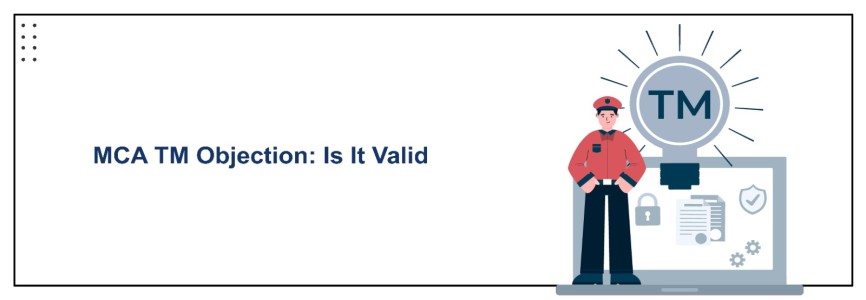



LEGAL ANALYSIS ON MCA OBJECTION REGARDING “TRADEMARK WORDS” UNDER RULE 8A(1)(b) OF THE COMPANIES (INCORPORATION) RULES, 2014 (AS AMENDED IN 2019)
For any company registration in India, selecting an appropriate name and obtaining approval from the Ministry of Corporate Affairs (MCA) is a mandatory first step and the process governing company name approval is laid down under Section 4 of the Companies Act, 2013, read with the Companies (Incorporation) Rules, 2014. Over the years, the regulatory approach adopted by the MCA particularly through the Central Registration Centre (CRC) has become more stringent. The objective is to prevent misuse of corporate names, protect intellectual property rights, and avoid confusion within the corporate registry.
One of the most contentious areas in the name approval process relates to objections raised by the CRC or Registrar of Companies (ROC) under Rule 8A(1)(b), where the proposed name is alleged to contain a registered trademark. This issue has gained prominence as objections are increasingly raised even when the trademarked word appears merely as a suffix or as part of a broader composite name.
Learn more about Finding a Company Name Search Availability is not as Simple as it Appears.
Such objections raise important legal and practical questions:
-
Can the MCA reject a proposed company name simply because a registered trademark word appears as a suffix?
-
Does Rule 8A(1)(b) allow objection even where the trademark is not the dominant or distinctive element of the proposed name?
-
Is the use of a trademarked term as part of a composite expression sufficient to classify the name as “undesirable”?
-
Does every instance of inclusion of a trademarked word automatically require submission of a No Objection Certificate (NOC) from the trademark owner?
Statutory Structure Governing Company Names
A. Section 4 of the Companies Act, 2013
The foundation of company name approval in India lies in Section 4 of the Companies Act, 2013. Under Section 4(2), the name proposed in the Memorandum of Association must not be identical with, or too closely resemble, the name of an existing company registered under the Act or any previous company law. The purpose of this provision is to prevent confusion, protect business identity, and maintain clarity within the corporate registry.
Further, Section 4(2)(b) provides that a company name shall not be approved if:
-
Its use would constitute an offence under any existing law; or
-
The name is considered “undesirable” in the opinion of the Central Government.
The concept of “undesirability” is intentionally broad and allows regulatory authorities to evaluate names beyond mere similarity. This ensures that public interest, intellectual property rights, and statutory compliance are safeguarded.
Importantly, Section 4(3) empowers the Central Government to frame rules for determining what constitutes an undesirable name. It is under this delegated authority that specific regulatory guidelines have been prescribed. Consequently, any objection raised under the Companies (Incorporation) Rules must trace its legal validity back to Section 4.
B. Companies (Incorporation) Rules, 2014
The procedural and substantive criteria for name approval are detailed in the Companies (Incorporation) Rules, 2014. Initially, Rule 8 governed the determination of undesirable names and laid down illustrative circumstances in which a proposed name could be rejected. However, with evolving regulatory concerns particularly relating to trademark conflicts and misuse of names the structure was revisited.
The Companies (Incorporation) Fifth Amendment Rules, 2019 significantly modified the position by substituting Rule 8 and introducing Rule 8A, which now specifically deals with undesirable names. Rule 8A provides more detailed parameters and addresses, among other aspects, the inclusion of registered trademarks in proposed company names.
Thus, the current regulatory structure governing company names is a combined reading of Section 4 of the Companies Act, 2013 and Rule 8A of the Companies (Incorporation) Rules, 2014.
Scope of the Word “Includes” Under Rule 8A (1)(b)
The rule does not use the phrase “identical to.” It uses “includes.”
Judicial interpretation of the term “includes” generally suggests expansion rather than limitation. Therefore, inclusion may occur:
-
As a prefix
-
As a suffix
-
As part of a composite name
-
As one word within a longer expression
Hence The from a literal reading, the rule does not distinguish between dominant or non-dominant use. Therefore, even if a registered trademark appears only as a suffix, the technical condition under Rule 8A(1)(b) is satisfied.
Legislative Intent Behind Rule 8A (1)(b)
The Companies (Incorporation) Fifth Amendment Rules, 2019 were introduced with a clear regulatory objective of strengthening scrutiny at the stage of company name approval. The amendment sought to prevent the misuse of well-established brands and registered trademarks in corporate names, to avoid misleading associations that may create confusion among consumers or stakeholders, and to minimize trademark disputes arising after incorporation. Prior to this amendment, regulatory examination largely centered on similarity between proposed names and existing company names in the MCA registry. However, the scope of scrutiny was expanded to include potential conflicts with registered trademarks, thereby aligning company law compliance with intellectual property protection.
The legislative intent behind Rule 8A(1)(b) therefore reflects a proactive approach ensuring that trademark rights are safeguarded at the incorporation stage itself, rather than leaving such disputes to be resolved through post-registration litigation.
Whether MCA Can Object To Trademark Used as a Suffix
A recurring issue in company name approval is whether the Ministry of Corporate Affairs (MCA) can raise an objection when a registered trademark appears merely as a suffix in the proposed name. Applicants often contend that the trademark is not the dominant portion of the name, that the proposed name is a composite expression, that the word in question is generic in nature, or that the trademark is registered under a different class of goods or services. These arguments are commonly advanced to suggest that the proposed name should not attract objection under Rule 8A(1)(b).
However, a plain reading of Rule 8A(1)(b) reveals that the provision is drafted in wide terms and does not restrict its application to situations where the trademark forms the dominant or primary part of the name. The rule does not make any distinction based on whether the mark appears as a prefix, suffix, or middle component. Nor does it expressly require similarity in class of registration or overlap in business activity as a precondition for objection. The language of the rule is broad enough to cover any inclusion of a registered trademark within a proposed company name, unless a No Objection Certificate (NOC) from the trademark owner is furnished.
Accordingly, even where a trademarked term appears only as a suffix for example, “ABC Innovation Private Limited” where “Innovation” is a registered trademark the MCA is legally empowered to raise an objection. The statutory framework does not differentiate between prefix and suffix usage, and therefore the mere structural placement of the word within the name does not automatically shield the applicant from scrutiny under Rule 8A(1)(b).
Interplay Between Trademark Law and Company Law
Trademark registration under the Trade Marks Act, 1999 confers exclusive rights upon the registered proprietor in respect of the goods or services for which the mark is registered. Section 29 of the Act specifically addresses infringement and provides remedies where an unauthorized party uses a registered mark in a manner that is likely to cause confusion or deception. Importantly, incorporation of a company under the Companies Act, 2013 does not grant immunity against trademark claims. Registration of a company name does not override pre-existing trademark rights, nor does it constitute a defense to an infringement action under trademark law.
In this context, the scrutiny exercised by the Ministry of Corporate Affairs during the name approval process serves as a preventive regulatory filter. By examining potential conflicts with registered trademarks at the incorporation stage, Rule 8A(1)(b) creates a point of convergence between company law and trademark law. This mechanism aims to reduce the likelihood of post-incorporation disputes and ensures that intellectual property rights are respected from the outset, thereby aligning corporate regulation with broader principles of brand protection and commercial fairness.
Does MCA Have Discretion?
Rule 8A(1)(b) employs mandatory language by stating that a proposed name containing a registered trademark “shall be considered undesirable.” The use of such phrasing indicates that the provision is intended to operate with limited administrative discretion, thereby making objection the default position where a registered trademark is found within the proposed name.
However, the application of the rule is not absolute. Its operation is subject to certain factual and legal conditions. An objection may not sustain where the trademark in question has expired, been abandoned, or is no longer valid on the register. Similarly, where the applicant itself is the registered proprietor of the trademark, the basis for objection naturally falls away. Further, if the applicant produces a valid No Objection Certificate (NOC) from the trademark owner, the regulatory concern underlying Rule 8A(1)(b) stands addressed.
Therefore, while the language of the rule appears mandatory, its practical application is conditional. The provision functions as a safeguard against unauthorized use of registered marks, but it does not operate as an inflexible prohibition in all circumstances.
Issue of Generic or Descriptive Words
A recurring practical concern in the name approval process arises when common dictionary words are registered as trademarks. In several cases, applicants propose company names that incorporate such words in a purely descriptive sense, reflecting the nature of their business activities rather than an intention to appropriate brand identity. This situation creates tension between trademark registration rights and legitimate descriptive usage in corporate names.
The Rule 8A(1)(b), however, does not differentiate between arbitrary, coined, or highly distinctive trademarks and those that are descriptive or generic in ordinary language. The provision is broadly framed and, on a technical reading, empowers the MCA to raise an objection even where the word is used descriptively within a composite company name.
That said, during the resubmission or representation process, applicants may advance certain legal and factual arguments to seek reconsideration. These may include demonstrating that the word is used descriptively and not as a trademark indicator, that there is no likelihood of confusion, that the registered mark does not form the dominant element of the proposed name, or that the applicant operates in an entirely different commercial field from the trademark proprietor. While the rule itself does not expressly carve out such distinctions, these contextual arguments may become relevant in determining whether the objection should ultimately be sustained.
Should Trademark Objection Apply to Suffix Words Indicating Business Activity?
Under Section 4 of the Companies Act, 2013 read with Rule 8A(1)(b) of the Companies (Incorporation) Rules, 2014, a proposed company name shall be considered undesirable if it includes a registered trademark, unless a No Objection Certificate (NOC) is provided. The rule uses the word “includes”, which is broad. It does not distinguish between:
-
Prefix or suffix usage
-
Dominant or non-dominant word
-
Business class similarity
Therefore, on a strict legal reading, MCA is justified in objecting even if the trademark word appears only as a suffix (for example, “ABC Innovation Private Limited” where “Innovation” is registered). However, practically, concerns arise when:
-
Common dictionary or descriptive words are registered as trademarks
-
The word is used only to describe business activity
-
There is no likelihood of confusion
While the rule is mandatory in wording, objection may not sustain if:
-
The applicant owns the trademark,
-
The trademark has expired, or
-
A valid NOC is submitted.
Learn more about How to Protect your Brand Name by Filing a Trademark Application.
In conclusion, under a strict reading of Rule 8A(1)(b), the MCA is legally empowered to object to a proposed company name if it includes a registered trademark, even when the trademarked word appears only as a suffix. The rule is broadly worded and does not distinguish between prefix or suffix usage, dominance, or business class overlap. Therefore, unless the applicant owns the trademark, the trademark has expired, or a valid NOC is furnished, such objection is legally sustainable. However, from a practical standpoint, automatic objection to commonly used descriptive suffix words may raise concerns of proportionality and administrative fairness, and a balanced application of the rule would better align trademark protection with ease of doing business.


_crop10_thumb.jpg)





_crop10_thumb.jpg)
_crop10_thumb.jpg)


_crop10_thumb.jpg)


_crop10_thumb.jpg)


_crop10_thumb.jpg)

_crop10_thumb.jpg)


-suratgujarat-section-158_crop10_thumb.jpg)
-suratgujarat_crop10_thumb.jpg)
-(33)_crop10_thumb.jpg)


-ahmedabad_crop10_thumb.jpg)
-learn_crop10_thumb.jpg)

-learnn_crop10_thumb.jpg)


_crop10_thumb.jpg)








_Guidelines_learn_crop10_thumb.jpg)


_learn_crop10_thumb.jpg)
_crop10_thumb.jpeg)


_crop10_thumb.jpg)


_Second_Amendment_Rules,_2025_learn_crop10_thumb.jpg)


_learn_crop10_thumb.jpg)



















_learn_crop10_thumb.jpeg)

















_learn_crop10_thumb.jpg)

_rd_roc_learn_crop10_thumb.jpg)













_learn_crop10_thumb.jpg)







_learn_crop10_thumb.jpg)
_Learn_crop10_thumb.jpg)


































_learn_crop10_thumb.jpg)



_learn_crop10_thumb.jpg)













_crop10_thumb.jpeg)
















_crop10_thumb.jpg)

















_crop10_thumb.jpg)