


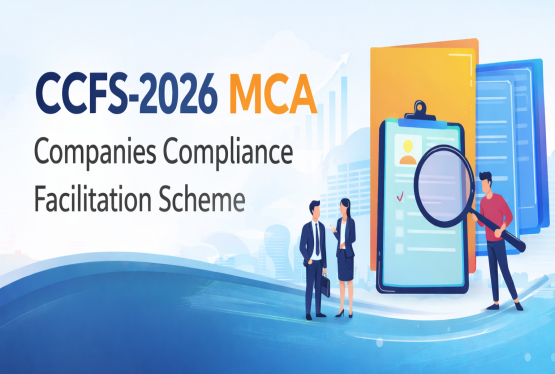
In 2025 following the 2026 new Year, the Ministry of Corporate Affairs (“MCA”) undertook a wide-ranging reform programme to simplify regulatory MCA compliance, improve the corporate governance standards, and improve the overall ease of doing business in India. These reforms were implemented through amendments to rules under the Companies Act, 2013, issuance of enabling circulars, and technology-driven institutional upgrades, reflecting a strong policy focus on reducing procedural burden while maintaining transparency and accountability like as followers:
New Definition of Small Company Thresholds (2025 onwards)
One of the most impactful reforms introduced during the year was the revision of the definition of a small company. Through the Companies (Specification of Definition Details) Amendment Rules, 2025, notified on December 1, 2025, the Ministry substantially enhanced the financial thresholds applicable for classification as a small company if not crossing the threshold:-
-
paid-up share capital limit was increased to Rs.10 crore, and
-
turnover threshold was raised to Rs.100 crore.
This amendment was carried out by substituting clause (t) in sub-rule (1) of rule 2 of the Companies (Specification of Definition Details) Rules, 2014, in alignment with Section 2(85) of the Companies Act, 2013. The new limits significantly broaden the scope of companies eligible for regulatory relaxations, enabling a larger segment of enterprises to operate under a lighter compliance structure.
Companies qualifying as small companies benefit from multiple procedural relaxations, including simplified annual returns, reduced board meeting requirements, exemption from cash flow statement preparation, and lower penalties for certain defaults. The reform directly supports startups, MSMEs, and growing businesses by lowering compliance costs and administrative complexity.
Facilitation of MCA V3 Transition and Filing Relaxations
To improve a smooth transition to the MCA V3 portal, the Ministry issued several general circulars during 2025 providing relaxation for ROC Annual filing for the year ended 31.03.2025, in additional fees, extension of filing timelines by 31.06.2026, and procedural flexibility. Since Covid-19 Times, Companies were also permitted to conduct Annual General Meetings and Extraordinary General Meetings through Video Conferencing (VC) or Other Audio-Visual Means (OAVM), enabling continued compliance with shareholder governance requirements without logistical constraints.
Director DIN KYC (Every 3 years)
Another major compliance relief was introduced in respect of director KYC filings. The annual KYC requirement under the Companies (Appointment and Qualification of Directors) Rules, 2014 was reviewed and amended, replacing the yearly filing obligation with a simplified KYC intimation once every three years, effective from March 31, 2026. This change significantly reduces repetitive compliance for directors while preserving the integrity of identification and disclosure mechanisms.
Easy for Company Closure under 248(2) (STK-2)
The Ministry also amended the Companies (Removal of Names of Companies from the Register of Companies) Rules, 2016 on December 31, 2025, to ease the company or LLP closure process for eligible government companies applying under Section 248(2) of the Companies Act, 2013, which allows indemnity bonds to be furnished by authorised government representatives on behalf of such companies, thereby facilitating faster and more efficient closure of non-operational government entities.
Share Recovery: Investor Protection through IEPFA Reforms
In August 2025, the Investor Education and Protection Fund Authority (IEPFA) introduced an integrated digital portal and a dedicated call centre to enhance investor services. The new system integrates data from MCA records, depositories, and payment platforms, enabling automated workflows and significantly faster settlement of claims related to shares and dividends. These measures have improved transparency, reduced processing timelines, and strengthened investor confidence.
Reforms in Mergers, Demergers, and Insolvency Structures
In line with broader economic and budgetary objectives, the Ministry expanded the scope of fast-track mergers and demergers under Section 233 of the Companies Act by amending the Companies (Compromises, Arrangements and Amalgamations) Rules, 2016, which allow additional classes of unlisted and group companies to undertake restructuring through simplified procedures, reducing both time and cost.
Parallelly, reforms under the Insolvency and Bankruptcy Code focused on reducing timelines, improving value realisation, and strengthening governance. By September 2025, a significant number of resolution plans had been approved, with recoveries exceeding liquidation values, demonstrating the effectiveness of the evolving insolvency structure..
Expansion of Regulatory Infrastructure
To support the growing number of corporate entities/ company registration in India and improve regulatory service delivery like MCA approvals, the Ministry announced the operationalisation of three new Regional Directorates (“RD Office”) at Chandigarh, Navi Mumbai, and Bengaluru, along with six new Registrar of Companies offices (“ROC”) at Delhi, Mumbai, Kolkata, Noida, Nagpur, and Chandigarh, effective from January 1, 2026.
Final Thought from CCL
The corporate governance and compliance reforms undertaken by the Ministry of Corporate Affairs in 2025 mark a decisive shift towards a more facilitative, technology-driven, and growth-oriented regulatory environment. By expanding the definition of small companies, simplifying recurring compliance requirements, strengthening investor protection, and upgrading institutional capacity, the Government has reinforced its commitment to making India a globally competitive and business-friendly jurisdiction while maintaining robust governance standards.


_crop10_thumb.jpg)





_crop10_thumb.jpg)
_crop10_thumb.jpg)


_crop10_thumb.jpg)


_crop10_thumb.jpg)


_crop10_thumb.jpg)

_crop10_thumb.jpg)


-suratgujarat-section-158_crop10_thumb.jpg)
-suratgujarat_crop10_thumb.jpg)
-(33)_crop10_thumb.jpg)


-ahmedabad_crop10_thumb.jpg)
-learn_crop10_thumb.jpg)

-learnn_crop10_thumb.jpg)


_crop10_thumb.jpg)







_Guidelines_learn_crop10_thumb.jpg)


_learn_crop10_thumb.jpg)
_crop10_thumb.jpeg)


_crop10_thumb.jpg)


_Second_Amendment_Rules,_2025_learn_crop10_thumb.jpg)


_learn_crop10_thumb.jpg)

















_learn_crop10_thumb.jpeg)

















_learn_crop10_thumb.jpg)

_rd_roc_learn_crop10_thumb.jpg)











_learn_crop10_thumb.jpg)







_learn_crop10_thumb.jpg)
_Learn_crop10_thumb.jpg)





















_learn_crop10_thumb.jpg)


_learn_crop10_thumb.jpg)









_crop10_thumb.jpeg)










_crop10_thumb.jpg)














_crop10_thumb.jpg)