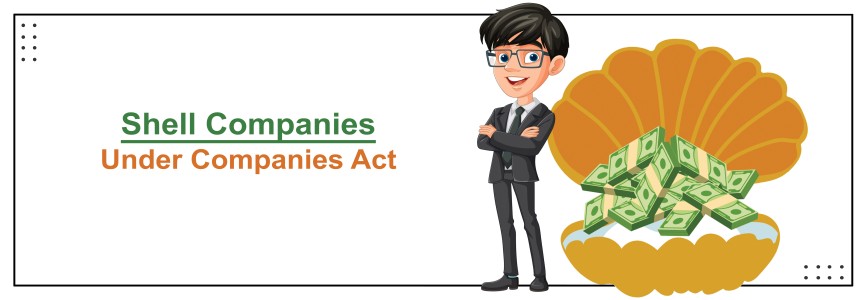



In India, many company categories we often hear of Private Limited, Public Company, Section 8 Company, NBFC Company, IRDAI-regulated Company, SEBI-listed Company and many more, but have we ever come across the category of a ‘shell company’?
The term ‘shell company’ does not exist as a formal definition under the Companies Act, 2013. This absence of a statutory definition often raises a common question: Is the Government planning to introduce a formal definition of shell companies to bring clarity, uniformity, and stronger enforcement?
The answer lies in understanding what the law currently states, how the Ministry of Corporate Affairs (MCA) deals with dormant or non-operative entities, and whether a separate classification is truly required.
The term “shell company” is frequently mentioned in public discussions, especially in the context of money laundering (PMLA), tax evasion, and fraudulent corporate structuring under SFIO Cases. Despite its widespread usage, the Companies Act, 2013 does not define the term “Shell Company”, which often leads to queries regarding the Government’s stance on introducing a formal definition for clarity and stronger enforcement.
We will explain the current legal position, the grounds under which companies are struck off or company closure by MCA including imposing a hefty penalty under MCA adjudication and whether the Government intends to define the term ?
No Statutory Definition of ‘Shell Company’ Under the Companies Act
The Ministry of Corporate Affairs (MCA) has clarified that there is no definition of ‘shell company’ under the Companies Act, 2013.However, the Companies Act 2013 contains clear grounds under Section 248(1) that empower the Registrar of Companies (ROC) to identify and strike off companies or company closure that appear inactive, defunct, or non-compliant and many of which, in practice, overlap with characteristics associated with “shell entities.”
Strike-Off Drives Under Section 248(1): The Four Statutory Grounds
Even without a formal definition, the MCA regularly conducts strike-off initiative to remove companies that meet any of the four statutory conditions under Section 248(1):-
Failure to commence business within 1 year of incorporation
If a company has not begun any business or operations within one year from the date of incorporation, it becomes liable for removal from the register.
Not carrying on any business or operations for the two immediately preceding financial years
Companies that remain inactive for two consecutive financial years and also do not apply for dormant status under Section 455 can be struck off.
Not maintaining a registered office
If at any time the ROC, after physical verification, finds that a company is not maintaining a registered office under section 12 of the Companies Act 2013, and not capable of receiving communications, action may be taken to remove the company's name or company closure under section 248 by ROC
Non-compliance with Section 10A (declaration of commencement of business)
Where subscribers have not paid subscription money or the company fails to file eForm INC-20A within 180 days of incorporation, the ROC may remove the company’s name.
These grounds collectively help the Government detect inactive, paper-based, or non-compliant corporate entities, often referred to informally as “shell-like” companies. The most recent strike-off drive was conducted in 2022–23, during which a significant number of defunct entities were removed from the MCA database.
Voluntary Strike-Off Under Section 248(2)
Companies may also voluntarily apply for strike-off after extinguishing all liabilities.
Under Section 248(2), such companies submit an application in Form STK-2, and after verifying compliance, the ROC removes their names.
The Government has published state-wise data of companies struck off under Section 248(2) of the Companies Act 2017 by issuance of Notice under STK-6 & STK-7
Is the Government Introducing a Definition of Shell Companies?
The Ministry has confirmed:
There is no proposal before the Government to define ‘Shell Companies’ under the Companies Act, 2013.
This means that, at present, the Government relies on existing legal tools instead of introducing a statutory definition.
Regulatory Approach: Functional Identification Over Legal Definition
In India, regulators such as MCA, SEBI, RBI, and the Income Tax Department follow a risk-based, functional approach rather than a rigid statutory classification.Therefore, While the term shell company remains undefined in law, the Companies Act, 2013 provides four clear grounds under Section 248(1) to strike off companies that exhibit characteristics commonly associated with shell entities. The Government has confirmed that no proposal is currently under consideration to introduce a formal definition.
Through periodic strike-off drives and compliance verification, the MCA continues to uphold corporate transparency and remove inactive or non-compliant companies from the statutory register, even in the absence of an express definition.


_crop10_thumb.jpg)





_crop10_thumb.jpg)
_crop10_thumb.jpg)


_crop10_thumb.jpg)


_crop10_thumb.jpg)


_crop10_thumb.jpg)

_crop10_thumb.jpg)


-suratgujarat-section-158_crop10_thumb.jpg)
-suratgujarat_crop10_thumb.jpg)
-(33)_crop10_thumb.jpg)


-ahmedabad_crop10_thumb.jpg)
-learn_crop10_thumb.jpg)

-learnn_crop10_thumb.jpg)


_crop10_thumb.jpg)





_Guidelines_learn_crop10_thumb.jpg)


_learn_crop10_thumb.jpg)
_crop10_thumb.jpeg)


_crop10_thumb.jpg)


_Second_Amendment_Rules,_2025_learn_crop10_thumb.jpg)


_learn_crop10_thumb.jpg)












_learn_crop10_thumb.jpeg)










_learn_crop10_thumb.jpg)

_rd_roc_learn_crop10_thumb.jpg)




_learn_crop10_thumb.jpg)





_learn_crop10_thumb.jpg)
_Learn_crop10_thumb.jpg)
















_learn_crop10_thumb.jpg)
_learn_crop10_thumb.jpg)







_crop10_thumb.jpeg)






_crop10_thumb.jpg)








_crop10_thumb.jpg)