
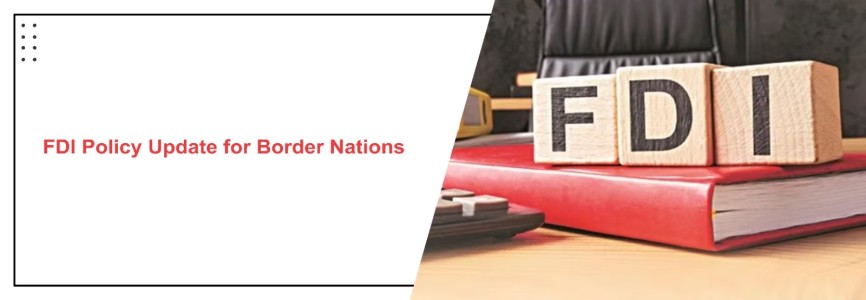



Complete Guide to FDI Compliance, Beneficial Ownership Rules and RBI Reporting Requirements with approval
Foreign Direct Investment (FDI) remains one of the most important channels through which India attracts capital, technology, and global partnerships. Over the last two decades, India has steadily liberalised its foreign investment framework to encourage international participation in various sectors of the economy. However, certain regulatory safeguards have also been introduced to ensure that investments do not adversely affect national security or strategic interests.
One such safeguard relates to investments originating from countries sharing land borders with India, commonly referred to as Land Bordering Countries (LBCs). These countries include China, Bangladesh, Pakistan, Nepal, Bhutan, Myanmar, and Afghanistan.
In April 2020, the Government of India introduced a major regulatory change through Press Note 3 (2020), requiring prior government approval for investments from these jurisdictions. The objective was to prevent opportunistic acquisitions of Indian companies during the economic slowdown caused by the COVID-19 pandemic.
After several years of implementation, the Government reviewed the policy and introduced amendments on 10 March 2026, aimed at improving clarity, reducing unnecessary compliance barriers, and supporting legitimate investments while maintaining adequate safeguards.
Land Bordering Countries under India’s FDI policy
India’s foreign investment regulations treat investments from neighbouring jurisdictions differently due to geopolitical and national security considerations. Under the FDI policy, the term Land Bordering Countries (LBCs) refers to countries that share a land boundary with India.
These include:
-
China
-
Bangladesh
-
Pakistan
-
Nepal
-
Bhutan
-
Myanmar
-
Afghanistan
If an entity incorporated in any of these jurisdictions invests in an Indian company as a Private Limited/ LLP or other category, the investment may fall within the scope of the special regulatory compliances applicable to LBC investments (FDI). Importantly, the restrictions do not apply only to direct investments but also apply where the beneficial owner of the investment is located in or is a citizen of any such country, even if the investment is routed through an entity incorporated in another jurisdiction. This aspect makes the concept of beneficial ownership extremely important when structuring foreign investments into India under section 89 & 90 under the companies Act 2013. The Companies (Significant Beneficial Owners) Rules, 2018, were initially introduced by the Ministry of Corporate Affairs (MCA) on June 13, 2018.
FDI Policy: Press Note 3 (2020) and the Government Approval Requirement
The RBI structure governing investments from land bordering countries underwent a major shift in April 2020 (Coid -19 Times) when the Government issued Press Note 3 (2020 Series).The policy introduced the following key requirement:
Any entity of a country sharing land borders with India, or where the beneficial owner of an investment into India is located in or is a citizen of such a country, can invest in India only under the Government approval route after the FDI Compliances.
Further, any transfer of ownership of existing or future FDI that results in beneficial ownership falling within these jurisdictions also requires government approval and must file the FC-TRS under FDI Compliances, which means that even indirect shareholding exposure from an LBC jurisdiction could trigger regulatory scrutiny. While the policy successfully prevented opportunistic acquisitions during a period of economic vulnerability, it also created operational challenges for global investors. Venture capital and private equity funds operating internationally often have diversified investor bases, including small institutional exposures from land bordering countries.As a result, even non-strategic or minority investments sometimes required lengthy approval processes.
Now, Recognising these challenges, the Union Cabinet approved amendments to the FDI policy relating to LBC investments on 10 March 2026 and introduces several improvements:
-
Formal definition and criteria for determining beneficial ownership (SBO)
-
Automatic route for certain minority investments
-
A defined timeline for approving investments in specific sectors
-
Greater clarity for global investors and venture capital funds
-
Continued safeguards for strategic investments.
Beneficial Ownership Rules under the Revised FDI Policy
One of the most significant changes introduced through the amendment is the incorporation of a clear definition of Beneficial Owner (BO) within the FDI policy. The policy now aligns the determination of beneficial ownership with the criteria prescribed under the Prevention of Money Laundering (Maintenance of Records) Rules, 2005.
Under these rules, the beneficial owner generally refers to the natural person who ultimately owns or controls the investment entity. For the purpose of LBC investment rules, the beneficial ownership test is applied at the level of the investor entity. This clarification is particularly important for global investment funds where shareholding structures may involve multiple layers of investors.
Automatic Route for Minority Investments
Another major improvement introduced through the amendment is the relaxation of approval requirements for certain minority investments.
Under the revised policy, investments where beneficial ownership from LBC investors does not exceed 10 percent and does not confer control may be permitted under the automatic route, subject to sectoral caps and regulatory conditions.
This means that small non-controlling investments by LBC investors will no longer automatically trigger the government approval process. However, such investments remain subject to disclosure requirements and must be reported appropriately by the Indian investee entity.
This change is expected to significantly benefit venture capital funds and global institutional investors, where LBC exposure is minimal and purely financial in nature.
Situations Where Government Approval is Still Required
Despite the relaxation for minority investments, government approval continues to be mandatory in several circumstances, Approval will generally be required where:
-
LBC investors hold controlling interest in the Indian company
-
Beneficial ownership exceeds the permitted threshold
-
Investments involve strategic sectors
-
Transfer of shares results in beneficial ownership shifting to an LBC jurisdiction.
Introduction of a 60-Day Approval Timeline
Another key improvement introduced through the amendment is the creation of a definitive timeline for processing certain investment proposals. Under the revised policy, proposals relating to specific manufacturing sectors will be processed and decided within approximately 60 days. These sectors include manufacturing activities such as:
-
capital goods
-
electronic capital goods
-
electronic components
-
polysilicon manufacturing
-
ingot-wafer manufacturing.
These industries are considered strategically important for India’s manufacturing ecosystem and supply chain resilience.
By introducing a predictable approval timeline, the government aims to encourage companies to enter into technology collaborations, manufacturing partnerships, and joint ventures more efficiently.
Ownership and Control
Even where investment from LBC investors is permitted, the policy requires that majority ownership and effective control of the Indian investee entity remain with resident Indian citizens or Indian entities owned and controlled by resident Indians. This protection allows that foreign participation does not compromise the strategic control of domestic businesses.
FDI Compliance Requirements under FEMA
Foreign investments into India are regulated under the Foreign Exchange Management Act (FEMA), 1999, and the Foreign Exchange Management (Non-Debt Instruments) Rules, 2019. While the FDI policy framework is issued by the Department for Promotion of Industry and Internal Trade (DPIIT), the operational and reporting aspects are administered by the Reserve Bank of India (RBI). Indian companies receiving foreign investment must comply with several reporting obligations through the RBI FIRMS portal FC-GPR & FC-TRS.
Advance Reporting of Foreign Investment
Whenever an Indian company receives foreign investment funds, the inflow must be reported to RBI through the Advance Reporting Form within 30 days of receiving the funds. This reporting requirement ensures that the RBI maintains records of all foreign capital entering the country.
Filing of Form FC-GPR
After the Indian company issues shares to the foreign investor, the company must file Form FC-GPR through its Authorised Dealer Bank within 30 days of the allotment of shares. This form provides details regarding the investment, shareholding structure, valuation of shares, and compliance with sectoral caps.
Reporting of Share Transfers through FC-TRS
Where shares are transferred between resident and non-resident investors, the transaction must be reported using Form FC-TRS.
This ensures that changes in foreign ownership of Indian companies are properly documented and monitored.
Annual FLA Return
Every Indian company that has received foreign investment must submit the Foreign Liabilities and Assets (FLA) Return annually to the RBI. This return captures information regarding foreign investment liabilities and overseas assets held by Indian companies.
Downstream Investment Reporting
If an Indian company receiving foreign investment subsequently invests in another Indian entity, the transaction may qualify as downstream investment and must be reported in accordance with FEMA regulations.
Compliance for Foreign Companies Establishing Presence in India
Foreign investors typically enter the Indian market through structures such as:
-
Joint Venture Company
-
Strategic equity investment in existing businesses
-
Venture capital funding of startups.
When the investor is from a land bordering country or has beneficial ownership exposure from such jurisdictions, additional due diligence is required. Companies must carefully evaluate:
-
beneficial ownership structure and filing of BEN-2 Reporting
-
applicable entry route under FDI policy
-
sectoral investment limits and approval
-
compliance with FEMA reporting requirements.
-
MCA Compliances and reporting with allotments
Impact on Startups and Venture Capital Investments
One of the most important objectives of the policy amendment is to improve access to global funding for Indian startups and deep-technology companies. Many venture capital funds have global investor bases where small allocations may originate from LBC jurisdictions. Allowing minority beneficial ownership under the automatic route reduces regulatory uncertainty and facilitates smoother fundraising for Indian startups.
DIN Security Clearance Requirement for Directors from Land Bordering Countries
In addition to compliance with the Foreign Direct Investment policy, foreign nationals from countries sharing land borders with India who intend to act as directors in Indian companies must comply with specific regulatory requirements relating to Director Identification Number (DIN) allotment and DIN security clearance from MHA.The Ministry of Corporate Affairs has mandated that individuals who are citizens of countries sharing land borders with India, including China, Bangladesh, Pakistan, Nepal, Bhutan, Myanmar, and Afghanistan, must obtain security clearance from the Ministry of Home Affairs (MHA) before a DIN can be allotted or before they are appointed as directors in Indian companies.Accordingly, while applying for a Director Identification Number (DIN) through Form DIR-3 or SPICe+, such applicants are required to undergo additional verification and obtain government approval. This requirement applies even where the investment itself is permitted under the FDI policy, ensuring that board-level participation by individuals from land-bordering countries is subject to national security review under the Companies Act, 2013 and MCA guidelines.
India’s Manufacturing Ecosystem
The revised policy also supports India’s broader objective of expanding domestic manufacturing capacity. Faster approval processes for investments in sectors such as electronics, capital goods, and solar components can encourage foreign companies to collaborate with Indian firms in establishing production facilities. These partnerships can contribute to technology transfer, domestic value addition, and integration into global supply chains.
Therefore, we can opine that, the amendments 2026 to the FDI policy for land bordering countries announced on 10 March 2026 represent a carefully balanced approach toward foreign investment regulation. By introducing a clear definition of beneficial ownership, allowing minority investments under the automatic route, and creating a time-bound approval mechanism for strategic sectors, the government has addressed many of the concerns raised by investors while maintaining necessary safeguards.
For companies receiving foreign investment, careful attention to beneficial ownership disclosures, FEMA compliance requirements, and RBI reporting obligations remains essential including DIN Security clearance.


_crop10_thumb.jpg)





_crop10_thumb.jpg)
_crop10_thumb.jpg)


_crop10_thumb.jpg)


_crop10_thumb.jpg)


_crop10_thumb.jpg)

_crop10_thumb.jpg)


-suratgujarat-section-158_crop10_thumb.jpg)
-suratgujarat_crop10_thumb.jpg)
-(33)_crop10_thumb.jpg)


-ahmedabad_crop10_thumb.jpg)
-learn_crop10_thumb.jpg)

-learnn_crop10_thumb.jpg)


_crop10_thumb.jpg)








_Guidelines_learn_crop10_thumb.jpg)


_learn_crop10_thumb.jpg)
_crop10_thumb.jpeg)


_crop10_thumb.jpg)


_Second_Amendment_Rules,_2025_learn_crop10_thumb.jpg)


_learn_crop10_thumb.jpg)




















_learn_crop10_thumb.jpeg)





















_learn_crop10_thumb.jpg)


_rd_roc_learn_crop10_thumb.jpg)















_learn_crop10_thumb.jpg)












_learn_crop10_thumb.jpg)
_Learn_crop10_thumb.jpg)



































_learn_crop10_thumb.jpg)



_learn_crop10_thumb.jpg)











_crop10_thumb.jpeg)
















_crop10_thumb.jpg)




















_crop10_thumb.jpg)