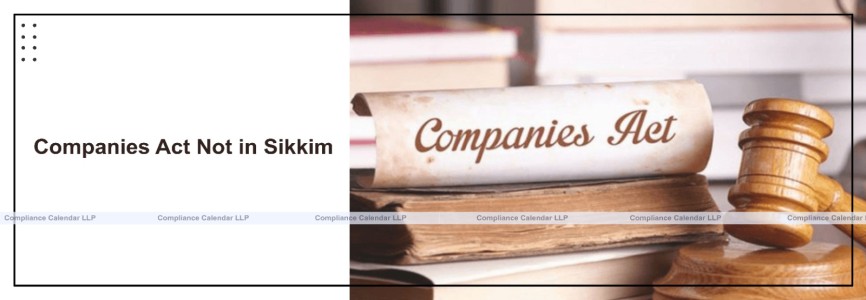



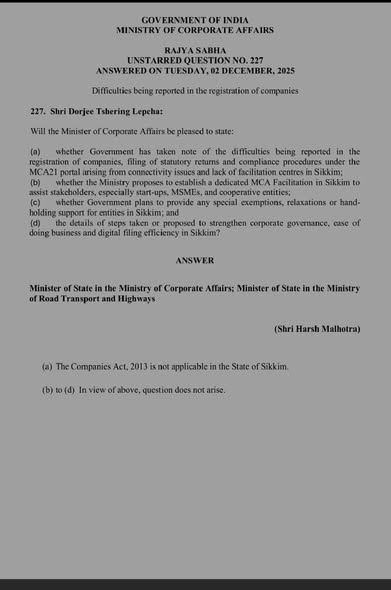
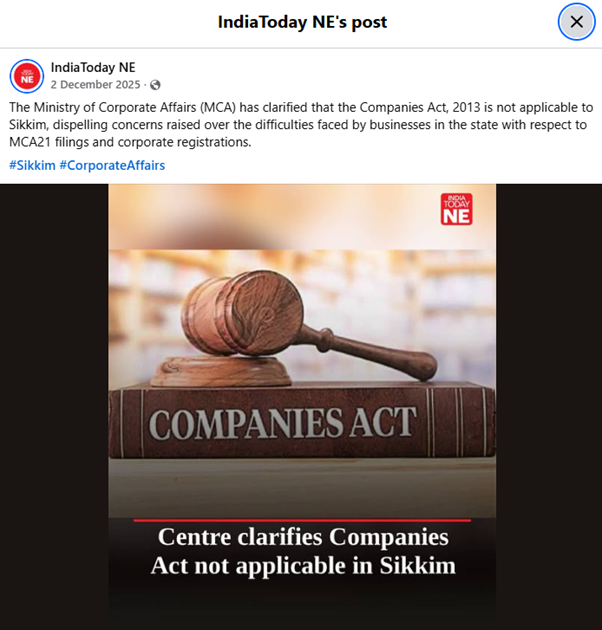
How to register a company in Sikkim which is part of India as the applicability of the Companies Act, 2013 to the State of Sikkim has long remained a subject of uncertainty for businesses, professionals, and policymakers and this ambiguity has now been decisively addressed following a written reply in the Rajya Sabha, where the Ministry of Corporate Affairs (MCA) clarified that the Companies Act, 2013 does not extend to the State of Sikkim, where clarification has far-reaching legal, regulatory, and economic implications for companies, startups, MSMEs, and cooperative entities operating or intending to operate in Sikkim.The Ministry’s repeated clarification through Dec 02, 2025, reaffirms that corporate regulation in Sikkim continues to rest exclusively with the State-specific legal framework. Until formal concurrence is granted and a notification is issued, the Companies Act, 2013 remains inapplicable to Sikkim, and any deviation from this position is liable to be treated as a procedural and administrative error.
The Rajya Sabha reply also implicitly acknowledges administrative inconsistencies. The Ministry disclosed that certain companies were mistakenly incorporated under the Companies Act, 2013 with registered offices in Sikkim, an action now admitted to be contrary to law. The MCA has confirmed that corrective and administrative action is being initiated against the officials responsible.
Constitutional and Legal Background of Sikkim’s Special Status
Sikkim occupies a unique constitutional position within the Indian legal framework. Upon its merger with India in 1975, special protections were preserved under Article 371F of the Constitution of India. Unlike other states, several Central enactments do not automatically apply to Sikkim unless specifically extended by a notification or legislative action. In the context of corporate law, this special status means that the Companies Act, 2013, India’s principal legislation governing companies has not been extended to the state of Sikkim.
As a result, corporate entities in Sikkim continue to be governed by the Companies Act, 1956 / Companies Act, 1961 (Sikkim) structures, which are administered at the state level. The MCA has now categorically confirmed that it has no jurisdiction to provide support, exemptions, facilitation, or regulatory oversight for companies in Sikkim under the 2013 Act while filing form Spice Part -B, not allowing the PIN code for Sikkim Companies.
Source: TOI
Implications of MCA’s Clarification
The legal position was once again unequivocally clarified by the Ministry of Corporate Affairs in response to Unstarred Question No. 2943 raised in the Rajya Sabha on 19 August 2025 by Dorjee Tshering Lepcha. Replying on behalf of the Ministry, the Hon’ble Minister of State for Corporate Affairs, Harsh Malhotra, categorically stated that:
“The Companies Act, 2013 is not applicable to the State of Sikkim.”
This statement formally reaffirmed the long-standing legal position and dispelled any residual ambiguity regarding the applicability of the 2013 Act within the State.
Further, A written reply placed before the Rajya Sabha has finally brought long-awaited clarity on the applicability of the Companies Act, 2013 to the State of Sikkim. In response to a question raised by Dorjee Tshering Lepcha, the Ministry of Corporate Affairs (MCA) categorically confirmed that the Companies Act, 2013 does not extend to Sikkim. The reply, issued by the Hon’ble Minister of State for Corporate Affairs Harsh Malhotra, has significant legal, regulatory, and economic implications for companies, startups, MSMEs, and cooperative entities operating in the State.
Continuing Force of the Sikkim Registration of Companies Act, 1961
As on date, and continuing through December 2025, the Sikkim Registration of Companies Act, 1961 remains fully operative and legally valid within the State of Sikkim. Companies incorporated under this Act such as Sikkim Mining Corporation Ltd. and Sikkim Distilleries Ltd. continue to be governed exclusively by its provisions. At the same time, companies incorporated outside Sikkim but operating within the State such as Reliance Jio Infocomm Ltd. and Zomato Ltd or other companies remain governed by the Companies Act, 2013 and other applicable Central laws, based on their place of incorporation.
Regulatory Vacuum and Economic Concerns
One of the most critical concerns arising from this situation is the existence of a regulatory vacuum. While Sikkim follows its own corporate legislation, the lack of digitised systems, public access to records, and harmonisation with national laws has created uncertainty. Investors, financial institutions, and startup founders often hesitate to engage due to unclear enforcement standards and limited visibility into corporate governance practices.
In an era where ease of doing business, digitisation, and regulatory certainty are essential, this legal isolation risks placing Sikkim at a disadvantage despite its strong potential in tourism, organic agriculture, hydropower, and MSME-driven industries.
Need for Immediate State-Level Action
Given the MCA’s unequivocal position, it is imperative for the State Government of Sikkim to take proactive steps. At the minimum, the state must issue a detailed public clarification on the continued applicability, scope, and operational mechanics of the Companies Act, 1961 (or the applicable local law). The long-pending committee report examining corporate regulation in Sikkim should be made public to ensure transparency and informed stakeholder participation.
Additionally, there is an urgent need to establish a dedicated facilitation mechanism for local companies, startups, MSMEs, and cooperatives. Without such support, businesses are left navigating outdated processes that do not align with contemporary compliance standards followed across India.
Strategic Opportunity for Harmonisation with Central Law
While the Companies Act, 2013 does not currently apply to Sikkim, this situation presents a strategic opportunity rather than a limitation. The State Government can initiate structured negotiations with the Central Government to selectively adopt or align key provisions of the 2013 Act, while still preserving constitutional protections under Article 371F.
Such harmonisation could enable modern corporate governance practices, stronger investor protection, improved compliance transparency, and enhanced economic integration—without diluting Sikkim’s special constitutional status.
Way Forward: Transparency, Digitisation, and Governance Reform
For sustainable economic growth, Sikkim must move toward a clear, time-bound roadmap for corporate regulation. Digitisation of corporate records, establishment of an online filing and inspection system, and creation of a multi-stakeholder advisory panel comprising professionals, industry representatives, and policymakers are essential steps.
The MCA’s clarification makes one position abundantly clear: Sikkim cannot function in a regulatory grey zone any longer. With the Companies Act, 2013 explicitly ruled out, the onus now lies squarely on the State Government to ensure clarity, transparency, and effective corporate governance under its own legal framework. Businesses, professionals, and citizens alike now expect timely policy direction and corrective action to secure Sikkim’s economic future within its unique constitutional identity.


_crop10_thumb.jpg)





_crop10_thumb.jpg)
_crop10_thumb.jpg)


_crop10_thumb.jpg)


_crop10_thumb.jpg)


_crop10_thumb.jpg)

_crop10_thumb.jpg)


-suratgujarat-section-158_crop10_thumb.jpg)
-suratgujarat_crop10_thumb.jpg)
-(33)_crop10_thumb.jpg)


-ahmedabad_crop10_thumb.jpg)
-learn_crop10_thumb.jpg)

-learnn_crop10_thumb.jpg)


_crop10_thumb.jpg)








_Guidelines_learn_crop10_thumb.jpg)


_learn_crop10_thumb.jpg)
_crop10_thumb.jpeg)


_crop10_thumb.jpg)


_Second_Amendment_Rules,_2025_learn_crop10_thumb.jpg)


_learn_crop10_thumb.jpg)


















_learn_crop10_thumb.jpeg)





















_learn_crop10_thumb.jpg)


_rd_roc_learn_crop10_thumb.jpg)















_learn_crop10_thumb.jpg)










_learn_crop10_thumb.jpg)
_Learn_crop10_thumb.jpg)



































_learn_crop10_thumb.jpg)



_learn_crop10_thumb.jpg)













_crop10_thumb.jpeg)
















_crop10_thumb.jpg)




















_crop10_thumb.jpg)