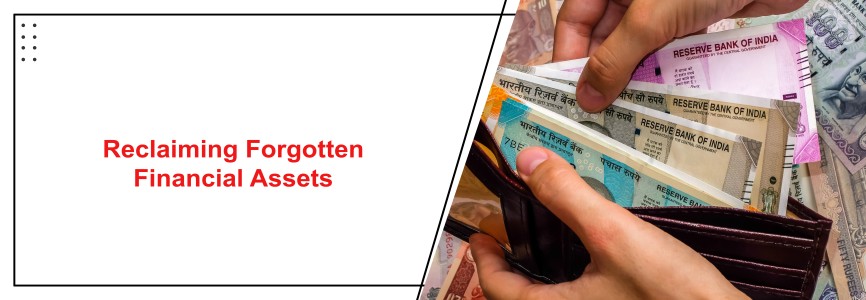



Across generations, Indian families have saved diligently by opening bank accounts, purchasing insurance policies, investing in mutual funds, earning dividends from shares, and setting aside funds for retirement. These financial decisions are made with the intention of securing education, healthcare, and financial stability for the future.
Over time, however, a significant portion of these savings remains unclaimed. The funds are safe with regulated financial institutions but become disconnected from their rightful owners due to lack of awareness, outdated records, migration, changes in contact details, or missing documentation. In many cases, families and legal heirs are unaware that such assets exist.
Your Money, Your Right is a national effort to reconnect citizens with these forgotten financial assets and ensure that money belonging to individuals and families is returned to them.
What Are Unclaimed Financial Assets
Unclaimed financial assets arise when funds held with financial institutions are not claimed by the account holder or their legal heirs for a prolonged period. These include:
-
Bank deposits such as savings, current, fixed, and recurring deposits that remain inactive for ten years or more
-
Insurance policy proceeds unpaid beyond the due date
-
Mutual fund redemption proceeds or dividends not credited due to closed or incorrect bank details
-
Dividends and shares transferred to statutory authorities due to non-claim
-
Pension and retirement benefits not claimed in the normal course
Such assets often become unclaimed due to routine life events such as relocation, job changes, closure of old accounts, or lack of information among family members.
The “Your Money, Your Right” Initiative
To address the issue of unclaimed financial assets in a structured and citizen-focused manner, the Government launched Your Money, Your Right in October 2025 as a nationwide awareness and facilitation initiative. The campaign aims to bridge the gap between citizens and their unclaimed financial assets through clear guidance and accessible recovery mechanisms.
The initiative is coordinated by the Department of Financial Services, Ministry of Finance, in close collaboration with key financial sector regulators, including the Reserve Bank of India (RBI), Insurance Regulatory and Development Authority of India (IRDAI), Securities and Exchange Board of India (SEBI), Investor Education and Protection Fund Authority (IEPFA), and the Pension Fund Regulatory and Development Authority (PFRDA).
Its core objective is to enable citizens to identify, access, and reclaim their rightful financial assets through simple, transparent, and standardized processes, thereby strengthening trust, financial inclusion, and citizen ownership within the formal financial system.
The Scale of Unclaimed Money
-
Unclaimed Bank Deposits – Rs.78,000 Crore: This includes savings, current, fixed, and recurring deposit accounts that have remained inactive for ten years or more. Such deposits usually become unclaimed due to migration, change in address, or lack of awareness among account holders or their legal heirs.
-
Unclaimed Insurance Proceeds – Rs.14,000 Crore: These amounts relate to life insurance maturity benefits and death claims that were not settled. Common reasons include missing nominations, outdated policy records, or beneficiaries being unaware of existing insurance policies.
-
Unclaimed Mutual Fund Amounts – Rs.3,000 Crore: This covers mutual fund redemption proceeds and dividends that could not be credited due to incorrect bank details, closed accounts, or incomplete KYC. The funds remain safe with mutual fund houses and registrars until claimed.
-
Unclaimed Dividends – Rs.9,000 Crore: Unclaimed dividends arise when shareholders do not encash dividend warrants or fail to update personal or bank details. After a prescribed period, such dividends are transferred to statutory authorities, though ownership rights remain intact.
-
Overall Significance: These figures represent a large pool of citizen-owned wealth that remains idle despite being securely held within the regulated financial system, highlighting the need for awareness and recovery initiatives.
Why Unclaimed Assets Matter
Unclaimed assets are not just unused money; they often represent essential financial support that families are unable to access when they need it most. For households, unclaimed savings can limit the ability to pay for education, medical treatment, daily expenses, or emergency needs. For senior citizens, unclaimed pensions or insurance benefits may directly affect their independence, financial stability, and dignity during retirement.
At a broader level, unclaimed assets create a disconnect between citizens and the formal financial system. When people cannot access money that rightfully belongs to them, trust in financial institutions may weaken. By enabling easy identification and recovery of such assets, the initiative helps restore confidence, strengthens household finances, and promotes a more inclusive and reliable financial system that works in the interest of all citizens.
Digital Platforms for Tracing Unclaimed Assets
Unclaimed Bank Deposits – UDGAM Portal
The UDGAM portal is an online platform created by the Reserve Bank of India to help citizens find unclaimed bank deposits in one place. Instead of approaching different banks separately, individuals can use this portal to check whether any inactive or unclaimed accounts exist in their name or in the name of a family member.
Although the search facility is centralized, the actual claim and payment are handled by the concerned bank. Even when deposits remain unclaimed for ten years and are transferred to the Depositor Education and Awareness Fund, the money continues to belong to the account holder or their legal heirs. There is no deadline for claiming these funds, ensuring that rightful owners can recover their money at any time.
Insurance Proceeds – Bima Bharosa Portal
The Bima Bharosa portal is an online platform designed to help policyholders, nominees, and legal heirs identify unclaimed insurance amounts. It connects users to the enquiry systems of insurance companies, making it easier to check whether any insurance maturity benefits or death claims are pending.
An insurance amount is considered unclaimed when it remains unpaid for more than twelve months from the due date. If such proceeds remain unclaimed for over ten years, they are transferred to the Senior Citizens’ Welfare Fund. This transfer does not change ownership rights, and beneficiaries can claim the amount for up to twenty-five years without paying any fee.
Conclusion
The Your Money, Your Right initiative strongly affirms that financial assets never lose their rightful ownership, even if they remain unclaimed for many years. Money held in banks, insurance companies, mutual funds, or retirement systems continues to belong to the individual or their legal heirs. By using digital platforms, coordinated efforts of financial regulators, and on-ground facilitation, the initiative makes it easier for citizens to trace forgotten savings and reclaim what is legally theirs without unnecessary complexity or cost.
By ensuring that unclaimed assets are identified and returned, the initiative plays an important role in strengthening financial inclusion and public confidence in the financial system. When people are able to recover their hard-earned money, it reinforces trust in financial institutions and encourages greater participation in formal savings and investment channels. Ultimately, Your Money, Your Right ensures that accumulated savings fulfil their original purpose supporting families, safeguarding financial security, and preserving dignity across generations.
Frequently Asked Questions (FAQs)
Q1. What does “Your Money, Your Right” mean?
Ans. “Your Money, Your Right” is a national initiative that helps citizens trace and reclaim unclaimed financial assets. It reinforces that money held in banks, insurance companies, and investment institutions always belongs to the rightful owner or legal heirs.
Q2. What are unclaimed financial assets?
Ans. Unclaimed financial assets are funds that remain inactive or unpaid for a long period. These include bank deposits, insurance proceeds, mutual fund investments, dividends, shares, pensions, and retirement benefits not claimed by owners or their heirs.
Q3. Why do financial assets become unclaimed?
Ans. Financial assets become unclaimed due to migration, job changes, death of the holder without nomination, outdated contact or bank details, lack of awareness, or family members being unaware of existing investments or financial accounts.
Q4. Does unclaimed money become government property?
Ans. No, unclaimed money never becomes government property. Even when transferred to statutory funds, ownership rights remain with the original holder or legal heirs, who can claim the money by following the prescribed recovery process.
Q5. Who is eligible to claim unclaimed financial assets?
Ans. The original account holder, registered nominee, or legal heirs are eligible to claim unclaimed financial assets. Legal heirs may need to submit supporting documents such as a death certificate, succession certificate, or legal heir certificate.
Q6. How can citizens check unclaimed bank deposits?
Ans. Citizens can search for unclaimed bank deposits through the RBI’s UDGAM portal. It provides a centralized search facility to identify deposits across participating banks, after which claims can be initiated with the respective bank.
Q7. What happens to bank deposits unclaimed for many years?
Ans. Bank deposits unclaimed for ten years or more are transferred to the Depositor Education and Awareness Fund. However, customers or their legal heirs can claim the money at any time, as there is no limitation period.
Q8. How can unclaimed insurance proceeds be traced?
Ans. Unclaimed insurance proceeds can be traced through the Bima Bharosa portal, which links users to insurer enquiry systems. Policyholders, nominees, or legal heirs can approach the concerned insurer to initiate the claim process.
Q9. Is any fee charged to claim unclaimed insurance or bank money?
Ans. No government fee is charged for claiming unclaimed bank deposits or insurance proceeds. Financial institutions are required to assist claimants free of cost, provided valid documents and claim requirements are fulfilled.
Q10. What documents are usually required to claim unclaimed assets?
Ans. Common documents include identity proof, address proof, PAN, bank account details, and claim forms. Legal heirs may also need a death certificate and succession or legal heir documents, depending on the nature of the asset.


_crop10_thumb.jpg)





_crop10_thumb.jpg)
_crop10_thumb.jpg)


_crop10_thumb.jpg)


_crop10_thumb.jpg)


_crop10_thumb.jpg)

_crop10_thumb.jpg)


-suratgujarat-section-158_crop10_thumb.jpg)
-suratgujarat_crop10_thumb.jpg)
-(33)_crop10_thumb.jpg)


-ahmedabad_crop10_thumb.jpg)
-learn_crop10_thumb.jpg)

-learnn_crop10_thumb.jpg)


_crop10_thumb.jpg)








_Guidelines_learn_crop10_thumb.jpg)


_learn_crop10_thumb.jpg)
_crop10_thumb.jpeg)


_crop10_thumb.jpg)


_Second_Amendment_Rules,_2025_learn_crop10_thumb.jpg)


_learn_crop10_thumb.jpg)

















_learn_crop10_thumb.jpeg)



















_learn_crop10_thumb.jpg)

_rd_roc_learn_crop10_thumb.jpg)













_learn_crop10_thumb.jpg)









_learn_crop10_thumb.jpg)
_Learn_crop10_thumb.jpg)



























_learn_crop10_thumb.jpg)


_learn_crop10_thumb.jpg)









_crop10_thumb.jpeg)


















_crop10_thumb.jpg)












_crop10_thumb.jpg)