


If you are reading this article, we assume that you/ your business has received RA/RIA License from SEBI and now looking forward to SCORES Registration to stay compliant. Congratulations on securing the License from SEBI to officially work as RA/RIA. It is important to note that SCORES Portal (www.scores.sebi.gov.in) that is available on basic Google Search is for the public to raise complaint against any SEB Intermediary including Research Analyst (RA) and Registered Investment Adviser (RIA) and same is not used for SCORES Registration for any SEBI Intermediary. It is also noteworthy to note that during the process of RA/RIA License Application to BSE, there is a login given to every RA/RIA, but that also does not provide the option to register on SCORES.
Read the full article as we cover all the steps required to complete SCORES Registration and in case you need assistance, feel free to connect with us for professional help.
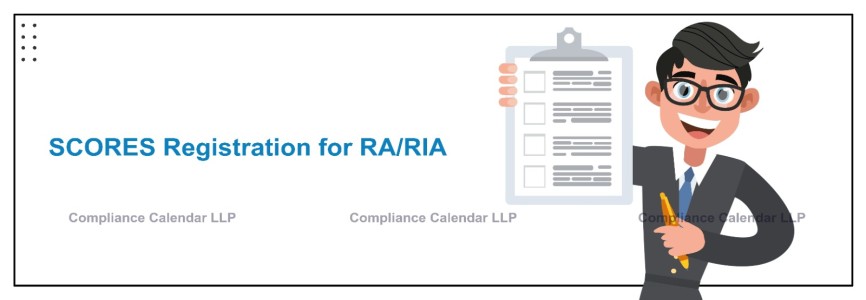
SCORES Registration for RA/RIA
Investor protection is at the heart of India’s securities regulatory (SEBI). For Research Analysts (RA) and Registered Investment Advisers (RIA), this responsibility is not limited to suitability, disclosures, or ethical conduct alone. It also extends to effective, timely, and traceable grievance redressal, which is operationalised through the SCORES platform. If you have recently received license from SEBI, it is mandatory to complete SCORES registration within 30 days to remain compliant and for continuing obligations for every RA and RIA operating in India.
SCORES Registration from an RA/RIA Perspective
SCORES, or the SEBI Complaints Redress System, is a centralised electronic grievance redressal platform administered by Securities and Exchange Board of India. It provides investors with a single, uniform channel to lodge complaints against SEBI-regulated entities, including Research Analysts and Investment Advisers.
For RAs and RIAs, SCORES functions as the only recognised regulatory interface through which investor complaints are formally received, tracked, responded to, and monitored by SEBI. Every complaint filed on SCORES is time-stamped, workflow-driven, and auditable. This makes grievance handling a measurable compliance parameter rather than an informal service function.
Regulatory basis for SCORES applicability to RAs and RIAs
Both the SEBI (Research Analysts) Regulations, 2014 and the SEBI (Investment Advisers) Regulations, 2013 mandate that registered intermediaries must have a robust investor grievance redressal mechanism. SEBI has prescribed SCORES as the official electronic system to fulfil this requirement.
Accordingly, an RA or RIA is expected to:
-
be registered and authenticated on SCORES,
-
receive and respond to investor complaints exclusively through the platform, and
-
comply with prescribed timelines and response standards.
SEBI treats non-registration on SCORES, non-response to complaints, or poor-quality redressal as regulatory non-compliance, which may affect registration status, renewal, or supervisory assessments.
SCORES V2.0 and its relevance for RA/RIA compliance
SEBI has migrated the grievance mechanism to SCORES V2.0, a more structured and process-oriented system. SCORES V2.0 standardises how complaints are received, routed, responded to, escalated, and closed.
The SCORES V2.0 requirement framework lays down:
-
mandatory authentication of intermediaries,
-
designation of an authorised grievance handling contact,
-
structured submission of Action Taken Reports (ATR), and
-
system-driven monitoring by SEBI and supervisory authorities
For RAs and RIAs, this means grievance handling is no longer discretionary or informal. Each stage from acknowledgement to closure is visible to SEBI.
SCORES registration process for RAs and RIAs
SCORES registration for an RA or RIA typically follows the grant of SEBI registration. The intermediary is required to apply for authentication and activation on the SCORES portal using the prescribed format and supporting documents.
At the registration stage, SEBI focuses on three key compliance pillars. The first is identity validation, where the intermediary’s name, category (RA or RIA), SEBI registration number, and registered office details must exactly match SEBI’s records. Any mismatch often leads to delays or re-submission.
The second pillar is designation of the authorised person. RAs and RIAs must nominate a responsible individual usually the Compliance Officer or the individual adviser who will act as the nodal officer for SCORES. This person receives portal access and becomes accountable for grievance handling, response quality, and timeliness.
The third pillar is regulatory undertaking, whereby the intermediary confirms adherence to SEBI’s grievance redressal timelines and commits to submitting accurate and reasoned Action Taken Reports.
RA/RIA needs to send the application to scores@sebi.gov.in for SCORES Registration in the prescribed format of Form-B for SCORES Authentication. Once SEBI authenticates the application, SCORES login credentials are issued, enabling access to the intermediary dashboard.
Particulars Required under Form-B for SCORES Registration (RA / RIA)
Form-B is the prescribed authentication form required to be submitted by SEBI-registered intermediaries for activation and access to the SCORES portal. For Research Analysts (RA) and Registered Investment Advisers (RIA), this form enables SEBI to verify the intermediary’s identity and designate an authorised person for handling investor grievances.
The following particulars are mandatorily required under Form-B:
1. Name of the Registered Intermediary
The legal name of the intermediary as recorded in SEBI’s registration records.
This must exactly match the name appearing on the SEBI Registration Certificate to avoid rejection or delay in authentication.
2. Nature of Registered Intermediary
The specific category under which the intermediary is registered with SEBI, such as:
-
Research Analyst, or
-
Investment Adviser
Correct classification is critical because SCORES access rights and supervisory mapping are linked to the intermediary category.
3. SEBI Registration Number
The unique registration number allotted by SEBI at the time of grant of registration.
This number acts as the primary identifier for mapping the intermediary on the SCORES system.
4. PAN of the Registered Intermediary
The Permanent Account Number (PAN) of the intermediary, as registered with SEBI.
PAN details are used for identity verification and regulatory cross-validation.
5. Date of SEBI Registration
The effective date on which SEBI granted registration to the intermediary.
This helps SEBI establish regulatory tenure and supervisory history.
6. Validity of SEBI Registration
The validity status of the registration, if applicable.
In cases where registration validity is not time-bound, the form typically reflects the same accordingly.
7. Office Address of the Intermediary
The complete registered or principal office address of the intermediary, including:
-
building or office name,
-
floor or unit details,
-
street or locality,
-
city, state, and PIN code.
This address should be consistent with SEBI filings and official correspondence records.
8. Details of the Authorised Person for SCORES Access
This is one of the most critical sections of Form-B. The intermediary must designate a responsible person to whom SCORES login credentials will be issued. The following particulars are required:
-
Name of the authorised person
-
Designation (such as Compliance Officer, Investment Adviser, or Authorised Signatory)
-
Corporate and permanent email ID (must remain active at all times)
-
Mobile number
-
Telephone number
-
Fax number (if applicable)
The authorised person becomes the official nodal officer for:
-
receiving investor complaints on SCORES,
-
submitting Action Taken Reports (ATR), and
-
coordinating grievance redressal with SEBI.
9. Place and Date
The place and date of execution of Form-B, confirming when and where the form was signed.
10. Signature and Designation of the Authorised Signatory
Form-B must be duly signed by the authorised signatory of the intermediary, clearly mentioning:
-
name, and
-
designation.
Where applicable, the intermediary’s seal may also be affixed.
Purpose of Form-B in SCORES Registration
Form-B serves as a formal declaration and authentication request enabling SEBI to:
-
validate the intermediary’s regulatory identity,
-
confirm authorised grievance-handling personnel, and
-
activate secure SCORES login credentials.
Without submission and acceptance of Form-B, SCORES access is not enabled, and the intermediary is treated as non-compliant with investor grievance redressal requirements.
Complaint lifecycle on SCORES for RAs and RIAs
After activation, all investor complaints relating to advisory or research services are routed to the RA/RIA through SCORES. The complaint lifecycle typically begins with system allocation of the grievance, followed by review and response by the intermediary.
RAs and RIAs are required to examine the grievance on merits, verify internal records, and communicate with the investor where necessary. The response is then uploaded on SCORES in the form of an Action Taken Report. SEBI expects ATRs to be factual, specific, and supported by documentation rather than generic explanations.
If the investor is dissatisfied or if the response is delayed, the complaint may be escalated within the system and flagged for SEBI’s review. Repeated escalations or unresolved complaints often attract regulatory attention.
Timelines and quality expectations
SEBI generally requires complaints on SCORES to be resolved within 30 days, unless a different timeline is prescribed. However, meeting the timeline alone is not sufficient. SEBI closely reviews the quality of responses, including whether:
-
the grievance has been properly understood,
-
regulatory obligations have been correctly applied, and
-
the investor has been provided a reasoned and transparent explanation.
From an RA/RIA compliance standpoint, poorly drafted or evasive responses can be as risky as non-response.
Internal systems expected from RAs and RIAs
SEBI expects SCORES compliance to be supported by internal governance mechanisms. RAs and RIAs should maintain an internal grievance register aligned with SCORES records, document all investor communications, and establish internal escalation and review processes.
Periodic review of complaint trends is also considered a good governance practice, as it helps identify systemic gaps in advisory or research processes. During inspections, SEBI often examines whether the intermediary’s internal records are consistent with SCORES data.
Regulatory consequences of weak SCORES compliance
Ineffective SCORES compliance can have far-reaching consequences for RAs and RIAs. SEBI may seek explanations, issue advisories, impose penalties, or initiate enforcement proceedings in serious cases. SCORES performance is also relevant during renewal of registration and while evaluating applications involving structural changes or expansion of activities.
In contrast, a clean and consistent SCORES track record strengthens regulatory confidence and demonstrates commitment to investor protection.
Role of professional assistance in SCORES compliance
Given the regulatory sensitivity attached to investor grievances, many RAs and RIAs engage professional advisors to support SCORES registration and ongoing compliance. Expert assistance helps ensure accuracy in registration documentation, proper designation of authorised persons, and legally sound drafting of Action Taken Reports.
Compliance Calendar LLP provides end-to-end support to Research Analysts and Investment Advisers for SCORES compliance, covering registration, change of authorised person, grievance response drafting, and advisory during SEBI inspections or escalations. The objective is not only to meet procedural requirements but to maintain a defensible and regulator-aligned grievance redressal framework.
Conclusion
For SEBI-registered Research Analysts and Investment Advisers, SCORES registration and compliance form an important pillar of regulatory obligations. It reflects how responsibly an intermediary handles investor concerns and how seriously it approaches regulatory accountability.
In the evolving securities market, where SEBI increasingly relies on data-driven supervision, disciplined SCORES compliance is indispensable. A structured, well-documented, and timely grievance redressal approach not only mitigates regulatory risk but also reinforces trust and credibility in advisory and research practices.


_crop10_thumb.jpg)




_crop10_thumb.jpg)
_crop10_thumb.jpg)


_crop10_thumb.jpg)


_crop10_thumb.jpg)


_crop10_thumb.jpg)

_crop10_thumb.jpg)


-suratgujarat-section-158_crop10_thumb.jpg)
-suratgujarat_crop10_thumb.jpg)
-(33)_crop10_thumb.jpg)


-ahmedabad_crop10_thumb.jpg)
-learn_crop10_thumb.jpg)

-learnn_crop10_thumb.jpg)


_crop10_thumb.jpg)






_Guidelines_learn_crop10_thumb.jpg)


_learn_crop10_thumb.jpg)
_crop10_thumb.jpeg)


_crop10_thumb.jpg)


_Second_Amendment_Rules,_2025_learn_crop10_thumb.jpg)


_learn_crop10_thumb.jpg)












_learn_crop10_thumb.jpeg)










_learn_crop10_thumb.jpg)

_rd_roc_learn_crop10_thumb.jpg)










_learn_crop10_thumb.jpg)






_learn_crop10_thumb.jpg)
_Learn_crop10_thumb.jpg)


















_learn_crop10_thumb.jpg)



_learn_crop10_thumb.jpg)









_crop10_thumb.jpeg)









_crop10_thumb.jpg)








_crop10_thumb.jpg)