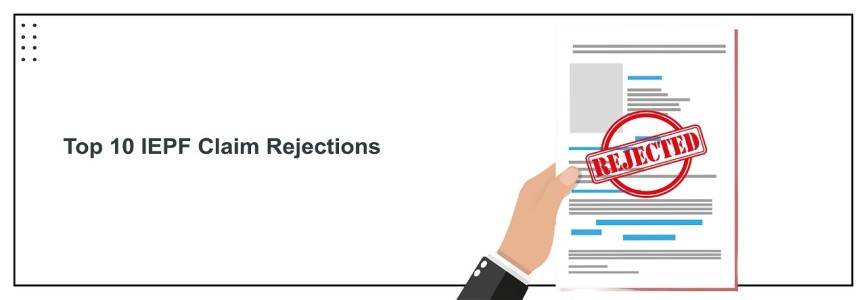



Recovery of shares and dividends transferred to the Investor Education and Protection Fund (IEPF) is governed by a strict statutory under the Companies Act, 2013 and the IEPF Rules. Although the mechanism is designed to protect investors, the actual claim process is highly documentation-driven and compliance-sensitive. As a result, a large number of genuine claims face rejection, resubmission, or prolonged delays.
In practice, IEPF claim rejections rarely arise due to ineligibility. Instead, they occur because of technical discrepancies, procedural non-compliance, or failure to align documents with company and IEPF records. Rejection triggers is an important for shareholders, legal heirs, and professionals handling share recovery matters.
Below is a detailed explanation of the top ten reasons why IEPF share recovery claims get rejected, along with the underlying legal logic behind each rejection.
Mismatch Between Claimant Details and Company Records
The most common and fundamental reason for rejection is mismatch in claimant details when compared with the company’s historical records. The IEPF Authority does not independently verify ownership; instead, it relies on the verification report submitted by the company or its Registrar and Transfer Agent (RTA). If the company cannot conclusively match the claimant’s name, address, or identity with its records, the claim is rejected.
These mismatches often arise due to spelling variations, initials used instead of full names, name changes after marriage, or outdated addresses. Even small differences, such as omission of a middle name or variation in surname spelling, can result in verification failure. Since IEPF operates on a strict documentary standard, subjective assumptions are not permitted, making precise alignment of records essential.
Defective or Incomplete KYC Documentation
IEPF claims involve transfer of securities and release of funds, which places them under heightened scrutiny from an anti-fraud and identity verification perspective. Claims are frequently rejected when KYC documents such as PAN, Aadhaar, passport, or address proof are incomplete, outdated, illegible, or inconsistent with each other.
Another common issue is mismatch between PAN details and bank or demat records. If PAN is not linked with Aadhaar or if the claimant’s name differs across documents, verification fails. Since IEPF refunds are routed only through verified banking and demat systems, any KYC discrepancy is treated as a material defect, leading to rejection.
Inadequate Legal Heir or Succession Documentation
Legal heir claims form a substantial portion of IEPF rejections. When the original shareholder has passed away, the claimant must establish clear legal entitlement to the securities. Rejections occur when claimants rely on informal family arrangements, notarized declarations, or affidavits that do not have statutory backing.
Depending on the circumstances, valid proof may include a succession certificate, probate of will, or letter of administration. Claims are rejected if these documents do not cover all legal heirs, do not specifically mention the securities, or are not issued by a competent court. The IEPF Authority follows a conservative legal approach to avoid wrongful transfer of ownership, making strict succession compliance unavoidable.
Incorrect or Unverified Bank Account Details
One of the most overlooked yet critical reasons for rejection of IEPF share recovery claims is incorrect or unverified bank account details. The Investor Education and Protection Fund releases dividend amounts only through electronic transfer to a bank account that is fully KYC-compliant and held in the claimant’s own name. Any deviation from this requirement is treated as a serious compliance lapse.
Claims are commonly rejected where the bank account is dormant, incorrectly entered, or not mapped correctly with the claimant’s PAN. In some cases, claimants provide joint accounts or accounts belonging to family members, assuming flexibility. However, IEPF strictly disallows third-party accounts to prevent misuse of funds. Even minor differences in spelling between bank records and PAN details can cause verification failure, leading to rejection.
Errors or Deficiencies in Demat Account Details
For recovery of shares from IEPF, possession of an active and correctly mapped demat account is mandatory. Rejections occur when demat accounts are inactive, frozen due to incomplete KYC, or not in the exact name of the claimant. Since IEPF-held shares are transferred only in electronic form, any demat-related issue directly blocks the transfer process.
Another frequent error involves incorrect DP ID or Client ID, or submission of outdated demat account statements. In cases where the demat account name does not exactly match the shareholder name in company records or PAN, the claim is treated as unverifiable. IEPF follows a strict identity-matching approach and does not permit assumptions or discretionary approvals.
Non-Submission or Delayed Submission of Physical Documents to the Company
Although Form IEPF-5 is filed online, the process is incomplete without timely submission of physical documents to the concerned company. Many claims are rejected simply because claimants assume that online filing alone is sufficient. In reality, the company must verify original documents before submitting its verification report to IEPF.
These physical documents typically include original indemnity bonds, advance stamped receipts, affidavits, cancelled cheque, and share certificates (if available). If documents are not submitted within the prescribed time or are incomplete, the company cannot complete verification. As a result, IEPF treats the claim as non-compliant and rejects it, irrespective of the claimant’s eligibility.
Improper Indemnity Bonds and Affidavits
Indemnity bonds and affidavits are legally enforceable documents that safeguard the company and IEPF against future claims or disputes. Rejections occur when these documents are executed on incorrect stamp value, lack proper witness signatures, are not notarized, or do not match the claim value.
Many claimants use generic formats without customizing them for the specific company or claim amount. Some execute indemnity bonds on insufficient stamp paper or omit mandatory declarations. Since these documents form part of the legal record, even minor defects are treated as substantive legal non-compliance, leading to rejection.
Incorrect or Incomplete Filing of Form IEPF-5
Form IEPF-5 is the statutory backbone of the IEPF recovery process. Errors in this form are a leading cause of rejection. Common mistakes include incorrect company CIN, wrong year of transfer to IEPF, mismatch in number of shares, incorrect dividend details, or inaccurate personal information.
The IEPF system cross-checks data entered in Form IEPF-5 with records filed by the company. Any mismatch, even if unintentional, leads to rejection or resubmission. Filing the form without first reconciling company records and dividend history significantly increases the risk of rejection.
Failure to Rectify Earlier Objections Properly
When an IEPF claim is rejected or marked for resubmission, the authority clearly specifies the deficiencies. However, many claimants refile claims without fully addressing these objections. Partial corrections or cosmetic changes do not satisfy IEPF’s verification standards.
Repeated refiling without rectifying the root cause of rejection leads to prolonged delays and repeated rejections. In some cases, it may also raise doubts about the claimant’s diligence. Proper analysis of objection remarks and complete rectification are essential before resubmission.
Lack of Procedural Awareness and Professional Handling
IEPF share recovery is a procedural legal process involving coordination between the claimant, the company, its RTA, and the IEPF Authority. Claims often fail when handled without understanding the correct sequence of steps, documentation hierarchy, and verification timelines.
Common procedural lapses include failure to follow up with the company, improper document sequencing, or misunderstanding company-specific requirements. Professional handling ensures that documents are aligned, timelines are followed, and verification is completed smoothly. Claims managed with procedural clarity have significantly higher approval rates.
Conclusion
Rejection of IEPF share recovery claims is rarely a reflection of lack of entitlement. In most cases, rejections occur due to procedural lapses, documentation defects, or technical mismatches that are entirely avoidable. Points 4 to 10 highlight how critical accuracy, compliance, and process awareness are in the IEPF recovery mechanism.
From correct bank and demat details to proper execution of legal documents and accurate filing of Form IEPF-5, each step carries legal significance. A single mistake can nullify an otherwise valid claim. Therefore, claimants must approach IEPF recovery as a formal legal process rather than a routine application. With careful preparation, proper sequencing, and professional handling, rejection risks can be substantially reduced, ensuring timely and successful recovery of shares and dividends from IEPF.
Frequently Asked Questions (FAQs)
Q1. What is the most common reason for rejection of IEPF share recovery claims?
Ans. The most common reason is mismatch between the claimant’s details and the company’s records. Even minor spelling differences in the shareholder’s name, address, or initials can lead to rejection because the company cannot verify ownership conclusively.
Q2. Can an IEPF claim be rejected even if I am the genuine shareholder?
Ans. Yes. IEPF claims are rejected not based on intention but on documentary verification. Even genuine shareholders face rejection if documents are incomplete, inconsistent, or do not exactly match company records.
Q3. What happens if my name has changed due to marriage or other reasons?
Ans. If your name has changed, you must submit documentary proof of name change, such as a marriage certificate, gazette notification, or affidavit supported by identity documents. Without proper linkage between old and new names, the claim is likely to be rejected.
Q4. Are KYC mismatches really treated as serious issues?
Ans. Yes. Since IEPF claims involve transfer of shares and payment of money, KYC compliance is treated as an important safeguard against fraud. Any mismatch between PAN, Aadhaar, bank, and demat details is considered a material defect.
Q5. Why are legal heir IEPF claims rejected so frequently?
Ans. Legal heir claims are rejected mainly due to insufficient succession proof. Informal family declarations or notarized affidavits without court authority are not accepted. IEPF requires legally recognized documents such as succession certificates, probate, or letters of administration.
Q6. Is a notarized affidavit enough to prove legal heirship?
Ans. In most cases, no. A notarized affidavit alone is usually insufficient unless accompanied by statutory documents. IEPF follows a conservative legal approach to avoid wrongful transfer of securities.
Q7. Can I use a joint bank account for receiving IEPF refunds?
Ans. Generally, no. The bank account must be in the claimant’s own name and fully KYC-compliant. Joint or third-party accounts often result in rejection unless specifically permitted and properly documented.
Q8. Is online filing of Form IEPF-5 enough to complete the process?
Ans. No. Filing Form IEPF-5 online is only the first step. Submission of original physical documents to the concerned company is mandatory. Failure to do so results in rejection, even if the online form is correctly filed.
Q9. What physical documents are usually required by the company?
Ans. Typically, companies require original indemnity bonds, advance stamped receipts, affidavits, share certificates (if available), identity proofs, and cancelled cheque. Missing or delayed submission of these documents leads to negative verification reports.
Q10. Why are indemnity bonds and affidavits scrutinized so strictly?
Ans. Indemnity bonds and affidavits are legally enforceable documents that protect the company and the Investor Education and Protection Fund from future claims. Incorrect stamp value, missing witnesses, or improper notarization makes them legally invalid.


_crop10_thumb.jpg)





_crop10_thumb.jpg)
_crop10_thumb.jpg)


_crop10_thumb.jpg)


_crop10_thumb.jpg)


_crop10_thumb.jpg)

_crop10_thumb.jpg)


-suratgujarat-section-158_crop10_thumb.jpg)
-suratgujarat_crop10_thumb.jpg)
-(33)_crop10_thumb.jpg)


-ahmedabad_crop10_thumb.jpg)
-learn_crop10_thumb.jpg)

-learnn_crop10_thumb.jpg)


_crop10_thumb.jpg)








_Guidelines_learn_crop10_thumb.jpg)


_learn_crop10_thumb.jpg)
_crop10_thumb.jpeg)


_crop10_thumb.jpg)


_Second_Amendment_Rules,_2025_learn_crop10_thumb.jpg)


_learn_crop10_thumb.jpg)




















_learn_crop10_thumb.jpeg)

















_learn_crop10_thumb.jpg)


_rd_roc_learn_crop10_thumb.jpg)










_learn_crop10_thumb.jpg)








_learn_crop10_thumb.jpg)
_Learn_crop10_thumb.jpg)























_learn_crop10_thumb.jpg)

_learn_crop10_thumb.jpg)











_crop10_thumb.jpeg)












_crop10_thumb.jpg)
















_crop10_thumb.jpg)