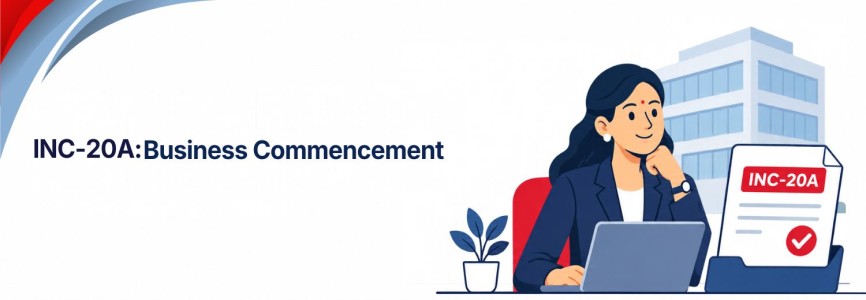



Registering a company is an important milestone for any entrepreneur. However, receiving the Certificate of Incorporation does not mean that every newly registered company can immediately begin commercial operations. Certain companies must first complete a legal requirement called the declaration for commencement of business, filed through Form INC-20A.
This declaration helps confirm that the subscribers have paid for the shares they agreed to take when the company was formed. It is an important part of post-incorporation compliance and should be planned alongside opening the company’s bank account, arranging its registered office and obtaining applicable business approvals. For founders, understanding INC-20A early can prevent launch delays, filing difficulties and penalties. This article explains its applicability, deadline, documents, filing process and practical points that companies should consider.
What Is Form INC-20A?
Form INC-20A is the declaration for commencement of business filed by a director with the Registrar of Companies, commonly called the ROC. It confirms that every subscriber to the Memorandum of Association has paid the value of the shares they agreed to take. The declaration forms part of the requirements under Section 10A of the Companies Act, 2013.
An applicable company must also have filed verification of its registered office before beginning business or exercising borrowing powers. In simple terms, incorporation establishes the company’s legal existence, while commencement compliance addresses additional conditions that apply before it starts operating. Founders should therefore treat INC-20A as an essential step in their launch preparations.
Legal Provisions Governing INC-20A Filing
The main provisions governing commencement of business filing are Section 10A of the Companies Act, 2013 and Rule 23A of the Companies (Incorporation) Rules, 2014. Rule 23A prescribes Form INC-20A and requires its contents to be verified by a practising Chartered Accountant, Company Secretary or Cost Accountant. It also requires applicable sectoral registration or approval to be obtained and attached where the company pursues objects requiring such permission.
The declaration should therefore be supported by reliable records. Directors should review the information carefully rather than treating professional certification as a substitute for checking the company’s own documents.
Which Companies Must File Form INC-20A?
The requirement generally applies to companies incorporated on or after 2 November 2018 that have share capital. The declaration must be filed within 180 days of incorporation and is a prerequisite for commencing business or exercising borrowing powers.
A company’s turnover, customer base or expected profits do not determine whether it needs to file. Even a small company preparing to launch its first service should assess the requirement immediately after incorporation.
Private Limited Companies
A private limited company meeting the incorporation-date and share-capital conditions must generally file INC-20A. This includes companies formed for trading, manufacturing, consulting, software services, e-commerce and other activities. Many founders begin arranging sales and customer contracts soon after registration. Including commencement compliance in the initial checklist helps ensure that the proposed launch date is supported by completed legal formalities.
Public Limited Companies
Public limited company also fall within the requirement when they meet the applicable conditions. The obligation is not restricted to private companies or businesses owned by a small group of founders. For companies with several subscribers, collecting and reconciling subscription receipts may require additional coordination. A subscriber-wise payment record can help the director and certifying professional review the position clearly.
One Person Companies
A One Person Company, or OPC, should also assess INC-20A applicability. Having a single member does not, by itself, provide an exemption. The sole subscriber should ensure that the agreed subscription amount has been paid and properly recorded. A simple ownership structure makes documentation easier to manage, but the declaration must still be accurate.
Section 8 Companies
For a Section 8 company, the existence of share capital is an important consideration. A Section 8 company with share capital that meets the incorporation-date condition generally falls within the requirement. A Section 8 company without share capital stands differently. Its charitable purpose alone should not be used to decide applicability; the company’s actual legal structure must be reviewed.
Subsidiaries and Foreign-Owned Companies
An Indian subsidiary company is assessed according to its own incorporation date and capital structure. Ownership by an Indian parent or a foreign company does not automatically remove the requirement. Where subscription money comes from overseas, the company should coordinate its incorporation compliance with applicable foreign investment requirements. Keeping remittance records and bank documents organised can make the review smoother.
Who Is Not Required to File INC-20A?
The form does not apply to every business organisation operating in India.
|
Entity or situation |
General position |
|
Company incorporated on or after 2 November 2018 with share capital |
INC-20A generally applies |
|
Company without share capital |
Outside the share-capital condition |
|
Company incorporated before 2 November 2018 |
Outside the current incorporation-date condition; historical requirements should be reviewed separately |
|
Does not file INC-20A |
|
|
Does not file INC-20A |
|
|
Does not file INC-20A |
An entity that does not need INC-20A may still require other registrations or permissions. For example, tax registration, local establishment requirements and industry licences must be examined separately.
What Is the Due Date for INC-20A Filing?
The filing deadline is 180 days from the date of incorporation. Companies should calculate the actual deadline rather than treating it approximately as six calendar months. The 180-day period is an outer filing limit. It should not be understood as permission to conduct business during that period without completing the commencement conditions. A company planning to launch earlier should arrange its compliance accordingly.
A practical approach is to work backwards from the intended launch date. Bank account opening, receipt of subscription money, document preparation and professional review should all be scheduled with enough time for corrections.
Read Releated Article: What is The Time Limit for Filing Form INC-20A.
Conditions to Complete Before Filing INC-20A
Payment of Subscription Money
Every subscriber must pay the value of the shares they agreed to take before the declaration is made. The amount should be checked against the subscription details in the Memorandum of Association.
For example, if one subscriber agreed to take shares worth Rs.70,000 and another agreed to take shares worth Rs.30,000, the company should verify receipt of both amounts. The review should establish each subscriber’s payment rather than relying only on the company’s total bank balance.
Registered Office Verification
Registered office compliance should be checked alongside the declaration. The MCA instruction kit recognises registered office information updated through SPICe+ Part B or Form INC-22, as applicable. Whether a separate INC-22 filing is needed depends on what was completed during incorporation and the company’s circumstances.
The registered office address should match the supporting records. Differences in premises numbers, building names or other address details should be resolved before filing.
Applicable Regulatory Approval
A company proposing regulated activities should identify the permissions needed from the relevant authority. Where Rule 23A requires sectoral approval, the necessary registration or approval must accompany the declaration. This should be considered during business planning. A regulated business may need a longer preparation period than a company carrying on ordinary consultancy or trading activities.
Documents and Information Required for INC-20A
Companies should check the live MCA form for the current mandatory fields and attachments. The following records are useful for preparing and verifying the filing.
Certificate of Incorporation
The Certificate of Incorporation provides the company’s legal name, Corporate Identity Number and incorporation date. These details should be checked carefully when preparing the form. Using the original incorporation records reduces the risk of entering an incorrect date or company name based on an informal message or working document.
Memorandum and Articles of Association
The Memorandum helps establish the subscribers, their share commitments and the company’s objects. The Articles provide information about the company’s internal governance. These documents should be available to the person preparing the filing. Subscription receipts should be reviewed against the commitments actually recorded at incorporation.
Bank Statements and Payment Evidence
Prepare clear evidence of subscription receipts, normally including relevant company bank statements and transaction records. Each payment should be traceable to the subscriber concerned. Where the payment description is unclear, additional records may be needed to explain it. A director’s loan or another unrelated receipt should not be presented as evidence of subscription payment.
Registered Office Records
Keep the relevant address evidence and premises-use documents available. These may include ownership or tenancy records, owner authorisation and utility documents, depending on the circumstances. Also retain the incorporation or INC-22 records through which the office details were filed. Prepare registered office photographs where required by the live form and check the applicable specifications.
Signing and Certification Details
The director and certifying professional should have the necessary credentials and valid Digital Signature Certificates associated with the MCA portal. The MCA instruction kit also identifies checks concerning signatory eligibility and professional membership details. Technical readiness should be checked before the final filing date. An expired signature certificate or an unresolved portal association issue can delay submission even when the documents are otherwise complete.
Process for Filing Form INC-20A
Step 1: Confirm Applicability
Review the company’s incorporation date and whether it has share capital. Record the deadline and identify any regulatory approvals that may affect the filing. This first review should also establish when the company intends to begin business. The filing timetable should support that intended start date.
Step 2: Arrange Subscription Payments
Complete the company’s banking arrangements and coordinate receipt of the agreed subscription amounts. Maintain a payment reconciliation showing each subscriber’s name, amount payable, amount received, receipt date and transaction reference. This provides a useful working record for verification.
Step 3: Check Registered Office Compliance
Review what was completed through the incorporation application and whether any further office-related filing is required. Confirm that the address in the company’s records is accurate and consistent with its supporting documents. Resolve discrepancies before preparing the final declaration.
Step 4: Prepare the Form and Attachments
Access the applicable MCA filing facility and complete the form using verified company information. Prepare readable attachments in the formats and sizes accepted by the portal. Review every entry against the supporting records. Particular attention should be given to subscriber details, payment information, office details and any sectoral approval.
Step 5: Obtain Signatures and Professional Certification
The director should review the declaration before signing. The practising professional should complete the prescribed verification based on the company’s records. Any unresolved question about a payment or document should be addressed before submission. Filing first and attempting to explain inconsistencies later can create avoidable difficulties.
Step 6: Submit, Pay and Track the Filing
Complete submission and payment through the MCA process. Retain the submitted form, attachments, payment receipt, Service Request Number and available acknowledgement. Track the filing status and respond to any communication requiring further action. Submission records should remain accessible for future compliance reviews, funding discussions and due diligence.
Government Fees and Professional Charges
The applicable government filing fee should be checked against the prescribed fee rules and the amount generated through the MCA process. Delayed filing may involve additional fees. Professional charges are separate.
They may depend on the work involved, such as reconciling subscriber payments, reviewing overseas remittances, correcting records or addressing an overdue filing. Companies should distinguish filing fees from statutory penalties. An amount paid to submit a delayed form does not automatically settle every consequence of the earlier default.
Penalties for Failure to Comply
Section 10A provides a Rs.50,000 penalty for the company and Rs.1,000 per day for every officer in default, capped at Rs.1 lakh per officer. Section 446B provides lesser penalties for eligible categories of companies, subject to its conditions.
The law also permits the Registrar to initiate removal proceedings where the declaration has not been filed within the prescribed period and there is reasonable cause to believe that the company is not carrying on business or operations. Removal is not automatic immediately after the deadline expires. Directors should therefore respond promptly to overdue compliance and any ROC communication.
Can INC-20A Be Filed After the Deadline?
An overdue company should promptly review the available filing route, its current MCA status and any pending notices with a practising professional. The first task is to establish the facts: whether subscription money was received, whether registered office compliance is complete and whether the company began business or borrowed before satisfying the conditions. The declaration must reflect the actual position. Documents should not be backdated, and a later filing should not be assumed to erase an earlier contravention.
Can a Company Open a Bank Account Before INC-20A?
Opening a bank account is a practical preparatory step that helps the company receive subscription money and maintain a clear payment trail. Founders should complete bank documentation promptly after incorporation. Delays can reduce the time available for collecting payments, resolving discrepancies and preparing the declaration. The company should distinguish these compliance preparations from beginning customer-facing business activities.
Can a Company Take a Director’s Loan Before Filing?
The restriction on exercising borrowing powers should be considered before accepting a director’s loan or other borrowing. Subscription capital and borrowed funds have different legal and accounting treatment. The company should establish the true nature of each receipt rather than assuming that money from a founder can be classified in whichever way is convenient. Funding arrangements should therefore be reviewed before the money is accepted.
Common Mistakes in INC-20A Filing
A common mistake is assuming that incorporation alone completes all launch requirements. Another is believing that a company with no turnover can ignore the declaration. Documentation errors also cause problems. These include incomplete subscriber payments, unexplained bank receipts, inconsistent addresses and unclear attachments.
Companies should also avoid confusing authorised capital with subscription commitments. The declaration concerns payment for the shares subscribers agreed to take; it does not mean that the entire authorised capital must necessarily be paid.
Compliance After INC-20A Filing
Completing commencement compliance is one part of managing a company. Founders should maintain an ongoing calendar covering applicable accounting, tax, governance and annual filing requirements.
Keep the INC-20A records with the incorporation documents and supporting payment evidence. Organised records make future reviews easier and help the company respond consistently to questions from banks, investors and professional advisers.
Conclusion
Form INC-20A is an important compliance requirement for applicable companies after incorporation. Before starting business or exercising borrowing powers, companies must ensure that subscribers have paid the agreed share subscription amounts and that registered office verification requirements are complete. Directors should carefully review payment evidence, company details and supporting documents before signing the declaration. Completing these steps within the prescribed timeline helps businesses avoid unnecessary delays, reduce compliance difficulties and maintain reliable records for future reviews by banks, investors and authorities.
Early planning makes the filing process easier and more manageable. Founders should assign responsibility, track the deadline and coordinate with a practising professional well before the proposed business launch. Clear communication between directors, subscribers and advisers helps identify missing payments or documentation errors promptly. By treating INC-20A as part of business preparation, companies can complete their commencement requirements systematically and begin operations with greater clarity, confidence and better administrative organisation.
Read also: Non-receipt of Subscription Money and Filing of INC-20A.
Frequently Asked Questions (FAQ’s)
Q1. What is INC-20A used for?
Ans. INC-20A is the declaration for commencement of business. A director files it to confirm that every subscriber has paid the value of the shares agreed to be taken in the company’s Memorandum of Association.
Q2. Which companies must file INC-20A?
Ans. It generally applies to companies incorporated on or after 2 November 2018 that have share capital. This includes eligible private companies, public companies, OPCs and Section 8 companies with share capital.
Q3. What is the filing deadline?
Ans. The declaration must be filed within 180 days of incorporation. An applicable company planning to start business earlier should complete the commencement conditions before beginning operations or exercising borrowing powers.
Q4. Does a company with no business activity need to file?
Ans. Having no business activity does not itself remove the filing requirement. Applicability depends on the legal conditions, so an inactive newly incorporated company should still review its obligation and deadline.
Q5. Who signs and certifies INC-20A?
Ans. A director signs the declaration. Its contents must be verified by a practising Chartered Accountant, Company Secretary or Cost Accountant in accordance with the prescribed requirements.
Q6. Must the entire authorised capital be deposited?
Ans. No. The declaration concerns the value of shares that subscribers agreed to take. Authorised capital is the permitted capital limit and may exceed the amount subscribed at incorporation.
Q7. Does GST registration replace INC-20A?
Ans. No. GST registration and commencement compliance serve separate purposes. Obtaining a GST number does not automatically satisfy the requirements associated with Form INC-20A.
Q8. Is INC-20A filed every year?
Ans. INC-20A is generally a one-time post-incorporation declaration. It is separate from annual returns, financial statement filings and other recurring obligations applicable to the company.
Q9. Does an LLP need to file INC-20A?
Ans. No. INC-20A is a company-law declaration and does not apply to LLPs. An LLP must follow the incorporation and continuing compliance requirements relevant to its own legal structure.
Q10. What should a company do if the deadline has passed?
Ans. The company should promptly review its records, MCA status and any notices with a practising professional. It should complete the appropriate corrective steps and separately address the consequences of the delay.
Article last updated on : 03 Nov 2026.























































_learn_crop10_thumb.jpg)