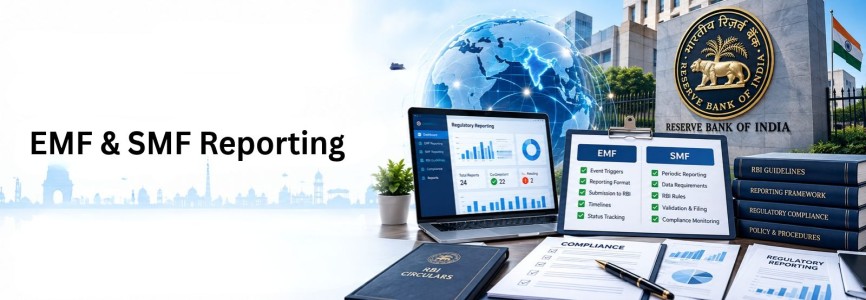



EMF and SMF Reporting in India are important regulatory requirements for businesses receiving Foreign Direct Investment (FDI) and undertaking other reportable foreign investment transactions. Indian companies, startups and Limited Liability Partnerships (LLPs) with foreign investment must understand the requirements prescribed under the Foreign Exchange Management Act, 1999 (FEMA), and applicable Reserve Bank of India (RBI) regulations.
To simplify foreign investment reporting, the RBI introduced the Foreign Investment Reporting and Management System (FIRMS) portal. This online system enables eligible entities to maintain their foreign investment information and submit prescribed regulatory returns. Two important components of the FIRMS portal are the Entity Master Form (EMF) and the Single Master Form (SMF). Although they operate within the same RBI reporting system, their purposes are different.
EMF is used to maintain entity-level foreign investment information, including historical ownership and shareholding details. SMF is the online facility through which prescribed foreign investment returns, including FC-GPR, FC-TRS and Form DI, are submitted. Incorrect Entity Master information, delayed reporting, inappropriate form selection and inconsistent foreign investment documents can create regulatory complications. With amendments to foreign investment payment and reporting regulations in 2025 and 2026, businesses should review the legal requirements applicable to each investment transaction.
What Is EMF and SMF Reporting Under FEMA?
EMF and SMF are two important components of the RBI FIRMS portal introduced to manage foreign investment information and prescribed reporting requirements.
What Is Entity Master Form (EMF)?
The Entity Master Form is an online facility used to record important details of Indian entities with foreign investment. The Entity Master contains information concerning the company's identification, capital structure, existing foreign shareholders, investment history and shareholding pattern. The RBI introduced the Entity Master reporting facility in 2018 to collect existing foreign investment information and support the transition to an integrated reporting system.
For example, if an Indian private limited company received foreign investment before the introduction of FIRMS, the relevant historical investment and ownership details may be reflected in its Entity Master records. Accurate information is important because the RBI FIRMS system may use existing Entity Master details when preparing subsequent foreign investment returns. EMF should not be confused with an annual return. There is no general requirement for every foreign-invested company to file a new Entity Master Form each financial year.
What Is Single Master Form (SMF)?
The Single Master Form is an integrated online reporting facility used for submitting prescribed foreign investment returns under FEMA. Through SMF, applicants can report relevant transactions, including issues of equity instruments to non-residents, specified transfers of securities, foreign investment in LLPs and applicable downstream investments. The RBI introduced SMF reporting in September 2018. Initially, FC-GPR, FC-TRS, LLP-I, LLP-II and convertible note reporting became available through the system.
The facility subsequently incorporated additional foreign investment reporting forms. A company must select the reporting form applicable to its transaction and follow the prescribed deadline. The primary distinction is that EMF maintains entity-level information, while SMF enables transaction-specific regulatory reporting.
Legal Provisions Governing EMF and SMF Reporting
EMF and SMF Reporting are governed by the Foreign Exchange Management Act, 1999, and applicable rules, regulations and RBI directions concerning foreign investment.
Foreign Exchange Management Act, 1999
-
Section 3 – Dealing in Foreign Exchange: Section 3 restricts unauthorised dealings in foreign exchange and foreign securities. Foreign investment consideration must be received or paid through permitted arrangements.
-
Section 6 – Capital Account Transactions: Section 6 governs capital account transactions, including foreign investments in India. It provides the legal basis for the rules regulating different categories of capital transactions.
-
Section 10 – Authorised Persons: Section 10 governs persons authorised to deal in foreign exchange. Authorised Dealer (AD) banks perform an important role in foreign investment reporting.
-
Section 11 – RBI Directions: Section 11 empowers the RBI to issue directions to authorised persons concerning foreign exchange transactions and related requirements.
-
Section 13 – Penalties: Section 13 establishes penalties for contraventions of FEMA and applicable subordinate provisions.
-
Section 15 – Compounding: Section 15 permits eligible FEMA contraventions to be compounded in accordance with the prescribed rules.
-
Section 47 – RBI Regulations: Section 47 empowers the RBI to make regulations under FEMA within its statutory authority.
Foreign Exchange Management (Non-Debt Instruments) Rules, 2019
The Foreign Exchange Management (Non-Debt Instruments) Rules, 2019, regulate various categories of foreign investment in India. These rules address investment eligibility, sectoral caps, prohibited sectors, pricing guidelines, entry routes and permissible investment instruments. For example, Rule 21 contains pricing provisions relevant to specified transactions involving equity instruments. Companies must ensure that the underlying investment complies with these requirements before submitting the applicable SMF return.
FEMA 395/2019-RB: Payment and Reporting Regulations
The Foreign Exchange Management (Mode of Payment and Reporting of Non-Debt Instruments) Regulations, 2019, prescribe permitted payment arrangements and reporting requirements. Regulation 3 addresses methods of payment and remittance of sale proceeds, while Regulation 4 establishes reporting obligations for relevant investment transactions. Regulation 5 addresses delays in reporting and the applicable Late Submission Fee mechanism. The consolidated RBI regulations incorporate amendments through 13 June 2026.
Difference Between EMF and SMF Reporting
Indian businesses should understand the difference between maintaining foreign investment information and filing transaction-specific returns. Although EMF and SMF are connected, completing one does not automatically satisfy the requirements of the other.
|
Particulars |
EMF |
SMF |
|---|---|---|
|
Full form |
Entity Master Form |
Single Master Form |
|
Primary purpose |
Maintaining entity-level foreign investment details |
Reporting prescribed foreign investment transactions |
|
Reporting portal |
RBI FIRMS |
RBI FIRMS |
|
User category |
Entity User |
Business User |
|
Information covered |
Entity details, shareholding and foreign investment history |
Transaction information and supporting documents |
|
Filing frequency |
As required for accurate entity records |
When a reportable transaction occurs |
|
Common forms |
Entity Master information |
FC-GPR, FC-TRS, DI, LLP-I and others |
|
Deadline |
No common annual deadline |
Depends on the applicable return |
|
Main responsibility |
Maintaining correct entity information |
Completing the applicable regulatory report |
For example, a company may have properly registered its historical foreign shareholding through Entity Master. However, if it subsequently issues new equity shares to a non-resident investor, FC-GPR reporting may still be required. Similarly, a company should verify the accuracy of its Entity Master before submitting a transaction-specific SMF form.
Who Is Required to Complete EMF and SMF Reporting?
EMF and SMF Reporting requirements apply according to the nature of the entity and foreign investment transaction. Indian private limited companies, public limited companies and LLPs having relevant foreign investment records may need to maintain information through the FIRMS system.
Applicability of EMF
The Entity Master facility is relevant to Indian entities covered by foreign investment reporting requirements. Companies with existing foreign shareholding should verify that their historical investment information, ownership details and capital structure are correctly recorded. Entities that completed the original Entity Master exercise in 2018 should not assume that a new annual EMF submission is required. However, inaccurate historical records should be examined and corrected through the applicable process.
Applicability of SMF
SMF applies where the transaction requires a prescribed foreign investment return. For example, an Indian startup issuing qualifying equity instruments to a foreign investor generally needs to examine FC-GPR applicability. Where an Indian resident transfers existing equity instruments to a non-resident, FC-TRS may be required. Foreign investments in LLPs, specified downstream investments and other covered transactions may also trigger reporting through the applicable SMF form. The reporting obligation should be determined individually because not every foreign exchange transaction is reportable through SMF.
EMF Registration Process on RBI FIRMS Portal
Entity Master information must be maintained accurately to support subsequent foreign investment reporting. The registration and correction procedures should be completed through the relevant RBI FIRMS facility.
Step 1: Visit the RBI FIRMS Portal
Access the official RBI FIRMS Portal.Select the relevant Entity User registration or login facility.
Step 2: Enter Entity Details
Provide or verify the legal name of the Indian entity, PAN, CIN or LLPIN, registered address and other identification particulars. These details should correspond with statutory records.
Step 3: Verify Foreign Investment Records
Review the company's foreign investment information, capital structure and existing shareholding. Details of foreign shareholders should match the relevant investment agreements, statutory registers and earlier filings.
Step 4: Check Ownership Information
The Entity Master should accurately reflect the relevant historical foreign investment position. Incorrect ownership information may create difficulties in subsequent transaction reporting.
Step 5: Complete the Applicable Verification
Follow the current portal instructions to submit or verify the entity details. If the information is incorrect or requires correction, the company should use the available correction procedure or seek assistance through the relevant RBI or AD bank channel. Entity Master access should not be confused with SMF Business User access. The RBI FIRMS portal specifically states that Entity Master credentials cannot be used to submit SMF returns.
SMF Filing Process Under RBI FIRMS
The SMF filing process requires applicants to select the appropriate transaction form and submit accurate foreign investment information.
Step 1: Register as a Business User
An authorised representative must obtain Business User access on the FIRMS portal. The applicant must provide the required entity, user and AD bank details.
Step 2: Log In to FIRMS
After completing the applicable registration, log in through the Business User account. Access the Single Master Form reporting facility.
Step 3: Select the Appropriate Form
Choose the return relevant to the transaction, such as FC-GPR, FC-TRS or Form DI. The correct form depends on whether the transaction involves a new issue of instruments, an existing share transfer, downstream investment or another reporting category.
Step 4: Enter Investment Information
Provide investor details, investment amount, issue or transfer date, type of equity instruments and relevant shareholding information. The information must be consistent with investment agreements, company records and banking evidence.
Step 5: Upload Supporting Documents
Upload the prescribed documents according to the reporting form. These may include valuation certificates, declarations, remittance confirmations, investment agreements and relevant approvals.
Step 6: Submit the Return
Review all information before submission. Incorrect reporting information can result in AD bank observations or rejection.
Step 7: Complete AD Bank Verification
The authorised dealer bank reviews the submission in accordance with the applicable checklist and instructions. If discrepancies are found, the applicant may need to provide corrections or submit a fresh form as permitted. The company should preserve the final reporting acknowledgement and status after completion.
Documents Required for EMF and SMF Reporting in India
The documents required for EMF and SMF Reporting depend on the type of Indian entity, nature of foreign investment and applicable RBI reporting requirements. Proper documentation helps businesses verify foreign investment information, complete filings and respond to AD bank queries.
-
Corporate Registration Documents: Companies should maintain their Certificate of Incorporation, PAN, CIN, Memorandum of Association, Articles of Association and relevant statutory records. These documents establish the company's legal identity and ownership structure.
-
Foreign Investment Documents: Foreign investment agreements are necessary for verifying the transaction terms. These may include Share Subscription Agreements, Share Purchase Agreements, share allotment records and valuation certificates.
-
Banking and Remittance Documents: Banking documents help establish the source and movement of foreign investment funds. These may include inward remittance confirmations, bank statements, foreign investor KYC records and AD bank correspondence.
-
RBI Reporting Records: Companies should preserve previous FC-GPR, FC-TRS, Form DI and other applicable filing acknowledgements. These records help verify historical investments and identify outstanding reporting issues.
EMF and SMF Document Checklist
|
Document |
Purpose |
|---|---|
|
Certificate of Incorporation |
Establishes legal identity |
|
PAN and CIN/LLPIN |
Verifies registration information |
|
Shareholding Pattern |
Confirms ownership information |
|
Board Resolution |
Supports relevant corporate approvals |
|
Share Subscription Agreement |
Records foreign investment terms |
|
Valuation Certificate |
Supports applicable pricing compliance |
|
Bank Remittance Evidence |
Confirms receipt of investment funds |
|
Foreign Investor KYC |
Identifies the foreign investor |
|
Previous RBI Filings |
Verifies historical reporting |
|
Government Approval |
Required for specified government-route investments |
Not every document is compulsory for every filing. Applicants should follow the requirements relevant to their specific transaction and reporting form.
EMF and SMF Reporting Due Dates in 2026
Understanding the difference between EMF and SMF deadlines is important for FEMA compliance. Entity Master was originally introduced as a registration and information-recording exercise. It does not carry a general recurring annual filing deadline. SMF, however, contains transaction-specific forms with prescribed reporting timelines.
Important RBI Reporting Deadlines
|
Reporting form |
General filing deadline |
|---|---|
|
Entity Master |
No general annual filing deadline |
|
FC-GPR |
Within 30 days of issue of qualifying equity instruments |
|
FC-TRS |
Generally within 60 days of transfer or receipt/remittance of consideration, whichever is earlier |
|
Form DI |
Within 30 days of allotment for applicable downstream investment |
|
LLP(I) |
Within 30 days of receipt of consideration, where applicable |
|
LLP(II) |
Within 60 days of relevant transfer or disinvestment |
|
FLA Return |
Generally 15 July annually, where applicable |
The FLA Return is submitted through a separate RBI reporting mechanism and is not an ordinary transaction form within SMF. Under the applicable Schedule I payment provisions, equity instruments are generally required to be issued within 60 days from receipt of investment consideration. If not issued, the consideration must generally be refunded within the following 15 days. Companies should separately calculate the share issuance deadline and the FC-GPR reporting deadline.
Latest RBI Rules and EMF SMF Reporting Updates in 2026
Foreign investment reporting regulations have undergone important changes during 2025 and 2026. However, businesses should distinguish amendments concerning foreign investment payments from changes to the Entity Master or SMF filing procedure.
January 2025: Amendment to Foreign Investment Payment Rules
The RBI amended the Mode of Payment and Reporting of Non-Debt Instruments Regulations in January 2025. The amendment updated payment and remittance arrangements for specified foreign investment categories, including permitted repatriable foreign currency or rupee accounts. These changes matter because the payment mechanism used for an investment must comply with the applicable regulations.
June 2026: Amendment to Non-Debt Instruments Regulations
Through Notification FEMA 395(4)/2026-RB dated 13 June 2026, the RBI amended certain provisions of the payment and reporting regulations. The amendment modified provisions concerning investment by individual persons resident outside India, including NRIs and OCIs, and reporting by designated AD Category-I banks. It also revised Regulation 4(9), concerning Form LEC (Individual Foreign Investor), for reporting specified purchases or transfers of equity instruments on Indian stock exchanges.nThis amendment did not introduce a universal new EMF deadline or replace the general FC-GPR and FC-TRS reporting requirements.
Important Regulatory Updates at a Glance
|
Year |
Regulatory development |
Compliance importance |
|---|---|---|
|
2018 |
Introduction of Entity Master and SMF |
Integrated foreign investment records and reporting |
|
2019 |
NDI Rules and FEMA 395 Regulations |
Investment eligibility, payment and reporting requirements |
|
2024 |
Amendment to FEMA 395 Regulations |
Changes to specified payment and reporting provisions |
|
2025 |
Third Amendment to FEMA 395 |
Updated permitted payment arrangements |
|
2026 |
FEMA 395(4)/2026-RB |
Changes to specified non-resident investment and AD bank reporting provisions |
Companies should verify the regulations applicable on the date of the transaction, especially when dealing with historical foreign investments.
EMF and SMF Reporting Fees and Penalties
Timely EMF and SMF compliance helps businesses avoid unnecessary reporting complications. The RBI does not prescribe a standard government filing fee for every timely Entity Master activity or SMF return. However, professional charges may arise for documentation, valuation certificates, regulatory assistance and supporting certifications.
Late Submission Fee
Regulation 5 of FEMA 395/2019-RB provides for the payment of a Late Submission Fee for delayed reporting under applicable conditions. The fee is determined in accordance with RBI directions and depends on the relevant reporting category and delay. A Late Submission Fee should not be confused with a statutory penalty imposed after adjudication.
Penalties Under Section 13 of FEMA
For a quantifiable FEMA contravention, the penalty may extend to three times the amount involved. Where the amount cannot be quantified, the penalty may extend to Rs.2 lakh. Continuing contraventions may attract an additional penalty of up to Rs.5,000 per day after the first day. These are statutory maximums rather than automatic penalties.
FEMA Compounding
Section 15 permits eligible FEMA contraventions to be resolved through compounding. The Foreign Exchange (Compounding Proceedings) Rules, 2024, and applicable RBI directions govern the procedure. The RBI also amended its compounding directions on 22 April 2025 to address certain procedural and payment-related requirements. Compounding is not available for every contravention, and payment of a late fee does not automatically regularise an otherwise impermissible transaction.
Common EMF and SMF Reporting Mistakes
Businesses frequently face difficulties because of incorrect ownership information, incomplete supporting documents or selection of the wrong reporting form. One common mistake is assuming that Entity Master registration automatically satisfies the reporting obligations arising from a new foreign investment. Another issue involves differences between the shareholding information recorded in Entity Master and the details provided in an FC-GPR or FC-TRS return.
Incorrect valuation certificates, missing remittance evidence, wrong transaction dates and incomplete foreign investor information can also result in AD bank observations. Companies should reconcile their statutory records, banking information and previous reporting acknowledgements before submitting a new return.
Why Choose Compliance Calendar LLP for EMF and SMF Reporting?
Compliance Calendar LLP provides professional assistance with EMF Registration, SMF Filing, RBI FIRMS Reporting and FEMA Compliance in India. Our services help Indian companies, startups, LLPs and foreign-invested businesses identify applicable reporting requirements and prepare the necessary documentation.
Our EMF and SMF Reporting Services
-
Entity Master Review: Assistance with reviewing foreign investment and shareholding information.
-
Business User Registration: Guidance on RBI FIRMS Business User registration and AD bank coordination.
-
SMF Filing Assistance: Support for applicable FC-GPR, FC-TRS, DI and LLP reporting.
-
Document Verification: Review of investment agreements, valuation records, corporate approvals and banking documents.
-
RBI Reporting Support: Assistance with preparing and submitting prescribed returns.
-
AD Bank Query Assistance: Support in addressing filing observations and documentation discrepancies.
-
Delayed Filing Assistance: Guidance on applicable Late Submission Fee and corrective procedures.
-
Related FEMA Services: Assistance with foreign investment compliance and FEMA due diligence.
Conclusion
EMF and SMF Reporting are important components of India's foreign investment reporting system. They help maintain accurate foreign investment information and enable companies to submit prescribed regulatory returns through the RBI FIRMS portal. While EMF records entity-level foreign investment and shareholding information, SMF is used for reporting qualifying transactions through forms such as FC-GPR, FC-TRS and Form DI.
Businesses must ensure that their Entity Master records are accurate, identify the correct reporting form, maintain appropriate supporting documents and complete filings within the prescribed deadlines. The 2025 and 2026 amendments to foreign investment payment and reporting regulations highlight the importance of regularly reviewing applicable RBI requirements.
Compliance Calendar LLP provides professional assistance with EMF Registration, SMF Filing, RBI FIRMS Reporting and related FEMA compliance services, helping businesses manage their foreign investment reporting obligations accurately and efficiently.
Frequently Asked Questions (FAQs)
Q1. What is EMF and SMF Reporting under FEMA?
Ans: EMF (Entity Master Form) records an Indian entity's foreign investment and shareholding details. SMF (Single Master Form) is used to report prescribed foreign investment transactions through the RBI FIRMS portal.
Q2. Is EMF and SMF Reporting mandatory in India?
Ans: EMF and SMF requirements apply to Indian entities covered by foreign investment reporting regulations. Companies receiving FDI must maintain accurate Entity Master records and submit applicable SMF returns within prescribed deadlines.
Q3. What is the difference between EMF and SMF Reporting?
Ans: EMF maintains entity-level foreign investment information, including ownership and shareholding details. SMF enables transaction-specific reporting through forms such as FC-GPR, FC-TRS and Form DI.
Q4. What is the due date for EMF and SMF Reporting in 2026?
Ans: EMF has no general annual filing deadline. SMF filing deadlines depend on the transaction, with FC-GPR generally due within 30 days of issuing qualifying equity instruments and FC-TRS generally subject to a 60-day timeline.
Q5. How to complete EMF and SMF Reporting online?
Ans: Visit the RBI FIRMS portal and verify the relevant Entity Master records. For SMF reporting, an authorised Business User selects the applicable form, enters investment details, uploads documents and submits the return for verification.
Q6. What documents are required for EMF and SMF Reporting?
Ans: Documents generally include incorporation certificates, PAN, shareholding details, investment agreements, valuation certificates and foreign remittance records. Additional documents depend on the transaction and applicable RBI requirements.
Q7. What are the penalties for delayed SMF Filing?
Ans: Delayed SMF returns may attract a Late Submission Fee under applicable RBI directions. Certain FEMA contraventions may also require compounding or other corrective measures, depending on the nature of the violation.
Q8. What are the latest RBI updates for EMF and SMF Reporting in 2026?
Ans: The RBI amended certain payment and reporting provisions for non-debt instruments in June 2026. Businesses should review the updated regulations, although no universal new annual EMF filing deadline was introduced.
9. Can FC-GPR and FC-TRS be filed through SMF?
Ans: Yes, FC-GPR and FC-TRS are available through the RBI FIRMS Single Master Form facility. FC-GPR generally covers qualifying new equity issues, while FC-TRS covers specified transfers of existing equity instruments.
10. How can Compliance Calendar LLP help with EMF and SMF Reporting?
Ans: Compliance Calendar LLP assists businesses with Entity Master records, SMF Filing, RBI FIRMS Registration and FEMA Compliance. Our team supports document verification, regulatory reporting and resolution of applicable AD bank observations.
Article last updated on : 29 Oct 2026.






































































_learn_crop10_thumb.jpg)