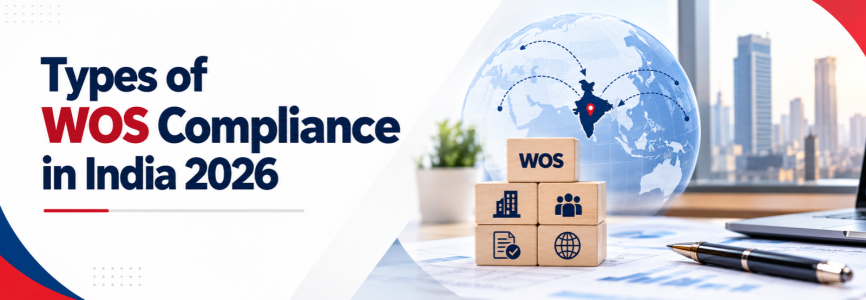



WOS Compliance is an important legal responsibility for Indian companies establishing or acquiring subsidiaries outside India. As Indian businesses expand into international markets, they must comply with the Foreign Exchange Management Act, 1999 (FEMA), applicable Reserve Bank of India (RBI) regulations, corporate laws and the legal requirements of the country where their overseas subsidiary operates.
An overseas wholly owned subsidiary is generally a foreign company whose entire equity ownership is held by an Indian parent company. Businesses establish these subsidiaries to expand internationally, access new customers, undertake manufacturing activities, provide services and manage overseas operations.
However, establishing an overseas company involves more than registering a business in another country. Indian parent companies must examine overseas investment eligibility, financial commitment limits, RBI reporting, Annual Performance Reports (APR), taxation, corporate governance and repatriation obligations. Understanding the types of WOS compliance in India in 2026 helps businesses identify the legal requirements applicable at different stages of establishing and operating an overseas subsidiary. The principal Indian overseas investment provisions continue to be the Overseas Investment Rules, 2022, Overseas Investment Regulations, 2022 and the RBI Master Direction on Overseas Investment issued on 24 July 2024.
What Is a Wholly Owned Subsidiary (WOS)?
A Wholly Owned Subsidiary is a company or other qualifying entity in which the entire ownership is held, directly or through an eligible ownership arrangement, by its parent company. When an Indian company establishes or acquires an overseas business and owns 100% of its equity capital, the overseas entity is commonly referred to as a WOS. For example, if an Indian private limited company establishes a subsidiary in Singapore and subscribes to its entire share capital, the Singapore company may qualify as its overseas WOS.
A WOS has a separate legal identity from its parent company, subject to the corporate laws of the country where it is incorporated. Its liabilities, governance requirements, accounting obligations and local regulatory approvals depend on its legal structure and business activities.
Under the Overseas Investment Rules, 2022, the broader legal term foreign entity is used for qualifying overseas investment structures. The RBI's 2022 directions replaced the earlier regulatory terminology of Joint Venture (JV) and WOS with the concept of a foreign entity. Therefore, although WOS remains widely used in business discussions, companies should apply the definitions and requirements contained in the current overseas investment provisions.
Legal Provisions Governing WOS Compliance in India
Overseas WOS investments are regulated by FEMA and the rules, regulations and directions issued under it.
Foreign Exchange Management Act, 1999
-
Section 3 – Dealing in Foreign Exchange: Section 3 restricts unauthorised foreign exchange transactions. Funds invested in overseas subsidiaries must be transferred through legally permitted arrangements.
-
Section 4 – Holding Foreign Assets: Section 4 regulates the acquisition, holding and transfer of foreign securities and other specified foreign assets by persons resident in India, except as permitted under FEMA.
-
Section 6 – Capital Account Transactions: Section 6 deals with capital account transactions, including eligible overseas investments by Indian residents.
-
Section 10 – Authorised Persons: This section governs authorised persons dealing in foreign exchange. AD Category-I banks play an important role in overseas investment remittances and regulatory reporting.
-
Section 11 – RBI Directions: This section empowers the RBI to issue relevant directions to authorised persons.
-
Section 13 – Penalties: Section 13 prescribes penalties for contraventions of FEMA.
-
Section 15 – Compounding: Section 15 provides for compounding of eligible FEMA contraventions.
Overseas Investment Rules, 2022
The Foreign Exchange Management (Overseas Investment) Rules, 2022, notified on 22 August 2022, govern the eligibility and conditions applicable to overseas investment by Indian residents. These rules address Overseas Direct Investment, Overseas Portfolio Investment, financial commitments, restrictions, transfer of investments and relevant approvals.
Overseas Investment Regulations, 2022
The Foreign Exchange Management (Overseas Investment) Regulations, 2022, issued under Notification FEMA 400/2022-RB, prescribe important requirements relating to financial commitments, reporting, investment evidence and delayed filings.
RBI Master Direction on Overseas Investment
The RBI Master Direction on Overseas Investment, issued on 24 July 2024, consolidates operational instructions covering overseas investment eligibility, reporting, valuation, financial commitments and AD bank procedures. These provisions form the principal Indian legal basis for examining overseas WOS Compliance in 2026.
Types of Overseas WOS Structures
Indian companies may establish different types of overseas wholly owned subsidiaries depending on their business objectives, ownership arrangements and host-country laws. These are commercial categories rather than separate statutory classes of WOS under FEMA. Their regulatory treatment depends on the actual investment structure and business activity.
Direct Wholly Owned Subsidiary
A direct WOS is an overseas entity in which the Indian parent company directly holds 100% ownership. For example, an Indian software company may establish a wholly owned subsidiary in the United States to provide services to international clients. The parent company must comply with applicable ODI eligibility, remittance, financial commitment and reporting requirements. The foreign subsidiary must separately comply with US corporate and tax laws.
Indirect Wholly Owned Subsidiary
An indirect WOS exists where an Indian parent company owns a foreign entity through one or more intermediate subsidiaries. For example, an Indian company may own a Singapore subsidiary that, in turn, owns a company in another country. Such arrangements can involve step-down subsidiaries (SDS). The Indian investor must examine the applicable rules regarding control, permissible ownership structures, financial commitments and reporting. Structures involving investment back into India also require examination of applicable round-tripping and subsidiary-layer restrictions.
Operating Wholly Owned Subsidiary
An operating WOS directly undertakes business activities such as manufacturing, software development, consulting, distribution or other commercial operations. The Indian parent must establish that the foreign entity undertakes a bona fide business activity permitted under the overseas investment provisions. Local business licences, taxation, labour compliance and operational permissions may also apply.
Holding Wholly Owned Subsidiary
A holding WOS is established primarily to hold investments in other companies rather than conduct substantial operating activities itself. Such arrangements require examination of the permitted investment structure, ownership and control conditions, subsidiary layers and the ultimate business activities of the underlying entities. A holding structure is not automatically prohibited, but it must satisfy applicable FEMA and host-country requirements.
Financial Services Wholly Owned Subsidiary
A financial services WOS operates in activities such as regulated lending, investment management, insurance or other eligible financial services.Overseas investment in financial services activities may be subject to additional eligibility conditions under the Overseas Investment Rules, 2022. The Indian parent must also consider whether approval or compliance with a financial sector regulator is necessary.
Comparison of WOS Structures
|
WOS structure |
Main purpose |
Important compliance considerations |
|
Direct WOS |
Overseas business expansion |
ODI reporting, capital contribution and annual compliance |
|
Indirect WOS |
International group ownership |
Step-down subsidiaries, control and ownership restrictions |
|
Operating WOS |
Manufacturing or services |
Bona fide activity, local licences and ODI compliance |
|
Holding WOS |
Holding overseas investments |
Investment structure, subsidiary layers and reporting |
|
Financial Services WOS |
Regulated financial activities |
Sector-specific eligibility and regulatory requirements |
Types of WOS Compliance Required in India
A company operating an overseas WOS must comply with several categories of legal and regulatory requirements.
FEMA and ODI Compliance
FEMA Compliance is the primary Indian regulatory requirement for overseas WOS investments. The Indian parent company must ensure that its investment is permitted, the overseas entity satisfies the relevant conditions and all financial commitments remain within applicable limits. The investor must also maintain the necessary documents and complete RBI reporting through its designated AD bank.
RBI Reporting Compliance
Overseas investments are subject to prescribed reporting requirements. Depending on the transaction, these may include Form FC, Annual Performance Reports, reporting of changes in financial commitments and reporting of disinvestment. Companies must preserve appropriate acknowledgements and ensure that reported information matches the actual transactions.
Companies Act and ROC Compliance
An Indian parent company must comply with applicable requirements under the Companies Act, 2013. Section 186 may be relevant to investments, loans, guarantees and securities involving overseas subsidiaries, subject to statutory conditions and exemptions. Sections 129 and 129(3) address financial statements and consolidated financial statements, where applicable. Companies should also examine relevant disclosure requirements, board approvals and applicable Registrar of Companies filings.
Taxation and Transfer Pricing Compliance
Overseas subsidiaries may create tax obligations in India and the foreign jurisdiction. Transactions between an Indian parent and its overseas WOS can attract transfer pricing requirements under the Income-tax Act, 1961. Sections 92 to 92F are relevant to international transactions between associated enterprises. Where applicable, companies must maintain transfer pricing documentation, comply with prescribed reporting obligations and evaluate tax treaty provisions.
Host-Country Legal Compliance
An overseas WOS must comply with the laws of the country where it operates. These may include annual corporate filings, business licences, local tax returns, accounting requirements, employment laws and beneficial ownership disclosures. Indian FEMA compliance does not replace the foreign subsidiary's local legal obligations.
WOS Registration and ODI Approval Process in 2026
An Indian company planning to establish or acquire a wholly owned subsidiary overseas must complete the applicable investment and reporting procedures.
Step 1: Determine Investment Eligibility
The Indian parent company should verify whether it is eligible to make Overseas Direct Investment under the Overseas Investment Rules, 2022. The proposed foreign entity must ordinarily undertake a bona fide business activity. The investor must also examine applicable restrictions concerning prohibited activities, financial commitments and investment structures.
Step 2: Select the Foreign Jurisdiction
The company should identify the country where it intends to establish the WOS. Important considerations include business regulations, corporate taxation, foreign ownership restrictions, operational costs and the availability of local banking facilities. The selection of jurisdiction does not eliminate the need for Indian FEMA compliance.
Step 3: Obtain Corporate Approvals
The Indian company should obtain necessary corporate approvals for the proposed investment. Depending on the transaction, relevant provisions of the Companies Act, 2013, may require board approval or additional corporate authorisation.
Step 4: Prepare ODI Documents
The company must prepare the relevant overseas investment documents, including applicable Form FC information, investment agreements, financial statements and details of the proposed foreign entity.
Step 5: Approach the Designated AD Bank
The Indian investor must approach its designated Authorised Dealer Category-I bank with the prescribed information and supporting documents. Where the investment qualifies under the automatic route, it may generally proceed without separate prior RBI approval, subject to compliance with applicable conditions. Transactions requiring approval must follow the prescribed approval procedure.
Step 6: Complete Reporting and Remittance
The AD bank processes the investment after completing the necessary verification. The investor must comply with applicable reporting requirements and maintain the investment evidence.
Step 7: Obtain UIN and Maintain Records
A Unique Identification Number (UIN) is allotted for the relevant overseas investment reporting arrangement. The UIN helps identify the foreign entity in the RBI's overseas investment records. However, allotment of a UIN should not be treated as RBI approval or certification that the underlying investment complies with every legal requirement.
Financial Commitment Limits for Overseas WOS
Financial commitment refers to the total permitted financial exposure undertaken by an Indian entity towards a foreign entity, including specified equity investments, debt commitments and non-fund-based commitments. Under the general Overseas Investment Rules, 2022, an Indian entity's aggregate financial commitment in foreign entities under the automatic route is ordinarily subject to a limit of 400% of its net worth, calculated in accordance with the applicable rules. This limit must be read together with transaction-specific eligibility conditions, exemptions and approval requirements.
For example, if an eligible Indian company has a qualifying net worth of ?10 crore, the general 400% limit would correspond to ?40 crore. This does not mean the company may automatically invest the entire amount in any overseas business. Investments must independently comply with the prescribed rules concerning eligible entities, financial commitments, business activities and investment restrictions.
Debt and Guarantee Commitments
An Indian company may extend eligible loans or debt commitments to its foreign entity, subject to applicable conditions. Under Regulation 3 of the Overseas Investment Regulations, 2022, certain non-equity financial commitments generally require the Indian entity to have made ODI and acquired control in the relevant foreign entity.
Loans must also satisfy applicable conditions, including appropriate loan documentation and arm's-length interest requirements. Corporate guarantees, performance guarantees and other permissible non-fund-based commitments have separate regulatory conditions. Businesses must consider their treatment when calculating the applicable financial commitment.
Annual WOS Compliance and RBI Reporting Requirements
Annual compliance is one of the most important responsibilities of an Indian company operating an overseas WOS. Unlike the initial investment reporting, annual compliance continues after the foreign subsidiary has been established.
Annual Performance Report (APR)
Under the applicable overseas investment regulations, an Indian investor required to submit an APR must provide information about the performance and activities of the foreign entity. The report includes prescribed financial information relating to the overseas investment and is generally submitted through the designated AD bank. The ordinary APR deadline is 31 December, subject to applicable exceptions and special provisions.
Certain overseas investments are exempt from APR reporting under the specified conditions, including relevant cases where the investor's holding is below 10%, there is no control and no financial commitment other than equity capital. An APR should not be assumed mandatory for every investment classified as Overseas Portfolio Investment.
Evidence of Investment
The Indian investor must submit relevant investment evidence within the prescribed timeline. Under Regulation 9 of the Overseas Investment Regulations, 2022, evidence of investment generally must be submitted to the designated AD bank within six months from the date of remittance or the date on which the dues were capitalised, as applicable.
Reporting Changes in Overseas Investments
Changes involving financial commitments, ownership, restructuring and disinvestment may trigger additional reporting obligations. Companies should examine the specific regulatory treatment before executing the transaction.
WOS Compliance Due Dates
|
Compliance requirement |
General timeline |
|
Initial overseas investment reporting |
As prescribed, generally at the time of financial commitment |
|
Evidence of overseas investment |
Within six months, where applicable |
|
Annual Performance Report |
Generally by 31 December |
|
Disinvestment reporting |
Within 30 days of receipt of proceeds, where applicable |
|
Repatriation of applicable dues |
Generally within 90 days of becoming due |
|
Indian ROC annual filings |
According to applicable Companies Act deadlines |
|
Host-country annual filings |
According to local laws |
These deadlines are general and may be subject to exceptions, modified reporting arrangements or transaction-specific provisions.
Documents Required for WOS Compliance in India
The documents required for WOS Compliance depend on the type of overseas subsidiary, investment structure and applicable RBI requirements.
-
Corporate and Parent Company Documents: The Indian parent company should maintain its Certificate of Incorporation, PAN, Memorandum of Association, Articles of Association, audited financial statements and relevant board resolutions. These records establish the company's legal identity, investment authority and financial position.
-
Overseas Subsidiary Documents: Relevant records may include the foreign entity's incorporation certificate, constitutional documents, shareholder register, business licence and beneficial ownership details. These documents help confirm the foreign entity's legal existence and ownership.
-
Investment and Banking Records: The company should preserve investment agreements, share subscription documents, valuation evidence where applicable, remittance records and correspondence with its designated AD bank.
-
RBI Reporting Records: Important records may include Form FC submissions, UIN details, investment evidence, APR acknowledgements, financial commitment information and disinvestment records.
-
Financial and Tax Documents: The company should maintain the overseas subsidiary's financial statements, relevant audit reports, transfer pricing documentation and other records required under applicable Indian and foreign laws. Accurate documentation helps identify differences between the parent company's financial records, actual remittances and information reported to the RBI.
Latest WOS Compliance Rules and Updates in 2026
Businesses reviewing overseas WOS Compliance in 2026 should distinguish between amendments that directly affect overseas investment and other FEMA notifications concerning different categories of international transactions.
Overseas Investment Rules, 2022
The 2022 overseas investment regime remains the central source of requirements for establishing and operating foreign entities through Indian investment. It introduced a broader definition of foreign entities, clarified investment categories and revised several approval and reporting procedures.
RBI Master Direction, July 2024
On 24 July 2024, the RBI issued its Master Direction on Overseas Investment, consolidating operational instructions for overseas investments. It explains reporting, approval routes, eligible transactions, designated AD bank procedures, financial commitments and other requirements. This direction replaced the older overseas JV/WOS directions and is particularly important when reviewing investments in 2026.
June 2024 Clarification on Overseas Investment Funds
The RBI issued a circular on 7 June 2024 clarifying the treatment of investments in overseas funds. It addressed investment in units or other permissible interests of overseas investment funds, subject to the applicable regulatory conditions. This development is particularly relevant when distinguishing overseas portfolio investments from direct investment in foreign operating entities. It does not mean that every investment in an overseas fund creates a WOS.
FEMA Amendments Issued During 2026
The RBI's 2026 notification register includes developments concerning guarantees, borrowing and lending, cross-border mergers and other foreign exchange transactions. These changes may be relevant where an overseas WOS is involved in borrowing arrangements, guarantee obligations or corporate restructuring. However, their applicability must be examined under the specific notification.
The verified notification register does not, by itself, establish that a new general WOS registration deadline, new universal APR deadline or replacement of the 2022 Overseas Investment Rules was introduced during 2026. Companies should therefore avoid relying on outdated pre-2022 ODI procedures or unsupported claims about changes in overseas WOS reporting.
WOS Compliance Penalties Under FEMA
Failure to comply with overseas investment regulations can result in monetary penalties, restrictions on additional investments and regulatory proceedings.
Penalties Under Section 13 of FEMA
Where a FEMA contravention is established, Section 13 provides that the penalty may extend to three times the amount involved if the contravention is quantifiable. Where the amount cannot be quantified, the penalty may extend to Rs 2 lakh. A continuing contravention may attract an additional penalty of up to Rs 5,000 for each day after the first day. These figures represent statutory maximum penalties and do not automatically apply to every reporting error.
Late Submission Fee
Regulation 11 of the Overseas Investment Regulations, 2022, permits certain delayed submissions to be regularised through payment of a Late Submission Fee (LSF). The facility is generally available within a maximum period of three years from the applicable due date, subject to the prescribed conditions. The Indian investor should identify whether the delay qualifies for LSF regularisation or requires another corrective procedure.
Restriction on Further Financial Commitments
Regulation 12 provides an important consequence for delayed overseas investment reporting. Where a reporting delay remains unregularised, the relevant person resident in India is restricted from making further financial commitments towards the foreign entity or transferring the overseas investment until the delay is regularised. This makes timely WOS reporting important for businesses planning additional overseas funding.
Common WOS Compliance Mistakes to Avoid
Indian businesses frequently encounter overseas investment compliance problems because they focus on incorporating the foreign subsidiary but overlook ongoing reporting obligations. One common mistake is assuming that incorporation of an overseas company automatically permits an Indian parent to transfer funds without completing the necessary FEMA procedures. Another issue involves incorrect calculation of financial commitments, particularly where loans, guarantees and equity investments are undertaken together.
Companies may also fail to maintain proper evidence of investment, miss APR deadlines or overlook reporting requirements following restructuring or disinvestment. A further risk arises when overseas subsidiaries establish additional companies without examining applicable step-down subsidiary and round-tripping restrictions. Maintaining an updated overseas investment register, monitoring reporting deadlines and conducting periodic compliance reviews can help businesses identify these issues early.
Why Choose Compliance Calendar LLP for WOS Compliance?
Compliance Calendar LLP provides professional assistance to Indian companies planning to establish, acquire or maintain overseas wholly owned subsidiaries. Our services help businesses understand FEMA requirements, prepare investment documentation and comply with applicable RBI reporting obligations.
Our WOS Compliance Services
-
Overseas Investment Eligibility Review: Assistance with examining eligible investment structures, business activities and applicable FEMA conditions.
-
WOS Registration Guidance: Support with understanding Indian ODI requirements and documentation for overseas subsidiary establishment.
-
ODI Reporting Assistance: Preparation and coordination of applicable Form FC and related reporting requirements.
-
Financial Commitment Review: Assistance in evaluating eligible equity investments, loans and guarantee arrangements.
-
APR Filing Assistance: Support with applicable Annual Performance Report documentation and reporting.
-
Document Verification: Review of incorporation records, financial statements, remittance evidence and investment agreements.
-
AD Bank Coordination: Assistance in addressing investment-related banking requirements and reporting observations.
-
Ongoing FEMA Compliance: Support with subsequent investments, reporting changes, disinvestment and related compliance reviews.
For professional support, businesses can explore WOS Compliance Services offered by Compliance Calendar LLP.
Frequently Asked Questions (FAQs)
Q1. What are the different types of WOS Compliance in India?
Ans: WOS Compliance includes FEMA and ODI reporting, RBI compliance, annual financial reporting, taxation and applicable Companies Act requirements. The obligations depend on the overseas subsidiary's ownership structure, business activities and investment arrangements.
Q2. What are the types of overseas Wholly Owned Subsidiaries?
Ans: Overseas WOS structures include direct subsidiaries, indirect subsidiaries, operating subsidiaries, holding subsidiaries and financial services subsidiaries. Each structure has different legal, reporting and regulatory requirements depending on its activities and jurisdiction.
Q3. Is WOS Compliance mandatory for Indian companies in 2026?
Ans: Yes, Indian companies establishing or investing in overseas WOS entities must comply with applicable FEMA and ODI regulations. This includes investment eligibility, financial commitment conditions, RBI reporting and annual compliance obligations where applicable.
Q4. What are the latest RBI rules for WOS Compliance in 2026?
Ans: Overseas WOS Compliance is primarily governed by the Overseas Investment Rules, 2022, Overseas Investment Regulations, 2022, and applicable RBI directions. Businesses must also examine relevant amendments concerning overseas guarantees, borrowing and cross-border transactions.
Q5. What is the annual compliance requirement for an overseas WOS?
Ans: Annual compliance may include submitting the Annual Performance Report (APR), maintaining financial statements and completing applicable overseas investment reporting. APR is generally due by 31 December, subject to prescribed exceptions.
Q6. What is the maximum ODI investment limit for an Indian company?
Ans: Under the general automatic-route provisions, an Indian entity's aggregate overseas financial commitment is ordinarily limited to 400% of its eligible net worth. The investment must also satisfy applicable eligibility conditions, restrictions and approval requirements.
Q7. What documents are required for WOS Compliance in India?
Ans: Documents generally include incorporation certificates, board resolutions, financial statements, overseas investment agreements, remittance records and UIN details. Companies may also need Form FC acknowledgements, APR records and supporting financial commitment documents.
Q8. What is the difference between a WOS and a Joint Venture under FEMA?
Ans: A Wholly Owned Subsidiary generally has 100% ownership by its parent company, while a Joint Venture involves shared ownership. Under the current overseas investment rules, the broader term foreign entity is used, and compliance depends on the actual investment and control arrangements.
Q9. What happens if an Indian company fails to comply with WOS reporting requirements?
Ans: Non-compliance may attract Late Submission Fees, regulatory restrictions or penalties under FEMA. Unregularised reporting delays may also restrict further financial commitments or transfers of overseas investments until the defaults are resolved.
Q10. How can Compliance Calendar LLP assist with WOS Compliance in India?
Ans: Compliance Calendar LLP provides professional assistance with overseas WOS Compliance, ODI Reporting, APR Filing and FEMA documentation. Our team helps Indian companies understand regulatory requirements, review investment records and manage applicable RBI reporting obligations.
Article last updated on : 29 Oct 2026.
































































_learn_crop10_thumb.jpg)