



Every company’s MCA annual filing is must and specially to file its financial statements, including consolidated financial statements and prescribed attachments, with the MCA in Form AOC-4 within 30 days of the AGM under Section 137. If the statements are not adopted, the unadopted statements must be filed within the prescribed period and the adopted statements must subsequently be filed within 30 days of the adjourned AGM. (The due date may differ if an AGM extension has been granted by the ROC.)
Pursuant to section 137 of the Companies Act, 2013 and rule 12(2) of the Companies (Accounts) Rules, 2014 read with Companies (Filing of documents and forms in Extensible Business Reporting Language) Rules, 2015, certain classes of companies as notified under Companies (Filing of documents and forms in Extensible Business Reporting Language) Rules, 2015 by the Central Government are required to mandatorily file their financial statement in Extensible Business Reporting Language (XBRL) format. Other companies can also file their financial statements in XBRL format voluntarily. However, once filed in XBRL format, they would be required to file subsequent financial statements only in XBRL format.
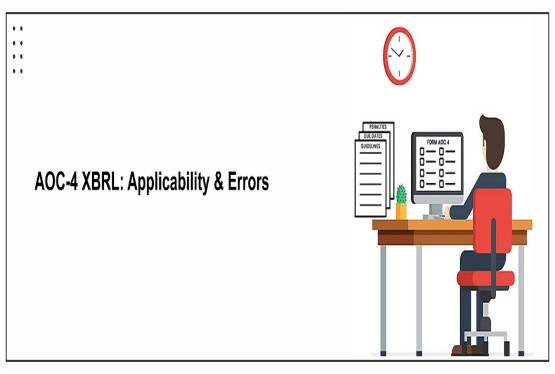
XBRL ( Extensible Business Reporting Language) is a digital format used to share financial and business information more easily and accurately. In India, the Ministry of Corporate Affairs (MCA) has made it mandatory for certain companies to file their financial statements, like balance sheets and profit and loss accounts, with the Registrar of Companies (ROC) using XBRL. Now, selected companies must submit their financial reports through the MCA portal using the AOC-4 XBRL Form, as required under Section 137 of the Companies Act, 2013.
MCA Notification dated 9th September, 2015, Ministry of Corporate Affairs has notified “Companies (Filing of documents and forms in Extensible Business Reporting Language) Rules, 2015”,companies falling in the following categories will have to file their Financial Statements under section 137 of the Companies Act, 2013 using the Extensible Business Reporting Language (XBRL) taxonomy for financial year commencing on or after 1st April, 2014:-
-
All companies listed on stock exchanges in India, and their Indian subsidiaries, regardless of their turnover or capital.
-
All companies having a paid-up capital of Rs.5 crore or more, whether public or private.
-
All companies having a turnover of Rs.100 crore or more in the immediately preceding financial year.
-
All companies which are required to prepare their financial statements as per Indian Accounting Standards (Ind AS) under the Companies (Indian Accounting Standards) Rules, 2015.
However, it is important to note that Non-Banking Financial Companies (NBFCs), Housing Finance Companies, and companies engaged in the business of banking and insurance are currently exempt from filing in XBRL format, unless otherwise specifically notified by the MCA.
XBRL Filing Checklist and Process
Preparation of Financial Statements
Companies eligible for XBRL filing must ensure that their financial statements are prepared in accordance with the applicable financial reporting framework, i.e., either Accounting Standards (AS) or Indian Accounting Standards (Ind AS), depending on their applicability and the primary documents to be filed in XBRL format include the Balance Sheet, Statement of Profit and Loss, Cash Flow Statement, Statement of Changes in Equity (for Ind AS companies), and Notes to Accounts.These need to be linked to the right categories in the format given by MCA, and the format depends on whether the company uses AS or Ind AS accounting standards.
Use of XBRL Software and Taxonomy
Companies are required to use MCA-approved XBRL conversion and validation software to generate their documents in .xml format. These documents must conform to the most recent version of the C&I Taxonomy (Commercial and Industrial), as notified by the MCA. For companies using Ind AS, the Ind AS Taxonomy should be used, whereas for companies following AS, the general purpose taxonomy applies. The tagging of financial data must be done accurately to ensure proper validation and readability of reports.
Important point needs to be taken Care while filing financial data in XBRL Software and Taxonomy
-
Firstly Import financial data of previous financial year by uploading the pdf file of the filed .xml filed in form AOC-4 XBRL of the preceding financial year.
-
Make sure that applicability and non applicability of any provision/ disclosures /note has been selected appropriately as wrong selection can cause unnecessary validation errors.
-
There are some prerequisites that must required in filing financial data in XBRLUtility:
-
Excel Soft Copy of Balance Sheet,Profit & Loss A/c, Cash Flow Statement and Notes to Accounts (With Detailed Schedules).
-
Directors report in word copy.
-
Complete Shareholding pattern including details of details of Shareholding pattern of top 10 shareholders, Shareholding pattern of Directors & KMP and Details of change in Promoter’s Shareholding
-
Number of Board meetings and shareholder’s meetings held in the financial year.
Validation and Pre-Scrutiny
Once the financial data has been completely entered, companies must validate their .xml file using the MCA XBRL Validation Tool, which checks for technical errors, incorrect taxonomy references, and improper tagging. The document should then be passed through the pre-scrutiny process available on the MCA portal to ensure it meets all regulatory requirements. Only upon successful validation and pre-scrutiny can the company proceed to file the document online.
Filing of Forms with MCA
The primary form used for XBRL filing is Form AOC-4 XBRL, which needs to be submitted within 30 days from the date of the Annual General Meeting (AGM). Other attachments like the Auditor’s Report, Director’s Report, and Notes to Accounts (in PDF format) must also be uploaded. The annual return in Form MGT-7 or MGT-7A (for small companies and OPCs) must also be filed, but it is not required in XBRL format.
Disclosures under Accounting Standards and Ind AS
The financial statements filed in XBRL format must include mandatory disclosures prescribed under the applicable accounting framework.
For companies following Accounting Standards (AS):
- AS-18: Related Party Disclosures must identify relationships, transactions, and balances.
- AS-17: Segment Reporting requires companies to disclose financial information by business or geographical segments.
- AS-22: Accounting for Taxes on Income mandates disclosure of deferred tax assets/liabilities.
- AS-29: Provisions, Contingent Liabilities, and Contingent Assets must be adequately explained.
For companies adopting Ind AS:
- Ind AS 107: Detailed disclosures of financial instruments, including risks and measurement techniques.
- Ind AS 115: Revenue recognition principles, including performance obligations and contract balances.
- Ind AS 116: Lease agreements, including right-of-use assets and liabilities.
- Ind AS 113: Fair value measurement hierarchy and valuation techniques.
- Ind AS 36: Impairment of assets and related recoverable amounts.
- Ind AS 24: Extensive related party disclosures.
- Ind AS 33: Earnings per share details.
- Ind AS 108: Segmental information by operating segments.
All these disclosures must be properly entered in the provided notes in the XBRL instance document using the MCA-approved taxonomy.
MCA Due Date and Consequences of Delayed XBRL Filing
Companies required to file their financial statements in XBRL format must submit Form AOC-4 XBRL within 30 days from the date of the Annual General Meeting (AGM). Where the AGM is not held, the form must generally be filed within 30 days from the date on which the AGM should have been held, along with the prescribed reasons for not holding the meeting.
MCA Amendments Applicable from 14 July 2025
The MCA introduced important changes through the Companies (Filing of Documents and Forms in Extensible Business Reporting Language) Amendment Rules, 2025, effective from 14 July 2025.
Mandatory PDF Attachment of Signed Financial Statements
Under the newly inserted Rule 3(1A), companies filing financial statements in XBRL format must also attach a signed PDF copy of the financial statements, duly authenticated in accordance with Section 134 of the Companies Act, 2013.
The attachment must include:
-
Signed financial statements;
-
Board’s Report;
-
Auditor’s Report; and
-
Other documents required to be attached to the financial statements.
Revised Form AOC-4 XBRL
The existing Form AOC-4 XBRL has been substituted with a revised form. Companies must use the updated version prescribed by the MCA for filing their financial statements.
Enhanced CSR Disclosures
The revised form includes detailed fields for reporting Corporate Social Responsibility matters, including:
-
CSR applicability;
-
Prescribed CSR obligation;
-
Amount spent or unspent;
-
Details of ongoing and other CSR projects; and
-
Treatment or transfer of unspent CSR amounts, wherever applicable.
These amendments are intended to improve the completeness, transparency and regulatory scrutiny of corporate financial filings.
Hence, For delayed filing of XBRL Reporting in form AOC-4 XBRL, an additional filing fee of Rs.100 per day is payable under Section 403 of the Companies Act, 2013, without any maximum limit. Separately, under Section 137(3), failure to file financial statements may attract the following penalties:
-
Company: Rs.10,000, plus Rs.100 for every day of continuing default, subject to a maximum of Rs.2,00,000.
-
Responsible officers: Rs.10,000, plus Rs.100 for every day of continuing default after the first day, subject to a maximum of Rs.50,000 for each officer.
Read more about the consequences of non-filing of XBRL forms


_crop10_thumb.jpg)





_crop10_thumb.jpg)
_crop10_thumb.jpg)


_crop10_thumb.jpg)


_crop10_thumb.jpg)


_crop10_thumb.jpg)

_crop10_thumb.jpg)


-suratgujarat-section-158_crop10_thumb.jpg)
-suratgujarat_crop10_thumb.jpg)
-(33)_crop10_thumb.jpg)


-ahmedabad_crop10_thumb.jpg)
-learn_crop10_thumb.jpg)

-learnn_crop10_thumb.jpg)


_crop10_thumb.jpg)







_Guidelines_learn_crop10_thumb.jpg)


_learn_crop10_thumb.jpg)
_crop10_thumb.jpeg)


_crop10_thumb.jpg)


_Second_Amendment_Rules,_2025_learn_crop10_thumb.jpg)


_learn_crop10_thumb.jpg)
















_learn_crop10_thumb.jpeg)


















_learn_crop10_thumb.jpg)


_rd_roc_learn_crop10_thumb.jpg)











_learn_crop10_thumb.jpg)







_learn_crop10_thumb.jpg)
_Learn_crop10_thumb.jpg)





























_learn_crop10_thumb.jpg)



_learn_crop10_thumb.jpg)









_crop10_thumb.jpeg)













_crop10_thumb.jpg)















_crop10_thumb.jpg)