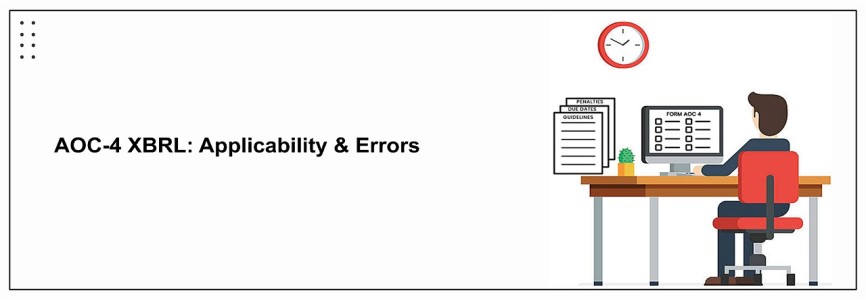



XBRL, i.e., Extensible Business Reporting Language, is a standardised electronic reporting language used for filing financial information in a structured and machine-readable format. Instead of submitting only scanned financial statements, XBRL enables financial data to be tagged under the prescribed taxonomy, making it easier for regulators, investors, lenders and stakeholders to analyse corporate financial information.
Under the Companies Act, 2013, specified companies are required to file their financial statements and related documents with the Registrar of Companies in e-Form AOC-4 XBRL instead of the normal AOC-4 form. The requirement is governed primarily by Section 137 of the Companies Act, 2013 read with the Companies (Filing of Documents and Forms in Extensible Business Reporting Language) Rules, 2015, as amended from time to time.
Section 137 requires filing of financial statements, including consolidated financial statements, if any, with the Registrar within the prescribed time after the Annual General Meeting. The XBRL Rules prescribe which companies must file such financial statements in XBRL mode.
Provisions under Companies Act 2013 for XBRL Filing
The legal aspect of XBRL filing may be summarised as follows:
-
Section 137 of the Companies Act, 2013 – filing of financial statements with the Registrar of Companies.
-
Companies (Filing of Documents and Forms in Extensible Business Reporting Language) Rules, 2015 – classes of companies required to file in XBRL format.
-
Companies (Indian Accounting Standards) Rules, 2015 – relevant for companies preparing financial statements under Ind AS.
-
MCA Taxonomy and e-Form AOC-4 XBRL – technical framework and filing form prescribed by MCA.
Rule 3 of the XBRL Rules provides that specified companies shall file their financial statements and other documents under Section 137 in e-Form AOC-4 XBRL.
Which companies Required to File AOC-4 XBRL ?
A company is required to file its financial statements in XBRL mode if it falls under any of the following categories:
A. Companies Listed on Stock Exchanges in India
Every company listed with stock exchanges in India is required to file its financial statements in XBRL format. This includes companies whose securities are listed on recognised stock exchanges in India.
B. Indian Subsidiaries of Listed Companies
Indian subsidiaries of companies listed with stock exchanges in India are also covered under XBRL filing requirements. Therefore, even if the subsidiary itself is not listed, the applicability must be examined where the holding company is listed.
C. Companies Having Paid-Up Share Capital of Rs.5 Crore or More
Every company having paid-up capital of Rs.5 crore or above is required to file its financial statements in AOC-4 XBRL.
D. Companies Having Turnover of Rs.100 Crore or More
Every company having turnover of Rs.100 crore or above is required to file its financial statements in XBRL format.
E. Companies Preparing Financial Statements under Ind AS
All companies that are required to prepare their financial statements in accordance with the Companies (Indian Accounting Standards) Rules, 2015 are required to file in XBRL mode.
Rule 3 specifically covers listed companies and their Indian subsidiaries, companies with paid-up capital of Rs.5 crore or more, companies with turnover of Rs.100 crore or more, and companies required to prepare financial statements under Ind AS.
Learn “Once XBRL, Always XBRL” Principle
One of the most important compliance points is that once a company files its financial statements in XBRL under Rule 3, it is required to continue filing its financial statements and other documents in XBRL in succeeding years, even if it later falls below the applicable threshold.
For example, if a company filed AOC-4 XBRL in an earlier year because its turnover was Rs.100 crore or more, it cannot automatically shift back to normal AOC-4 merely because its turnover falls below Rs.100 crore in a subsequent year.
This continuing obligation is expressly provided under the XBRL Rules.
Exemptions from XBRL Filing
The following categories of companies are exempted from filing financial statements under the XBRL Rules:
-
Non-Banking Financial Companies (NBFCs)
-
Housing Finance Companies (HFCs)
-
Companies engaged in banking business
-
Companies engaged in insurance business
Accordingly, such companies are not required to file their financial statements in AOC-4 XBRL merely because they cross the paid-up capital or turnover thresholds, provided they fall within the exempted category under the Rules.
Care should be taken while relying on older notes or old compliance checklists, as earlier references may not always reflect the substituted and amended position under the current Rule 3. The current Rule 3 text refers to exemption for NBFCs, HFCs, banking companies and insurance companies.
Details & Documents Required in XBRL Filing
In AOC-4 XBRL filing, the company is generally required to prepare and file the financial statements and related documents as per the applicable MCA taxonomy. The filing may include, as applicable:
-
Balance Sheet
-
Statement of Profit and Loss
-
Cash Flow Statement
-
Statement of Changes in Equity, where applicable
-
Notes to Accounts
-
Consolidated Financial Statements, where applicable
-
Board’s Report
-
Auditor’s Report
-
Other documents required to be attached with financial statements under the Companies Act, 2013
As per the 2025 amendment, companies filing under Rule 3 are also required to attach a copy of signed financial statements duly authenticated under Section 134 of the Companies Act, including the Board’s Report, Auditor’s Report and other documents, in PDF format in e-Form AOC-4 XBRL. This amendment became effective from 14 July 2025.
MCA Form to be Filed
Companies covered under XBRL applicability are required to file: e-Form AOC-4 XBRL, a form is filed instead of the normal AOC-4. Companies not covered under XBRL applicability, and not otherwise required to file in XBRL, continue to file the applicable version of AOC-4.
Due Date for AOC-4 XBRL
The due date for filing AOC-4 XBRL follows the same statutory timeline applicable to filing of financial statements under Section 137 of the Companies Act, 2013.
Generally, financial statements are required to be filed with the Registrar within 30 days from the date of the Annual General Meeting. Where financial statements are not adopted at the AGM, the unadopted financial statements are required to be filed within the prescribed time and later replaced after adoption, as applicable.
For most companies following the financial year ending on 31 March and holding AGM by 30 September, the practical due date for AOC-4 / AOC-4 XBRL is generally 30 October, subject to the actual date of AGM and applicable statutory provisions.
XBRL Applicability Table
|
Particulars |
XBRL Applicability |
|
Company listed with stock exchanges in India |
Applicable |
|
Indian subsidiary of listed company |
Applicable |
|
Paid-up share capital of Rs.5 crore or more |
Applicable |
|
Turnover of Rs.100 crore or more |
Applicable |
|
Company required to prepare financial statements under Ind AS |
Applicable |
|
Company that has already filed in XBRL in an earlier year |
Continues to be applicable |
|
NBFC |
Exempt |
|
Housing Finance Company |
Exempt |
|
Banking company |
Exempt |
|
Insurance company |
Exempt |
Practical Compliance Checklist Before Filing AOC-4 XBRL
Before proceeding with XBRL filing, the company should verify the following:
-
Whether the company is listed or is an Indian subsidiary of a listed company.
-
Paid-up share capital as per the latest audited financial statements.
-
Turnover as per the latest audited financial statements.
-
Whether the company is required to prepare financial statements under Ind AS.
-
Whether the company has filed XBRL in any previous financial year.
-
Whether the company falls under any exempted category such as NBFC, HFC, banking or insurance.
-
Whether standalone and consolidated financial statements are required.
-
Whether the signed financial statements, Board’s Report, Auditor’s Report and other attachments are available in the required format.
-
Whether the XBRL instance document is validated through the applicable MCA taxonomy and validation utility.
-
Whether the form is filed within the due date under Section 137.
Common Mistakes in XBRL Filing
Companies often face resubmission or rejection due to the following mistakes:
-
Filing normal AOC-4 instead of AOC-4 XBRL despite applicability.
-
Ignoring the “once XBRL, always XBRL” rule.
-
Not checking Ind AS applicability.
-
Using outdated exemption lists.
-
Mismatch between audited financial statements and XBRL-tagged data.
-
Incorrect mapping of notes to accounts.
-
Not attaching signed financial statements and reports in PDF format where required.
-
Filing without validating the XBRL instance document properly.
-
Missing consolidated financial statements where applicable.
-
Delayed filing leading to additional fees and compliance risk.
CCL Observations
XBRL filing is not merely a technical conversion exercise. It is a statutory filing requirement under Section 137 of the Companies Act, 2013 read with the XBRL Rules. Companies crossing the prescribed thresholds, companies listed in India, Indian subsidiaries of listed companies and companies preparing financial statements under Ind AS must carefully examine AOC-4 XBRL applicability before annual filing.
The most important compliance principle is that once a company has filed its financial statements in XBRL, it must continue filing in XBRL in subsequent years, even if it later falls below the prescribed thresholds. Further, with the 2025 amendment requiring signed financial statements and related reports to be attached in PDF format along with AOC-4 XBRL, companies should ensure that their annual accounts, reports, approvals and XBRL tagging are aligned before filing.
FAQs on XBRL Filing under Companies Act, 2013
Q1. Which companies are required to file AOC-4 XBRL?
Ans. Companies listed with stock exchanges in India, their Indian subsidiaries, companies having paid-up capital of Rs.5 crore or more, companies having turnover of Rs.100 crore or more and companies required to prepare financial statements under Ind AS are required to file AOC-4 XBRL.
Q2. Is XBRL applicable to private companies?
Ans. Yes. A private company is required to file AOC-4 XBRL if it meets the paid-up capital threshold, turnover threshold, Ind AS applicability, or if it has filed in XBRL in any previous year.
Q3. Are NBFCs required to file AOC-4 XBRL?
Ans. NBFCs are exempted from filing financial statements under the XBRL Rules.
Q4. Does a company have to continue XBRL filing after falling below the threshold?
Ans. Yes. Once a company has filed its financial statements in XBRL, it must continue filing in XBRL in subsequent years even if it later falls below the prescribed threshold.
Q5. What is the due date for AOC-4 XBRL?
Ans. AOC-4 XBRL is generally required to be filed within 30 days from the date of the Annual General Meeting, in line with Section 137 of the Companies Act, 2013.
Q6. Is Board’s Report required in AOC-4 XBRL filing?
Ans. Yes. The Board’s Report, Auditor’s Report and other applicable documents forming part of the financial statements are required to be filed. Pursuant to the 2025 amendment, a signed copy of financial statements and related documents duly authenticated under Section 134 is also required to be attached in PDF format in e-Form AOC-4 XBRL.


_crop10_thumb.jpg)





_crop10_thumb.jpg)
_crop10_thumb.jpg)


_crop10_thumb.jpg)


_crop10_thumb.jpg)


_crop10_thumb.jpg)

_crop10_thumb.jpg)


-suratgujarat-section-158_crop10_thumb.jpg)
-suratgujarat_crop10_thumb.jpg)
-(33)_crop10_thumb.jpg)


-ahmedabad_crop10_thumb.jpg)
-learn_crop10_thumb.jpg)

-learnn_crop10_thumb.jpg)


_crop10_thumb.jpg)







_Guidelines_learn_crop10_thumb.jpg)


_learn_crop10_thumb.jpg)
_crop10_thumb.jpeg)


_crop10_thumb.jpg)


_Second_Amendment_Rules,_2025_learn_crop10_thumb.jpg)


_learn_crop10_thumb.jpg)


















_learn_crop10_thumb.jpeg)



















_learn_crop10_thumb.jpg)


_rd_roc_learn_crop10_thumb.jpg)












_learn_crop10_thumb.jpg)







_learn_crop10_thumb.jpg)
_Learn_crop10_thumb.jpg)

































_learn_crop10_thumb.jpg)



_learn_crop10_thumb.jpg)











_crop10_thumb.jpeg)















_crop10_thumb.jpg)



















_crop10_thumb.jpg)