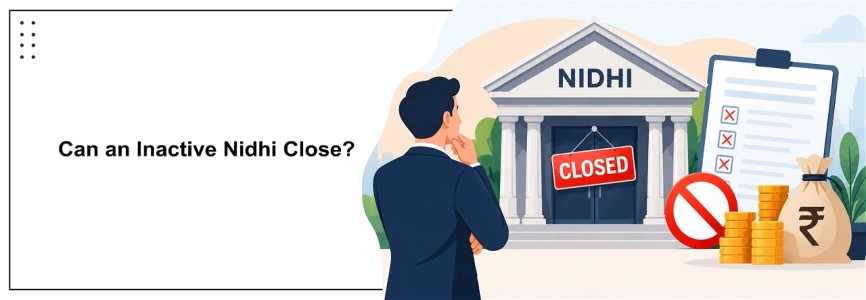



A Nidhi Company may be incorporated with the intention of carrying on mutual-benefit activities among its members, but not every incorporated company eventually begins operations. Some companies remain inactive from the date of incorporation, never accept deposits, never advance loans and eventually seek to close their corporate existence through filing of STK-2 with MCA after all Assets & Liabilities NIL and by following section 248 of the Companies Act 2013
The difficulty arises when such a company applies for removal of its name from the register of companies through Form STK-2 and the Registrar of Companies (ROC) raises objections relating to pending Nidhi-specific compliances, may include non-filing of Form NDH-3, absence of a declaration under Form NDH-4 and the requirement to establish that the company has no deposits, creditors or liabilities. The practical question is whether a company that never commenced Nidhi operations should be required to complete every pending Nidhi-related filing before its closure can be considered.
The answer cannot be determined merely by looking at whether the company carried on business. It requires an examination of the statutory filing obligations, the conditions governing strike-off and the legal principles emerging from decisions concerning rejected NDH-4 applications.
Nidhi Company Registrations Does Not Mean That Nidhi Operations Have Commenced
A company incorporated with the word “Nidhi” in its name does not necessarily have the regulatory status required to commence Nidhi operations. Section 406 of the Companies Act, 2013, read with Rule 3A of the Nidhi Rules, 2014, governs the declaration of a company as a Nidhi, prescribed process involves filing Form NDH-4 and obtaining the applicable declaration from the Central Government.
This distinction matters when examining the compliance history of an inactive company. A company that has never filed NDH-4 is not in the same position as one whose NDH-4 application was rejected. In the first case, there is no rejection order to challenge. The company must explain why it did not seek the declaration and establish what activities, if any, it actually carried out. Where the company never commenced operations, accepted deposits or advanced loans, these facts are relevant to its explanation. They do not, however, automatically remove the company's obligations under the Companies Act or the Nidhi Rules. The distinction between incorporation and commencement of regulated operations should therefore form the starting point of any representation to the ROC.
Does Non-Operation Excuse the Non-Filing of Form NDH-3?
Rule 21 of the Nidhi Rules, 2014 prescribes the half-yearly return in Form NDH-3. The return is generally required within 30 days after the conclusion of each half-year. The difficulty for an inactive company is that the absence of deposits or loans does not necessarily mean that no return is required. A return may be required to disclose a nil or inactive position where the company falls within the scope of the applicable provision.
Consequently, an explanation that the company did not file NDH-3 because it never commenced business may explain the circumstances of the default, but it does not by itself cure the default. A company facing an STK-2 objection should first establish which half-yearly returns were due, which remain outstanding and whether the applicable filing process permits their submission with the prescribed fees. It should not claim that NDH-3 is inapplicable merely because the company has no members making deposits or has never advanced a loan, unless that conclusion is supported by the applicable statutory provisions and the company's specific circumstances.
What does the case law establish?
In Krantijyoti Savitribai Phule Nidhi Limited v. Union of India, the Bombay High Court considered a challenge concerning rejection of Form NDH-4, including issues relating to NDH-3 compliance and the treatment of deficiencies. The decision is relevant to the manner in which the authority considers compliance objections and the opportunity available to the company to address them. It should not be read as a general exemption from filing NDH-3.
The legal lesson is narrower but important: where the authority's decision is challenged on procedural grounds, the facts of the case, the reasons recorded in the rejection and the opportunity afforded to the company must be examined. The decision does not eliminate the underlying statutory filing obligation.
Form NDH-4 Was Never Filed with MCA
An ROC observation requesting a commencement certificate or the outcome of Form NDH-4 requires an accurate response. Where the company never filed NDH-4, it should expressly state that no application was made and that no declaration was obtained. It should not submit a reply framed around the rejection of NDH-4 because that would misstate the company's filing history.
The explanation should address three separate matters:
-
The company never commenced business or accepted deposits.
-
Form NDH-4 was never filed, and therefore there is no rejection order or post-rejection compliance record.
-
The company does not intend to commence operations and is seeking closure, subject to the applicable statutory conditions.
The company's inability to fund further compliance may also be disclosed if factually correct. However, lack of funds is an explanation for the company's position, not an independent statutory exemption from filing requirements.
Judicial treatment of NDH-4 disputes
In Jan Utkarsh Nidhi Limited v. Union of India, decided by the Delhi High Court on 16 April 2026, the dispute concerned rejection of an NDH-4 application, decision is relevant to the treatment of regulatory objections and the need for a decision in accordance with law. Similarly, Trikaripur Nidhi Limited v. Union of India, decided by the Kerala High Court on 24 June 2026, concerned an NDH-4 rejection and the opportunity to address deficiencies.
These decisions should be used within their proper scope. A company whose application was rejected may have grounds to challenge the rejection, depending on the facts. A company that never filed NDH-4 cannot rely on the same procedural argument as though a rejection had occurred. Neither situation should be confused with the separate question of eligibility for strike-off under Section 248 of the Companies Act, 2013.
Is Filing Form NDH-3 a Mandatory Precondition for STK-2?
This is the central issue in many Nidhi Company closure cases. Rule 4 of the Companies (Removal of Names of Companies from the Register of Companies) Rules, 2016 prescribes conditions relating to overdue financial statements and annual returns for an application in Form STK-2. The prescribed annual filings under the Companies Act must be examined independently of the company's Nidhi-specific obligations. The company should identify pending AOC-4 and MGT-7/MGT-7A filings, as applicable, and determine which must be completed before the strike-off application can proceed.
NDH-3 arises under a different set of rules. Its non-filing remains a compliance issue, but it should not automatically be described as an express precondition under Rule 4 unless the applicable provision or a relevant direction establishes that requirement. This distinction is important in a representation to the ROC. The company may request the Registrar to identify the statutory basis for any additional filing insisted upon as a prerequisite to STK-2. At the same time, the company should not assume that the absence of an express reference in Rule 4 means the Registrar must disregard an NDH-3 default. The correct position is to address the specific objection on its legal merits rather than rely on a blanket argument that an inactive Nidhi Company need not comply with the Nidhi Rules.
Can the Existing CA Certificate Accompanying STK-8 Satisfy the ROC?
Where the ROC requests a Chartered Accountant's certificate confirming that the company has no deposits, creditors or liabilities, the first step is to examine the certificate already submitted with the Statement of Accounts in Form STK-8. If that certificate covers the relevant facts and date, the company may request the ROC to consider the certificate already on record, together with its declarations.
The company should not assume that a certificate prepared for one purpose necessarily satisfies every additional requirement. Its wording, reporting date and scope must match the observation raised by the ROC. A declaration that the company never accepted deposits is also different from a confirmation that it has no outstanding liabilities. Both must be supported by the company's actual records. If the Registrar specifically insists on a separate certificate, the company should address that request on its merits instead of treating the existing STK-8 certificate as automatically sufficient.
What Should a Non-Operational Nidhi Company Do Before Applying for Closure?
A company that has remained inactive since incorporation should prepare a compliance position based on its actual records rather than simply state that it has not conducted business.
The review should cover:
First, annual company filings. Determine the status of financial statements and annual returns under the Companies Act, including AOC-4 and MGT-7/MGT-7A, as applicable. Rule 4 of the STK Rules must be considered before proceeding.
Second, Nidhi-specific returns. Prepare a list of the half-years for which NDH-3 was required and identify the outstanding periods. The company should address the defaults and the ROC's specific observations.
Third, NDH-4 status. Confirm whether the form was never filed, remains pending or was rejected. Each situation requires a different explanation.
Fourth, financial position. Reconcile the Statement of Accounts with bank statements, books of account and the declarations concerning deposits, creditors and liabilities.
Finally, closure eligibility. Verify the conditions under Section 248 and the STK Rules, including the requirements concerning liabilities and pending filings.
This process allows the company to explain its non-operation without making an unsupported claim that inactivity removes every statutory obligation.
Final Notes
The closure of a Nidhi Company that never commenced operations is not simply a question of whether it accepted deposits. It involves two related but distinct issues: whether the company satisfies the statutory conditions for strike-off and how its outstanding Nidhi-specific filing obligations should be addressed. The decisions concerning rejected NDH-4 applications demonstrate that regulatory objections and the procedure followed by the authority may be open to judicial scrutiny in appropriate cases.
They do not, however, establish a general exemption from NDH-3 or other applicable filings for every non-operational Nidhi Company. The strongest representation is therefore one based on verified facts, a clear filing history, the company's actual financial position and a precise response to each ROC observation. This approach preserves the company's position without relying on an exemption that the statute or the cited judgments may not provide.


_crop10_thumb.jpg)





_crop10_thumb.jpg)
_crop10_thumb.jpg)


_crop10_thumb.jpg)


_crop10_thumb.jpg)


_crop10_thumb.jpg)

_crop10_thumb.jpg)


-suratgujarat-section-158_crop10_thumb.jpg)
-suratgujarat_crop10_thumb.jpg)
-(33)_crop10_thumb.jpg)


-ahmedabad_crop10_thumb.jpg)
-learn_crop10_thumb.jpg)

-learnn_crop10_thumb.jpg)


_crop10_thumb.jpg)








_Guidelines_learn_crop10_thumb.jpg)


_learn_crop10_thumb.jpg)
_crop10_thumb.jpeg)


_crop10_thumb.jpg)


_Second_Amendment_Rules,_2025_learn_crop10_thumb.jpg)


_learn_crop10_thumb.jpg)



















_learn_crop10_thumb.jpeg)





















_learn_crop10_thumb.jpg)

_rd_roc_learn_crop10_thumb.jpg)










_learn_crop10_thumb.jpg)







_learn_crop10_thumb.jpg)
_Learn_crop10_thumb.jpg)





























_learn_crop10_thumb.jpg)



_learn_crop10_thumb.jpg)












_crop10_thumb.jpeg)













_crop10_thumb.jpg)




















_crop10_thumb.jpg)