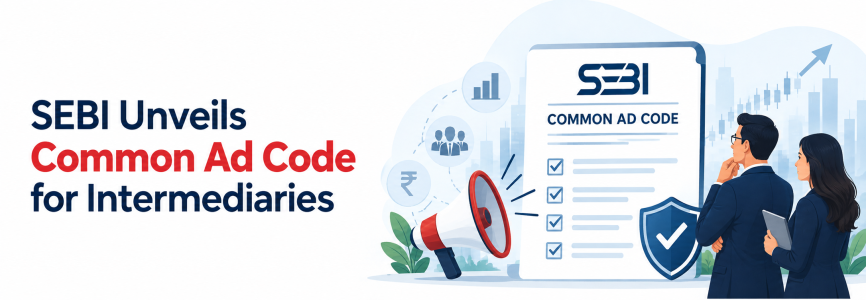



The Securities and Exchange Board of India (SEBI) has introduced a Common Advertisement Code for Intermediaries, bringing uniform advertising requirements for several categories of regulated entities operating in India's securities market. The new regulations aim to improve transparency, prevent misleading financial promotions, strengthen investor protection and ensure that advertisements provide accurate information.
Through the SEBI (Intermediaries) (Second Amendment) Regulations, 2026, notified on October 8, 2026, SEBI has inserted Chapter IIID into the SEBI (Intermediaries) Regulations, 2008. This chapter contains Regulations 16G to 16Q and addresses advertisements, mandatory disclosures, celebrity endorsements, prohibited promotional practices and regulatory responsibilities. The notification appeared in the Official Gazette dated October 9, 2026. The regulations will come into force on the 180th day from their publication in the Gazette, giving affected entities a transition period to review their advertising practices.
What Is SEBI's Common Advertisement Code?
The SEBI Common Advertisement Code is a set of advertising regulations intended to establish consistent standards for how specified securities-market intermediaries promote their brands, products and services. Previously, different categories of market intermediaries operated under their respective advertising requirements. The new common code introduces a shared set of standards for the entities covered by the amendment. Consider an investment advisory company promoting its services through Instagram. If its advertisement suggests that investors can earn guaranteed profits, such a claim may mislead potential customers about investment risks.
Similarly, a stockbroker publishing exaggerated claims about trading success could create unrealistic expectations among inexperienced investors. The Common Advertisement Code addresses such practices by requiring regulated entities to provide fair, accurate and understandable promotional information. Importantly, the regulations do not prohibit advertising altogether. Instead, they establish conditions under which advertisements can be issued responsibly.
Why Has SEBI Introduced the Common Advertisement Code?
Advertising plays an important role in helping financial businesses reach customers. However, financial advertisements can also influence investment decisions involving substantial monetary risks. The increasing use of social media, financial influencers, digital marketing campaigns and online investment platforms has made responsible advertising particularly important.
SEBI's new requirements address several concerns.
Misleading investment claims: Advertisements suggesting assured profits or unrealistic outcomes can encourage investors to make decisions without understanding the risks involved.
Inconsistent advertising practices: Common requirements help create greater consistency across specified categories of regulated entities.
Celebrity influence: Well-known personalities can influence financial decisions even when they do not possess expertise in investments or securities markets.
Digital advertising practices: Online promotions, including short-form messages and social media campaigns, require clear disclosure standards.
Investor protection: The rules seek to help individuals evaluate financial products and services using reliable information rather than exaggerated promotional statements.
By addressing these concerns, SEBI aims to encourage responsible marketing while allowing regulated entities to communicate their services to potential customers.
Which SEBI Intermediaries Are Covered Under the New Advertisement Code?
Regulation 16G(3) identifies the regulated entities covered by the Common Advertisement Code.
|
Regulated entity |
Examples of covered advertising |
|
Stock Brokers |
Trading platforms, broking services and promotional campaigns |
|
Depository Participants |
Demat account and depository service promotions |
|
Online Bond Platform Providers |
Online bond investment platform promotions |
|
Investment Advisers |
Investment advisory service advertisements |
|
Research Analysts |
Research and market-analysis service promotions |
|
Mutual Funds |
Mutual fund advertising campaigns |
|
Asset Management Companies |
Asset management and fund-related promotions |
|
Portfolio Managers |
Portfolio management service advertisements |
SEBI may also specify additional entities from time to time.
The code applies to advertisements issued by these entities concerning products or services falling within SEBI's regulatory jurisdiction. For instance, a SEBI-registered Investment Adviser promoting its advisory services on LinkedIn would need to consider the new requirements. Similarly, a Research Analyst advertising services through online videos must ensure that promotional claims comply with the applicable regulations.
What Counts as an Advertisement Under SEBI's New Rules?
One important feature of the Common Advertisement Code is its broad definition of an advertisement.
Under Regulation 16G(1), an advertisement can include written, verbal, audio, visual or other communications issued directly or indirectly by a regulated entity, or on its behalf, for the promotion of its brand, products or services.
The definition covers several forms of media:
- Print media: Newspapers, magazines and other printed publications.
- Broadcast media: Television, radio and podcasts.
- Digital media: Websites, social media platforms, streaming services and online news websites.
- Outdoor media: Billboards, transit advertising and in-store displays.
For example, a brokerage company's advertisement on YouTube and a portfolio manager's promotional campaign in a newspaper may both fall within the Common Advertisement Code.
The important consideration is the purpose and effect of the communication, not merely the platform used. Consequently, regulated entities should review advertising distributed through their own channels as well as promotional content issued on their behalf.
Mandatory Disclosures Under the SEBI Advertisement Code 2026
Regulation 16I introduces mandatory disclosure requirements. Advertisements must contain basic information identifying the regulated entity and applicable disclaimers. These requirements include the regulated entity's name, its SEBI Registration number and its logo, where applicable. Regulated entities must also display or communicate disclaimers as specified by SEBI from time to time.
Special provision for short advertisements
Some digital advertisements have limited space. SMS messages, push notifications and pop-up advertisements may not accommodate all the required information.
SEBI has therefore provided a specific arrangement for such formats.
Where the character limit prevents the inclusion of basic details and disclaimers, the communication must provide a hyperlink to the relevant information and disclaimers available on the entity's official website. This provision recognises the practical limitations of short digital messages without removing the requirement to make essential information accessible. For compliance purposes, regulated entities should ensure that the linked information is accurate, accessible and appropriately maintained.
SEBI Allows Celebrity Endorsements With Certain Restrictions
One of the most significant changes introduced by the SEBI Common Advertisement Code 2026 concerns celebrity endorsements. Under Regulation 16K, celebrities may endorse regulated entities at the brand or entity level. However, advertisements featuring celebrities must not directly or indirectly induce investment in, or make claims regarding, specific products or services.
For example, a celebrity may appear in a campaign promoting the overall brand identity of a stockbroking company. However, the celebrity cannot use that advertisement to make promotional claims suggesting that a particular investment product will generate superior or assured returns.
Who qualifies as a celebrity?
The regulations adopt a broad definition that can include film and television personalities, prominent sportspersons, qualifying social media influencers, certain television hosts, reality-programme personalities and virtual influencers. SEBI or the relevant supervisory body may also consider whether a person is capable of influencing viewers' opinions. Founders, promoters, directors, key managerial personnel and senior management personnel appearing in advertisements of their own regulated entities are excluded from the definition of celebrity under this provision.
Prior approval for celebrity advertisements
An advertisement featuring a celebrity must obtain prior approval from the relevant supervisory body or SEBI, where no supervisory body has been specified. Additionally, the expenses of celebrity endorsements cannot be passed on to clients or charged to mutual fund schemes. Relevant disclaimers must also be included as prescribed. This means that celebrity-led campaigns require additional regulatory scrutiny, even though the code does not impose a general prior-approval requirement for every ordinary advertisement.
Key Restrictions Under SEBI's New Advertisement Rules
Regulations 16L and 16O introduce important obligations and restrictions that intermediaries must consider when creating marketing content.
No misleading or exaggerated claims
Advertisements must be truthful, fair, accurate, complete and unambiguous. Entities must avoid statements that exaggerate investment opportunities, conceal important facts or create unrealistic expectations among investors.
No guaranteed or risk-free return promises
Advertisements cannot directly or indirectly assure investors of guaranteed, risk-free or indicative returns. Fixed-return promises are also prohibited, subject to the specified exceptions for Online Bond Platform Providers or other entities in the manner permitted by SEBI.
For example, an investment advisory advertisement claiming that subscribers will earn a guaranteed monthly profit would raise serious compliance concerns.
Restrictions on past performance claims
Advertisements cannot imply that historical investment performance will necessarily continue in the future. References to past performance are permitted only in the manner specified by SEBI.
No misleading comparisons
Intermediaries must not make unfair comparisons with competitors or misrepresent another regulated entity's services. Comparisons between fundamentally different investment products or asset classes must not create misleading impressions.
No inappropriate trading incentives
Regulation 16L restricts incentives such as vouchers, coupons, monetary certificates, tokens and subscription plans intended to induce clients to trade, obtain services, reactivate inactive accounts, invest in schemes or download applications.
No prohibited testimonials
The code prohibits testimonials in advertisements. Marketing teams should therefore carefully review client-success stories, customer endorsements and promotional claims before publishing them.
Restrictions on regulatory logos
Advertisements must not use SEBI's logo or imagery, or the symbols of Market Infrastructure Institutions or similarly reputable organisations, unless specifically permitted. Displaying a SEBI registration number as required should not be confused with permission to use SEBI's official logo for promotional purposes.
Rules for Financial Charts, Statistics and Investment Examples
Many investment-related advertisements use charts, statistics and performance comparisons to attract potential investors. Under Regulation 16L, statistical information must be supported by identifiable sources. Advertisements containing charts, graphs or financial statistics must disclose the relevant source alongside the information. They must also indicate the date or period to which the data relates.
Additionally, where an advertisement refers to particular securities or schemes merely as examples, the required disclaimer must appear on the same page of a written advertisement or in the same video frame as the example, rather than only at the end. These requirements are intended to prevent investors from mistaking illustrative information for an investment recommendation. For regulated businesses, the practical lesson is that financial advertisements should be supported by verifiable information and presented in a manner that does not hide important qualifications.
SEBI Prohibits Dark Patterns in Financial Advertising
The Common Advertisement Code also addresses manipulative digital practices.
Under Regulation 16M, regulated entities must not engage in dark patterns specified in Annexure I of the Central Consumer Protection Authority's Guidelines for Prevention and Regulation of Dark Patterns, 2023. Dark patterns are deceptive design practices that can manipulate users into taking actions they might not otherwise choose.
Examples may include misleading interface designs, disguised advertisements and subscription practices that obstruct informed consumer decisions. For securities-market intermediaries, this means that compliance considerations extend beyond the wording of advertisements. The design of digital interfaces, promotional journeys and customer acquisition campaigns can also become relevant. A marketing campaign should not rely on confusing layouts or misleading interaction methods to obtain investor participation.
Use of Ratings and Rankings in Advertisements
Regulation 16N contains specific restrictions concerning ratings and rankings used in advertisements. Under the provision, regulated entities may use ratings or rankings assigned by a Past Risk and Return Verification Agency, subject to prescribed conditions. The advertisement must provide sufficient information about the meaning and methodology of the rating or ranking, either directly or through an appropriate website reference. It must also make clear that ratings and rankings are only one factor investors should consider when selecting a regulated entity. The underlying study or survey must cover relevant market participants within the concerned category to support fair and objective comparisons. Entities should therefore avoid using unsupported promotional descriptions such as being the best-performing or highest-ranked intermediary without considering the regulatory requirements.
Which Communications Are Exempt From the Advertisement Code?
Regulation 16J recognises that not every communication issued by a regulated entity is an advertisement. Certain communications are excluded, subject to the conditions prescribed in the regulation. These include educational materials intended to improve financial awareness, research reports shared with existing clients without claims concerning the entity's performance, factual product listings, regulatory communications, responses to client information requests, product demonstrations without promotional inducement, greetings, recruitment announcements and certain sponsorship communications.
However, an important distinction applies. If a communication promotes products or services or solicits interest in obtaining them, it can be treated as an advertisement even if it is presented as educational or informational content.
For example, an article explaining the basics of portfolio diversification may qualify as educational material where the prescribed conditions are satisfied.
However, the same article could fall within the advertising requirements if it encourages readers to purchase a particular advisory subscription. Therefore, SEBI-registered intermediaries should assess the actual content and promotional purpose of their communications rather than relying only on their titles or formats.
Responsibility for Unauthorised Third-Party Advertisements
The Common Advertisement Code also addresses unauthorised advertisements published by third parties.
Under Regulation 16L(2), where a third party issues an advertisement without the consent of a regulated entity, the regulated entity must initiate appropriate action within seven days of becoming aware of it.
The action may include legal measures, depending on the circumstances. The regulated entity must also inform the relevant supervisory body about the action taken and its outcome. Furthermore, the entity must prominently disclose details of such incidents on its website, including information about the concerned third party and the action taken. These requirements are particularly relevant where unauthorised individuals misuse the identity or brand of a SEBI-registered intermediary to attract investors.
Reporting Requirements and Penalties for Non-Compliance
Regulation 16P states that advertising-related reporting obligations will apply as specified by SEBI from time to time. Regulated entities must therefore remain attentive to subsequent circulars and instructions concerning reporting.
Regulation 16Q empowers SEBI to take appropriate action where an entity violates the Common Advertisement Code or circulars issued under it. Such action may include measures under Chapter V of the SEBI (Intermediaries) Regulations, 2008, or other applicable statutory and regulatory provisions.
SEBI may also direct supervisory bodies to take appropriate action. The amendment does not prescribe a single fixed monetary penalty applicable to every advertising violation. The consequences will depend on the applicable provisions, the nature of the contravention and regulatory action taken.
How Should SEBI-Registered Intermediaries Prepare for the New Rules?
The introduction of the Common Advertisement Code means intermediaries should begin reviewing existing promotional practices before the regulations become effective. A sensible compliance approach would include examining advertisements on websites, social media, mobile applications, email campaigns, promotional videos and other channels. Marketing and compliance teams should work together to identify misleading claims, unsupported statistics, prohibited incentives, inappropriate comparisons and missing disclosures.
Entities using celebrities or influencers should examine the proposed campaign, identify whether the personality falls within the regulatory definition of celebrity and arrange the necessary approvals. Businesses should also review third-party marketing arrangements, particularly those involving agencies, affiliates and digital promotional partners. Internal procedures can be strengthened through documented advertising reviews, designated compliance responsibility and proper preservation of supporting records. These are practical compliance recommendations, rather than a separate list of mandatory procedures expressly prescribed in the amendment.
Impact of SEBI's Common Advertisement Code on the Financial Industry
The new advertising rules could influence how intermediaries design and manage their marketing campaigns. For stockbrokers, the requirements may affect promotional messages relating to trading platforms, new customer acquisition and account reactivation. For investment advisers and research analysts, greater care will be necessary when presenting market-related claims, examples, research services and promotional representations.
For mutual funds and asset management companies, celebrity endorsements, disclaimers and performance-related communications require particular attention. Digital marketing agencies working with regulated financial businesses may also need to adjust their content review processes. The wider purpose is to encourage advertising based on transparent, factual communication rather than aggressive promises or misleading claims.
Conclusion
The introduction of the SEBI Common Advertisement Code for Intermediaries 2026 represents an important development in India's securities-market advertising regulations. By establishing common requirements for disclosures, celebrity endorsements, ratings, promotional claims and digital advertising practices, SEBI is seeking to improve the quality of information provided to investors.
For regulated entities, the amendment offers an opportunity to reassess how financial products and services are promoted. Businesses that begin reviewing their advertising practices during the transition period will be better placed to address compliance requirements when the new provisions come into force. Ultimately, the Common Advertisement Code reinforces a fundamental principle of responsible financial marketing: investors should receive accurate and understandable information without being influenced by misleading promises.
FAQs
Q1. What is the SEBI Common Advertisement Code 2026?
Ans. The SEBI Common Advertisement Code 2026 introduces uniform advertising requirements for specified regulated entities. It covers promotional claims, mandatory disclosures, celebrity endorsements and investor protection.
Q2. When will the SEBI Common Advertisement Code come into effect?
Ans. The regulations will take effect on the 180th day from their publication in the Official Gazette dated October 9, 2026. They have been notified but are not yet in force as of October 23, 2026.
Q3. Which intermediaries must follow the new advertisement rules?
Ans. The code applies to specified entities, including stockbrokers, depository participants, investment advisers, research analysts, online bond platform providers, mutual funds, asset management companies and portfolio managers.
Q4. Can SEBI-registered intermediaries use celebrities in advertisements?
Ans. Yes. Celebrities can promote regulated entities at the brand or entity level. However, they cannot make promotional claims or induce investors regarding specific financial products or services. Prior approval is required for advertisements featuring celebrities.
Q5. Is prior approval required for every advertisement?
Ans. The Common Advertisement Code does not impose a general prior-approval requirement on all advertisements. However, Regulation 16K specifically requires prior approval for advertisements featuring celebrities. Other applicable requirements must also be observed.
Q6. Can investment advisers advertise guaranteed returns?
Ans. No. Investment advisers cannot directly or indirectly promise guaranteed, risk-free or indicative investment returns. Such claims are prohibited under Regulation 16O.
Q7. Are financial education posts considered advertisements under SEBI rules?
Ans. Genuinely educational or informational communications may be excluded when the prescribed conditions are met. However, content promoting particular products or services or encouraging customers to obtain them is treated as advertising.
Q8. What information must appear in advertisements?
Ans. Advertisements must include the regulated entity's name, SEBI registration number, logo where applicable, and prescribed disclaimers. Special hyperlink provisions apply to certain short-format digital communications.
Q9. Can SEBI intermediaries provide coupons or incentives to attract customers?
Ans. Regulation 16L restricts incentives, vouchers, coupons, tokens and similar benefits intended to induce clients to trade, obtain services, reactivate accounts, invest in schemes or download mobile applications.
Q10. What happens if an intermediary violates SEBI's advertisement rules?
Ans. SEBI may initiate appropriate regulatory action under the applicable laws and regulations. It may also direct supervisory bodies to take action against entities responsible for violations.
Article last updated on : 23 Oct 2026.









































































_learn_crop10_thumb.jpg)