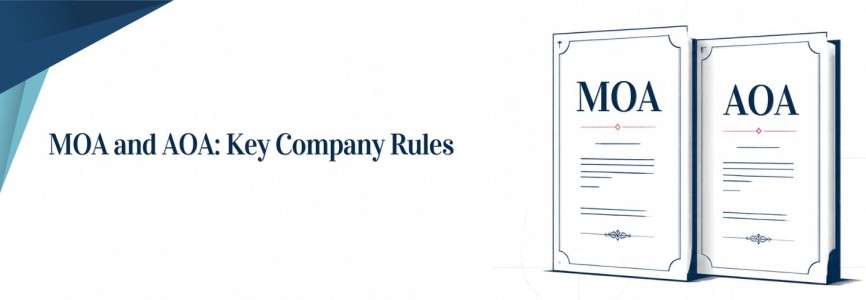



Every company needs a clear understanding of what it intends to do and how it will be managed. These matters are addressed through two important documents: the Memorandum of Association (MOA) and the Articles of Association (AOA). Founders sometimes approve these documents during incorporation without reading them closely. Their importance often becomes clear later, when the company raises investment, introduces a new business activity or faces a disagreement between shareholders.
Carefully prepared documents can make these decisions easier to manage. The main difference is straightforward: the MOA records the company’s fundamental particulars and business objects, while the AOA provides regulations for its internal management. Both operate within the Companies Act, 2013.
What Is a Memorandum of Association?
The Memorandum of Association is a constitutional document containing the fundamental information prescribed for a company. Section 4 of the Companies Act, 2013 governs its contents. The MOA identifies the company’s name, the state where its registered office is situated, its objects and the nature of members’ liability. For companies with share capital, it also states the authorised capital and records the initial subscribers’ share commitments.
Its objects clause is particularly important when assessing business scope. Before entering a new activity, the company should check whether the existing objects cover the proposal or whether an amendment is required. For example, a company established to develop software may have objects covering software products, technology consultancy and related services. If it later proposes an unrelated manufacturing business, management should review the wording before proceeding.
What is an Articles of Association?
The Articles of Association contains the regulations governing the company’s internal management. Section 5 of the Companies Act, 2013 addresses this document. The AOA may contain provisions concerning shares, transfers, directors, meetings, voting and dividends. It helps establish how the company makes decisions and how members exercise their rights.
A company can adopt applicable model articles and include suitable provisions within the law. However, the articles should reflect its actual ownership and governance arrangements. For example, founders may want a procedure requiring a shareholder to offer shares to existing members before selling them to an outside buyer. Appropriately drafted articles can address that arrangement, subject to applicable law.
MOA and AOA: Comparison Table
|
Basis of Difference |
MOA |
AOA |
|
Full form |
Memorandum of Association |
Articles of Association |
|
Main purpose |
Records fundamental particulars and business objects |
Regulates internal management |
|
Principal provision |
Section 4 |
Section 5 |
|
Main contents |
Name, state, objects, liability, capital and subscription particulars |
Share rights, transfers, meetings, directors and decision-making |
|
Business relevance |
Helps assess the company’s objects and fundamental structure |
Helps determine internal authority and procedures |
|
Legal position |
Subject to the Companies Act |
Subject to the Companies Act and MOA |
|
Alteration |
Depends on the clause and applicable statutory procedure |
Generally requires a special resolution, with additional conditions where applicable |
|
Typical use |
Reviewing expansion, name changes and capital structure |
Reviewing investor rights, ownership changes and governance |
Both documents may be relevant to the same transaction. A fundraising exercise, for instance, can involve the MOA’s capital clause and the AOA’s provisions concerning shares and investor rights.
Main Clauses of the Memorandum of Association
Name Clause
The name clause states the company’s registered name. The name must satisfy the applicable legal requirements, including restrictions concerning names that are identical, resemble existing names too closely or are otherwise undesirable. The registered company name identifies the legal entity. It should appear appropriately in contracts, invoices and company records.
A product brand or trading style may differ from this name. Company-name approval should also be distinguished from trademark protection. Incorporation does not automatically resolve whether a business name or brand conflicts with another person’s trademark rights.
Registered Office State Clause
The MOA states the state in which the company’s registered office is situated. It does not ordinarily serve as the document containing the complete street address. This distinction affects the procedure for moving an office. A change within the same state does not automatically require alteration of the MOA’s state clause.
However, separate registered office approvals and filings may still apply. Moving the registered office from one state to another involves alteration of the relevant memorandum provision and additional statutory requirements. The company must identify the exact type of move before deciding the procedure.
Read More : Change in Registered Office of Company
Objects Clause
The objects clause describes the objects for which the company is incorporated and matters necessary for their furtherance. It should be drafted around the company’s intended business. If the wording is too narrow, a later expansion may require amendment. If it contains unrelated activities without proper consideration, it can become difficult to understand the company’s actual purpose.
The clause should allow sensible business development while remaining clear. Management should review it when proposing a significant new activity, acquisition or change in business model. Including an activity in the MOA does not provide a regulatory licence. A company proposing insurance, financial services or another regulated activity must obtain the relevant permissions separately.
Liability Clause
The liability clause identifies the nature of members’ liability. In a company limited by shares, members’ liability is generally limited to the amount unpaid on their shares. For example, where a member has fully paid the agreed amount on shares, there is ordinarily no further contribution due on those shares merely because the company suffers a loss.
However, limited liability should not be treated as protection from every personal obligation. A shareholder may separately give a personal guarantee, and specific statutory liabilities can arise in appropriate circumstances.
Capital Clause
For a company having share capital, the capital clause states the authorised share capital and its division into shares of a fixed amount. Authorised capital is different from paid-up capital. It does not mean that the company has already received that amount from shareholders.
For example, a company may have authorised capital of ?10 lakh while its paid-up capital is ?1 lakh. Before issuing further shares, it should assess the proposed issue against its available authorised capital and complete any necessary changes.
Subscription Particulars
The subscription portion records the initial subscribers’ agreement to form the company. Where the company has share capital, it also records the shares they agree to take.
These particulars establish the initial commitments made at incorporation. They should be consistent with the company’s other formation records and supporting documents. The subscription records also become relevant when reviewing receipt of initial share subscription money and related post-incorporation requirements.
Important Provisions in the Articles of Association
Share Capital and Share Rights
The AOA may contain provisions concerning shares and the rights attached to them. These operate alongside the Companies Act and the applicable share-issue requirements. When a company raises funds, it should assess whether the proposed securities and rights are supported by its articles. Investor arrangements may require amendments before implementation.
For example, an investor may negotiate particular voting or governance rights. The company should review how these arrangements fit within the articles and the proposed transaction documents.
Transfer and Transmission of Shares
A share transfer involves a voluntary change in ownership. Transmission arises through events such as death or operation of law. The AOA can address relevant procedures and legally permitted restrictions.
In a private company, transfer provisions are especially important because the articles must restrict the right to transfer shares as required by law. Clear drafting helps shareholders understand the steps involved in an exit. It can also reduce disputes about whether shares must first be offered to existing members.
Appointment and Powers of Directors
The articles may regulate aspects of board composition, appointment arrangements and directors’ powers. These provisions are important where founders or investors have negotiated board representation.
However, the contractual right to nominate a person should be distinguished from the statutory process for appointing that person as a director. The company should also identify which decisions the board can make and which require shareholder approval or other consent.
Meetings and Voting
The AOA may address meeting procedures, quorum, voting and other decision-making matters, subject to statutory requirements. These provisions become particularly relevant when shareholders disagree.
Clear procedures help establish whether a meeting was properly constituted and whether a decision received the required approval. The articles should be reviewed alongside notices, resolutions and meeting records. Good drafting cannot compensate for failing to follow the actual procedure.
Dividends and Reserves
The AOA may contain provisions concerning dividends, reserves and related matters. These remain subject to the law governing distributions. Shareholders should not assume that accounting profits can automatically be withdrawn.
The company must examine its financial position, applicable statutory conditions and required approvals. Clear records help distinguish a lawful dividend from payments that may require a different legal or accounting treatment.
Entrenchment Provisions
Entrenchment makes specified provisions harder to amend than the ordinary special-resolution requirement. The Act permits such provisions subject to prescribed conditions. Where entrenchment is introduced after incorporation, all members must agree in a private company, while a public company requires a special resolution.
The required notice must also be given to the Registrar. These provisions should be used carefully. They can protect important governance arrangements but may also make future changes more difficult.
Relationship Between the Companies Act, MOA and AOA
The Companies Act has overriding effect over inconsistent provisions in the memorandum, articles, agreements and resolutions, except where the Act expressly provides otherwise. The AOA must also operate within the MOA. Articles cannot independently expand the company’s objects or authorise an activity prohibited by law.
A shareholders’ agreement should be examined alongside both documents. Parties should not assume that signing a private agreement automatically changes the articles or removes statutory requirements. When reviewing a transaction, the company should consider the law, its constitutional documents, contractual arrangements and the required approvals together.
Practical Example: How MOA and AOA Work Together
Consider a private company that sells home décor products and plans to raise investment for expansion. First, management reviews whether the MOA covers the proposed activities. If the expansion involves an activity already supported by its objects, an objects amendment may be unnecessary.
Next, the company checks its authorised capital and proposed share issue. It also examines the AOA for provisions concerning share rights, transfers, board representation and investor approvals. The investment documents should then be aligned with the constitutional arrangements. This avoids a situation where the commercial agreement promises rights that have not been appropriately reflected or implemented.
Can a Company Alter Its MOA?
Yes, but the procedure depends on the provision being changed. Section 13 governs important memorandum alterations, while capital changes may follow the separate provisions of Section 61. It is therefore inaccurate to say that every MOA amendment requires exactly the same approvals.
-
Alteration of the Name Clause: A voluntary name change generally involves the applicable name-approval process, shareholder approval and the required statutory filings. The company should also consider the practical consequences. Contracts, banking records, tax registrations and business communications may need updating after the change becomes effective.
-
Alteration of the Objects Clause: A company can change its object through the prescribed process. Management should prepare suitable wording and obtain the required shareholder approval and registration. Additional conditions may apply in particular cases, including where the company raised money from the public through a prospectus and still has unutilised funds.
-
Alteration of the Capital Clause: Where the articles authorise it, an increase in authorised share capital under Section 61 generally follows an ordinary-resolution route and the applicable filing requirements. If the articles do not provide the necessary authority, an AOA amendment may first be required. Other capital actions, such as reduction, follow different procedures.
Can a Company Alter Its AOA?
Yes. Section 14 generally allows alteration by special resolution, subject to the Companies Act and the memorandum. Particular changes may require additional approvals. For example, conversion of a public company into a private company requires the prescribed Central Government approval.
The company must also satisfy any applicable entrenchment conditions. After completing the required process, it should maintain an updated set of articles and preserve the supporting resolutions and filings.
General Process for Amending MOA or AOA
-
Review the Proposed Amendment: Identify the existing wording, the desired change and its commercial purpose. Check whether the amendment affects other clauses, investor agreements or regulatory permissions. A focused review helps avoid solving one problem while creating another inconsistency.
-
Obtain the Required Approvals: Arrange the relevant board and shareholder approvals using the appropriate notices and meeting procedures. The resolution type and additional consents depend on the amendment. They should be identified before documents are finalised.
-
Complete the Applicable Filings: File the required resolution, altered documents and other forms within the applicable timelines. Some changes become effective only after registration or approval. The company should confirm completion rather than assume the shareholder resolution alone finishes the process.
-
Update All Maintained Copies: After the amendment becomes effective, update the company’s maintained copies and relevant records. Keeping old and new versions clearly identified is important during audits, fundraising and due diligence.
Why Founders Should Review Both Documents Carefully
MOA and AOA can affect decisions involving expansion, investment, shareholder exits and control of the business. Founders should understand the documents before signing them. Later investors should also review them before committing funds.
A suitable review should examine the company’s actual ownership structure and business plans. Standard wording may be appropriate for some matters, while others require tailored provisions.
Common Mistakes to Avoid
-
Treating the Documents as Interchangeable: MOA and AOA serve different functions. Changing an internal management provision does not necessarily resolve an objects issue, and changing objects does not establish the required internal authority.
-
Copying Another Company’s Documents: Another business may have different shareholders, activities and funding arrangements. Copying its documents can introduce unsuitable restrictions or leave important issues unaddressed.
-
Assuming All Amendments Follow One Procedure: A name change, capital increase and alteration of articles can involve different requirements. The correct process must be selected for the specific change.
-
Keeping Conflicting Investor Terms: Investment agreements and articles should be reviewed for consistency. Contradictions concerning transfers, voting or board rights can complicate implementation.
-
Failing to Preserve Updated Records: The company should retain its current MOA and AOA together with the supporting approvals and filing records. Using an outdated copy can lead to incorrect decisions.
Conclusion
The Memorandum of Association and Articles of Association serve different but connected purposes in a company. The MOA records fundamental particulars, including the company’s name, objects, liability and capital structure, while the AOA regulates internal management and decision-making. Understanding these documents helps founders assess business expansion, share transfers, investment proposals and governance arrangements. Both must remain consistent with the Companies Act, 2013, and neither should be treated as paperwork that becomes irrelevant once incorporation is complete.
Companies should review their MOA and AOA whenever their activities, ownership or management arrangements change significantly. Proposed amendments require the correct approvals, filings and, where applicable, regulatory consent. Maintaining updated copies alongside resolutions and acknowledgements makes future reviews easier. Careful drafting also helps identify conflicting investor terms and unclear procedures before they cause disputes. Together, accurate constitutional documents and consistent recordkeeping support informed decisions, clearer responsibilities and organised corporate administration throughout the company’s business journey.
Frequently Asked Questions (FAQ’s)
Q1. What is the main difference between MOA and AOA?
Ans. The MOA records a company’s fundamental particulars and business objects, while the AOA regulates its internal management. Together, they address the company’s constitutional structure and governance arrangements. Both documents must comply with the Companies Act, 2013 and applicable legal requirements.
Q2. Can the AOA override the MOA?
Ans. The AOA cannot override the MOA or authorise activities beyond the company’s lawful objects. Its provisions must remain consistent with the memorandum and applicable legislation. Any proposed governance arrangement should therefore be reviewed against both documents before implementation or amendment.
Q3. Can MOA or AOA override the Companies Act?
Ans. Neither the MOA nor the AOA can override mandatory provisions of the Companies Act, 2013. Inconsistent clauses are ineffective to the extent provided by law. However, where the Act expressly allows flexibility, companies may adopt suitable provisions within those limits.
Q4. Does every MOA amendment require a special resolution?
Ans. Not every MOA amendment requires a special resolution. The procedure depends on the clause and proposed change. For example, certain authorised capital alterations follow Section 61 and generally require an ordinary resolution where the articles provide the necessary authority beforehand.
Q5. Can a company change its objects?
Ans. A company can alter its objects by following the applicable statutory process, including the required shareholder approval and registration. Additional conditions may apply in specific circumstances. Management should confirm that the alteration has become effective before relying on revised objects.
Q6. Does an activity mentioned in the MOA provide a business licence?
Ans. Including an activity in the MOA does not provide a regulatory licence or approval. The company must separately satisfy applicable sectoral requirements. For example, regulated financial or insurance activities may require authorisation even when the objects clause expressly includes them.
Q7. Can a company adopt model articles?
Ans. A company may adopt applicable model articles, either wholly or with suitable modifications, subject to the Companies Act, 2013. Founders should nevertheless review whether the provisions suit their ownership structure, investment plans and management needs before finalising the constitutional documents.
Q8. Is reviewing the AOA important before investing in a company?
Ans. Investors should review the AOA because it can affect share rights, transfer restrictions, board representation and decision-making procedures. The articles should also be examined alongside investment agreements. Consistent documents help clarify negotiated rights and identify implementation requirements before funds move.
Q9. Does every registered office move require alteration of the MOA?
Ans. Not every registered office move requires alteration of the MOA. The memorandum identifies the state rather than ordinarily recording the complete address. Applicable approvals and filings depend on whether the move crosses local limits, Registrar jurisdictions or boundaries between states.
Q10. Should companies keep updated copies after amendments?
Ans. Companies should maintain updated MOA and AOA copies after amendments, together with relevant resolutions, approvals and filing acknowledgements. Accurate records help directors, investors and advisers understand current provisions. They also support due diligence and reduce reliance on outdated constitutional documents.
Article last updated on : 03 Nov 2026.


































































_learn_crop10_thumb.jpg)