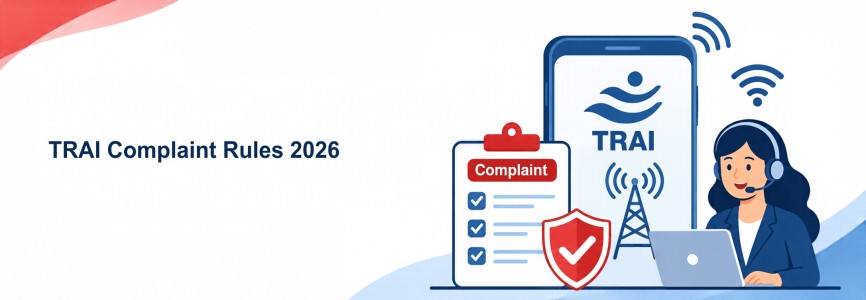



The Telecom Regulatory Authority of India (TRAI) has introduced important changes to improve how telecom consumers register complaints and receive solutions from service providers. On 2 November 2026, TRAI issued the Telecom Consumers Complaint Redressal (Fourth Amendment) Regulations, 2026, bringing new requirements for customer support, complaint registration, appeal procedures, consumer feedback and regulatory monitoring. These amendments aim to make the complaint redressal process faster, easier and more transparent. Telecom consumers often face issues such as poor network connectivity, incorrect billing, internet service interruptions, unwanted deductions and delays in customer support. The new regulations are intended to help consumers report these problems through convenient digital channels and receive better assistance from telecom companies.
One of the major changes is the introduction of 24-hour complaint centre support, along with the facility to register complaints and appeals through mobile applications. TRAI has also reduced the time available for filing appeals from 30 days to 15 days and introduced stronger responsibilities for service providers. The amendments also introduce consumer satisfaction surveys, grievance oversight committees and financial disincentives for specified compliance failures. These measures are expected to improve accountability and encourage telecom operators to resolve consumer complaint more effectively.
Why Did TRAI Introduce These New Regulations?
TRAI introduced these amendments to address changing consumer expectations and improve the existing complaint handling system. Many telecom users depend on reliable mobile and internet services for education, business, employment and daily communication. Delays in resolving complaints can therefore create financial difficulties and inconvenience. To review the existing provisions, TRAI released a consultation paper on 7 May 2026. Stakeholders were invited to submit comments by 12 June 2026 and counter-comments by 19 June 2026. TRAI received 32 comments and 24 counter-comments, followed by an online Open House Discussion on 17 July 2026.
After considering stakeholder feedback, TRAI finalised the Fourth Amendment Regulations. The changes focus on improving digital complaint registration, ensuring customer support throughout the day, making services accessible to persons with disabilities and strengthening monitoring by telecom management and the regulator
Major Changes Under TRAI Complaint Redressal Rules 2026
Applicability to Internet Service Providers
The new amendments simplify the applicability requirements for Internet Service Providers (ISPs). Under the revised provisions, the regulations apply to ISPs having more than 10,000 subscribers on the last day of the preceding financial year. Earlier, an alternative criterion based on annual financial turnover exceeding Rs.5 crore was also used. TRAI has removed this turnover-based criterion, making subscriber numbers the relevant threshold for determining applicability to ISPs. This change makes it easier for internet service businesses to understand whether they fall within the prescribed requirements. ISPs should regularly review their subscriber records to determine applicability and take appropriate steps to comply with the relevant complaint redressal obligations.
Complaint Registration Through Mobile Applications
TRAI has expanded the channels available to consumers for registering complaints, filing appeals, raising service requests and making service-related queries. Consumers can now use their service provider's mobile application in addition to existing complaint centres, websites and web portals. This change is particularly useful for consumers who prefer managing their mobile or broadband services through smartphones. For example, a consumer facing repeated internet disconnections may use the operator's application to register a complaint rather than depending only on a customer care call. Service providers will need to ensure that their digital systems support the required complaint and appeal facilities. The amendment is intended to make complaint submission more convenient and improve access to customer support services.
Round-the-Clock Customer Support
One of the most important changes is the introduction of 24-hour complaint centre support, seven days a week. Earlier, the prescribed support arrangement was 16 hours daily. Under the amended provisions, telecom service providers must make complaint centre support available throughout the day. The regulations permit providers to use human representatives, automated systems, artificial intelligence agents or other customer-focused technological solutions. However, human assistance must remain available for at least 16 hours every day, and technology-based solutions must operate with appropriate human oversight. This means consumers can access complaint centre support outside regular working hours, although a human customer support representative is not necessarily required to be available at every hour. The provision allows telecom companies to use technology while retaining human supervision over automated support.
Better Accessibility for Persons with Disabilities
The revised regulations introduce specific measures to improve accessibility for persons with disabilities. Every service provider must equip dedicated desks or helplines within its complaint centre or consumer support centres with personnel or assistive technology capable of receiving calls from persons with disabilities. Service providers must also ensure that their mobile applications, websites and portals include accessibility features according to applicable government guidelines or standards.
These requirements are intended to remove communication barriers that may prevent some consumers from registering complaints or seeking assistance. Accessible services can make it easier for individuals with different disabilities to contact telecom operators, understand available support and participate in complaint resolution procedures.
Appeal Filing Deadline Reduced to 15 Days
TRAI has reduced the time available for filing an appeal after the disposal of a complaint. Earlier, consumers had 30 days to file an appeal. Under the amended provisions, the time limit has been reduced to 15 days. The purpose of this change is to encourage faster escalation and reduce unnecessary delays in resolving consumer grievances. Consumers who are dissatisfied with the outcome of their complaint should therefore review the decision promptly and file an appeal within the prescribed period. The regulations also expand the available appeal filing channels. Consumers may file appeals through the service provider's mobile application, website or portal, in addition to existing channels such as email, post, personal submission and the Consumer Care Number.
Appellate Authority Must Decide Within 15 Days
The amendments introduce stronger responsibilities for the Appellate Authority responsible for reviewing consumer appeals. The authority must comprise one or more persons who are regular management employees of the service provider and possess at least five years of experience. The Appellate Authority is required to examine the appeal, take appropriate action to resolve the grievance and communicate its final decision within 15 days from receiving the appeal. This requirement aims to make the appeal process more responsible and time-bound. Consumers should receive a final appellate decision within the prescribed period instead of facing prolonged uncertainty. Telecom companies must therefore ensure that their internal appeal handling systems can meet these requirements.
Advisory Committee Process Removed
The new regulations remove the earlier process of resolving appeal cases through an Advisory Committee. This change is intended to simplify the appeal mechanism and support more efficient grievance resolution. Under the revised arrangement, the Appellate Authority carries greater responsibility for reviewing complaints and communicating decisions within the prescribed period. Removing the earlier advisory committee process may reduce procedural steps and support quicker decision-making.
However, the Appellate Authority must still examine the consumer's concerns properly and take suitable action before issuing a final decision. The objective is not simply faster disposal of appeals, but a more effective and accountable appeal handling process.
New Consumer Feedback Survey System
TRAI has introduced a consumer feedback survey mechanism to assess whether consumers are satisfied with the resolution of their complaints and appeals. After a complaint or appeal is resolved or closed, the service provider must conduct an online survey to collect feedback. Consumers will provide their satisfaction rating using a five-point scale. The highest rating, five points, represents full satisfaction, while the lowest rating, one point, represents total dissatisfaction. This system can help identify whether the consumer believes the complaint was handled properly.
Telecom companies must publish the results of these feedback surveys on their websites on a quarterly basis. This introduces a greater level of transparency and allows consumer satisfaction to become part of the formal monitoring process. The feedback system may also help telecom operators identify common customer concerns, improve internal processes and evaluate the performance of their complaint handling teams.
Quarterly Reporting to CEO or Board of Directors
The Fourth Amendment Regulations introduce stronger management-level oversight of consumer complaints. Every service provider must place a quarterly report before its Chief Executive Officer or Board of Directors covering complaint redressal, appeals and consumer feedback survey results. This means grievance management will not remain limited to customer support teams. Senior management will also receive information about the functioning of the complaint handling system and consumer satisfaction levels.
Regular reporting can help company leadership identify unresolved problems, repeated complaints and areas requiring improvement. It also encourages telecom operators to treat consumer grievances as an important part of business operations rather than merely a customer service activity. For compliance teams, this requirement makes accurate complaint records, periodic performance reviews and timely reporting particularly important.
Consumer Grievance Redressal Oversight Committee
TRAI has introduced a new requirement for service providers to establish a Consumer Grievance Redressal Oversight Committee. The committee will oversee and periodically review the functioning of the company's complaint redressal mechanism. The committee must include representatives of the service provider and at least one representative from each consumer organisation registered with TRAI in the relevant State or Union Territory forming part of the licensed service area. The regulations require service providers to include representation from States and Union Territories where their subscriber base exceeds 10,000.
The committee must meet at least once every year to review the grievance redressal mechanism. This initiative provides a structured opportunity for consumer organisations to participate in the review process. Their involvement may help bring consumer experiences and concerns to the attention of telecom companies and encourage improvements in complaint handling practices.
Stronger Regulatory Review by TRAI
The new amendments provide TRAI with a structured mechanism for reviewing how service providers manage consumer grievances. The regulator may periodically examine the functioning of complaint redressal systems through audits, inspections and performance analysis. The review process may include examining service provider records, analysing Quarterly Performance Reports and considering consumer feedback. These measures are intended to help TRAI evaluate whether companies are meeting the prescribed complaint handling requirements.
Such regulatory reviews may also reveal repeated service failures, delays in appeals or weaknesses in internal grievance management. Telecom companies should therefore maintain reliable records and ensure that their complaint handling procedures reflect the applicable requirements. A stronger review mechanism can improve transparency and create additional pressure on service providers to maintain effective consumer support systems.
Financial Disincentives for Non-Compliance
The Fourth Amendment Regulations introduce financial disincentives for specified failures to comply with complaint redressal requirements. These include cases where complaints or appeals are disposed of contrary to the regulations, as identified through audits, inspections, analysis or regulatory reviews. Financial disincentives have also been introduced for the non-submission or delayed submission of Quarterly Performance Reports.
These provisions make regulatory compliance more important for telecom service providers. Companies must ensure that complaints are handled according to the prescribed procedures and that reporting obligations are completed on time. The exact financial disincentive amounts and applicable conditions should be checked in the full regulations issued by TRAI. Businesses should not assume that every consumer complaint automatically results in a financial penalty. Enforcement depends on the applicable provisions and findings of non-compliance.
Old Rules vs New TRAI Complaint Rules 2026
The following table highlights the important changes introduced under the Fourth Amendment Regulations.
|
Particulars |
Earlier provisions |
Changes in 2026 |
|---|---|---|
|
Complaint centre support |
16 hours daily |
24 hours daily, seven days a week |
|
Human assistance |
Earlier support arrangement |
Minimum 16 hours daily |
|
Complaint registration |
Existing complaint channels |
Mobile application added |
|
Appeal filing period |
30 days |
15 days |
|
Appellate decision |
Earlier appeal process |
Final decision within 15 days |
|
Appeal Advisory Committee |
Earlier committee-based process |
Removed |
|
Consumer feedback |
No comparable mandatory survey under the earlier process |
Five-point online survey and quarterly publication |
|
Management oversight |
Earlier reporting arrangements |
Quarterly report to CEO or Board |
|
Consumer oversight |
Earlier arrangements |
New oversight committee |
|
Financial disincentives |
Earlier enforcement provisions |
New disincentives for specified violations |
How Can Telecom Consumers File Complaints Under the New Rules?
The amended regulations provide additional options for consumers to register complaints and pursue appeals. A consumer experiencing billing problems, poor service quality or other service-related issues may contact the telecom operator through its complaint centre, mobile application, website or web portal. After registering a complaint, consumers should retain the complaint reference number and any acknowledgement provided by the service provider. These details can help them follow up on their complaint and maintain a record of previous communication.
If the complaint is disposed of but the consumer is dissatisfied with the outcome, an appeal may be filed with the service provider's Appellate Authority within 15 days. The Appellate Authority must examine the appeal and communicate its final decision within 15 days of receiving it. Consumers should also provide accurate feedback through the online survey after their complaint or appeal is resolved. This feedback contributes to the monitoring of grievance redressal performance.
Compliance Requirements for Telecom Service Providers
The revised regulations introduce several operational and reporting responsibilities for telecom operators and applicable ISPs. Businesses should review their existing complaint management procedures and identify the changes required to meet the amended provisions.
Important compliance activities include:
-
Updating customer support systems: Ensure complaint centre support is available round the clock while maintaining the required daily human assistance.
-
Improving digital access: Provide the required complaint, appeal and service request facilities through mobile applications and other prescribed channels.
-
Strengthening accessibility: Equip relevant support facilities and digital platforms with accessibility features for persons with disabilities.
-
Revising appeal procedures: Update internal processes to reflect the 15-day appeal filing period and 15-day appellate decision requirement.
-
Introducing feedback surveys: Collect consumer satisfaction ratings after complaint or appeal closure and publish results quarterly.
-
Improving management reporting: Prepare quarterly grievance reports for review by the CEO or Board of Directors.
-
Establishing oversight arrangements: Constitute the required Consumer Grievance Redressal Oversight Committee and conduct periodic reviews.
-
Maintaining compliance records: Preserve accurate complaint and appeal data to support regulatory inspection, audit and performance reporting.
Businesses should review the full notified regulations for precise obligations, implementation requirements and applicable timelines. These activities can reduce regulatory risks while improving the quality of customer support.
Impact of TRAI's New Regulations on Telecom Companies and Consumers
The new regulations are expected to influence how telecom companies manage customer service operations. Service providers may need to invest in complaint management software, mobile application improvements, accessibility tools, customer support technology and employee training. For businesses, the new requirements may initially involve operational changes and additional compliance work. However, improved complaint handling can also help reduce customer dissatisfaction, support consumer trust and improve service quality over time.
For consumers, the amendments provide more convenient complaint filing channels, continuous complaint centre support and a clearer appeal procedure. The new consumer feedback and oversight arrangements can also improve accountability by bringing customer experiences into regular management and regulatory reviews. The overall effectiveness of these changes will depend on proper implementation by service providers and continued monitoring of compliance.
Conclusion
The Telecom Consumers Complaint Redressal (Fourth Amendment) Regulations, 2026, represent an important step towards improving consumer protection in India's telecom sector. By introducing 24-hour complaint centre support, digital complaint registration, accessible customer service and shorter appeal timelines, TRAI aims to make grievance redressal more convenient and responsible. The new requirements for consumer satisfaction surveys, management reporting, oversight committees and regulatory review also place greater responsibility on telecom service providers. Companies must strengthen their internal complaint handling processes, maintain reliable records and ensure compliance with the revised provisions.
For consumers, the amendments provide clearer ways to register complaints, escalate unresolved issues and share feedback. For telecom businesses, early compliance planning can help reduce operational difficulties and regulatory risks. Compliance Calendar LLP helps businesses understand regulatory requirements, maintain compliance records and manage applicable legal obligations. Telecom businesses should review the complete TRAI notification and assess how the amended requirements affect their operations.
Related Reading: DoT–TRAI 1600 Series Numbers for BFSI Calls
Frequently Asked Questions (FAQs)
Q1. What are the new TRAI complaint rules for 2026?
Ans. TRAI has introduced the Telecom Consumers Complaint Redressal (Fourth Amendment) Regulations, 2026, providing digital complaint registration, 24-hour complaint centre support, faster appeals, consumer feedback surveys and stronger regulatory oversight.
Q2. Can consumers register telecom complaints through mobile apps?
Ans. Yes. Consumers can register complaints, file appeals, raise service requests and make service-related queries through their telecom service provider's mobile application, in addition to other available channels.
Q3. Is 24-hour customer care mandatory under the new TRAI rules?
Ans. The amended regulations require round-the-clock complaint centre support. However, human assistance must be available for at least 16 hours daily, while automated or AI-based support may operate with appropriate human oversight.
Q4. What is the new time limit for filing telecom appeals?
Ans. Consumers have 15 days after the disposal of a complaint to file an appeal. Earlier, the prescribed appeal filing period was 30 days.
Q5. How quickly must a telecom company resolve an appeal?
Ans. The Appellate Authority must examine the appeal, take appropriate action and communicate its final decision within 15 days of receiving the appeal.
Q6. Are the new regulations applicable to Internet Service Providers?
Ans. The revised applicability requirement covers Internet Service Providers with more than 10,000 subscribers on the last day of the preceding financial year.
Q7. What is the new consumer feedback survey?
Ans. Telecom service providers must conduct online feedback surveys after closing complaints or appeals. Consumers rate their satisfaction on a five-point scale, and survey results must be published quarterly.
Q8. What is the Consumer Grievance Redressal Oversight Committee?
Ans. It is a committee established by service providers to review their grievance redressal systems. It includes service provider representatives and relevant TRAI-registered consumer organisation representatives.
Q9. Can TRAI impose financial disincentives for non-compliance?
Ans. Yes. The amendments introduce financial disincentives for specified complaint or appeal handling violations and for non-submission or delayed submission of Quarterly Performance Reports.
Q10. When were the new TRAI Complaint Redressal Regulations issued?
Ans. TRAI issued the Telecom Consumers Complaint Redressal (Fourth Amendment) Regulations, 2026, on 2 November 2026. The applicable commencement provisions should be checked in the full notified regulations.
Article last updated on : 03 Nov 2026.

















































_learn_crop10_thumb.jpg)