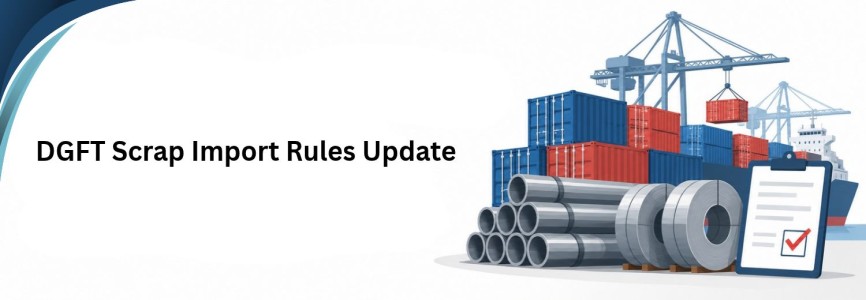



Metal scrap is widely used by manufacturers, foundries and recycling businesses in India. It provides raw material for production and helps businesses recover useful metals from discarded products. However, scrap consignments can also present safety concerns if they contain radioactive substances, explosives or other unsuitable materials. Importers must therefore check the applicable inspection and documentation requirements before arranging shipment.
The Directorate General of Foreign Trade, commonly known as DGFT, has revised the provisions relating to the Pre-Shipment Inspection Certificate (PSIC) exemption for certain metallic waste and scrap imports. Public Notice No. 35/2026-27, dated 21 October 2026, amends paragraph 2.51(d)(v)(iv) of the Handbook of Procedures, 2023. The amendment expands the specified entry-port list and clarifies how the exemption applies when eligible goods are cleared at an Inland Container Depot. It does not remove PSIC requirements for every scrap shipment. Importers must examine the country or region, supplier certification, shipping arrangements and entry-port checks before claiming the exemption.
What Is a Pre-Shipment Inspection Certificate?
A Pre-Shipment Inspection Certificate is a document connected with the inspection of goods before shipment. For metallic waste and scrap, the inspection process helps establish whether the consignment meets the applicable requirements, including checks relating to potentially dangerous material. Scrap can come from several industrial sources, and the contents of a shipment may not always be clear from a general commercial description. A consignment described simply as “metal scrap” may contain different grades, components or materials.
Proper inspection and accurate documentation help the importer understand what is being shipped and prepare for clearance. A PSIC is different from the supplier or scrap yard certificate required under the exemption. The supplier certificate supports a claim that an eligible consignment does not need a PSIC. It should not be presented as though it were an inspection certificate issued by a recognised inspection agency.
What Has DGFT Changed in the PSIC Rules?
The revised provision explains the conditions for the PSIC exemption in clearer terms. It covers both shredded and unshredded metallic waste and scrap imported from designated safe countries or regions, provided the consignment satisfies the prescribed conditions. The specified entry-port list has expanded from eight to eleven sea ports. Hazira, Kamarajar and Adani Gangavaram have been added to the earlier list.
This gives eligible importers additional routing choices when planning shipments under the exemption. The amendment also expressly allows customs clearance for home consumption at an Inland Container Depot, or ICD. However, the required conditions must first be satisfied at the designated entry sea port. Where clearance takes place at an ICD, proof of that compliance must be presented there.
Does the Amendment Remove PSIC Requirements for All Scrap Imports?
The amendment does not provide a general exemption for every metallic scrap consignment. PSIC remains the general requirement under the revised provision, while the exemption is available only where the specified conditions are fulfilled. Importers should not assume that the exemption applies merely because the seller is located in a designated country.
The actual facts of the shipment, including its sourcing and movement, must support the claim. A supplier’s business address alone may not explain where the goods came from or how they were routed. The exemption also concerns the PSIC requirement specifically. Businesses must separately examine other applicable customs, import-policy, environmental and product-related requirements. Eligibility for a PSIC exemption does not establish that every other requirement has been met.
Countries and Regions Covered by the PSIC Exemption
The designated safe countries and regions are the United States of America, United Kingdom, Canada, New Zealand, Australia and the European Union. Imports from these locations may qualify for the exemption when all other prescribed conditions are satisfied. The reference to the European Union should not be understood as covering every European country. Importers should confirm the relevant country’s status and ensure that the shipment records support the exemption being claimed.
These checks should begin during supplier selection. Before confirming an order, the importer should ask the supplier to explain where the scrap is sourced, how it will be shipped and whether the required certificate can accompany the consignment.
Designated Sea Ports Under the Revised Rules
The eleven specified sea ports are Chennai, Tuticorin, Kandla, JNPT, Mumbai, Krishnapatnam, Mundra, Kattupalli, Hazira, Kamarajar and Adani Gangavaram. The exemption requires eligible consignments to enter through one of these ports and undergo the prescribed checks. The addition of three ports may help businesses choose routes that better suit their factories, customers or inland transport arrangements.
However, the most suitable port should be selected after considering both compliance and commercial factors. For example, a cheaper freight quotation may offer limited value if the proposed route creates difficulties with exemption eligibility or inland clearance. The importer should discuss the planned entry port with its customs broker and logistics provider before confirming the booking.
Conditions for Claiming the PSIC Exemption
Certificate From the Supplier or Scrap Yard Authority
The consignment must be accompanied by a certificate from the supplier or scrap yard authority confirming that it does not contain radioactive materials or explosives. This certificate is an essential part of the exemption conditions and should be obtained as part of shipment preparation.
As a practical document-control measure, the certificate should be clearly traceable to the relevant consignment. References to the invoice, shipment or container details can help connect it with the goods. Importers should confirm the documentation acceptable for their particular clearance rather than rely on a general declaration unrelated to the shipment.
Entry Through a Specified Sea Port
The consignment must enter India through one of the eleven specified sea ports. The chosen entry point should therefore be checked before shipment, rather than after the vessel has arrived.
If the shipping line changes the route or entry port, the importer should review the exemption position again. A change made for operational reasons can affect the assumptions on which the original clearance plan was prepared.
Mandatory Radiation and Explosive Checks
Eligible consignments remain subject to mandatory radiation and explosive checks through portal monitors and container scanners at the specified ports. The exemption from a PSIC does not remove these arrival-stage safeguards.
Importers should coordinate with their customs broker to understand how the required checks and supporting records will be handled. This becomes particularly important where the goods will move inland for clearance, because the relevant proof must remain available.
Restriction on Trans-shipments
Consignments trans-shipped through the designated safe countries or regions are not entitled to the exemption on that basis. Routing goods through a listed location does not, by itself, make the consignment eligible.
The importer should examine the shipping history and commercial records carefully. Where the route raises questions, the inspection position should be clarified before dispatch. Assumptions made at the booking stage can become difficult and expensive to resolve once the goods are in transit.
How the Exemption Applies to ICD Clearance
An Inland Container Depot is an inland facility used for cargo handling and customs clearance. Businesses located away from the coast may use an ICD to complete clearance closer to their operations. The revised provision expressly recognises the PSIC exemption for eligible consignments cleared for home consumption at an ICD.
The conditions relating to the supplier certificate, designated entry port and shipment eligibility must be satisfied at the port of entry. Proof must then be furnished at the ICD. This requires a clear handover between the teams working at the sea port and inland location. The importer should decide who will obtain the relevant records, who will verify them and who will present them during ICD clearance. A complete shipment file helps prevent documents from being lost between different service providers.
Practical Examples of the Revised Rules
Eligible Import Cleared at a Sea Port
Consider an Indian manufacturer purchasing metallic scrap from a supplier in a designated safe country. The shipment is planned through one of the specified sea ports, and the supplier provides the required certificate.
The importer should still verify that the shipment satisfies all exemption conditions and undergoes the mandatory checks. If those conditions are fulfilled, the exemption may be claimed for the consignment. Supporting records should be retained with the customs-clearance documents.
Eligible Import Cleared at an ICD
Consider a business that plans to move an eligible consignment from the designated entry sea port to an ICD. The business should prepare the inland clearance arrangement before shipment and identify how evidence of entry-port compliance will be collected.
The key issue is continuity of documentation. The team at the ICD should receive the necessary proof rather than assume that completion of checks at the sea port will automatically resolve the inland clearance requirements.
Scrap Routed Through a Designated Safe Country
Consider a supplier proposing to route scrap through a designated safe country and claiming that this makes the shipment exempt. The importer should examine the actual shipment history instead of accepting that statement without review.
The trans-shipment restriction must be considered. If the exemption conditions are not satisfied, the applicable PSIC requirement should be addressed before shipment.
Steps Importers Should Take Before Shipment
Identify the Goods Accurately
The first step is to establish what material is being purchased. The commercial description, scrap grade, composition and relevant tariff classification should be reviewed together.
Vague descriptions can create uncertainty for the supplier, inspection provider and customs broker. A clear purchase specification helps everyone understand the goods and identify the requirements that may apply.
Review the Exemption Conditions
The importer should prepare a short written review covering the relevant country or region, supplier certificate, shipping route, entry port and clearance location. This provides a record of why the exemption is considered available.
Where information is incomplete, the purchasing team should obtain clarification before releasing the shipment. It is generally easier to correct documents or arrange inspection while the goods remain with the supplier.
Agree on Supplier Responsibilities
The purchase contract should clearly explain the documents the supplier must provide and the agreed shipment arrangements. It should also address responsibility for incorrect certificates, inconsistent descriptions or unauthorised route changes. Clear contract terms help the parties resolve problems quickly. They also reduce the chance that the importer will discover missing records only after the cargo arrives in India.
Coordinate With the Customs Broker
The proposed invoice, packing list, certificate and shipping details should be shared with the customs broker before dispatch. The broker can identify gaps relevant to the planned entry port and clearance process. This early review is especially useful for ICD shipments. It allows the importer to arrange the document handover and confirm how entry-port evidence will be presented inland.
Maintain a Complete Shipment File
The importer should keep the purchase order, invoice, packing list, transport documents, relevant certificates and clearance correspondence together. For ICD clearance, the file should include the proof received from the entry port. Organised records help employees respond to queries without repeatedly approaching the supplier or logistics provider. They also support later internal checks and reviews.
Business Benefits of the Revised Provision
The expanded port list may help eligible importers choose routes that are closer to their operations or better connected to inland destinations. Depending on the shipment, this could improve transport planning or reduce unnecessary movement.
The express clarification for ICD clearance also gives importers a clearer basis for planning inland clearance. Businesses can organise sourcing, shipping and documentation around the prescribed conditions. These benefits depend on the individual shipment. Freight, handling, storage, inland transport and documentation costs should be assessed together before choosing a route.
Common Mistakes Scrap Importers Should Avoid
A common mistake is treating the amendment as a complete removal of PSIC requirements. Another is assuming that the seller’s location or the vessel’s last port of call establishes exemption eligibility. Importers should also avoid accepting a general supplier declaration without checking whether it relates to the actual consignment.
For ICD shipments, failure to obtain and transfer entry-port evidence can create another documentation gap. The best time to identify these issues is before dispatch. A coordinated review by the purchasing team, supplier, customs broker and logistics provider can help prevent avoidable clearance difficulties.
Conclusion
DGFT’s revised PSIC provision expands the specified entry-port options and clarifies how eligible metallic scrap consignments can receive the exemption when cleared at an ICD. The exemption remains conditional, with supplier certification, shipment eligibility and mandatory safety checks continuing to matter.
Importers should review these conditions before shipment and maintain a clear document trail through the sea-port and inland clearance stages. Accurate records and early coordination can help businesses use the exemption correctly and manage their shipments more effectively.
Frequently Asked Questions (FAQ’s)
Q1. What is PSIC in scrap imports?
Ans. PSIC stands for Pre-Shipment Inspection Certificate. It relates to inspection of a consignment before shipment. For metallic waste and scrap, it helps establish compliance with applicable inspection and safety requirements.
Q2. What has DGFT changed in the PSIC rules?
Ans. DGFT has revised the conditions for the PSIC exemption for eligible metallic waste and scrap imports. The amendment expands the specified entry-port list from eight to eleven and clarifies the exemption’s availability when customs clearance takes place at an Inland Container Depot.
Q3. Is PSIC now exempt for all metallic scrap imports?
Ans. No. The exemption applies only to eligible consignments that satisfy all prescribed conditions. Importers must examine the relevant country or region, supplier certificate, entry port, mandatory safety checks and trans-shipment restriction.
Q4. Which countries and regions are covered by the exemption?
Ans. The designated safe countries and regions are the USA, UK, Canada, New Zealand, Australia and the European Union. Importing from one of these locations does not automatically establish eligibility; the remaining exemption conditions must also be fulfilled.
Q5. Does the exemption cover both shredded and unshredded scrap?
Ans. Yes. The revised provision covers both shredded and unshredded metallic waste and scrap, subject to the specified conditions. Importers must still check the classification and other requirements applicable to their goods.
Q6. Which sea ports are specified for the PSIC exemption?
Ans. The eleven specified sea ports are Chennai, Tuticorin, Kandla, JNPT, Mumbai, Krishnapatnam, Mundra, Kattupalli, Hazira, Kamarajar and Adani Gangavaram. Eligible consignments must enter through one of these ports and undergo the prescribed checks.
Q7. Which three ports have been added?
Ans. Hazira, Kamarajar and Adani Gangavaram have been added to the earlier list. These additions provide more entry-port options for consignments eligible for the PSIC exemption.
Q8. What certificate must accompany an exempt consignment?
Ans. The consignment must be accompanied by a certificate from the supplier or scrap yard authority confirming that it does not contain radioactive materials or explosives. The importer should ensure that the certificate clearly relates to the shipment being cleared.
Q9. Are radiation and explosive checks still mandatory?
Ans. Yes. Eligible consignments remain subject to mandatory radiation and explosive checks through portal monitors and container scanners at the specified entry ports. The PSIC exemption does not remove these safety checks.
Q10. Can an eligible scrap consignment be cleared at an ICD?
Ans. Yes. The revised provision expressly allows customs clearance for home consumption at an Inland Container Depot. All prescribed exemption conditions must first be satisfied at the designated entry sea port, and proof must be provided at the ICD.
Article last updated on : 31 Oct 2026.





























































_learn_crop10_thumb.jpg)