



Imagine Meera wants to invest in an Alternative Investment Fund (AIF). Her annual income is below Rs.2 crore, but she holds more than Rs.5 crore in qualifying securities. Can she be recognised as an Accredited Investor?
Under SEBI’s revised, she may qualify through her securities market exposure. If the AIF manager offers accreditation, she can have her eligibility verified as part of onboarding. She can also apply through a recognised Accreditation Agency.
The Securities and Exchange Board of India (SEBI) issued its circular on the Review of the for Accredited Investors on 5 November 2026, with immediate effect. Circular No. HO/19/34/11(6)2026-AFD-POD1/I/25244/2026 implements amendments to the SEBI (Alternative Investment Funds) Regulations, 2012, notified on 15 October 2026. SEBI also updated its AIF Master Circular dated 3 June 2026 to incorporate the revised provisions.
The changes followed the September 2026 SEBI Board Meeting, where SEBI approved the manager-led accreditation route and the securities market exposure test.
What Is an Accredited Investor?
An Accredited Investor is a person or entity recognised under the applicable SEBI. Applicants generally qualify by meeting the financial criteria for their category and having their eligibility verified by a recognised Accreditation Agency or an eligible manager. Certain categories, including Persons Resident Outside India under FEMA, are deemed accredited under the regulations.
Accreditation matters when an investment product is designed for Accredited Investors or applies different conditions to them. For instance, a fund that accepts only Accredited Investors needs to establish an applicant’s status before onboarding them. The fund’s minimum investment, fees, risk disclosures and exit terms are set separately under the applicable rules and scheme documents.
Read Related Article: sebi-circular-on-accredited-investors-ai-only-and-lvf-schemes-december-2025
Who Can Grant Accreditation Under the New Structure?
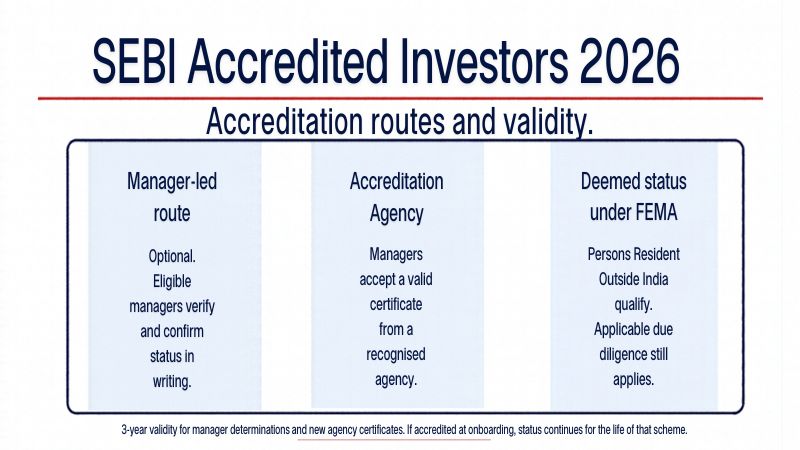
The circular introduces manager-led accreditation as an additional route. An eligible manager can verify the investor’s financial eligibility and determine their accredited status at onboarding or during the life of a scheme.
|
Participant |
Role under the circular |
|
Manager of an Alternative Investment Fund |
May assess and record accredited status at onboarding or during the tenure of the scheme. |
|
Asset management company of a Specialized Investment Fund (SIF) |
May determine accredited status after verifying eligibility. |
|
May determine accredited status for the applicable portfolio management services. |
|
|
Recognised Accreditation Agency |
Continues to assess eligibility and issue accreditation certificates. |
|
May rely on a valid determination made by a manager in its corporate group. Independent determination is outside its role under the circular. |
Manager-led accreditation is optional. An investor can still approach a recognised Accreditation Agency. When an investor provides a valid certificate from such an agency, the manager must rely on it for the rest of its validity. When the manager determines accredited status directly, it must record the decision and give the investor written confirmation stating the accreditation date and validity period.
Read Recent Update on Decoding SEBI’s Portfolio Managers Regulations.
Who Qualifies as an Accredited Investor in 2026?
The eligibility tests are set out in Regulation 2(1) (ab) of the amended AIF Regulations. The November circular explains which investments count towards securities market exposure and what documents the verifier should use.
|
Applicant category |
Eligibility criteria |
|
Individual, Hindu Undivided Family (HUF), family trust or sole proprietorship |
Any one of four tests applies. Annual income of at least Rs.2 crore. Net worth of at least Rs.7.5 crore, including at least Rs.3.75 crore in financial assets. Annual income of at least Rs.1 crore combined with net worth of at least Rs.5 crore, including at least Rs.2.5 crore in financial assets. Qualifying securities market exposure of at least Rs.5 crore. |
|
Body corporate other than an LLP |
Net worth of at least Rs.50 crore or qualifying securities market exposure of at least Rs.20 crore. |
|
Trust other than a family trust |
Net worth of at least Rs.50 crore or qualifying securities market exposure of at least Rs.20 crore. |
|
Net worth of at least Rs.50 crore, qualifying securities market exposure of at least Rs.20 crore, or every partner independently meeting the criteria applicable to that partner. |
|
|
Partnership firm under the Indian Partnership Act, 1932 |
Every partner must independently meet the eligibility criteria applicable to them. |
|
Person Resident Outside India under FEMA |
Deemed accredited. The manager must document the basis for the residence classification. |
The financial tests are alternatives within the relevant applicant category. For example, an individual with Rs.5 crore in verified qualifying securities exposure can use that route even if their annual income falls below Rs.2 crore. An individual relying on the combined income and net worth test must meet the income threshold, the overall net worth threshold and the minimum financial-asset component.
What Counts as Securities Market Exposure?
SEBI recognises the following holdings for the exposure test.
-
Securities held in dematerialised form.
-
Mutual fund investments held through mutual fund folios.
-
Unlisted securities held in dematerialised form.
-
Investments in overseas securities markets.
-
Investments under the National Pension System (NPS).
For demat holdings, the verifier uses the value shown in the electronic Consolidated Account Statement (eCAS) as of the statement date. If the eCAS does not provide a value for eligible unlisted securities or overseas securities investments, the applicant must furnish a certificate from a practising Chartered Accountant (CA). The certificate must state the nature of the securities, their valuation date and their value.
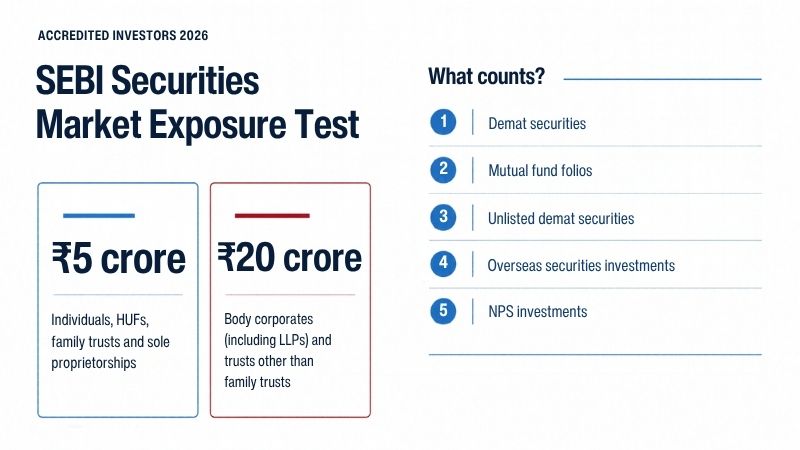
Example of the Rs.5 Crore Exposure Test
Suppose Meera holds Rs.3.8 crore in listed demat securities, Rs.90 lakh in separate mutual fund folios and Rs.40 lakh in NPS investments. Her qualifying exposure would total Rs.5.1 crore, provided the holdings are eligible, supported by the required evidence and counted once each.
Meera may also own a flat. Its value may be relevant when assessing net worth, while the exposure calculation uses the qualifying holdings listed in the circular. This distinction matters when an investor has substantial wealth tied up in property and wants to determine which test they can meet.
Documents Required for Accredited Investor Verification
|
Eligibility test |
Evidence to furnish |
|
Annual income |
Latest income tax return or a practising CA’s certificate confirming that the applicant meets the applicable income threshold. |
|
Net worth |
Latest audited financial statements or a practising CA’s net worth certificate that is no older than six months. |
|
Securities market exposure |
A depository-generated eCAS summary no older than six months, or a practising CA’s certificate confirming that the exposure threshold was met within the preceding six months. |
|
Combined income and net worth |
Evidence supporting both parts of the test, including the minimum financial-asset component. |
The documentation depends on the route used. For instance, if an investor includes overseas securities whose value is missing from the eCAS, the specific CA valuation requirement applies. An LLP using the partner-based route should provide evidence showing how each partner independently qualifies on the date of determination.
How Long Does Accredited Investor Status Last?
A manager’s determination and a certificate issued by a recognised Accreditation Agency under the revised each have a three-year validity period from the date of accreditation. A certificate issued before the circular remains valid for its original unexpired period. During the validity period, eligible managers in the same corporate group recognise the original manager’s determination across AIFs, SIFs and portfolio management services. The definition of a corporate group comes from Explanation I to Regulation 19F(1) of the AIF Regulations.
If an investor approaches a manager in an unrelated group and relies on manager-led accreditation, the new manager must make a fresh determination. If the investor instead presents a valid certificate from a recognised Accreditation Agency, the new manager must rely on that certificate.
What Happens When Accreditation Expires During a Scheme?
If an investor was accredited at the time of onboarding, the scheme continues to treat the investor as accredited for the remainder of that scheme’s life.
For example, if Meera joins Fund A while her accreditation is valid and the three-year period ends before Fund A closes, her accredited status continues for Fund A. If she later applies to join Fund B after that period expires, she will need valid status for the new onboarding where Fund B requires it. The circular expressly ties the continuation rule to investors who were accredited at onboarding.
How Does Accreditation Work for LLPs?
The amended AIF Regulations give an LLP three ways to qualify. It can meet the Rs.50 crore net worth test, the Rs.20 crore securities market exposure test, or qualify because every partner independently meets the eligibility criteria applicable to that partner. Paragraph 8 of the November circular explains how the partner-based route works.
Consider an LLP with two partners, an individual and a private limited company. If the individual meets the Rs.2 crore annual income test and the company has Rs.23 crore in qualifying securities market exposure, both could independently qualify, subject to verification. If either partner falls short of all the criteria applicable to them, the LLP can still be assessed on its own net worth or securities market exposure under the amended regulations.
What Changes for Persons Resident Outside India?
A Person Resident Outside India, as defined under the Foreign Exchange Management Act, 1999 (FEMA), is deemed to be an Accredited Investor. Such an investor can rely on deemed status without obtaining an agency certificate or undergoing a manager-led accreditation assessment. The manager must record how it established the investor’s residence status under FEMA.
The AIF and its manager remain responsible for applicable obligations under the Prevention of Money-laundering Act, 2002 (PMLA) and its rules. These include client due diligence, identifying beneficial owners and meeting applicable source-of-funds requirements. In practice, the onboarding team records the basis for deemed accreditation and carries out the relevant due diligence checks.
For help reviewing the foreign exchange requirements of a proposed cross-border investment, explore our FEMA Advisory and Compliance Services.
What Managers Must Do Before Offering Accreditation
A manager that offers accreditation is responsible for verifying eligibility and complying with the circular. SEBI requires safeguards because the same organisation may be assessing an investor’s eligibility and seeking their investment.
|
Compliance area |
What the manager must do |
|
Conflict-of-interest controls |
Adopt an accreditation policy and separate the accreditation function from business development and distribution. |
|
Decision records |
Document the decision, the eligibility test used and the supporting verification so the decision can be independently reviewed. |
|
Investor grievances |
Establish a process to escalate and resolve concerns about accreditation decisions. |
|
Record retention |
Keep supporting documents and verification evidence for at least five years from accreditation or five years after the investor ceases to be an investor in any scheme managed by the manager, whichever is later. Make records available for inspection when requested. |
|
Confidentiality |
Maintain record retention infrastructure with data privacy and cybersecurity controls to protect investor information. |
|
Audit and compliance review |
Include periodic internal audit and compliance review of the accreditation process in the manager’s existing audit arrangements. |
For example, if a manager accredits an investor in November 2026 and the investor exits the last scheme managed by that manager in March 2033, the later retention date falls in March 2038. Tracking the investor’s last exit date alongside the accreditation date helps the manager calculate the correct retention period.
How to Get Accredited Under the Revised Structure
-
Identify the applicant category: Start with the person or entity making the investment. For example, a family trust and a trust other than a family trust are subject to different tests.
-
Identify the applicable eligibility test: Determine whether the applicant qualifies on income, net worth, a combined test, securities market exposure, partner eligibility or deemed status.
-
Choose the accreditation route: Check whether the manager offers accreditation. Investors planning to onboard with managers in several corporate groups can use a valid certificate issued by a recognised Accreditation Agency.
-
Submit evidence for the selected test: Check the date on the eCAS or CA certificate and arrange the required valuation evidence for eligible holdings whose values are missing from the eCAS.
-
Keep the written confirmation or agency certificate: Record the accreditation date, validity period and scheme onboarding date. These dates help establish whether accreditation can be reused and whether the scheme-life rule applies.
Conclusion
SEBI’s November 2026 circular gives eligible investors a choice between a recognised Accreditation Agency and a manager that offers accreditation. The securities market exposure route matters for investors who hold substantial qualifying investments and may fall below the standalone income or net worth thresholds. For anyone planning to invest through several unrelated managers, a valid agency certificate can reduce the need for repeated determinations.
For managers, the main operational changes are to separate accreditation from sales and distribution, document the evidence behind each decision, and track the dates that determine validity and record retention. These records help the manager establish which investors can rely on existing accreditation when they join another scheme or move between products in the same corporate group.
Frequently Asked Questions (FAQ’s)
Q1. When did SEBI’s Accredited Investor circular take effect?
Ans. The circular took effect on 5 November 2026, the day SEBI issued it. It implements amendments to the AIF Regulations notified on 15 October 2026.
Q2. Is Rs.5 crore the minimum amount an Accredited Investor must invest?
Ans. Rs.5 crore is the qualifying securities market exposure threshold for an individual, HUF, family trust or sole proprietorship using that route. The minimum amount an investor must commit depends on the product, applicable regulations and scheme terms.
Q3. Can a portfolio manager accredit an existing client?
Ans. An eligible portfolio manager that offers accreditation can determine an investor’s status at onboarding or during the tenure of a scheme after verifying eligibility. The continuation rule for the rest of a scheme’s life specifically covers investors who were accredited at onboarding.
Q4. Can I use a manager’s confirmation with another financial group?
Ans. A manager-led determination is recognised within the same corporate group during its validity. A manager in an unrelated group must make a fresh determination if the investor relies on the manager-led route. A valid certificate from a recognised Accreditation Agency can be used with the new manager.
Q5. Does an older accreditation certificate automatically get three years of validity?
Ans. A certificate issued before the circular remains valid until its original expiry date. The three-year validity applies to accreditation under the revised.
Q6. Can NPS and overseas investments count toward securities market exposure?
Ans. Both appear in SEBI’s list of qualifying holdings. If an overseas securities investment has no valuation in the eCAS, a practising CA must certify the nature of the securities, valuation date and value.
Q7. Do overseas investors still need to complete due diligence checks?
Ans. A Person Resident Outside India under FEMA can rely on deemed accreditation. The manager must record the basis for the residence classification, and applicable client due diligence, beneficial ownership and source-of-funds checks continue.
Q8. Can an Investment Adviser or Research Analyst grant Accredited Investor status?
Ans. An Investment Adviser (IA) or Research Analyst (RA) may rely on a valid accreditation determination made by an eligible manager in the same corporate group. The circular reserves independent manager-led assessments for AIF managers, asset management companies of Specialized Investment Funds, and portfolio managers.
Q9. Can an LLP qualify if one of its partners falls short of the eligibility criteria?
Ans. Yes. The LLP can qualify on its own if it has a net worth of at least Rs.50 crore or qualifying securities market exposure of at least Rs.20 crore. Every partner must qualify independently only when the LLP relies on the partner-based route.
Q10. Can an investor use an eCAS that is more than six months old?
Ans. The eCAS summary used as evidence must be no older than six months. The investor can provide a newer depository-generated summary or submit a practising Chartered Accountant’s certificate confirming that the applicable exposure threshold was met within the preceding six months.
Article last updated on : 09 Nov 2026.





























































_learn_crop10_thumb.jpg)