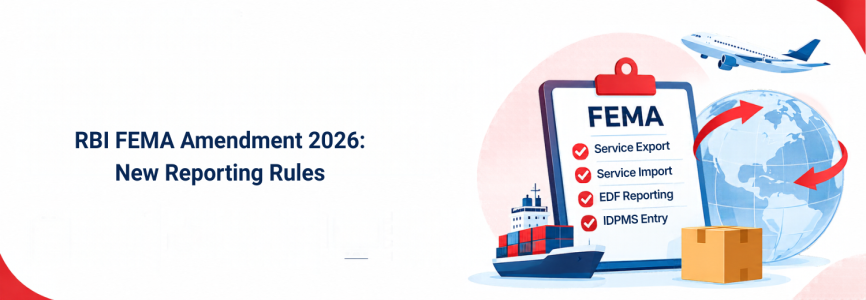



The Reserve Bank of India (RBI) has introduced important changes to foreign exchange reporting requirements through the Foreign Exchange Management (Export and Import of Goods and Services) (Second Amendment) Regulations, 2026. The amendment was notified on 2 November 2026 and came into effect from 1 October 2026. The notification, issued under FEMA Notification No. 23(R)/(2)/2026-RB, mainly changes how certain service export and import transactions are reported through Authorised Dealer (AD) banks.
One of the biggest developments is the introduction of a Rs.10 lakh threshold for specified transactions involving persons other than resident individuals. The amendment also provides a simpler method of submitting Export Declaration Form (EDF) information for resident individuals exporting services. These changes are particularly relevant for freelancers, consultants, IT companies, digital marketing agencies, startups, and businesses receiving payments from overseas clients or making payments to foreign service providers. However, the amendment does not mean that all foreign exchange reporting requirements have been removed. Businesses must understand which transactions qualify for the simplified process and what information their banks may still require.
What Is the RBI FEMA Second Amendment 2026?
The RBI FEMA Second Amendment 2026 is a regulatory update that modifies certain provisions of the Foreign Exchange Management (Export and Import of Goods and Services) Regulations, 2026. The principal regulations were issued on 13 January 2026 under Notification No. FEMA 23(R)/2026-RB. They deal with foreign exchange requirements relating to the export and import of goods and services. The second amendment introduces changes in three main areas:
-
Definition of a resident individual under Regulation 2.
-
Deemed submission of EDF for certain service exports under Regulation 3.
-
Reporting of specified service imports in the Import Data Processing and Monitoring System (IDPMS) under Regulation 18.
The objective of these changes appears to be to simplify reporting for certain service transactions while allowing banks to continue monitoring foreign exchange movements.
For example, an Indian freelancer receiving payment for graphic design services from an overseas client is treated differently from an Indian company receiving payment for software development services. Similarly, a business importing a service worth Rs.8 lakh may face different IDPMS reporting treatment from a company importing a service worth Rs.15 lakh. Understanding these distinctions is important for avoiding reporting mistakes.
When Did the New FEMA Amendment Come into Effect?
The notification contains two important dates.
|
Particulars |
Date |
|---|---|
|
Principal FEMA Regulations, 2026 |
13 January 2026 |
|
First Amendment Notification |
22 September 2026 |
|
Second Amendment Effective Date |
1 October 2026 |
|
Second Amendment Notification Date |
2 November 2026 |
Although the second amendment was notified on 2 November 2026, it expressly states that the changes came into force from 1 October 2026. This means businesses should review relevant service export receipts and service import transactions from the effective date. Where transactions were already processed during October 2026, exporters and importers may need to coordinate with their AD banks to understand how the revised requirements apply to those records. The notification itself does not provide a separate transitional procedure for transactions processed before its publication.
New Definition of Resident Individual Under FEMA 2026
The RBI has inserted a new clause (da) in Regulation 2(1). According to the amendment, a resident individual means a person resident in India who is a natural person. In simple words, the expression refers to an individual who qualifies as resident in India under the applicable FEMA provisions. It does not include companies, LLPs, partnership firms, or other non-individual business entities. This distinction is important because the revised EDF reporting provisions provide different treatment to resident individuals and other exporters.
For example, an individual freelancer working from India may qualify as a resident individual, whereas a private limited company providing the same services would be treated as a person other than a resident individual. A sole proprietorship also requires careful consideration because it is not generally a separate legal person from its proprietor. The relevant FEMA status and bank documentation should be examined rather than assuming that every business registration creates a separate legal entity.
Major Change in EDF Reporting for Service Exports
One of the most significant changes under the amendment relates to the Export Declaration Form, commonly called EDF. The RBI has inserted two new provisos in Regulation 3(2) to simplify declaration requirements for certain service exporters.
EDF Rules for Resident Individual Service Exporters
Under the amended provision, when a resident individual exports services and provides the required information concerning receipt of payment to the Authorised Dealer bank for credit to the exporter's account, the exporter is deemed to have submitted the EDF. This is an important simplification.
For example, suppose an Indian freelance graphic designer provides design services to a client in Canada and receives a payment of Rs.12 lakh. If the freelancer qualifies as a resident individual and provides the required information to the AD bank for crediting the payment, the amended provision treats the EDF as submitted. Importantly, the amendment does not specify a Rs.10 lakh ceiling for this resident-individual provision. However, the freelancer must still provide the information required by the bank. The amendment should not be interpreted as permission to receive foreign payments without appropriate transaction details or applicable FEMA compliance.
EDF Rules for Companies, LLPs and Other Entities
The second proviso applies to service exporters who are persons other than resident individuals. For these exporters, the EDF is deemed submitted when:
-
The exporter provides the information required for receipt of the service export payment to the AD bank.
-
The information is supplied for crediting the exporter's account.
-
The value of the inward remittance for the service does not exceed Rs.10 lakh or its foreign currency equivalent.
For example, an Indian software company receiving Rs.7 lakh for services provided to an overseas customer may qualify for this simplified treatment. However, if the same company receives Rs.14 lakh for a service export, the newly introduced Rs.10 lakh deemed-submission provision would not apply to that remittance. The company would then need to follow the otherwise applicable declaration requirements. This makes the distinction between individual exporters and non-individual exporters especially important.
Understanding the Rs.10 Lakh Threshold Under the New FEMA Rules
The Rs.10 lakh figure is one of the most important elements of this amendment, but it must be applied correctly. For service exports by persons other than resident individuals, the notification refers to the value of the inward remittance for the service. For service imports, the amended Regulation 18 refers instead to the invoice or contract value. These are not identical tests.
|
Transaction |
Revised treatment |
|---|---|
|
Service export by resident individual |
EDF deemed submitted when required payment information is furnished to the AD bank |
|
Service export by company or LLP, inward remittance Rs.8 lakh |
May qualify for deemed EDF submission |
|
Service export by company or LLP, inward remittance Rs.12 lakh |
New Rs.10 lakh proviso does not apply |
|
Service import by resident individual |
Outside the revised IDPMS entry requirement in Regulation 18(1)(d) |
|
Service import by company, invoice/contract value Rs.8 lakh |
Outside the revised IDPMS entry requirement |
|
Service import by company, invoice/contract value Rs.15 lakh |
Falls within the revised IDPMS entry requirement |
The threshold also includes an equivalent amount in foreign currency. For transactions invoiced in US dollars, euros, or other currencies, the applicable conversion and banking treatment should be confirmed with the AD bank. Businesses should not assume that splitting invoices or remittances automatically makes a transaction eligible. The underlying contract, service arrangement, and applicable regulations remain relevant.
New IDPMS Reporting Rules for Service Imports
Another significant change has been made to Regulation 18(1)(d). IDPMS stands for Import Data Processing and Monitoring System. It is used in connection with the monitoring of import-related transactions by authorised banks. Under the amended provision, the AD bank must enter details of a service import in IDPMS where both of the following conditions are satisfied:
-
The importer is a person other than a resident individual.
-
The invoice or contract value exceeds Rs.10 lakh or its foreign currency equivalent.
Where these conditions apply, the bank must enter the details within five working days of receiving the relevant information. Earlier wording required entry of service import details furnished by the importer within five working days of receipt of documents. The amendment changes both the scope of the requirement and the reference point for the five-working-day period.
Example: Indian Company Importing Marketing Services
Suppose an Indian company hires a UK-based marketing agency for an advertising campaign worth Rs.9 lakh. Because the invoice or contract value does not exceed Rs.10 lakh, the transaction would not fall within the revised service-import IDPMS entry requirement under Regulation 18(1)(d). Now suppose the company signs a Rs.20 lakh contract with the same agency. In this case, the value exceeds the prescribed threshold. The AD bank would be required to enter the relevant service import details in IDPMS within five working days of receiving the information. This is a reporting distinction. It does not independently determine whether the underlying payment is permitted or whether other tax and regulatory obligations apply.
How the Amendment Benefits Freelancers and Independent Professionals
The revised rules are particularly relevant to individuals who provide services to customers outside India. These may include freelance writers, graphic designers, programmers, consultants, online educators, video editors, digital marketers, and other independent professionals. Previously, understanding export declarations and banking documentation could be difficult for individuals receiving international payments. The new deemed-submission provision provides clearer treatment for resident individuals. For instance, an independent website developer in Delhi may work for a client based in Singapore. When the client makes payment, the developer must provide the required information to the AD bank. Once the conditions in the amended provision are fulfilled, the EDF is treated as submitted. This could make the declaration process simpler, particularly for professionals regularly receiving overseas payments. However, freelancers should continue to maintain invoices, client agreements, payment confirmations, and other relevant records. They must also separately assess GST, income tax, and any other requirements applicable to their activities. The RBI amendment does not create a general exemption from those obligations.
Impact on Indian Startups, IT Companies and Service Exporters
Indian businesses providing services internationally may also benefit from the updated regulations. Small IT firms, SaaS businesses, consulting companies, digital agencies, and other service exporters often receive payments from overseas customers. For qualifying inward remittances of not more than Rs.10 lakh, the amended EDF provision may reduce separate declaration requirements when the necessary information is furnished to the bank. This may be particularly useful for businesses receiving comparatively small overseas service payments.
However, the threshold applies to the value of the inward remittance covered by the provision, and not automatically to a company's annual turnover. A business receiving several payments should maintain proper records of each transaction and should not presume that every payment qualifies without examining its nature and the applicable bank requirements. Companies should also ensure that their accounting and compliance teams understand the distinction between deemed EDF submission and other foreign exchange obligations. The amended rule provides a specific simplification; it does not eliminate all FEMA requirements.
What Documents Should Businesses Maintain?
Although the amendment simplifies certain declarations and IDPMS entries, accurate documentation remains important. Depending on the transaction and bank requirements, exporters and importers should maintain:
-
Service invoices containing the nature and value of services.
-
Agreements or contracts with overseas clients or suppliers.
-
Payment receipts or bank remittance confirmations.
-
Foreign inward remittance advice or related banking records.
-
Details of the overseas customer or service provider.
-
Records explaining the purpose of the transaction.
-
Correspondence supporting the delivery or receipt of services.
-
Applicable tax records and other statutory documents.
For example, an Indian consulting firm receiving Rs.6 lakh from a foreign customer should maintain its invoice, service agreement, and payment details even if its EDF is deemed submitted under the revised provision. Similarly, a company importing services worth Rs.7 lakh should maintain transaction records even though the revised IDPMS entry requirement may not apply. Banks may request further documents based on the nature of the payment, regulatory requirements, and their verification procedures.
What Businesses Should Do After the FEMA Amendment
The revised regulations make it important for businesses to review their existing processes for international service transactions.
Step 1: Identify the type of exporter or importer
Determine whether the person involved is a resident individual or another type of entity, such as a company or LLP.
Step 2: Check the transaction value
For a service export by a non-individual exporter, examine the inward remittance value. For a service import, review the invoice or contract value.
Step 3: Verify the applicable reporting provision
Check whether the transaction qualifies for deemed EDF submission or falls within the revised IDPMS entry requirement.
Step 4: Provide accurate details to the AD bank
Make sure transaction descriptions, contract values, client details, and other required information are complete and consistent.
Step 5: Maintain supporting records
Keep invoices, agreements, bank records, and relevant correspondence available for verification.
Step 6: Review transactions from 1 October 2026
Since the amendment came into force from this date, businesses should consult their AD banks where clarification is required regarding transactions processed during the intervening period.
Step 7: Continue other applicable compliance
Review FEMA, GST, income tax, and other regulatory obligations independently. The simplified reporting provisions do not replace them.
Why the RBI FEMA Amendment 2026 Matters
International service transactions have become a regular part of business in India. Individual professionals work for overseas customers, Indian technology companies serve international clients, and domestic businesses frequently purchase services from foreign providers. The amended regulations recognise the need to distinguish between different types of participants and transaction values. For resident individuals exporting services, the amendment offers a clearer deemed-submission process without specifying the Rs.10 lakh ceiling contained in the separate non-individual provision.
For companies and other non-individual service exporters, it introduces a Rs.10 lakh limit for the new deemed EDF submission treatment. For service imports, it narrows the specified IDPMS entry requirement to qualifying transactions involving non-individual importers where the invoice or contract value exceeds Rs.10 lakh. These measures may reduce reporting work for qualifying transactions. At the same time, they preserve a reporting requirement for larger service imports and continue to place importance on accurate information being supplied to authorised banks. Businesses should therefore treat the amendment as a simplification of particular reporting requirements rather than a complete exemption from foreign exchange regulation.
How Compliance Calendar LLP Can Help
Understanding FEMA requirements is important for businesses dealing with international customers, overseas vendors, and foreign exchange transactions. Compliance Calendar LLP provides professional assistance with FEMA Compliance, regulatory reporting, and foreign exchange advisory matters. Our professionals can assist businesses in understanding applicable reporting requirements, reviewing transaction documents, coordinating compliance information, and identifying the regulations relevant to their cross-border activities. Businesses can also explore our FEMA Advisory Services for guidance relating to international transactions and related compliance requirements.
Conclusion
The RBI FEMA Second Amendment 2026 introduces targeted changes to the reporting of service exports and imports in India. The most important developments are the deemed EDF submission process for resident individual service exporters, the Rs.10 lakh inward-remittance threshold for other service exporters, and the revised IDPMS reporting requirement for specified service imports above Rs.10 lakh. The regulations came into force on 1 October 2026, even though the notification was issued on 2 November 2026. For freelancers, startups, service exporters, and businesses purchasing services from overseas providers, the amendment may make certain reporting procedures easier. However, businesses must continue providing accurate transaction information to their AD banks and complying with other applicable laws. Understanding the exact conditions will help businesses take advantage of the simplified provisions without misunderstanding the scope of the exemption.
Frequently Asked Questions (FAQs)
Q1. What is the RBI FEMA Second Amendment 2026?
Ans. It is an amendment to the Foreign Exchange Management (Export and Import of Goods and Services) Regulations, 2026. It changes specified EDF declaration and IDPMS reporting requirements for service transactions.
Q2. When did the RBI FEMA Second Amendment 2026 become effective?
Ans. The amendment came into force on 1 October 2026, although the RBI notification was dated 2 November 2026.
Q3. What is the Rs.10 lakh limit under the new FEMA rules?
Ans. The Rs.10 lakh threshold applies to the inward remittance value for deemed EDF submission by non-individual service exporters and to the invoice or contract value for specified service-import IDPMS reporting.
Q4. Is EDF filing mandatory for freelancers under the new rules?
Ans. A resident individual exporting services is deemed to have submitted the EDF when the required payment information is provided to the AD bank for crediting the exporter's account. The individual must still comply with other applicable requirements.
Q5. Does the Rs.10 lakh EDF limit apply to individual freelancers?
Ans. The new resident-individual deemed-submission provision does not specify a Rs.10 lakh ceiling. The Rs.10 lakh limit appears in the separate provision applicable to exporters other than resident individuals.
Q6. Is IDPMS reporting mandatory for service imports below Rs.10 lakh?
Ans. Under the amended Regulation 18(1)(d), the specified IDPMS entry requirement applies to service imports by non-individual importers where the invoice or contract value exceeds Rs.10 lakh.
Q7. What is the IDPMS reporting timeline under FEMA 2026?
Ans. For service imports covered by the revised provision, the AD bank must enter the details in IDPMS within five working days of receiving the relevant information.
Q8. Does the amendment remove GST on exported services?
Ans. No. The amendment deals with FEMA reporting. GST treatment of exported services continues to be governed by the applicable GST legislation.
Q9. Are Indian private limited companies eligible for simplified EDF submission?
Ans. Yes, a company exporting services may qualify for the new deemed-submission provision where the inward remittance does not exceed Rs.10 lakh and the required information is furnished to its AD bank.
Q10. Does the FEMA amendment remove all foreign exchange compliance requirements?
Ans. No. The amendment changes specific reporting provisions. Other applicable FEMA obligations, banking verification requirements, and statutory compliances continue to apply.
Article last updated on : 04 Nov 2026.
































































_learn_crop10_thumb.jpg)