



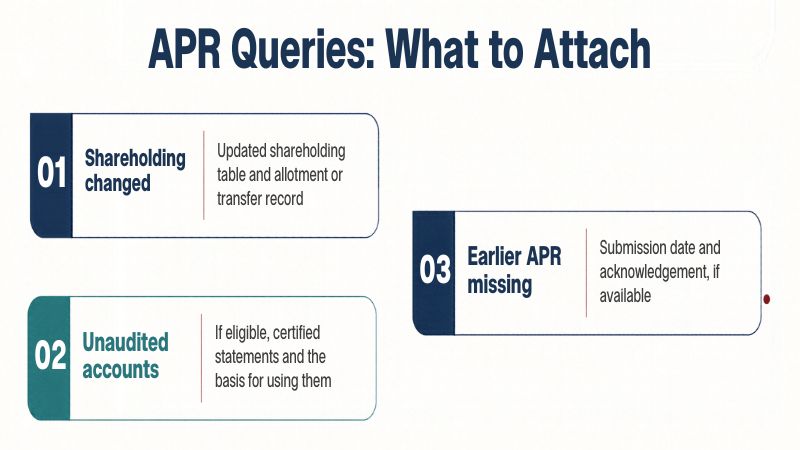
After submitting the Annual Performance Report (APR) for your overseas subsidiary, your designated Authorised Dealer (AD) bank may ask you to clarify changes in shareholding, explain the use of unaudited accounts or provide proof of an earlier filing. For example, your shareholding may fall from 60% to 50% because the foreign entity issued new shares to another investor. In that case, explain that your share count stayed the same and attach the allotment record and updated shareholding table.
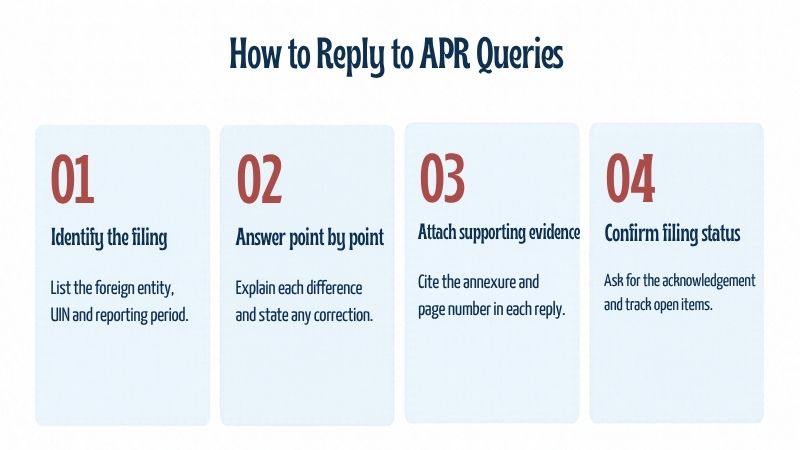
Start your reply with the foreign entity’s name, Unique Identification Number (UIN) and reporting period. Answer each query in order and refer to the attachment or page. If the bank questions unaudited accounts, explain why you used them and provide the applicable certification. If an earlier APR is missing, share its submission date and acknowledgement reference, if available. If you find an error, state what you corrected and attach the revised form.
What Is APR Filing Under FEMA?
The Annual Performance Report (APR) is an annual filing for a foreign entity in which a person resident in India has acquired equity capital classified as Overseas Direct Investment (ODI), subject to the exceptions under Regulation 10(4) of the FEMA Overseas Investment Regulations, 2022. The investor submits it through the designated Authorised Dealer (AD) bank.
Before preparing the report, gather the foreign entity’s financial statements, the previous APR acknowledgement, the Unique Identification Number (UIN), and records of changes in ownership or financial commitment. Check your bank’s checklist for the applicable form, certification and supporting documents.
What Is the APR Filing Deadline?
The annual filing deadline is 31 December. Where the foreign entity’s accounting year ends on 31 December, the APR is due by 31 December of the following year.
|
Foreign entity’s accounting year-end |
APR filing deadline |
|
31 December 2025 |
31 December 2026 |
|
31 March 2026 |
31 December 2026, under the general annual deadline |
Use the foreign entity’s accounting period when identifying the return. Its year-end may differ from that of the Indian investor.
When Is APR Filing Exempt?
Regulation 10(4) provides an exception where the foreign entity is under liquidation. It also provides an exception where the Indian resident meets all three conditions below.
-
The resident holds less than 10% of the foreign entity’s equity capital.
-
The resident has no control over the foreign entity.
-
The resident has no financial commitment beyond equity capital.
Where more than one Indian resident has made ODI in the same foreign entity, the resident holding the highest stake is responsible for filing the APR. If the holdings are equal, the investors may file jointly.
10 Common AD Bank Queries and How to Reply
The UIN or Foreign Entity Name Does Not Match
What to check: Compare the APR against the UIN confirmation, the previous filing and the foreign registry record. If the foreign entity changed its name, identify the effective date. If the APR contains a typing error or the wrong UIN, explain the correction and ask the bank how to submit the revised form.
What to attach: UIN confirmation or previous filing acknowledgement, registry extract or name-change certificate, and a corrected APR where applicable.
Sample reply
The APR relates to [current legal name], formerly [previous name], under UIN [number]. The name change took effect on [date]. Annexure 1 contains the registry evidence. Please confirm whether a separate update to the bank’s records is required.
The Foreign Entity’s Financial Statements Are Unaudited
What to check: The APR is generally based on the foreign entity’s audited financial statements. Unaudited statements may be used where the Indian resident does not have control and the host jurisdiction does not require a statutory audit of the foreign entity. The statements must be certified by the Indian entity’s statutory auditor or by a chartered accountant where statutory audit is inapplicable. RBI also requires CA certification of the APR where statutory audit is inapplicable, including for resident individuals.
Read more about Audit Requirement for APR Filing Clarification under FEMA.
What to attach: Certified financial statements, applicable certification, documents showing the investor’s governance rights, and the basis for the host-country audit exemption.
Sample reply where both conditions are met
The Indian investor does not control [foreign entity], as shown by the shareholding and governance documents in Annexure 1. The host jurisdiction does not require an audit for the entity for [period]. The supporting basis and certified unaudited financial statements are enclosed.
The Reporting Period or Financial Figures Do Not Match
What to check: Match the APR’s dates to the foreign entity’s financial statements. Then trace each queried amount to the relevant line or note. A difference may arise because one document presents figures in thousands, the APR uses whole units, or the statements cover a shorter first accounting period. Where you used a currency conversion, explain the rate, date and basis.
What to attach: Relevant financial statement pages, a reconciliation showing the amounts and units, and a revised signed or certified APR where needed.
Sample reply
The APR covers [start date] to [end date]. Note [number] presents the figures in USD thousands, while the APR entry used whole USD. Annexure 1 reconciles the amounts, and Annexure 2 contains the revised form showing the reporting unit clearly.
The Shareholding Percentage Has Changed
What to check: Compare the number of shares held by the Indian investor with the total shares issued by the foreign entity at the beginning and end of the year. Explain whether the change resulted from a fresh allotment, transfer or other corporate event. A drop in percentage can happen even when the Indian investor holds the same number of shares. Disclose the change in the APR and review whether the underlying event triggers separate reporting.
What to attach: Opening and closing cap tables, the shareholder register, and relevant allotment or transfer records.
Sample reply
We held 6,000 shares throughout the year. On [date], the foreign entity issued 2,000 shares to another shareholder, increasing the total issued shares from 10,000 to 12,000. Our holding moved from 60% to 50%. The allotment record and the cap tables before and after the issue are enclosed.
Equity, Loan or Guarantee Figures Differ From Bank Records
What to check: Reconcile equity, debt and guarantees separately. Start with the previous year’s closing figures, list each movement and calculate the new closing position. For guarantees, specify whether they were issued, extended, invoked or released. If the difference reveals a pending transaction filing, identify it and ask the bank how to address it separately.
What to attach: An instrument-wise reconciliation, Form FC references where applicable, remittance or receipt evidence, and relevant loan or guarantee documents.
Sample reply
The difference of [amount and currency] relates to a loan repayment received on [date]. Annexure 1 reconciles the opening and closing loan principal, and Annexure 2 contains the bank credit advice. The transaction reporting reference or current status is [details].
The Bank Wants Details of a Step-Down Subsidiary
What to check: Compare the group structure at the start and end of the reporting period. Identify any step-down subsidiary the foreign entity set up, acquired, transferred or wound up during the year. Include the effective date, jurisdiction, immediate parent and ownership or control details. For a winding-up event, distinguish the start of proceedings from the date the entity legally ceased to exist.
What to attach: Updated group structure chart and the relevant incorporation, acquisition, transfer or winding-up records.
Sample reply
[Foreign entity] incorporated [step-down subsidiary] in [jurisdiction] on [date] and holds [percentage]. The updated structure chart and incorporation records are attached. The change has been disclosed in the revised APR.
The Foreign Entity Is Inactive or Under Liquidation
What to check: Confirm the entity’s legal status. A company can have zero turnover and remain legally active. Dormancy or zero revenue alone does not create an APR exemption. If the entity is formally under liquidation, provide the effective date and evidence. Ask the bank to confirm the treatment of prior-year APRs and any separate closure or disinvestment reporting.
Read Related Article: APR Filing for Inactive Foreign Companies.
What to attach: Financial statements and, where relevant, registry records, a liquidation resolution, a court order or liquidator documents.
Sample reply for an inactive entity
[Foreign entity] recorded no operating revenue during [period] and remained registered. It was not under liquidation during the period. The APR and the supporting financial statements are enclosed.
Several Indian Investors Hold Shares in the Same Foreign Entity
What to check: List the Indian ODI investors and their holdings. Identify who holds the highest stake and whether that investor has filed the APR. If the holdings are equal and the investors choose to file jointly, coordinate the filing and retain the joint submission reference.
What to attach: The cap table or shareholder register and, where available, the filing acknowledgement.
Sample reply
[Investor name] holds the highest stake among the Indian ODI investors, as shown in the attached cap table. The APR for [period] was submitted by [investor] on [date] under reference [number].
Dividend, Interest or Other Investment Dues Are Outstanding
What to check: Distinguish the amount declared or accrued from the amount that became due, the amount received in India and the balance outstanding. Record the relevant dates and currency. Regulation 9 generally requires covered investment dues and proceeds to be realised and repatriated within 90 days of the relevant trigger. Where a balance remains outstanding, explain the facts and ask the bank what action is required.
What to attach: Dividend declaration, loan agreement or repayment schedule, bank credit advice, and a reconciliation of amounts due and received.
Sample reply
A dividend of [amount and currency] became due on [date]. We received [amount] in India on [date] under reference [number]. The balance of [amount] remains outstanding for [documented reason]. The dividend declaration, credit advice and reconciliation are enclosed.
A Previous Year’s APR Is Pending or Was Filed Late
What to check: Establish whether the earlier APR was never filed, returned for correction or processed under another reference. An email showing that you sent documents can help establish the timeline. Ask the bank to confirm the actual filing status against the UIN.
Where eligible, delayed APR filing can be regularised through the designated AD bank under the Late Submission Fee (LSF) mechanism. The fee is Rs.7,500 per delayed APR, and the facility under Regulation 11(1) is available within a maximum of three years from the original due date. If that period has expired, ask the bank to identify the applicable regularisation route. Regulation 12 restricts further financial commitment or transfer of the investment until the reporting delay is regularised.
Read more about ODI Compliance Reporting Errors.
What to attach: Prior correspondence, acknowledgements, a year-wise filing status, and the pending APR and supporting documents where applicable.
Sample reply
The APR for [period] was due on [date]. Our records show [brief factual explanation]. Please confirm whether the return remains pending against UIN [number] and advise on the applicable regularisation process. The signed APR and supporting documents are enclosed.
Sample Email to the AD Bank
Subject — Response to APR queries | [Foreign entity] | UIN [number] | Year ended [date]
Dear [AD Bank Team],
Thank you for your email dated [date]. Please find our point-wise responses regarding the APR for [foreign entity] for the year ended [date].
-
Query on [issue] — [Give the factual answer and refer to the annexure and page number.]
-
Query on [issue] — [State the original and corrected figures, explain the difference and identify the supporting record.]
-
Query on [issue] — [Identify any outstanding document and state when you expect to provide it.]
We have enclosed the supporting documents and the revised signed or certified APR, where applicable. Please confirm receipt and let us know whether any items remain open. Once the filing is processed, please share the acknowledgement or filing reference for our records.
Regards,
[Name and designation]
[Indian investor name]
Checklist Before Sending Your Reply
|
Check |
What to verify |
|
Entity and period |
The UIN, legal name, Indian investor and foreign entity’s year-end match the records. |
|
Financial figures |
Amounts, currency and reporting units reconcile with the statements. |
|
Shareholding |
Share counts and percentages agree with the cap table and underlying records. |
|
Certification |
The APR and supporting statements carry the applicable signatures and certification. |
|
Attachments |
Each answer points to a numbered annexure or specific page. |
|
Separate reporting |
Any pending Form FC, disinvestment or other transaction filing is identified separately. |
|
Filing status |
The bank has confirmed whether the APR is pending, processed or awaiting further information. |
If a document is still pending, answer the queries you can substantiate, identify the missing document and give a realistic delivery date. Track the bank’s response deadline separately from the statutory APR due date.
Conclusion
A clear APR reply starts with the UIN and reporting period, answers each question in order, and gives the bank a document it can verify. If the query reveals an overdue return or a missing transaction filing, record it separately and track it until the bank confirms its status. Retain the final acknowledgement with the records for that foreign entity.
Compliance Calendar LLP can help businesses organise APR records, reconcile shareholding and financial commitment figures, and prepare point-wise responses to AD bank queries. It can also help identify missing documents and coordinate with the finance team and certifying professional before submission.
Frequently Asked Questions (FAQ's)
Q1. Can I file the APR directly with RBI?
Ans. The APR is submitted through the designated AD bank. Follow the bank’s prescribed submission process.
Q2. Is APR filing required if there was no new remittance during the year?
Ans. It can still be required. Applicability depends on whether the investment is covered ODI and whether an exception under Regulation 10(4) applies.
Q3. Can a loss-making foreign entity skip APR filing?
Ans. Losses alone do not create an exemption. Where the APR is required, report the figures supported by the applicable financial statements.
Q4. Does a pending foreign audit automatically extend the APR deadline?
Ans. An audit delay does not automatically extend the deadline. Contact the AD bank early and check whether the conditions for using certified unaudited statements are met.
Q5. Can I correct an APR after submitting it?
Ans. Ask the bank whether the filing is pending or already processed. Identify the incorrect field, explain the correction and provide a revised form and supporting evidence through the bank’s prescribed process.
Q6. Are APR and FLA the same return?
Ans. They are separate filings. APR reports on the foreign entity under the ODI framework. The Foreign Liabilities and Assets (FLA) return has its own applicability, submission route and timeline.
Q7. Can an APR response resolve a missing Form FC filing?
Ans. An APR reply can explain the discrepancy. The underlying transaction filing should be addressed separately where Form FC reporting was required.
Q8. How do I know whether the bank has processed the APR?
Ans. Ask the designated AD bank for the filing acknowledgement, reference or written status confirmation. Keep it with the submitted APR and the correspondence for that reporting year.
Q9. What if the AD bank raises the same APR query again?
Ans. Refer to your earlier reply by date and point the bank to the exact annexure and page number. If the issue remains open, ask which figure, document or explanation needs further clarification so you can address it directly.
Q10. How should I reply if a figure in the current APR differs from last year’s closing balance?
Ans. Prepare a short reconciliation showing last year’s reported balance, the reason for the difference and the figure you are using in the current APR. If the difference comes from an error in the earlier return, explain the error and ask the designated AD bank how to correct that filing.
Article last updated on : 10 Nov 2026.






































































_learn_crop10_thumb.jpg)