


A fintech company agrees to buy 24% of an NBFC. The shareholders’ agreement also gives the buyer the right to appoint four of the company’s seven directors. The investment falls below the 26% shareholding threshold, but the right to appoint a majority of the board can give the buyer control. In that case, the target NBFC must obtain prior written approval from the Reserve Bank of India before the buyer takes control. The parties must also factor the applicable public notice period into the closing timetable.
An NBFC acquisition therefore starts with three questions. How much equity is being acquired? Who will control the company after the transaction? How will the board change? The answers determine what the target NBFC needs to file through PRAVAAH and when the transaction can close.
If the buyer plans to acquire shares in stages, see how earlier purchases count under the 26% shareholding rule for NBFC acquisition.
What Is PRAVAAH and Who Files the Application?
PRAVAAH is the RBI’s online portal for regulatory applications. Paragraph 7 of the Reserve Bank of India (Non-Banking Financial Companies – Acquisition of Shareholding or Control) Directions, 2025, issued on 28 November 2025, requires the target NBFC to submit the prior approval application on its company letterhead through PRAVAAH.
The target coordinates and submits the application. The buyer provides the information needed to support it, including its ownership structure, funding details, declarations and bankers’ reports. For a corporate buyer, the application may also need to explain who ultimately owns the acquiring entity and how the purchase will be funded.
Applicants can use PRAVAAH to track the filing, respond to RBI queries and receive the decision. Select the relevant application from the portal catalogue and follow its current document instructions. RBI’s general portal guidance provides a general-purpose form where a specific form is unavailable.
When Does an NBFC Acquisition Require Prior RBI Approval?
|
Transaction or change |
When prior written approval is required |
|
Takeover or acquisition of control |
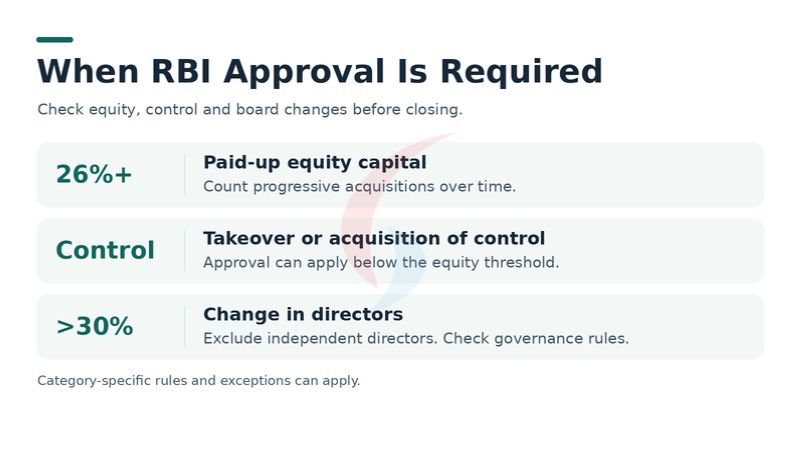
When the transaction gives the acquirer control of the NBFC, regardless of whether the existing management changes. |
|
Acquisition or transfer of equity |
When the change results in acquisition or transfer of 26% or more of the NBFC’s paid-up equity capital, including progressive increases over time. |
|
Change in management |
Under the separate NBFC Governance Directions, where applicable, when the management change results in a change of more than 30% of the directors, excluding independent directors. Re-election on retirement by rotation is excepted. |
Acquisition or Transfer of 26% or More
The shareholding threshold includes exactly 26%. If an investor previously acquired 18% and proposes to purchase another 9%, the parties should assess the earlier and proposed acquisitions together. On those facts, the investor would reach 27%, bringing the proposed increase within the prior approval requirement.
Prepare a shareholding table that shows the existing position, each proposed transaction step and the resulting percentage of paid-up equity capital. A secondary share purchase changes who holds existing shares. A fresh allotment can also increase the total paid-up equity capital, which affects the percentage calculation. If the deal includes both, show the effect of each step.
A narrow exception applies when a shareholding goes beyond 26% because of a buyback or reduction in capital approved by a competent court. In that situation, the Directions require reporting to the RBI or NHB, as applicable, within one month of the occurrence. The company should separately assess whether a control or governance approval requirement applies.
Acquisition of Control Below 26%
The Acquisition Directions adopt the definition of control in the SEBI Takeover Regulations. It includes the right to appoint a majority of directors or to control management or policy decisions. Control may arise directly or indirectly through shareholding, management rights, a shareholders’ agreement, a voting arrangement or other means.
Read the share purchase agreement alongside the shareholders’ agreement and the proposed articles of association. Look at who can appoint or remove directors, determine business policy and exercise voting rights. If the buyer receives consent or veto rights, assess the decisions those rights cover and how they operate together. An acquisition higher up the ownership chain also warrants review if it changes who controls the target NBFC while its immediate shareholders remain the same.
Read our guide to NBFC change in control to see how board appointment and voting rights can trigger prior RBI approval even below 26% shareholding.
Change in More Than 30% of Directors
The board-change test comes from the separate RBI NBFC Governance Directions, 2025. Suppose an NBFC has six directors, two of whom are independent. If two of the four non-independent directors are replaced as part of a management change, the change is 50% on those facts. That exceeds the threshold and requires prior RBI permission where the provision applies.
The Governance Directions also require applicable NBFCs to continue informing the RBI, or NHB for HFCs, about changes in directors or management. Where both the acquisition and governance rules apply, check the PRAVAAH process and supporting documents for each approval before fixing a closing date.
Check the Target’s NBFC Category Before Applying
Begin with the target’s Certificate of Registration. The general Acquisition Directions cover several categories, including NBFC-ICCs, NBFC-MFIs, NBFC-Factors, housing finance companies, core investment companies, NBFC-P2P platforms and account aggregators. Some categories have additional rules that can affect the filing even when the transaction falls below the general 26% threshold.
|
NBFC category |
Additional rule to check |
|
Housing Finance Company accepting or holding public deposits |
Prior approval can apply to an acquisition or transfer by or to a foreign investor involving 10% or more of paid-up equity capital. A specific public notice exception applies to qualifying changes from 10% to below 26%. |
|
Standalone Primary Dealer |
Any change in its shareholding pattern or capital structure requires prior RBI approval under paragraph 6(4). |
|
NBFC-P2P |
Its category-specific directions also require prior approval for a shareholding change that gives the acquirer a right to nominate a director. They also specify how holdings are aggregated for certain allotments. |
|
Mortgage Guarantee Company or NOFHC |
The general Acquisition Directions exclude these categories. Review the rules applicable to the entity and transaction. |
Documents Required for RBI PRAVAAH Filing
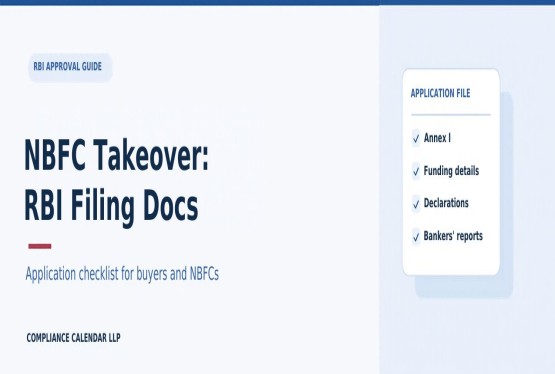
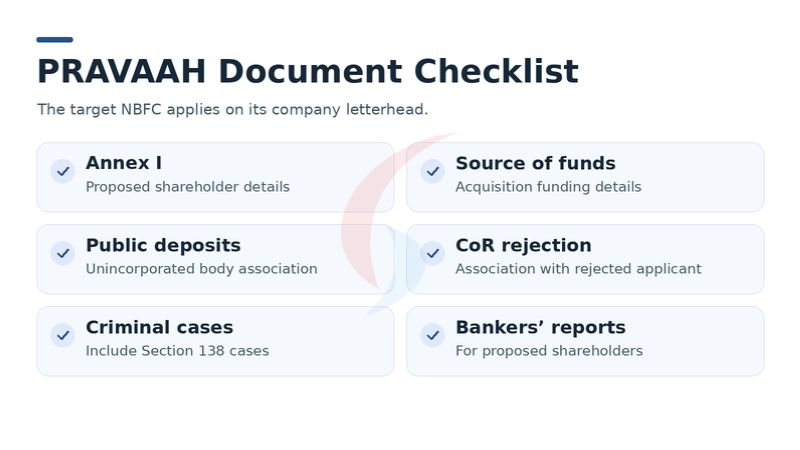
Start with an application on the target NBFC’s letterhead. Explain who the parties are, what the buyer proposes to acquire, why prior approval is required and how the transaction will change ownership, control or management. Paragraph 7 of the Acquisition Directions specifies the following supporting material.
|
Required material |
What the filing team should prepare |
|
Information on proposed shareholders |
Complete the current RBI Annex I for the proposed shareholders, as applicable. |
|
Source of acquisition funds |
Explain where the purchase or subscription money will come from and gather records that support the explanation. |
|
Public deposit declaration |
Obtain the proposed shareholders’ declaration concerning association with an unincorporated body that accepts public deposits. |
|
Registration rejection declaration |
Obtain the proposed shareholders’ declaration concerning association with a company whose RBI Certificate of Registration application was rejected. |
|
Criminal case declaration |
Obtain the prescribed declaration concerning criminal cases, including cases under Section 138 of the Negotiable Instruments Act, 1881. If a case exists, disclose the facts accurately. |
|
Bankers’ report |
Obtain reports from the bankers of the proposed shareholders. Start early if several shareholders or banks are involved. |
Depending on the transaction and the portal instructions, keep the target’s Certificate of Registration, signatory authorisation, pre- and post-transaction shareholding tables, transaction agreements, corporate ownership chart and supporting financial records ready. For a management change, prepare the applicable governance annexure and director documents shown in the relevant process.
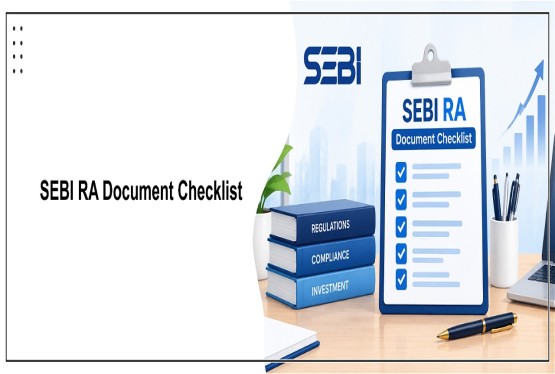
Before submitting the PRAVAAH application, use our checklist of documents required for RBI approval of an NBFC takeover to organise the shareholder declarations, funding details and bankers’ reports.
For example, a corporate buyer may use money received through an equity subscription by its parent company. In that case, the application should explain both movements of funds. The parent funds the buyer, and the buyer uses those proceeds to pay for the NBFC shares. The agreements, bank records and purchase consideration should support that sequence.
Process for Filing on PRAVAAH
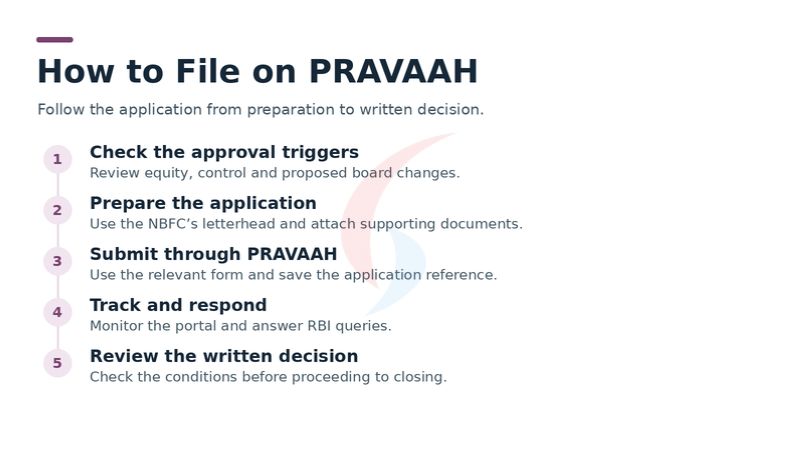
Step 1. Review the Target and the Deal Structure
Verify the NBFC’s category, registration status, current shareholders and board composition. Review whether the deal involves a share transfer, a fresh issue, an indirect change in control or a combination of these. Check whether existing RBI correspondence, regulatory conditions or lender covenants could affect the transaction.
An NBFC Compliance Audit can help buyers identify gaps in the target’s regulatory filings and records before proceeding with the acquisition.
Step 2. Identify the Approvals and Set Closing Conditions
Record which facts trigger the shareholding, control or board-change requirements. If the parties sign before regulatory approval, make the applicable approvals and public notice period conditions to closing. Review interim arrangements as well. Board appointment rights, voting powers or management authority can affect when control passes, even if the shares will transfer later.
Step 3. Prepare the Application and Reconcile the Attachments
Draft the application on the target NBFC’s letterhead. Check that legal names, share numbers, percentages, purchase consideration, funding sources and proposed directors match across the application, agreements, declarations and supporting tables. If the acquisition will happen in stages, show what changes at each stage and how the final shareholding is calculated.
Step 4. Submit the Application Through PRAVAAH
Sign in to the official PRAVAAH portal and select the relevant regulatory application. Enter the requested details and upload the signed application and supporting documents. Check the RBI’s general-purpose form guidance if the portal has no dedicated form for the application. Retain the submission reference and a copy of the complete filing.
Step 5. Respond to RBI Queries
Assign a person at the target NBFC to monitor the application. If the RBI raises questions, respond to each point and identify the supporting document. If the buyer, funding arrangement, transaction size or board rights change during the review, bring the change to the RBI’s attention and determine whether revised documents or a fresh filing are required.
Step 6. Review the Decision and Plan Closing
Once the RBI issues its written decision, check any approval conditions, validity period and reporting requirements stated in the letter. Confirm that the approved buyer, shareholding and governance rights match the final deal. For a covered transfer, publish the public notice after obtaining prior permission and allow the minimum notice period before closing.
When Is the 30-Day Public Notice Required?
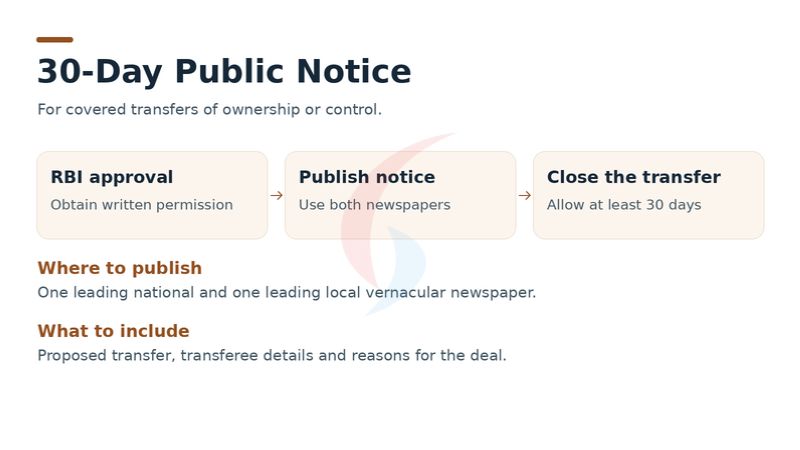
Paragraphs 8 to 10 of the Acquisition Directions require public notice at least 30 days before a covered transfer of ownership by sale of shares or a transfer of control, with or without a sale of shares. The parties publish the notice after receiving prior RBI permission. The NBFC and the transferee may publish it jointly or each give notice as provided in the Directions.
The notice must appear in at least one leading national newspaper and one leading local vernacular newspaper covering the place of the NBFC’s registered office. It should state the intention to transfer ownership or control, identify the transferee and explain the reasons for the transaction. If publication takes place on different dates, schedule closing so both publications satisfy the minimum period.
To see where newspaper publication and the 30-day notice period fit into the deal timeline, read our guide to the RBI approval process for an NBFC takeover.
Consider a buyer acquiring 60% of a lending NBFC from existing shareholders and taking control. The target first obtains written RBI approval. The parties then publish the notice in the required newspapers and wait at least 30 days before giving effect to the transfer. The overall transaction schedule must also allow time for the RBI’s review, any clarification rounds and other conditions to closing.
Additional Requirements for Foreign Buyers
Where a foreign investor is involved, identify the immediate buyer, upstream investors and the jurisdictions through which the funds and ownership interests flow. The RBI’s FATF provisions restrict fresh investments from or through jurisdictions identified on the relevant FATF lists. New investors from or through those jurisdictions may not directly or indirectly acquire significant influence. Their aggregate voting power must also stay below 20% under both the existing voting power test and the test that includes potential voting power. Convertible instruments and contractual voting rights can affect that assessment.
If the buyer is based overseas, review our FDI Compliance in NBFCs page for guidance on the applicable investment route and reporting requirements.
Separately, review the applicable FEMA entry route, pricing and payment rules with the authorised dealer bank. An eligible issue of equity instruments to a non-resident may require Form FC-GPR, while a reportable transfer may require Form FC-TRS. These reports are filed through FIRMS. Where applicable, FC-GPR is due within 30 days of issue. FC-TRS is generally due within 60 days of the transfer or receipt or remittance of funds, whichever occurs earlier.
For a reportable transfer of existing shares involving a non-resident, see our Form FC-TRS filing page for the documents and submission process.
Closing and Post-Acquisition Compliance
Before closing, compare the final documents with the RBI decision. Confirm the buyer’s identity, the number of shares, the ownership percentage, the agreed governance rights and the proposed director changes. Check that any required newspaper notice period has elapsed and that the parties have obtained applicable lender or contractual consents.
After closing, update the register of members and other statutory records. Complete applicable ROC filings for share allotments or director changes, along with any RBI, NHB or FEMA reporting. Keep the approval letter, newspaper notices, closing documents and filing acknowledgements together. If the RBI approval sets out continuing obligations, assign responsibility for each one.
After closing, our NBFC RBI Compliance services can help the company manage its ongoing RBI reporting obligations.
How Compliance Calendar LLP Can Help
Compliance Calendar LLP can help the target NBFC and buyer assess whether the proposed shareholding, control rights or board changes require prior RBI approval. We can review the transaction documents, prepare the PRAVAAH application checklist, coordinate the shareholder declarations and bankers’ reports, and assist with responses to RBI queries. We can also help plan the public notice, closing and transaction-specific corporate and FEMA filings.
For assistance with your NBFC acquisition, email info@ccoffice.in or reach us at 9988424211.
Frequently Asked Questions (FAQ’s)
Q1. Can a 24% acquisition require RBI approval?
Ans. Yes. An acquisition below 26% can require prior approval if the buyer acquires control. Category-specific requirements may also apply, such as the NBFC-P2P rule concerning director nomination rights.
Q2. Who submits the application if the buyer is a foreign company?
Ans. The target NBFC submits the prior approval application through PRAVAAH. The foreign buyer provides ownership, funding and background information, along with the prescribed declarations and supporting records.
Q3. Does replacing exactly 30% of the non-independent directors trigger prior approval?
Ans. The general governance provision applies when the change exceeds 30%, excluding independent directors. Check whether the transaction triggers another approval or reporting obligation.
Q4. Can the parties sign a share purchase agreement before RBI approval?
Ans. The parties can structure signing and closing separately. The agreement should make the applicable regulatory approvals and public notice period conditions to closing and specify when governance or control rights take effect.
Q5. Does the RBI prescribe a 30-day approval timeline for NBFC acquisitions?
Ans. The 30-day period in the Acquisition Directions is the minimum public notice period for covered transfers after prior RBI permission. The RBI’s review takes place before that period.
Q6. What happens if the buyer or deal structure changes during the review?
Ans. The target should inform the RBI of material changes. Depending on the revision, the RBI may require updated documents, a revised application or a fresh submission.
Q7. Does a fresh allotment of shares require prior RBI approval?
Ans. Yes, if the allotment results in the acquisition of 26% or more of the NBFC’s paid-up equity capital or gives the investor control. Calculate the investor’s holding using the paid-up equity capital after the allotment and review any board appointment or voting rights granted under the deal.
Q8. Can a change in the NBFC’s parent company trigger RBI approval?
Ans. Yes. A transaction involving the parent company can trigger prior RBI approval if it indirectly transfers control of the NBFC. Review the ownership chain and governance rights before and after the transaction, even if the NBFC’s immediate shareholders remain the same.
Q9. Is a bank statement sufficient in place of the bankers’ report?
Ans. The RBI Directions list evidence of the source of funds and the bankers’ report as separate requirements. A bank statement can support the funding explanation. The target NBFC should also obtain the prescribed bankers’ report on the proposed shareholders.
Q10. Does the RBI’s acquisition approval transfer the NBFC’s registration to the buyer?
Ans. The approval permits the proposed acquisition of shares or control, subject to any conditions imposed by the RBI. In a share acquisition where the target remains the same legal entity, the Certificate of Registration remains with the target NBFC.
Article last updated on : 13 Nov 2026.

































































_learn_crop10_thumb.jpg)