



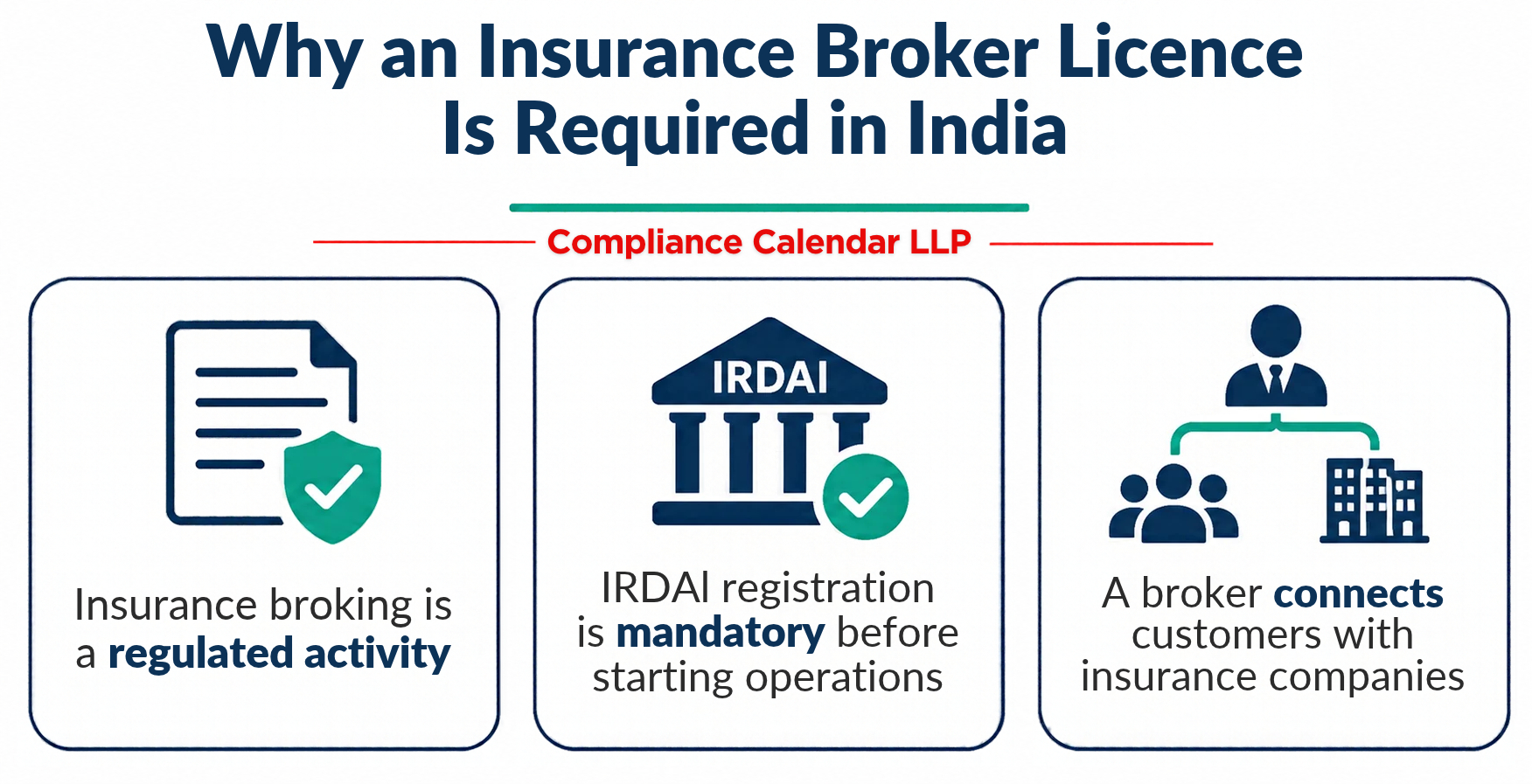
Starting an insurance broking business in India can be a good opportunity for entrepreneurs who want to work in the growing insurance sector. However, insurance broking is a regulated activity, and a business cannot simply start selling or arranging insurance policies without obtaining the required approval. An insurance broker licence from the Insurance Regulatory and Development Authority of India (IRDAI) is necessary before undertaking regulated insurance broking activities.
An insurance broker acts as an intermediary between customers and insurance companies. The broker helps customers understand insurance policies, compare suitable coverage options, arrange insurance protection and receive assistance with insurance-related matters. Unlike an insurance company, a broker does not normally undertake the insurance risk itself.
Obtaining an insurance broker licence involves more than submitting an application. The applicant must satisfy financial conditions, appoint qualified professionals, prepare a business plan and demonstrate the ability to operate within IRDAI regulations.
What is Insurance Broker Registration in India?
Insurance Broker Registration is the regulatory approval granted by IRDAI to an eligible entity to carry out insurance broking activities in India. An insurance broker acts as an intermediary between customers and insurance companies. The broker helps customers understand their insurance requirements, evaluate available policies, compare coverage and select appropriate insurance products. For example, a company planning to purchase health insurance for its employees may need to compare coverage, exclusions, premium costs and claim settlement conditions. A registered insurance broker can assist the company in evaluating suitable options. However, insurance broking involves financial responsibilities and customer interests. Therefore, IRDAI requires applicants to demonstrate that they have the necessary financial resources, professional qualifications and operational systems before registration.
Real-Life Example: When a Business Owner Realised the Importance of an Insurance Broker Licence
Imagine Priya, who runs a growing insurance consultancy in Mumbai. For years, she helped friends and local business owners understand insurance policies. As her network expanded, several companies started approaching her for assistance with employee health insurance, fire insurance and other business insurance requirements.
Priya saw an opportunity to turn her knowledge into a proper business. She wanted to work with multiple insurance companies and help customers choose suitable policies. However, while discussing her plans with a compliance professional, she learned that registering a company alone would not allow her to operate as an insurance broker.
She needed an insurance broker licence from IRDAI.
Priya initially thought the process would involve only filling out an application form. She soon discovered that she would also need to arrange the prescribed capital, appoint a qualified Principal Officer, prepare a business plan and meet several regulatory conditions.
Instead of rushing into the application, she decided to organise her finances, review the eligibility requirements and prepare the necessary documents before approaching IRDAI.
Her experience highlights an important point: Having insurance industry knowledge or potential customers does not automatically qualify someone to operate as an insurance broker. The business must obtain the appropriate IRDAI registration before undertaking regulated insurance broking activities.
Before applying for registration, businesses should understand the Types of Insurance Brokers to select the appropriate category.
Legal Rules Governing Insurance Broker Registration in India
Insurance Broker Registration is primarily governed by the Insurance Regulatory and Development Authority of India (Insurance Brokers) Regulations, 2018, as amended. The important legal provisions include:
-
Insurance Act, 1938: Section 42D deals with registration of insurance intermediaries, including insurance brokers. Businesses must obtain the required registration before undertaking regulated insurance broking activities.
-
IRDA Act, 1999: This legislation establishes IRDAI and provides the authority with powers to regulate and supervise the insurance industry.
-
IRDAI (Insurance Brokers) Regulations, 2018: These regulations prescribe eligibility conditions, registration procedures, capital requirements, professional qualifications and operational responsibilities.
-
IRDAI (Insurance Intermediaries) (Amendment) Regulations, 2026: Notified on 30 July 2026, these amendments introduced important changes relating to registration validity, annual fees, recordkeeping and regulatory compliance. Businesses applying for insurance broker registration must comply with the relevant provisions of these laws and regulations.
Applicants should understand the IRDAI Compliance Requirements for Insurance Intermediaries before starting their insurance broking operations.
Eligibility Criteria for Insurance Broker Registration
Before submitting an application, the applicant must satisfy the eligibility requirements prescribed by IRDAI.
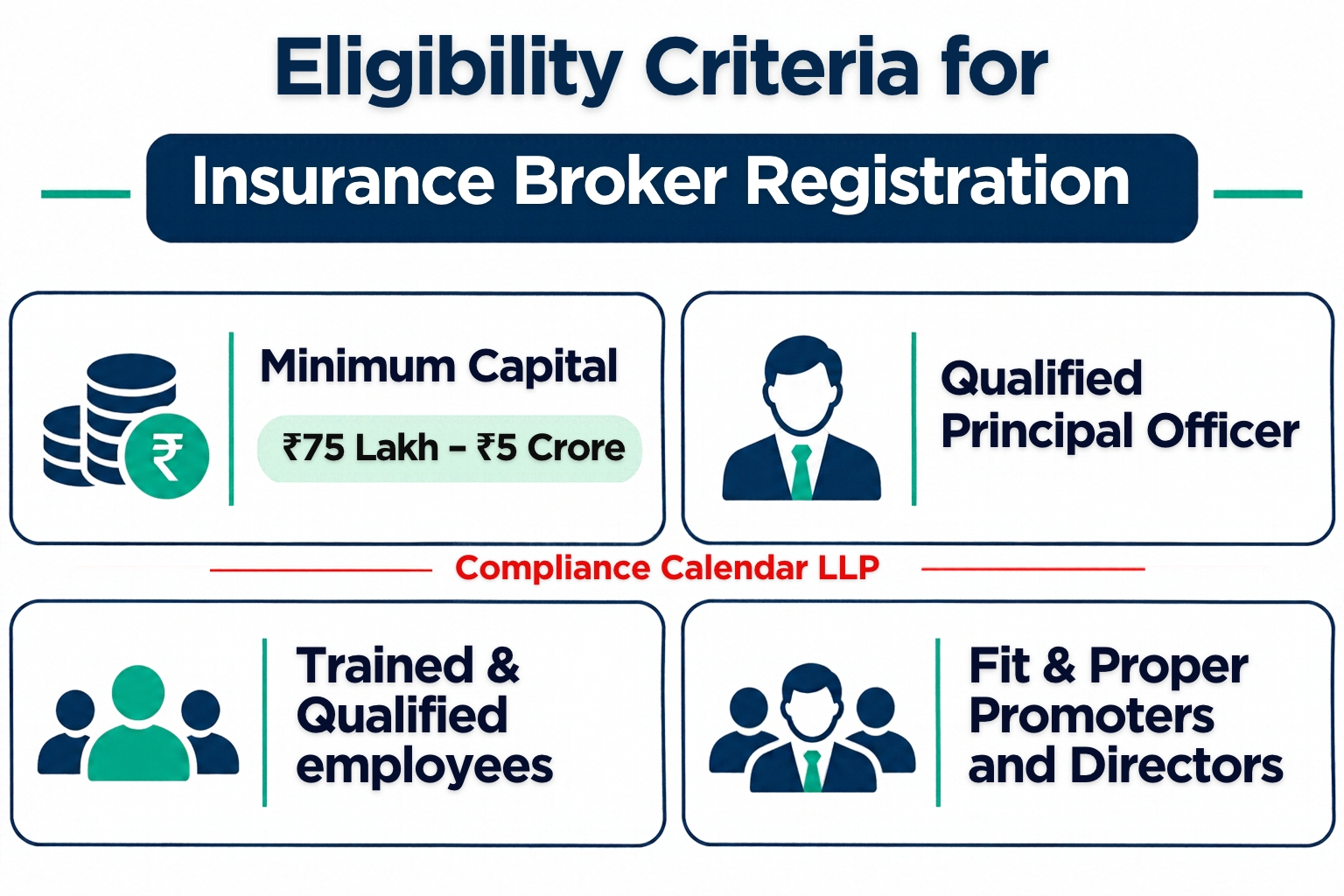
Eligible Business Entity: The applicant must be an entity permitted under the IRDAI regulations. Eligible entities include companies incorporated under the Companies Act, 2013, Limited Liability Partnerships (LLPs), cooperative societies and other specifically permitted entities. The applicant's constitutional documents must allow it to undertake insurance broking activities. For example, if a private limited company plans to apply for registration, its Memorandum of Association should clearly include insurance broking within its permitted business objectives.
|
Eligibility Criteria |
Requirements |
|---|---|
|
Minimum Capital Requirement |
Under Regulation 19 of the IRDAI (Insurance Brokers) Regulations, 2018, applicants must maintain the prescribed minimum paid-up capital or contribution, ranging from Rs.75 lakh to Rs.5 crore, depending on the broker category. Capital must come from permitted sources, and borrowed funds cannot be treated as promoters' own capital contribution. |
|
Qualified Principal Officer |
Every applicant must appoint a Principal Officer who meets IRDAI's prescribed educational qualifications, professional experience, training and examination requirements. The officer supervises broking operations and regulatory compliance. |
|
Qualified Employees |
Applicants must employ an adequate number of trained and qualified professionals. Broker Qualified Persons (BQPs) must complete the applicable training and examinations before performing regulated insurance broking activities. |
|
Fit and Proper Requirements |
IRDAI evaluates the suitability of applicants, promoters, directors, partners and key management personnel based on financial background, professional experience, integrity and previous regulatory conduct. This ensures responsible management of insurance broking businesses. |
Documents Required for Insurance Broker Registration
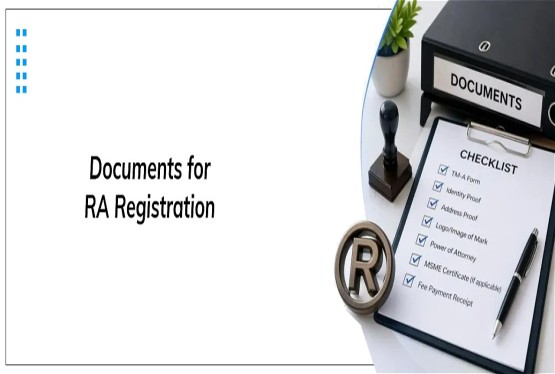
Proper documentation is one of the most important parts of the registration process. Applicants should prepare their documents before submitting the application to avoid unnecessary regulatory queries.
The commonly required documents include:
- Certificate of Incorporation or entity registration certificate.
- Memorandum and Articles of Association or LLP Agreement.
- PAN and registered office details.
- Details of directors, partners, promoters and shareholders.
- Shareholding pattern and beneficial ownership information.
- Proof of minimum paid-up capital or contribution.
- Net worth certificate from the appropriate professional.
- Audited financial statements, where applicable.
- Principal Officer's qualifications and experience documents.
- Training and examination certificates of qualified persons.
- Detailed business plan and proposed organisational structure.
- Office infrastructure and operational arrangements.
- Required declarations, undertakings and regulatory disclosures.
The application is supported by the documents prescribed under Schedule I – Form C of the IRDAI regulations. Additional documents may be required depending on the applicant's ownership structure, business activities and regulatory examination.
Insurance Broker Registration Process in India: Step-by-Step Guide
Obtaining insurance broker registration requires proper planning and compliance with the application procedure. The main steps are explained below.
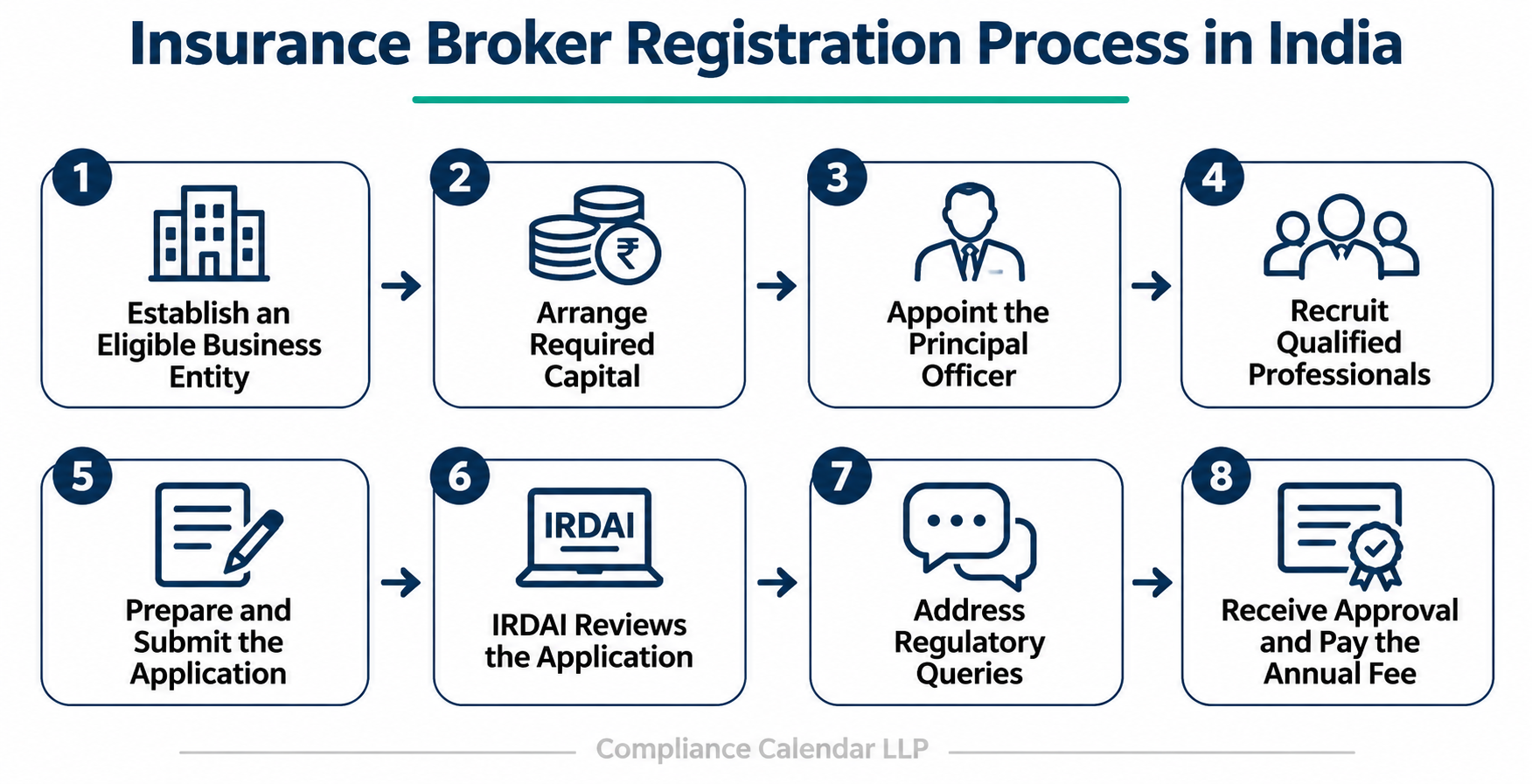
Step 1: Establish an Eligible Business Entity
The first step is to establish an eligible legal entity, such as a company or LLP, in accordance with the applicable law. The entity must have appropriate business objectives and constitutional documents permitting insurance broking activities. Applicants should also ensure that the proposed business name complies with IRDAI requirements.
Step 2: Arrange the Required Capital
After establishing the entity, the applicant must arrange the minimum capital prescribed for the relevant registration category. The funds should come from permissible sources and must be properly reflected in the applicant's financial records. For example, a business may have enough funds to rent an office and hire employees but still fail to meet the required regulatory capital. Such a business should address the capital shortfall before applying.
Step 3: Appoint the Principal Officer
The applicant must appoint an eligible Principal Officer who meets the applicable educational qualifications, experience, training and examination requirements. The appointment is important because IRDAI evaluates whether the proposed business has competent management capable of supervising insurance broking activities.
Step 4: Recruit Qualified Professionals
The applicant must ensure that sufficient qualified professionals are available to conduct the proposed insurance broking business. Relevant employees must complete the prescribed training and examinations. Businesses should maintain proper records of their employees' qualifications and professional certifications.
Step 5: Prepare the Registration Application
Under Regulation 5 of the IRDAI (Insurance Brokers) Regulations, 2018, the applicant must submit the registration application in Schedule I – Form B. The form requires information about the business entity, ownership, management, financial position and proposed operations. Applicants must also submit supporting documents in accordance with Schedule I – Form C. All information should be consistent with the company's statutory records and financial statements.
Step 6: Submit the Application and Pay the Prescribed Fee
The completed application must be submitted to IRDAI through the applicable procedure, together with the prescribed application processing fee. The fee is non-refundable and varies according to the registration category. Applicants should follow the current filing and electronic payment instructions issued by IRDAI. An application without the prescribed fee will not be processed.
Step 7: IRDAI Reviews the Application
After receiving the application, IRDAI examines whether the applicant satisfies the regulatory requirements. The regulator may assess the applicant's capital, ownership, financial position, professional qualifications, infrastructure and business plan. IRDAI may also request additional documents, clarifications or a personal representation. For example, if the applicant's shareholding pattern does not match the information in its supporting documents, IRDAI may ask for clarification before proceeding.
Step 8: Address Regulatory Queries
Applicants must respond to queries raised during the examination process. The responses should be accurate, supported by documents and submitted within the period specified by the regulator. Under Regulation 6, incomplete applications may be rejected, but the applicant must be given a reasonable opportunity to rectify deficiencies.
Step 9: Receive Approval and Pay the Annual Fee
Once IRDAI is satisfied that the applicant meets the prescribed requirements, it may communicate its decision to grant registration. Under the 2026 amendments, the applicant must pay the prescribed annual fee for the ongoing financial year within 15 days of receiving the relevant communication. After receiving the required payment and completing the applicable formalities, IRDAI grants the Certificate of Registration. The applicant must also meet the applicable requirements before commencing insurance broking operations.
Insurance Broker Registration Fees in India 2026
The IRDAI (Insurance Intermediaries) (Amendment) Regulations, 2026 revised the fee arrangements for insurance brokers. The application processing fee ranges from Rs 25,000 to Rs 75,000, depending on the category of registration. At the time of grant of registration, the applicant must pay an annual fee of Rs 10,000 plus applicable taxes for the ongoing financial year. For subsequent financial years, the annual fee is the higher of:
- Rs 10,000; or
- 0.04% of the prescribed commission and other receipts from insurers or clients during the relevant preceding financial year, rounded up as required by the regulations.
The prescribed annual fee must generally be paid before 31 January of the preceding financial year. Late payment may attract an additional fee of 2% if paid within 30 days after the deadline or 10% if paid later but before the end of the relevant financial year. Continued non-payment may result in suspension or cancellation of registration.
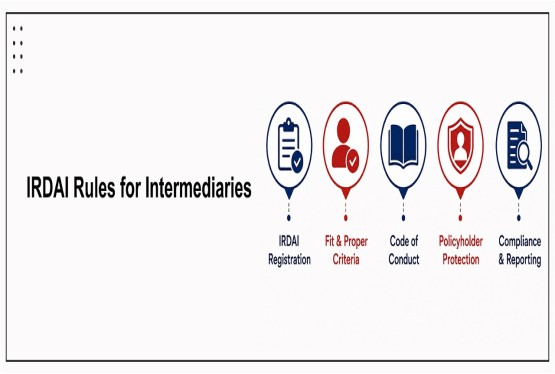
Important IRDAI Rules for Insurance Brokers
Insurance brokers must follow several regulatory conditions, both during registration and after commencing operations.
Rule 1: Maintain the Prescribed Net Worth
Under Regulation 22, insurance brokers must maintain the prescribed minimum net worth throughout their operations. The minimum requirement depends on the registration category. A broker whose net worth falls below the prescribed level must restore it and report compliance to IRDAI.
Rule 2: Maintain the Required Security Deposit
Under Regulation 23, insurance brokers must maintain a prescribed fixed deposit with a scheduled bank before commencing business. The deposit is subject to a lien in favour of IRDAI and cannot be used as security for loans or overdraft facilities. The required deposit depends on the broker's registration category.
Rule 3: Obtain Professional Indemnity Insurance
Under Regulation 24, insurance brokers must maintain professional indemnity insurance in accordance with the prescribed requirements. This insurance provides protection against certain professional liabilities arising from errors, omissions or negligence. A newly registered broker may be permitted additional time to obtain the policy where the applicable regulations allow it.
Rule 4: Follow the Code of Conduct
Insurance brokers must comply with the applicable code of conduct. They should explain insurance products accurately, disclose relevant information, protect confidential customer data and avoid misleading sales practices. For example, a broker should not recommend a policy merely because it offers higher commission while ignoring the customer's insurance needs.
Rule 5: Maintain Proper Records
Insurance brokers must maintain complete and accurate business records. These include policy-related documents, customer information, financial records, commission receipts and relevant correspondence. The 2026 amendments also introduced additional requirements relating to the identification and recording of individuals involved in soliciting or selling insurance policies.
Rule 6: Submit Regulatory Returns
Under Regulation 39 and other applicable provisions, insurance brokers must submit prescribed returns, auditor certificates and compliance information. These filings help IRDAI monitor financial stability and regulatory compliance.
Rule 7: Comply with Foreign Investment Conditions
Insurance brokers with foreign investment must comply with the applicable foreign investment rules and regulatory conditions. Additional undertakings and annual disclosure requirements may apply, including where foreign shareholders hold a majority stake.
Insurance broking companies receiving foreign investment may need FEMA Due Diligence to review applicable foreign investment requirements.
Validity of Insurance Broker Registration in 2026
Under the new IRDAI rules introduced in 2026, an insurance broker licence does not have a fixed three-year validity period. Earlier, insurance brokers had to renew their registration every three years. Now, the registration remains valid as long as the broker pays the prescribed annual fee and follows IRDAI regulations.
Existing insurance brokers holding older three-year registration certificates must apply for a new certificate under the updated rules before 31 January 2027. Late applications may be accepted until 31 March 2027, subject to additional fees and IRDAI approval. In simple terms, insurance brokers no longer need to renew their licence every three years, but they must pay annual fees and maintain regulatory compliance to keep their registration active.
After obtaining registration, businesses should understand IRDAI Insurance Broker Compliance to meet their ongoing regulatory obligations.
Common Reasons for Delay or Rejection of Insurance Broker Registration
Even businesses with sufficient capital may face difficulties during registration if their application is incomplete or does not satisfy the regulations. Common problems include insufficient capital, incorrect ownership information, missing documents, an ineligible Principal Officer and inconsistent financial statements. Applications may also be delayed when the proposed business plan does not clearly explain the applicant's activities or operational arrangements.
For example, an applicant may submit a business plan showing ambitious revenue projections but fail to explain how it will recruit qualified employees, maintain customer records or comply with regulatory requirements. To reduce such problems, applicants should review their financial documents, professional qualifications, internal systems and application information before submission.
Why Choose Compliance Calendar LLP for an Insurance Broker Licence?
At Compliance Calendar LLP, we assist startups, entrepreneurs and businesses in obtaining an insurance broker licence in India. Our team provides professional support with IRDAI eligibility, documentation, capital requirements, application filing and regulatory compliance.
We also offer Company Registration, LLP Registration and Insurance Broker Licence Assistance to simplify the registration process.
Need help with an insurance broker licence? Contact Compliance Calendar LLP today on +91 9988424211
or info@ccoffice.in
Frequently Asked Questions (FAQs)
Q1. What is Insurance Broker Registration in India?
Ans. Insurance Broker Registration is an official approval granted by the Insurance Regulatory and Development Authority of India (IRDAI). It allows eligible businesses to legally provide insurance broking services in India. Registration ensures that brokers follow prescribed financial, professional and regulatory requirements.
Q2. Is IRDAI registration mandatory for insurance brokers?
Ans. Yes, IRDAI registration is mandatory for businesses intending to undertake regulated insurance broking activities in India. Operating without the required registration may result in regulatory action and penalties. Businesses must obtain an insurance broker licence before starting such operations.
Q3. What is the minimum capital required for insurance broker registration?
Ans. The minimum capital requirement depends on the insurance broker category. Direct Insurance Brokers require Rs.75 lakh, Reinsurance Brokers require Rs.4 crore, and Composite Insurance Brokers require Rs.5 crore. Applicants must also maintain the prescribed minimum net worth under IRDAI regulations.
Q4. Which application form is required for insurance broker registration?
Ans. Applicants must submit Schedule I – Form B under the IRDAI (Insurance Brokers) Regulations, 2018, as amended. Supporting documents prescribed under Schedule I – Form C must also be provided. These include financial information, company details, professional qualifications and the proposed business plan.
Q5. Can a private limited company apply for insurance broker registration?
Ans. Yes, a private limited company can apply for an insurance broker licence in India. The company must satisfy the prescribed capital, net worth, management and professional qualification requirements. Its Memorandum of Association should also permit insurance broking activities.
Q6. Is a Principal Officer required for insurance broker registration?
Ans. Yes, every applicant must appoint a qualified Principal Officer as required by IRDAI regulations. The officer must meet the prescribed educational qualifications, professional experience, training and examination requirements. The Principal Officer is responsible for supervising insurance broking operations and regulatory compliance.
Q7. What is the application fee for insurance broker registration in India?
Ans. The non-refundable application fee is Rs.25,000 for Direct Insurance Brokers, Rs.50,000 for Reinsurance Brokers and Rs.75,000 for Composite Insurance Brokers. Applicable taxes are charged additionally. Applicants must also pay the prescribed annual registration fee and meet other financial requirements.
Q8. How long is insurance broker registration valid?
Ans. Under the 2026 amendments, an insurance broker licence no longer requires renewal every three years. Registration continues as long as the broker pays the prescribed annual fee and complies with IRDAI regulations. The licence may be suspended, cancelled or surrendered under the applicable provisions.
Q9. Can IRDAI reject an insurance broker registration application?
Ans. Yes, IRDAI may reject an application if the applicant does not satisfy the prescribed eligibility or regulatory requirements. Common reasons include insufficient capital, incomplete documentation and an unqualified Principal Officer. Applicants are provided applicable procedural opportunities to address deficiencies before rejection.
Q10. What happens if an insurance broker fails to pay the annual registration fee?
Ans. Failure to pay the annual registration fee within the prescribed deadline may attract additional charges. Continued non-payment can result in suspension or cancellation of the insurance broker licence. Brokers should pay their fees on time and maintain regulatory compliance to avoid business disruption.
Article last updated on : 12 Nov 2026.










































































_learn_crop10_thumb.jpg)