


An RBI application for an NBFC takeover should answer three questions. Who will acquire the shares or control? Where will the purchase money come from? What will change in the NBFC after the transaction?
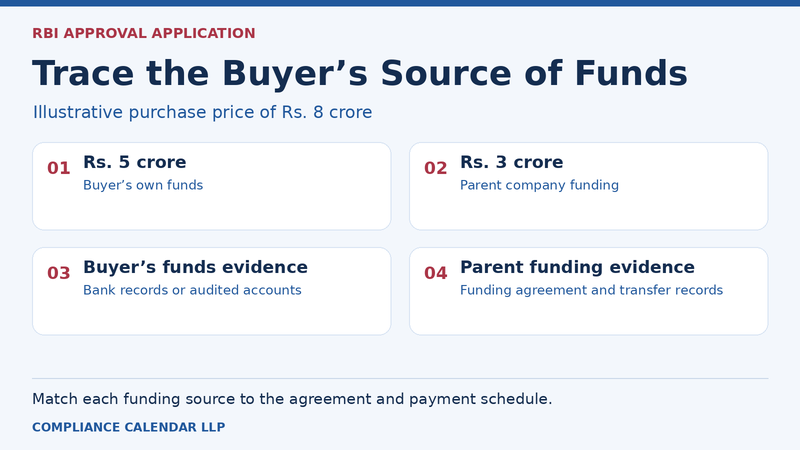
Suppose a buyer agrees to acquire 40% of an NBFC for Rs. 8 crore. The buyer will use Rs. 5 crore of its own funds and receive Rs. 3 crore from its parent company. The share purchase agreement explains the price, the funding records explain where the money comes from, and the shareholding table shows who will own the NBFC after the deal. The application should connect all three so the RBI can follow the transaction.
When is prior RBI approval required?
Under the RBI’s NBFC Acquisition of Shareholding or Control Directions, 2025, a covered NBFC must obtain prior written approval for a NBFC takeover or acquisition of control, whether or not its management changes. Approval also applies to a shareholding change, including progressive increases over time, that results in the acquisition or transfer of 26% or more of the NBFC’s paid-up equity capital.
Control is a separate test. A buyer acquiring less than 26% may still need approval if the transaction gives it control through board appointment rights, voting arrangements or other contractual rights. If the deal also changes more than 30% of the directors, excluding independent directors, assess the separate approval requirement under the RBI’s NBFC Governance Directions. Directors re-elected on retirement by rotation are covered by an exception. Category-specific rules can also apply, including to deposit-taking housing finance companies and standalone primary dealers.
If you’re still assessing whether the deal requires prior approval, start with our guide to RBI approval for an NBFC takeover.
Six documents expressly required for RBI approval
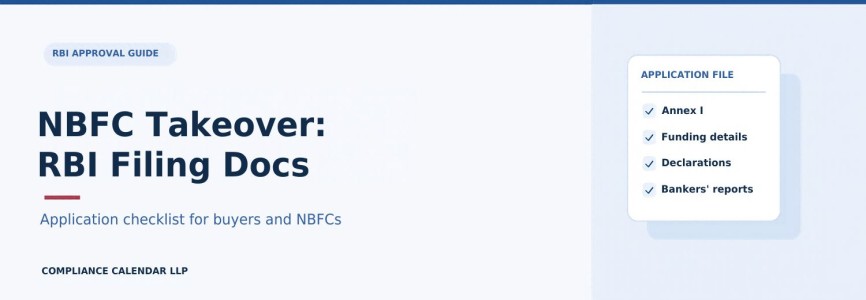
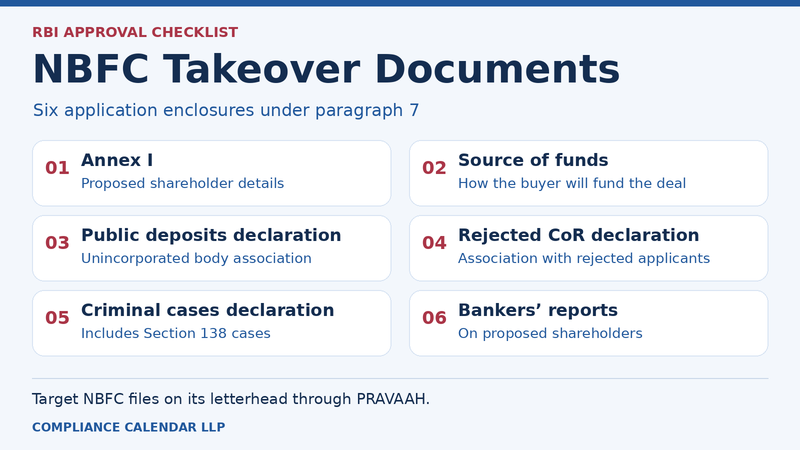
The target NBFC submits the application on its company letterhead through PRAVAAH. Paragraph 7 of the Acquisition of Shareholding or Control Directions identifies the following enclosures.
Proposed shareholder details in Annex I
Annex I gives the RBI information about the proposed shareholders in its prescribed format. Use the same names and identifiers in the form, transaction agreements and banking records.
If the buyer is a company, keep its incorporation records and ownership chart ready as supporting evidence. For instance, if an acquisition vehicle is buying the shares, the chart can show which parent company owns it and who ultimately controls the structure.
Source-of-funds details
Explain how the buyer will pay for the acquisition. Set out the purchase price, the amount from each source, the entity providing the funds and the documents that support each amount.
In the Rs. 8 crore example, the buyer should explain how it holds the Rs. 5 crore and how the parent will provide the remaining Rs. 3 crore. Depending on the funding structure, relevant evidence may include bank statements, audited financial statements, capital contribution records or financing documents. If the transaction combines a purchase from an existing shareholder with a fresh issue, show separately what goes to the seller and what goes to the NBFC.
Declaration on association with unincorporated bodies accepting public deposits
The proposed shareholders must declare that they are not associated with an unincorporated body that accepts public deposits. Check the shareholders’ relevant business associations before signing the declaration.
Declaration on rejected RBI registration applications
The proposed shareholders must declare that they are not associated with a company whose application for an RBI Certificate of Registration (CoR) was rejected. Review the relevant company associations so the declaration reflects the facts.
Declaration on criminal cases
The proposed shareholders must provide the prescribed declaration concerning criminal cases against them, including cases involving an offence under Section 138 of the Negotiable Instruments Act, 1881. This provision deals with cheque dishonour in specified circumstances. If a proposed shareholder cannot make the declaration as required, clarify the facts and how to present them before filing.
Bankers’ reports on proposed shareholders
Obtain the bankers’ reports on the proposed shareholders and check the applicable submission instructions. Request these reports early so the application can be assembled on time. A bank statement helps show how money moved. The bankers’ report is a separate prescribed enclosure.
Supporting documents to prepare for the RBI review
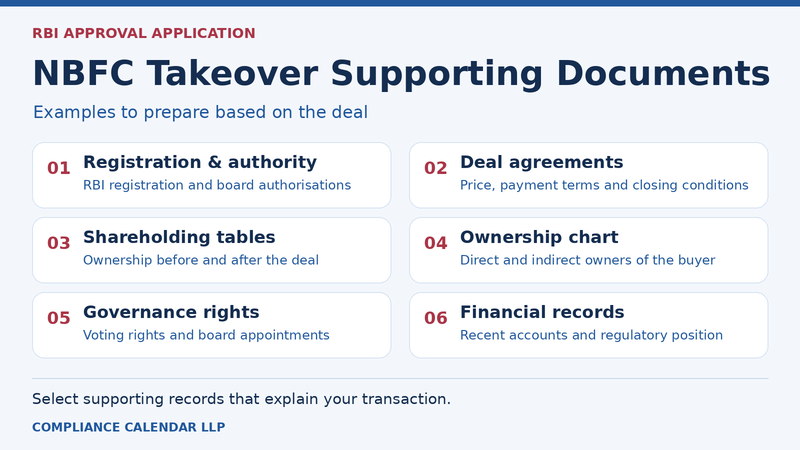
The six enclosures form the core application. The supporting documents depend on the transaction structure, the applicable PRAVAAH form and any follow-up requirements from the RBI.
|
Supporting document |
What it explains |
|
Target NBFC’s Certificate of Registration and corporate particulars |
Which NBFC is being acquired and its regulatory category |
|
Board resolutions and signatory authorisations |
Who approved the transaction and who can sign or file the application |
|
Share purchase, subscription or shareholders’ agreement |
The price, payment terms, closing conditions and rights the buyer will receive |
|
Pre- and post-transaction shareholding tables |
Who owns the NBFC before and after the transaction, including the effect of dilution or earlier acquisitions |
|
Acquirer’s ownership chart |
Who owns or controls a corporate buyer, directly or indirectly |
|
Schedule of voting and governance rights |
Who can appoint directors, influence policy or exercise other rights relevant to control |
|
Recent financial statements and a compliance summary |
The financial and regulatory position of the target NBFC |
|
Existing and proposed board composition |
Which directors will change and whether a separate management approval test applies |
|
Valuation and foreign investment records, where applicable |
How the price was determined and which cross-border requirements apply |
Explain what changes in control
A shareholding table shows how much equity the buyer will own. The agreements show what the buyer can do with that stake. For example, if a buyer will hold 20% but can appoint a majority of directors, explain that right in the application. If control changes without a share transfer, describe the mechanism and assess how the shareholder-focused filing requirements apply to that structure.
Explain the funding route for a foreign buyer
Where acquisition money comes from overseas, identify the source and any intermediate jurisdictions through which it passes. Assess the RBI restrictions that apply to new investments from or through FATF non-compliant jurisdictions, including where instruments or agreements carry potential voting rights. Review applicable FEMA pricing, approval and reporting requirements separately.
Where the transaction involves a transfer of existing shares between a resident and a non-resident, check whether FC-TRS filing applies.
How to organise the application before filing
Start with the application on the NBFC’s letterhead and an index of enclosures. Compare the annexures, agreements, shareholding tables and funding records side by side. Shareholder names, share numbers, percentages and purchase consideration should match. Where figures differ because of deferred consideration or a fresh issue, explain how the amounts reconcile.
Keep a copy of the application acknowledgement, the documents submitted and the replies to RBI queries. If the buyer, funding structure or control rights change during the review, assess whether the filing needs to be updated before proceeding.
What documents should the parties keep after RBI approval?
Where the public notice requirement applies, publish the notice after obtaining RBI permission and at least 30 days before effecting the transfer of ownership or control. The notice must appear in at least one leading national newspaper and one leading local vernacular newspaper covering the place of the NBFC’s registered office. It should identify the intended transfer, the transferee and the reason for the transaction. A specified exception applies to certain foreign investments in deposit-taking housing finance companies.
Keep the RBI permission letter, copies of both newspaper notices, their publication dates, evidence that the approval conditions were met and the final closing documents. Together, these records show when approval was granted, when the notice period ran and when the transfer took effect.
Conclusion
A well-prepared takeover application connects the buyer’s identity, the funding trail and the rights that will change at closing. Begin with Annex I, the source-of-funds details, the three declarations and the bankers’ reports. Add the agreements, ownership charts and shareholding tables that explain the specific transaction.
Before completing the takeover, check that the final deal reflects the transaction covered by the RBI’s written permission, the applicable public notice period has elapsed and the parties have met the approval conditions.
Frequently Asked Questions (FAQ’s)
Q1. Who files the RBI application for an NBFC takeover?
Ans. The target NBFC files the application through PRAVAAH on its company letterhead. The proposed shareholders provide their particulars, declarations, funding details and bankers’ reports.
Q2. Can a bank statement replace the bankers’ report?
Ans. No. A bank statement supports the source-of-funds explanation. The bankers’ report is a separate enclosure expressly required under paragraph 7.
Q3. Is the share purchase agreement one of the six prescribed enclosures?
Ans. Paragraph 7 does not separately list the agreement. It is useful supporting evidence because it sets out the purchase price, closing conditions and rights being transferred.
Q4. Can an acquisition below 26% require RBI approval?
Ans. Yes. Acquisition of control is a separate approval trigger. Assess the buyer’s board appointment, voting and other contractual rights along with the shareholding percentage.
Q5. When should the NBFC takeover notice be published?
Ans. Where required, publish the notice after obtaining RBI permission and at least 30 days before effecting the transfer of ownership or control.
Q6. What if the buyer acquires the shares in stages?
Ans. Review the proposed purchase together with earlier acquisitions. The RBI’s shareholding test expressly covers progressive increases that result in acquisition or transfer of 26% or more of the paid-up equity capital.
Q7. What documents help explain a change in control without a share sale?
Ans. Provide the agreements, voting arrangements or board appointment provisions that create the change in control. A short summary comparing decision-making rights before and after the transaction helps explain how those documents work together.
Q8. What if a parent company funds part of the acquisition?
Ans. Show the amount funded by the parent, the nature of the funding and how it reaches the buyer. Depending on the arrangement, supporting records may include funding approvals, contribution or financing documents, and bank records.
Q9. Should the application show changes to the NBFC’s board?
Ans. Yes, where the deal involves board changes. Include the existing and proposed board composition so the separate approval test for a management change affecting more than 30% of directors, excluding independent directors, can be assessed.
Q10. What if the deal terms change after the RBI application is filed?
Ans. Compare the revised terms with the submitted application. A change in the buyer, funding structure or control rights may require an updated filing or clarification before the parties can rely on the approval.
Article last updated on : 11 Nov 2026.
































































_learn_crop10_thumb.jpg)