



In India, many families own ancestral property, manage investments and run businesses together. While most people know that individuals and companies need to follow income tax rules, not everyone is aware that a Hindu Undivided Family (HUF) can also have its own PAN card, bank account and income tax return. An HUF is recognised as a separate taxpayer under Indian income tax law, which means its financial transactions and tax responsibilities are different from those of its individual family members.
To understand how an HUF is legally formed, who can become its members and what documents are required, read our detailed guide on HUF Formation in India.
Imagine One of our client Rajesh, who lives in Delhi with his parents, wife and children. His family owns an ancestral property that generates rental income every month. Rajesh decides to manage the property income through the family's HUF and opens a separate bank account. However, he soon realises that having an HUF PAN card is only one part of the process. He also needs to understand who can manage the family assets, whether the HUF must file an income tax return and what documents should be maintained.
This is where HUF Compliance in India becomes important. Although an HUF is not registered like a private limited company or LLP, it must follow the applicable income tax, banking and legal requirements. The Income-tax Act, 2025, which came into force on 1 April 2026, continues to recognise an HUF as a separate taxpayer. In this article, we will explain HUF PAN requirements, ITR filing, Karta responsibilities, documentation and important compliance rules in simple language.
What is HUF Compliance in India?
HUF compliance refers to the legal and financial responsibilities that apply to a Hindu Undivided Family when it owns property, earns income, makes investments or carries on business activities. Under Indian income tax law, an HUF is treated as a separate taxpayer, meaning it can have its own Permanent Account Number (PAN), bank account and income tax return. However, the HUF must maintain proper records and follow the rules applicable to its income and financial transactions.
An HUF generally comes into existence through family relationships under Hindu law rather than through a formal incorporation process. It is usually managed by the Karta, who represents the family in financial and tax-related matters. For example, if an HUF owns a residential property and receives rent, the Karta is generally responsible for maintaining rental records, managing the bank account and ensuring that the income is reported correctly. Proper compliance helps the family avoid confusion between personal income and income legally belonging to the HUF.
Who Needs to Follow HUF Compliance Rules?

HUF compliance is relevant to families that have genuine HUF assets, income or financial transactions. An HUF may exist even without owning property or having a PAN card, but specific compliance requirements become important when the family starts receiving taxable income or carrying out transactions that require a separate tax identity. The nature of these requirements depends on the income earned, the assets owned and the business activities undertaken by the family.
Families Earning Rental Income
If an HUF owns residential or commercial property and receives rent, the rental income should be recorded and reported according to the applicable tax rules. For example, if a family receives Rs 30,000 every month from an ancestral house that legally belongs to its HUF, the Karta should maintain rental agreements, bank statements and property ownership documents. These records help establish the source of income and support the tax calculation.
Families Managing Joint Investments
An HUF may invest its genuine funds in fixed deposits, mutual funds and other permitted investment options. The returns from these investments may be taxable in the HUF's hands, depending on the ownership of funds and applicable tax provisions. Maintaining separate investment statements and bank records helps the family identify which income belongs to the HUF and prevents confusion with personal investments made by individual members.
Families Running a Business
Some families operate trading or other business activities through their HUF, with the Karta managing daily operations. When the business legally belongs to the HUF, its profits may be assessed separately from the personal income of family members. Such businesses may also need GST registration, accounting records or other registrations depending on their activities, turnover and applicable legal requirements.
Families Holding Ancestral or Joint Property
Where an HUF owns ancestral or other joint family property, maintaining proper ownership records becomes important. These documents help establish the rights of family members and may be required during property transactions, tax assessments or partition. Families should remember that not every inherited property automatically becomes HUF property, because ownership depends on the applicable succession laws and circumstances.
HUF PAN Card Rules in India
A Permanent Account Number is an important document for an HUF because it gives the family a separate tax identity. The HUF PAN is different from the personal PAN of its Karta and other members. It is used for filing income tax returns, opening accounts, making certain investments and completing financial transactions where PAN is required. Having a separate PAN also makes it easier to maintain financial records in the HUF's name.
From 1 April 2026, Form No. 94 is prescribed for new PAN applications by Indian HUFs under the Income-tax Rules, 2026. Earlier, Form 49A was commonly used for PAN applications by Indian applicants. The updated rules introduced revised forms for different categories of applicants. However, existing HUF PAN cards remain valid, and families that already have an HUF PAN do not need to apply again merely because the application form has changed.
Documents Required for HUF PAN Application
Before applying for an HUF PAN, the Karta should collect the necessary documents and verify that the details are correct. The PAN application generally requires information about the HUF and supporting documents relating to the Karta and coparceners. An affidavit containing the prescribed coparcener details is particularly important, as it helps identify the family members recognised under the relevant legal requirements.
|
Document |
Purpose |
|---|---|
|
Form No. 94 |
Application for an Indian HUF PAN |
|
Karta's Affidavit |
Provides the prescribed details of coparceners |
|
Karta's PAN or Identity Proof |
Establishes the Karta's identity |
|
Address Proof |
Supports address verification |
|
Date of Birth Proof |
Supports the prescribed identification requirements |
|
HUF Deed or Declaration |
Helps record family details, where available |
|
Other Supporting Documents |
May be required for particular verification purposes |
Under Rule 158 of the Income-tax Rules, 2026, the prescribed Karta affidavit must be authenticated by an authorised person, such as a Notary Public, Oath Commissioner or Judicial Magistrate. The affidavit should contain the required details of the coparceners, while the prescribed identity, address and date-of-birth documents must also be provided. Families should follow the latest instructions issued by the Income Tax Department or authorised PAN service provider to avoid errors.
How to Apply for an HUF PAN Card?
Applying for an HUF PAN card is generally straightforward when the family has collected the necessary documents. The application can be submitted through authorised PAN service providers, including Protean eGov and UTIITSL. The Karta should ensure that the HUF's name, address and supporting details are entered correctly because mistakes may result in additional verification requirements or delays.
Collect Family Details
The first step is to identify the HUF's name, address, Karta and coparceners. The information should match the family records and supporting documents wherever applicable. Families should also confirm that the HUF is correctly identified under the relevant legal provisions before applying for a separate PAN.
Prepare the Karta's Affidavit
The Karta must prepare an affidavit containing the prescribed details of the coparceners and obtain the required authentication. This document is important because it supports the PAN application and provides information about the family structure. Incorrect or incomplete details should be corrected before submission.
Complete the PAN Application
The applicant should fill out Form No. 94 using the authorised application facility and select the correct HUF category. All required details should be reviewed before submission, especially the HUF name, address and identification information. The documents should be uploaded or submitted in the format accepted by the service provider.
Submit Documents and Pay Fees
After completing the application, the Karta should provide the required supporting documents and pay the applicable processing fee. The amount may vary depending on the service and delivery options selected. Once the application is submitted, the acknowledgement details should be preserved for tracking and future reference.
Receive and Verify the PAN
After successful processing, PAN is allotted to the HUF. The Karta should check the recorded details and preserve the PAN information for future tax and banking transactions. A separate HUF bank account may then be opened, subject to the bank's applicable KYC and documentation requirements.
Who is the Karta of an HUF?
The Karta is the person responsible for managing the affairs of a Hindu Undivided Family. The Karta generally handles financial transactions, property management, investment decisions and income tax compliance on behalf of the HUF. Traditionally, the senior-most male coparcener acted as Karta, but the legal position has developed with the recognition of equal coparcenary rights for daughters. An eligible woman coparcener can also act as the Karta of an HUF.
The Karta has important responsibilities, but this does not mean that all HUF property belongs personally to that individual. Other coparceners may have legal rights in the family property, and their interests must be considered when making important decisions. For example, if the Karta manages an ancestral house owned by the HUF, the rental income and related financial transactions should be handled as HUF matters rather than as personal transactions.
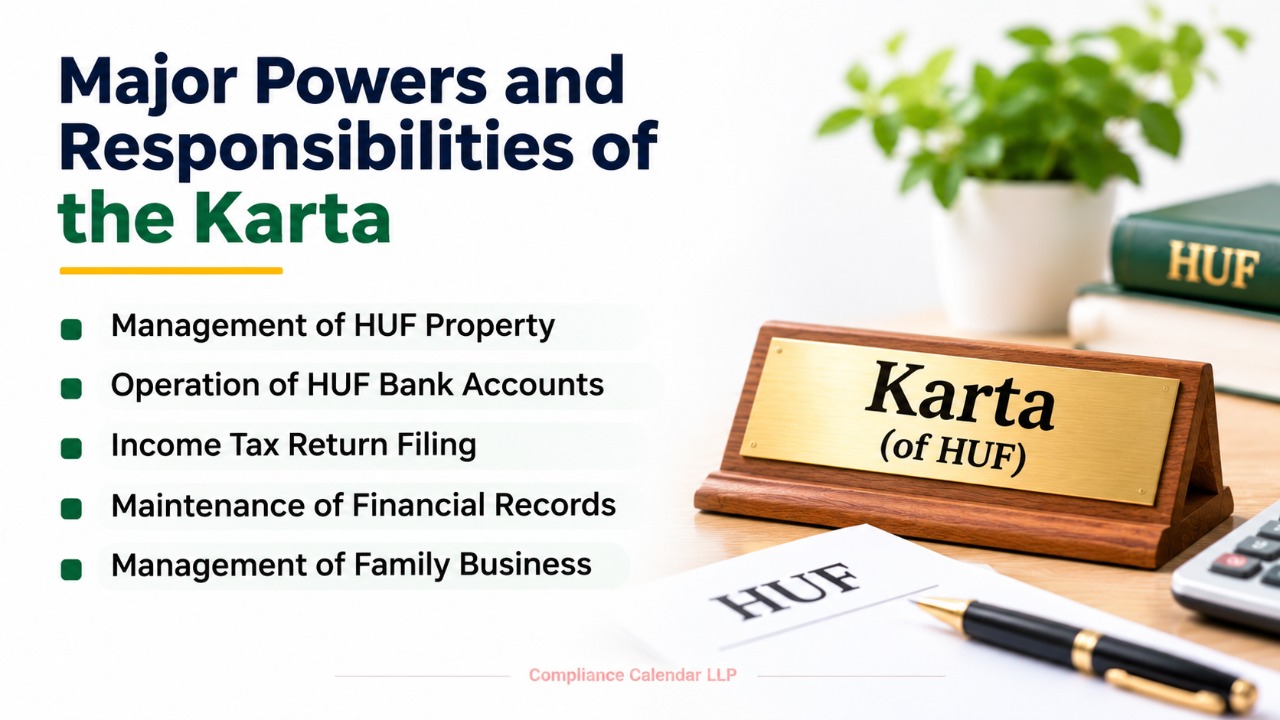
Major Powers and Responsibilities of the Karta
The Karta plays an important role in the daily management of the HUF and is generally responsible for ensuring that its financial affairs are handled properly. Since the Karta represents the family in various transactions, the person acting in this role should understand the difference between personal property and assets legally belonging to the HUF. Proper recordkeeping, timely tax filing and responsible management are important parts of this position.
Management of HUF Property
The Karta manages property legally belonging to the HUF and handles matters such as rental agreements, maintenance expenses and related financial transactions. However, important decisions involving the sale or transfer of joint family property must follow applicable legal principles. The Karta cannot automatically dispose of HUF property for personal purposes without considering the rights of other eligible members.
Operation of HUF Bank Accounts
The Karta generally operates the HUF bank account and manages funds received from genuine family income sources. For example, rent received from HUF property may be deposited into the HUF account, while related maintenance expenses may be paid from the same account. Keeping these transactions separate from personal income helps maintain clear financial records.
Income Tax Return Filing
The Karta ordinarily manages the preparation and verification of the HUF's income tax return. This includes reviewing rental income, business profits, investment returns and eligible deductions before calculating the final tax liability. The Karta should ensure that the return contains accurate information and is filed within the applicable deadline.
Maintenance of Financial Records
The Karta should preserve important documents, including property records, bank statements, investment details, tax payment challans and income tax returns. These documents help explain the source of HUF income and may be useful during tax verification or other financial transactions. Maintaining organised records also makes annual compliance easier for the family.
Management of Family Business
If the HUF genuinely owns and operates a business, the Karta may manage its commercial activities on behalf of the family. This may include handling business transactions, maintaining accounts and completing applicable registrations. The Karta should also ensure that the business complies with relevant tax and regulatory requirements based on its nature and activities.
Can a Woman Become the Karta of an HUF?
Yes, an eligible woman coparcener can become the Karta of an HUF. The Hindu Succession (Amendment) Act, 2005 strengthened daughters' rights by recognising their coparcenary status by birth in the same manner as sons under the relevant provisions. The Supreme Court also clarified important aspects of daughters' coparcenary rights in Vineeta Sharma v. Rakesh Sharma (2020). These developments are important because they recognise that women cannot be denied eligible coparcenary rights merely because of their gender.
For example, suppose a family has a daughter who is the senior-most eligible coparcener and is capable of managing the HUF's affairs. Her gender alone does not prevent her from acting as Karta. However, the exact legal position may depend on the family's circumstances, the nature of its property and the applicable succession rules. It is also important to distinguish between an HUF member and a coparcener, because their legal rights and responsibilities may differ.
HUF Income Tax Return Filing Rules
An HUF must file an income tax return when it meets the applicable statutory filing requirements. The return is submitted separately from the personal income tax returns of the Karta and other family members. For example, suppose Rajesh earns Rs 12 lakh annually from employment while his family's HUF earns Rs 6 lakh from property and investments. Rajesh's salary generally remains part of his individual income, while the genuine HUF income may be assessed separately under the HUF PAN.
Under the Income-tax Act, 2025, the provisions concerning furnishing and verification of returns are important for HUF compliance. The correct return form depends on the nature of the HUF's income, including whether it earns rental income, capital gains, business profits or income eligible for presumptive taxation. Families should also understand that obtaining an HUF PAN does not automatically mean that an income tax return must be filed every year, because the filing obligation depends on the applicable statutory conditions.
Which ITR Form Should an HUF File?
The appropriate income tax return form depends on the type of income earned by the HUF and the filing conditions applicable to the relevant tax year. An HUF receiving rent and investment income may have different filing requirements from an HUF operating a business. The following table explains the commonly recognised ITR categories under the established return system, although the prescribed forms and instructions for tax year 2026–27 should be checked before filing.
|
ITR Form |
Generally Applicable To |
Example |
|---|---|---|
|
ITR-2 |
Eligible HUFs without business or professional income |
Rental income, investment income or capital gains |
|
ITR-3 |
HUFs with business or professional income that do not qualify for another prescribed form |
Trading or other business income |
|
Eligible resident HUFs qualifying under presumptive taxation provisions and other conditions |
Certain small business activities |
For example, if the Sharma family's HUF earns rental income and interest from fixed deposits, the relevant non-business return category may apply, subject to the prescribed eligibility requirements. However, if the HUF operates a trading business, a return form dealing with business income may be required. Selecting the wrong form can lead to filing errors or additional compliance work, so the Karta should review the official instructions for the applicable tax year.
How to File an HUF Income Tax Return?
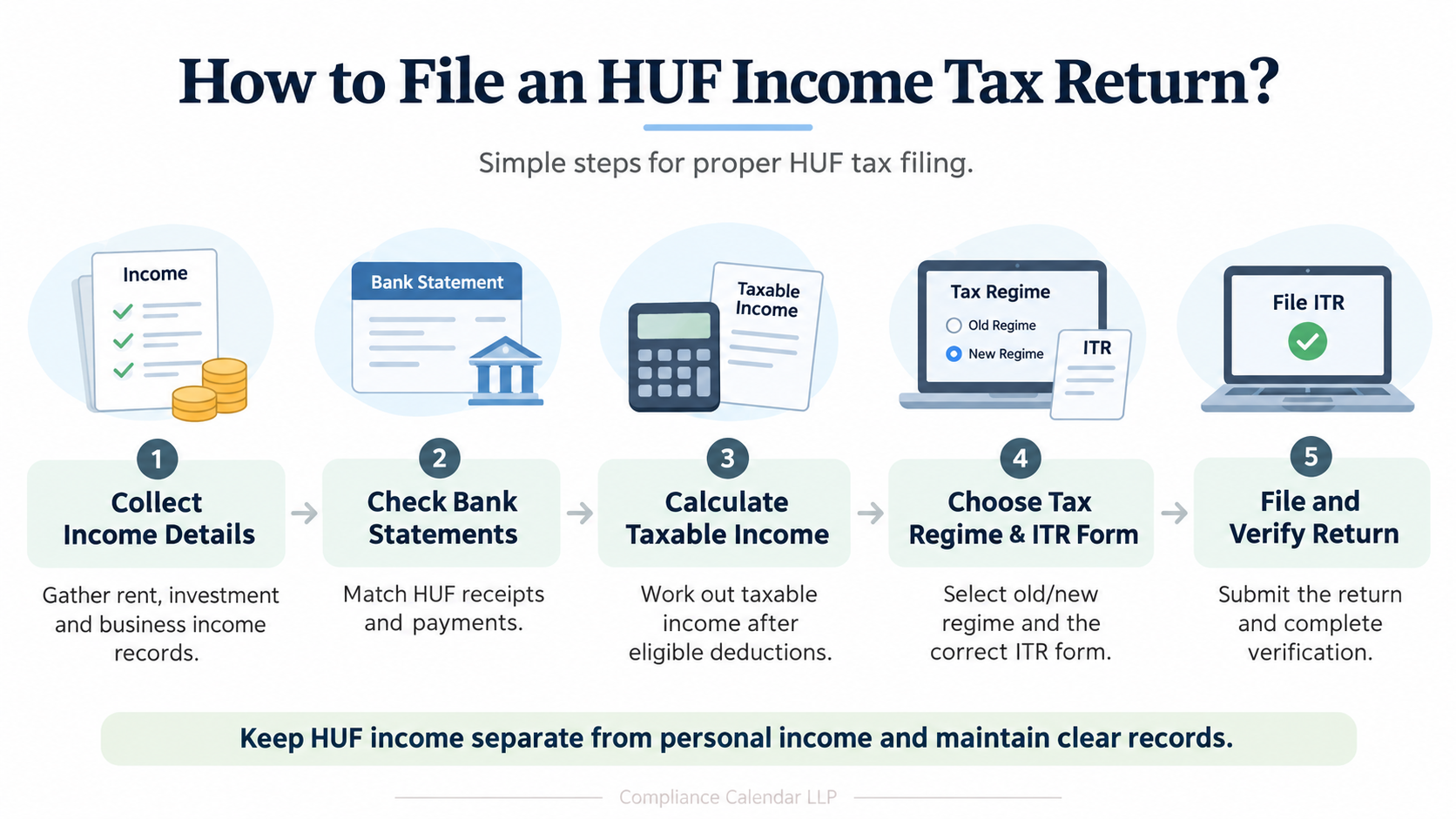
Filing an HUF income tax return becomes easier when the Karta maintains proper records throughout the year. The process begins with identifying income legally belonging to the HUF and separating it from the personal earnings of family members. After calculating taxable income and reviewing available deductions, the Karta can prepare the return using the Income Tax e-Filing Portal and the prescribed form.
To understand how HUF income is taxed separately and what deductions and tax benefits are available, read our detailed guide on HUF Taxation in India.
Collect Income and Expense Details
The Karta should gather information relating to rental income, investment returns, business profits, capital gains and other receipts belonging to the HUF. Relevant expenses and deductions should also be identified. This helps ensure that the tax calculation includes only genuine HUF transactions.
Review Bank and Investment Statements
The HUF bank statements should be compared with income and expense records to identify missing or incorrectly classified transactions. Investment statements, interest certificates and other supporting documents should also be reviewed. Any significant transfers between personal and HUF accounts should be examined before filing.
Calculate the HUF's Taxable Income
After collecting the records, the taxable income should be calculated under the applicable income heads. The Karta should consider permitted deductions, exemptions and adjustments according to the chosen tax regime. Special tax provisions may apply to certain capital gains and other income sources.
Select the Applicable Tax Regime
The HUF should compare the old and new tax regimes before determining its tax liability. Although the new regime is generally the default, eligible HUFs may choose the old regime subject to the relevant conditions. Additional restrictions can apply where the HUF earns business or professional income.
File and Verify the Return
The completed return should be submitted through the Income Tax e-Filing Portal using the HUF's PAN and the appropriate authorised procedure. The Karta should check the details carefully before verification and preserve the acknowledgement after successful filing.
Who Can Sign or Verify an HUF Income Tax Return?
The Karta ordinarily signs or verifies the income tax return filed on behalf of the HUF. This responsibility is important because verification confirms the information provided in the return according to the applicable legal requirements. Before submitting the return, the Karta should review income details, deductions, tax payments and supporting records to ensure that the information is accurate.
Where the Karta is absent from India or is mentally incapacitated, another adult member of the family may verify the return in accordance with the applicable statutory provisions. However, the authority to verify an income tax return does not automatically provide unrestricted control over HUF property. The person acting on behalf of the family must follow the relevant legal and procedural requirements.
What Happens When the Karta Changes?
A change in Karta may take place because of death, incapacity or a change in the family's circumstances. The HUF does not necessarily come to an end when its existing Karta dies or is unable to continue managing family affairs. Another eligible coparcener may take responsibility for managing the HUF according to the applicable law, and the family should ensure that relevant records are updated where required.
For example, suppose Mohan has managed his family's HUF for several years but later passes away. The family may need to identify the eligible person who will become the new Karta and update the bank's authorised signatory records. Supporting documents may include the death certificate, KYC records and declarations requested by the relevant institution. The HUF's existing PAN generally continues to identify the same HUF rather than becoming the personal PAN of the new Karta.
HUF Bank Account Compliance Rules
An HUF can open a separate bank account in its own name for managing genuine family income and financial transactions. Banks generally require the HUF PAN, Karta's identity and address documents and the relevant HUF declaration or supporting records. The exact documentation may vary depending on the bank's KYC policies and the type of account being opened.
For example, if a family receives rental income from property legally owned by its HUF, the rent may be deposited into the HUF account and property-related expenses may be paid from that account. This makes the financial records easier to understand and supports income tax calculations. However, simply depositing money into an HUF account does not establish that the money legally belongs to the HUF. The source and ownership of funds remain important for tax purposes.
Important Documents for HUF Compliance
Proper documentation helps an HUF maintain clear financial records and meet banking and income tax requirements. Although every HUF may not need the same documents, families should preserve records that explain their legal status, financial transactions and ownership of assets. These documents become especially important when the HUF earns regular rental income, makes investments, carries on business or undergoes a change in Karta.
|
Document |
Importance |
|---|---|
|
HUF PAN Card |
Provides a separate tax identity |
|
HUF Deed or Declaration |
Records family details and management arrangements |
|
Karta's Identity Proof |
Supports KYC and verification |
|
Karta's Affidavit |
Supports the prescribed PAN application requirements |
|
Bank Statements |
Records financial transactions |
|
Property Ownership Documents |
Helps establish ownership of HUF assets |
|
Investment Records |
Supports investment income calculations |
|
Rental Agreements |
Helps verify rental income |
|
Income Tax Returns |
Provides records of tax compliance |
|
Business Records |
Supports business income and applicable registrations |
For example, Suppose an HUF receives rental income from an ancestral property but does not maintain ownership documents or bank records. If questions arise about whether the property legally belongs to the HUF, the family may find it difficult to explain the tax treatment. Maintaining relevant property papers, family records and income statements can help establish the facts and make future compliance easier.
Important Legal Rules for HUF Compliance in 2026
The Income-tax Act, 2025 came into force on 1 April 2026 and introduced revised provisions and procedures for income tax compliance. However, the basic recognition of an HUF as a separate taxpayer continues. Families should use the forms and rules applicable to the relevant tax year, while also following the personal laws governing HUF property and coparcenary rights.
|
Legal Provision |
Importance for HUF |
|---|---|
|
Income-tax Act, 2025 |
Governs income taxation from 1 April 2026 |
|
Section 202 |
Covers the applicable new tax regime provisions |
|
Section 263 |
Deals with furnishing income tax returns |
|
Section 265 |
Deals with income tax return verification |
|
Rule 158, Income-tax Rules, 2026 |
Prescribes relevant PAN application requirements |
|
Hindu Succession Act, 1956 |
Governs relevant succession and coparcenary rights |
|
Hindu Succession (Amendment) Act, 2005 |
Recognises daughters' equal coparcenary rights |
An important point is that financial year 2025–26 and tax year 2026–27 should not be confused. Returns relating to FY 2025–26, generally identified under Assessment Year 2026–27, are governed by the applicable provisions of the Income-tax Act, 1961. The Income-tax Act, 2025 applies from 1 April 2026 for the relevant subsequent tax years. This distinction is particularly important when checking return forms, deduction provisions and filing instructions.
HUF ITR Filing Due Dates and Tax Payments
An HUF should file its income tax return within the deadline applicable to its income category and statutory filing requirements. The due date may depend on whether the HUF earns business income, whether its accounts require an audit and whether other special provisions apply. An HUF may also have advance tax obligations, depending on its estimated tax liability and the relevant legal conditions.
For example, an HUF receiving rental income and interest may have different filing requirements from an HUF operating an audited trading business. Families should therefore identify the correct return category rather than assuming that the same deadline applies to every HUF. For tax year 2026–27, the applicable statutory due dates and any subsequent government extensions should be checked before filing. Maintaining a compliance calendar can help the Karta avoid late filing, interest and other possible consequences.
Common HUF Compliance Mistakes to Avoid
Many HUF compliance problems arise because families treat HUF income and personal income as interchangeable. For example, a Karta may deposit personal salary into the HUF bank account and assume that the amount has become HUF income. However, the income tax treatment depends on the actual source and ownership of funds. Certain transfers may also attract clubbing provisions, meaning income may continue to be taxed in the hands of the individual who originally owned the asset.
Another common mistake is failing to update records after a change in Karta or filing the HUF income tax return using the wrong form. Families may also face difficulties when they do not preserve property ownership documents or investment statements. These problems can often be avoided by maintaining organised records and reviewing compliance requirements before completing important transactions.
|
Common Mistake |
What Should Be Done Instead? |
|---|---|
|
Mixing personal and HUF income |
Maintain separate financial records |
|
Using the Karta's personal PAN |
Use the HUF PAN where applicable |
|
Filing the wrong ITR form |
Check the correct return category |
|
Missing property documents |
Preserve ownership records |
|
Not updating Karta details |
Update relevant banking and tax records |
|
Claiming incorrect deductions |
Check the applicable tax regime |
|
Filing ITR after the deadline |
Monitor and follow statutory due dates |
Families should also avoid assuming that every inherited asset automatically belongs to an HUF. The ownership of inherited property depends on the relevant succession laws, family circumstances and legal documentation. Similarly, transferring personal property into an HUF does not always shift the resulting income tax liability. These matters should be examined carefully before reporting income or claiming tax benefits.
Is Professional Assistance Necessary for HUF Compliance?
An HUF is not automatically required to appoint a Chartered Accountant simply because it exists. Families with straightforward income and properly maintained records may be able to handle routine tax filing themselves. However, professional assistance can be useful when the HUF earns business income, sells valuable property, deals with capital gains or has complicated ownership arrangements. Tax audit requirements and disputes among family members may also make professional guidance necessary.
For example, suppose an HUF owns several rental properties and operates a family trading business. The Karta may need assistance in calculating income, identifying eligible deductions, determining whether an audit is required and selecting the correct return form. Similarly, where the family plans to partition property or transfer significant assets, legal advice may help protect the rights of coparceners and avoid unexpected tax consequences.
Why choose Compliance Calendar LLP?
HUF Compliance in India involves much more than obtaining a separate PAN card. Families must understand how the HUF is recognised under law, who can act as the Karta, which income legally belongs to the HUF and when income tax returns must be filed. Proper documentation is particularly important for families managing joint property, investments or business activities because it helps distinguish personal financial transactions from those belonging to the HUF.
The Income-tax Act, 2025, the Income-tax Rules, 2026 and the applicable Hindu succession laws provide important requirements that families should understand. Maintaining accurate financial records, filing tax returns on time and updating relevant details after changes in family management can help prevent compliance problems. With responsible financial management and suitable professional guidance where necessary, an HUF can manage joint family assets in an organised and legally compliant manner.
If you are planning to start a political party and need assistance with the registration process, you can contact Compliance Calendar on +91 9988424211 or info@ccoffice.in
Frequently Asked Questions (FAQs)
Q1. Is HUF registration mandatory in India?
Ans. No, HUF registration is not mandatory because a Hindu Undivided Family generally comes into existence through family relationships under Hindu law. However, an HUF may need a separate PAN card, bank account and supporting documents for income tax and financial transactions.
Q2. How to apply for an HUF PAN card online in 2026?
Ans. An HUF can apply for a separate PAN through the authorised Protean eGov or UTIITSL portals. From 1 April 2026, Indian HUFs must use Form No. 94 and submit the prescribed Karta affidavit and supporting documents.
Q3. What documents are required for HUF PAN card application?
Ans. The main documents include the Karta's identity proof, address proof, prescribed supporting documents and an affidavit containing details of the coparceners. The affidavit must follow the applicable requirements under Rule 158 of the Income-tax Rules, 2026.
Q4. Is income tax return filing mandatory for every HUF?
Ans. No, every HUF is not required to file an income tax return simply because it has a PAN card. Filing becomes mandatory when the HUF's income exceeds the applicable basic exemption limit or when another statutory filing requirement applies.
Q5. Which ITR form should an HUF file in 2026?
Ans. For AY 2026–27, an HUF may use ITR-2 for eligible non-business income, ITR-3 for business or professional income, or ITR-4 when it satisfies the presumptive taxation conditions. The correct form depends on its income sources and applicable eligibility rules.
Q6. Can a woman or daughter become the Karta of an HUF?
Ans. Yes, an eligible woman coparcener can become the Karta of an HUF. Under the Hindu Succession (Amendment) Act, 2005, daughters have equal coparcenary rights by birth under the applicable provisions, allowing them to manage HUF affairs when legally eligible.
Q7. What are the main responsibilities of the Karta in an HUF?
Ans. The Karta manages HUF property, bank accounts, investments, business activities and income tax compliance. The Karta is also generally responsible for maintaining financial records, ensuring timely tax filing and protecting the legal interests of eligible family members.
Q8. Can an HUF open a bank account without a PAN card?
Ans. Banks generally require a separate HUF PAN card and prescribed KYC documents to open an HUF bank account. The Karta may also need to submit identity proof, address proof and an HUF declaration according to the bank's requirements.
Q9. What is the HUF income tax return filing due date in 2026?
Ans. For AY 2026–27, the general filing deadline was 31 August 2026 for eligible non-audit business cases. For specified audit cases, CBDT extended the deadline to 21 November 2026. The applicable deadline depends on the HUF's filing category and official extensions.
Q10. Can an HUF use the personal PAN card of its Karta?
Ans. No, an HUF and its Karta are treated as separate taxpayers. The HUF should use its own PAN for income tax returns and financial transactions requiring HUF identification, while the Karta uses a personal PAN for individual income.
Q11. What happens to an HUF when the Karta dies?
Ans. An HUF does not automatically come to an end when its Karta dies. Another eligible coparcener may become the Karta, and the family should update relevant banking and tax records while preserving supporting documents.
Q12. Can an HUF run a business and apply for GST registration?
Ans. Yes, an HUF can carry on a business through its Karta and may obtain GST registration when required under the applicable GST provisions. The business must maintain proper accounting records and follow the relevant tax and regulatory requirements.
Q13. Can an HUF claim tax deductions under Section 80C and Section 80D?
Ans. An HUF choosing the old tax regime may claim eligible deductions for qualifying investments and health insurance payments, subject to statutory conditions. These are commonly known by their earlier Section 80C and Section 80D references, with corresponding provisions applying under the Income-tax Act, 2025.
Q14. Is an HUF eligible for the Rs 12 lakh income tax rebate in 2026?
Ans. No, the income tax rebate available to eligible resident individuals with taxable income up to Rs 12 lakh under the new regime does not apply to HUFs. An HUF must calculate its tax liability using the applicable tax slabs and other relevant provisions.
Q15. What happens if an HUF does not file its income tax return on time?
Ans. If an HUF is required to file an income tax return but misses the deadline, it may face late filing fees, interest and restrictions on certain tax benefits or loss carry-forwards. The consequences depend on the HUF's taxable income, filing circumstances and applicable statutory provisions.
Article last updated on : 11 Nov 2026.
































































_learn_crop10_thumb.jpg)