


A founder agrees to sell a 20% stake in a lending NBFC. The buyer will also get the right to appoint four of its seven directors. The founder plans to stay on as managing director, and the buyer assumes the deal can close without prior RBI approval because the stake is below 26%. But the right to appoint a majority of the board can give the buyer control. The NBFC needs prior written RBI permission before that right takes effect.
An NBFC change in control can arise through a share purchase, a voting agreement, new board appointment rights or the acquisition of a parent company. The first question is who can direct the NBFC after the transaction. The percentage of paid-up equity being acquired is a separate approval test.
What is a change in control of an NBFC?
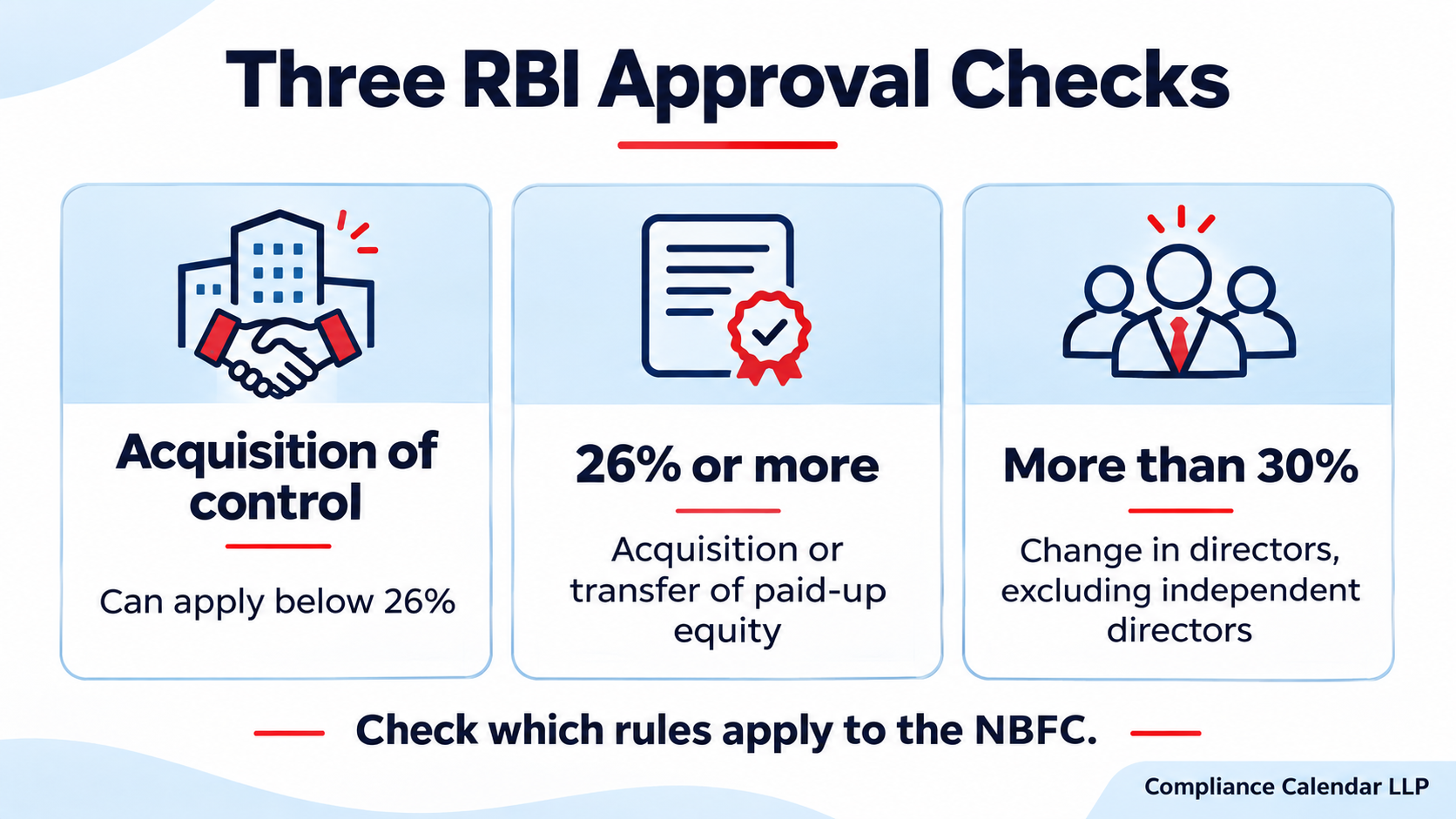
The Reserve Bank of India (Non-Banking Financial Companies – Acquisition of Shareholding or Control) Directions, 2025, issued on 28 November 2025, govern covered transactions. Paragraph 6(1) requires prior written RBI permission for a takeover or acquisition of control of a covered NBFC, whether or not it results in a change of management.
Paragraph 4 adopts the definition of control in Regulation 2(1)(e) of the SEBI Takeover Regulations, 2011. Under that definition, control can arise through the right to appoint a majority of directors or to direct management or policy decisions. A person can exercise those rights directly or indirectly, alone or with others acting in concert. The rights may come from shareholding, a shareholders’ agreement, a voting agreement or another arrangement. Holding a position as a director or officer does not, by itself, establish control.
Which arrangements can lead to a change in control?
The review should cover the shareholders’ agreement, articles of association, voting agreements and any side letters. Read these documents together. A board nomination clause may appear narrow on its own, while a separate voting agreement gives the same investor the power to decide who joins or leaves the board.
|
Arrangement |
What to check |
|
Board appointment rights |
Who can appoint or remove directors? Can the buyer appoint a majority of the board? |
|
Voting agreements or proxies |
Can the buyer direct other shareholders’ votes? Check which decisions the arrangement covers and when it takes effect. |
|
Consent rights and reserved matters |
Can the buyer shape operating budgets, lending policy or key management appointments? Assess the scope and combined effect of those rights. |
|
Acquisition of a parent company |
Will a new person control the parent’s voting or board appointment rights over the Indian NBFC? |
|
Amendment to an existing agreement |
Will a current shareholder gain new governance rights while retaining the same percentage of equity? |
|
Options, convertibles or enforcement rights |
When can voting or management rights arise? Review the initial grant and what happens on exercise, conversion or enforcement. |
For example, a right to block an amendment to the articles raises a different question from a package of rights over the annual budget, lending strategy and senior management appointments. The wording and combined effect of those rights determine whether they confer control.
Example: An offshore acquisition changes control of an Indian NBFC
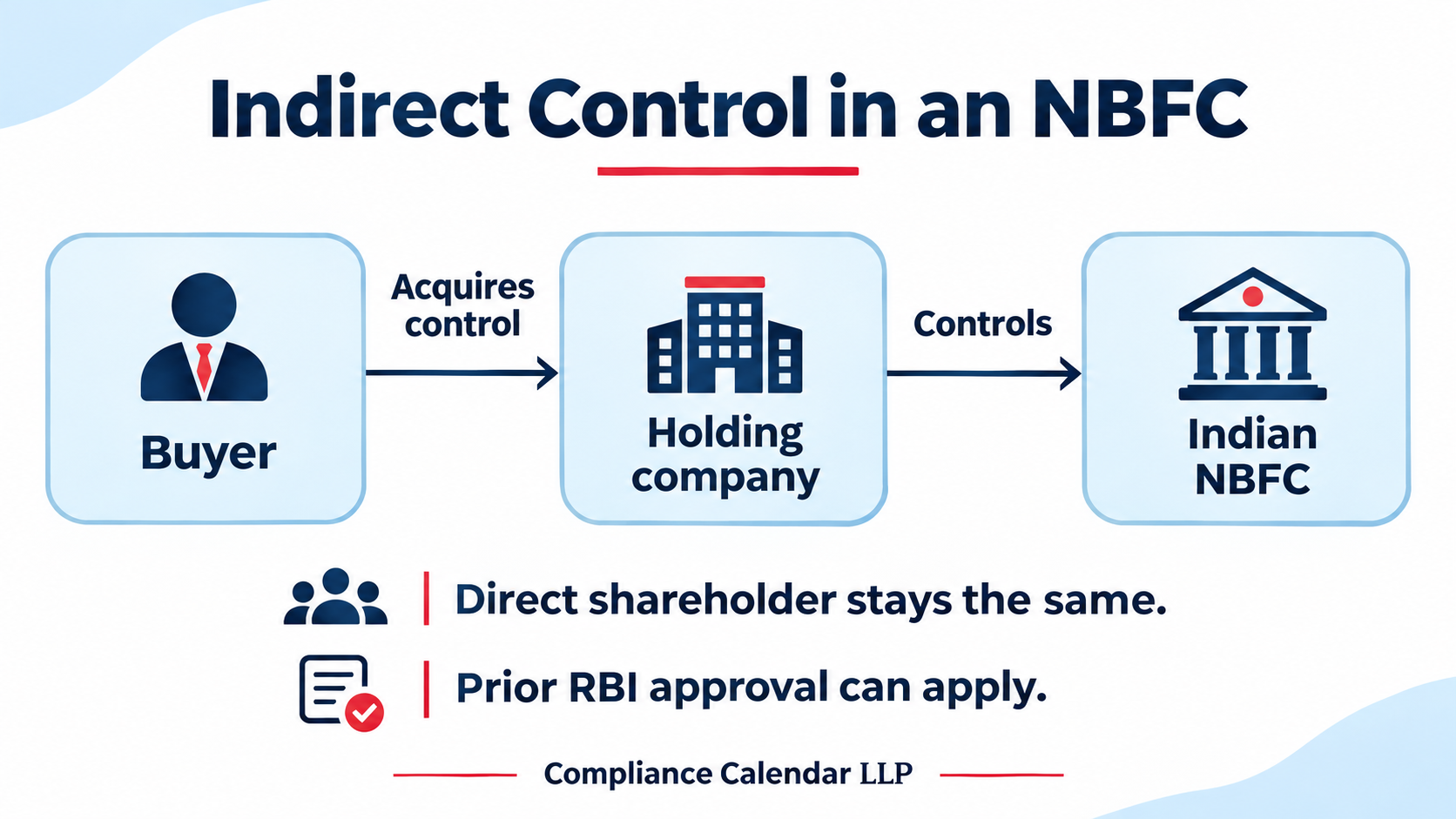
Suppose a foreign holding company controls an Indian NBFC. An investor acquires control of the holding company. The NBFC’s register of members still shows the same direct shareholder, but the investor can now direct how the holding company votes and exercises its board appointment rights. If the transaction gives the investor indirect control of the Indian NBFC, the prior approval requirement can apply even without a direct transfer of NBFC shares.
How does the 26% shareholding threshold apply?
Paragraph 6(2) separately requires prior written RBI approval for a shareholding change involving an acquisition or transfer of 26% or more of the covered NBFC’s paid-up equity capital. Progressive increases over time count toward this threshold.
A purchase of 20% can require approval under paragraph 6(1) if it gives the buyer control. A purchase of exactly 26% can require approval under paragraph 6(2) even if the buyer receives no control rights. If an investor acquires 18% and later plans to acquire another 9% on the same capital base, the NBFC should assess the cumulative 27% acquisition before completing the second purchase.
A limited exception applies when shareholding rises above 26% because of a buyback or capital reduction approved by a competent court. The change must be reported within one month to the RBI or National Housing Bank (NHB), as applicable. Any separate acquisition of control must still be assessed.
Does replacing directors also require RBI approval?
Where paragraph 10 of the RBI NBFC Governance Directions applies, a management change resulting in a change of more than 30% of directors, excluding independent directors, requires prior written RBI permission. Directors re-elected on retirement by rotation are exempt from this approval requirement. The applicable requirement to report changes in directors or management continues, and paragraph 11 provides for a separate management-change application through PRAVAAH.
For example, replacing two of six non-independent directors changes one-third of the relevant board seats. That can trigger the management-change approval requirement even if the shareholders stay the same. A contractual right to appoint a majority of directors can also trigger the control test before the investor exercises that right.
How to obtain RBI approval for an NBFC change in control
Step 1: Compare ownership and governance rights before and after the deal
Confirm the target’s Certificate of Registration (CoR), NBFC category, public deposit status and applicable RBI Directions. Prepare an ownership chart that shows the direct shareholders and the ultimate owners. Then compare who can vote, appoint directors and approve key decisions before and after the transaction.
Identify the date on which each right becomes effective. In a deal that closes in stages, the buyer may gain a right to direct policy before it acquires the full agreed stake. The approval timetable should reflect when control is acquired.
Step 2: Make regulatory approval a condition of closing
The transaction documents should make the transfer of control conditional on prior written RBI approval, completion of any applicable public notice period and satisfaction of other required clearances. Review rights that begin at signing, including voting arrangements and consent rights over business decisions.
For example, if an agreement gives the buyer authority over lending policy immediately on signing, the control question may arise before the scheduled share transfer. The parties should align the effective date of the governance rights with the approval and closing conditions.
Step 3: Submit the application through PRAVAAH
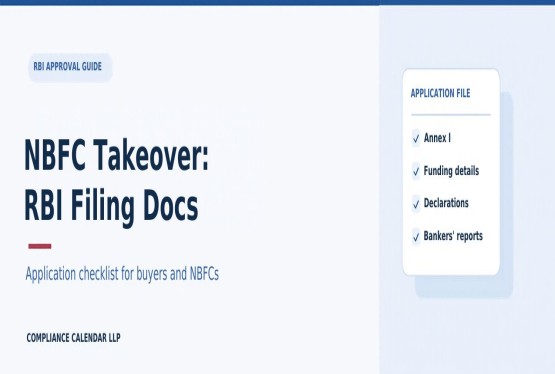
Under paragraph 7, the target NBFC applies through PRAVAAH on its company letterhead. The Directions call for the following information and documents.
|
Document or information |
What to prepare |
|
Proposed shareholder details |
Complete the disclosures in Annex I to the Acquisition Directions. |
|
Sources of acquisition funds |
Explain where the funds will come from and retain supporting evidence of the funding trail. |
|
Public deposit declaration |
Obtain the proposed shareholders’ declaration that they are not associated with an unincorporated body accepting public deposits. |
|
Rejected registration declaration |
Obtain the declaration concerning association with companies whose CoR applications the RBI has rejected. |
|
Criminal case declaration |
Obtain the required declaration concerning criminal cases, including offences under Section 138 of the Negotiable Instruments Act, 1881. |
|
Bankers’ report |
Arrange the bankers’ report on the proposed shareholders. |
For an indirect acquisition or a transaction that changes control through contractual rights, prepare a note explaining who acquires control, how they acquire it and when the rights take effect. An ownership chart, marked-up agreements and a comparison of voting and governance rights can support the filing. If the transaction does not introduce a new direct shareholder, check how the filing requirements apply to that structure.
Step 4: Obtain written RBI approval and publish the public notice
Where paragraphs 8 to 10 apply, the NBFC and the transferee publish the notice separately or jointly after receiving RBI permission. The notice must appear in at least one leading national newspaper and one leading local vernacular newspaper covering the location of the NBFC’s registered office. It should identify the transferee, describe the proposed transfer and state the reasons for it. The notice rule covers a transfer of control with or without a share sale.
Publish the required notices at least 30 days before effecting the transfer. If the newspapers publish on different dates, use the later publication date when planning the earliest possible closing so both notices meet the minimum period. The 30 days concern publication and transfer. The Acquisition Directions do not prescribe a fixed RBI processing period.
Step 5: Complete the transaction and applicable filings
Review the RBI approval letter for any conditions, validity period and reporting requirements. Once the applicable notice period has elapsed and the parties have met the other closing conditions, complete the transfer and bring the approved governance rights into effect.
Update the company’s statutory records and complete any applicable corporate, FEMA or regulatory filings. In a share acquisition, the registered NBFC continues to hold its CoR, subject to the applicable requirements and approval conditions.
Read Related Article: RBI FEMA/FDI Reporting.
Special cases that need a separate review
Housing Finance Companies
A separate 10% shareholding threshold applies to qualifying acquisitions or transfers by or to a foreign investor in an HFC that accepts or holds public deposits. Paragraph 8 contains a public notice exception for qualifying shareholding changes of at least 10% and below 26%. If the deal also transfers control, assess that aspect separately. The RBI can review the permission to accept public deposits when control of an HFC holding a CoR valid for that activity is acquired or transferred.
Standalone Primary Dealers
Paragraph 6(4) requires an SPD to obtain prior RBI approval for changes in its shareholding pattern or capital structure. The parties should check the provisions that apply to the target’s category before relying on the general NBFC approval tests.
Foreign investment
For a foreign acquisition, review the applicable FEMA entry route, beneficial ownership, pricing and reporting requirements. Paragraphs 11 to 13 of the Acquisition Directions also restrict new investments from or through jurisdictions on the relevant Financial Action Task Force (FATF) lists. The significant-influence and voting-power tests can account for potential voting rights, including rights arising from convertible instruments.
Know more about : FEMA Advisory.
Mergers and amalgamations
An NBFC merger under a scheme follows the separate RBI Voluntary Amalgamation Directions, 2025. The applicable RBI no-objection certificate or prior approval must be obtained before approaching the court or tribunal. For a listed target, the parties should also assess the applicable SEBI takeover and disclosure obligations.
For the full process from assessing the transaction to preparing the application, read our guide to RBI approval for an NBFC takeover.
Conclusion
An NBFC control review should start with a practical comparison of who can appoint directors, exercise votes and direct policy before and after the deal. Check the buyer’s cumulative shareholding and any proposed board changes separately, since each can trigger its own approval requirement.
Where prior RBI approval and public notice both apply, the parties must obtain written permission, publish the notices and allow the applicable 30-day period before effecting the transfer. Draft the closing conditions so the buyer’s control rights take effect only after those steps and the other required conditions are complete.
Frequently Asked Questions (FAQ’s)
Q1. Can a 20% investor acquire control of an NBFC?
Ans. Yes. An investor holding 20% can acquire control if it gets the right to appoint a majority of directors or direct the NBFC’s management or policy decisions.
Q2. Can control change without a sale of shares?
Ans. Yes. A new voting agreement or an amendment to existing governance rights can confer control even when the share register stays the same.
Q3. Does keeping the same managing director remove the approval requirement?
Ans. No. Paragraph 6(1) applies to a takeover or acquisition of control even when the existing management continues.
Q4. Can an offshore parent company sale trigger RBI approval?
Ans. Yes, if it results in the buyer acquiring indirect control over the Indian NBFC. Check the ownership chain and the rights the buyer can exercise through the parent company.
Q5. Who files the application through PRAVAAH?
Ans. The target NBFC submits the application on its company letterhead. The proposed acquirer or shareholders provide the applicable disclosures, declarations and supporting documents.
Q6. When can the parties publish the public notice?
Ans. The required notice is published after prior RBI permission. Where the notice applies, both publications must precede the transfer by at least 30 days.
Q7. Is 30 days the RBI approval timeline?
Ans. The 30 days are the minimum period between the required newspaper publication and the transfer. The Acquisition Directions do not specify a fixed RBI decision timeline.
Q8. Does a single board seat give an investor control?
Ans. A single board seat alone does not establish control. Review it alongside the investor’s voting rights, appointment rights and ability to direct management or policy decisions.
Q9. Can a buyer exercise control rights before RBI approval?
Ans. No. These rights can take effect only after written RBI approval and any applicable notice period.
Q10. Does a court-approved buyback that raises a stake above 26% need RBI approval?
Ans. A shareholding approval exemption may apply, but the NBFC must report the change within one month. Any change in control must be assessed separately.
Article last updated on : 11 Nov 2026.








































































_learn_crop10_thumb.jpg)