



In India, families often own property, manage investments and run businesses together. But did you know that a family can also have a separate PAN card, bank account and income tax return? This is possible through a Hindu Undivided Family (HUF). Imagine Rajesh, who works in a private company and earns a regular salary. His family also owns an ancestral property that generates rental income. Rajesh wants to understand whether this income should be added to his personal income or whether his family can manage it separately. This is where HUF Formation in India becomes relevant.
Under Indian law, an HUF is recognised as a separate taxpayer. It can help families manage joint property, investments and income in an organised manner. However, an HUF is not simply a tax-saving arrangement. There are important legal requirements concerning family relationships, ownership of property and taxation. This guide explains how an HUF works, the documents required, its benefits and the legal rules that families should understand in 2026.
What is a Hindu Undivided Family (HUF)?
A Hindu Undivided Family, commonly called an HUF, is a family recognised under Hindu law. It generally includes people who are descended from a common ancestor, along with family members recognised under the applicable rules. An HUF has two important features. First, it exists because of family relationships. Second, it can be treated as a separate taxpayer under Indian income tax law.
For example, suppose a family owns ancestral agricultural land and a residential property. If these assets legally belong to the HUF, their income may be managed and assessed separately from the personal income of individual family members. An HUF usually has a person called the Karta, who manages its financial and legal affairs. It is important to understand that an HUF is not a company or partnership firm. Its existence comes from family law rather than a commercial agreement.
Who Can Form an HUF in India?
HUF is primarily associated with Hindu families. For income tax purposes, eligible Jain, Sikh and Buddhist families can also be recognised as HUFs. An HUF normally arises automatically through the relevant family relationships. Unlike a private limited company or LLP, family members do not create an HUF merely by signing an agreement. The following points are important:
| Family relationship | The members must belong to a family recognised under the applicable law |
| Common ancestry | An HUF generally consists of family members connected through a common ancestor. |
| Coparceners | Certain members have ownership rights in coparcenary property by birth. |
| Karta | A person manages the affairs of the HUF on behalf of its members. |
| Joint family property | An HUF may hold ancestral property or other property that legally belongs to it. |
A person may belong to an HUF even before the family obtains a separate PAN card. However, the existence of an HUF does not automatically mean that it has taxable income or property of its own.
Who is the Karta of an HUF?
The Karta is the person responsible for managing the HUF's affairs. The Karta usually represents the family in financial transactions, banking activities, property matters and tax-related work. Traditionally, the senior-most male coparcener acted as the Karta. However, the legal position has developed with the recognition of daughters' equal coparcenary rights. An eligible woman coparcener can also act as Karta. The Karta may perform several responsibilities:
-
Manage HUF property and investments.
-
Open and operate the HUF bank account.
-
Apply for PAN and complete tax-related formalities.
-
Maintain records of family assets and liabilities.
-
Represent the HUF in permitted legal and financial matters.
The Karta cannot treat HUF property as personal property without considering the legal rights of other members.
How to Form an HUF in India? Step-by-Step Process
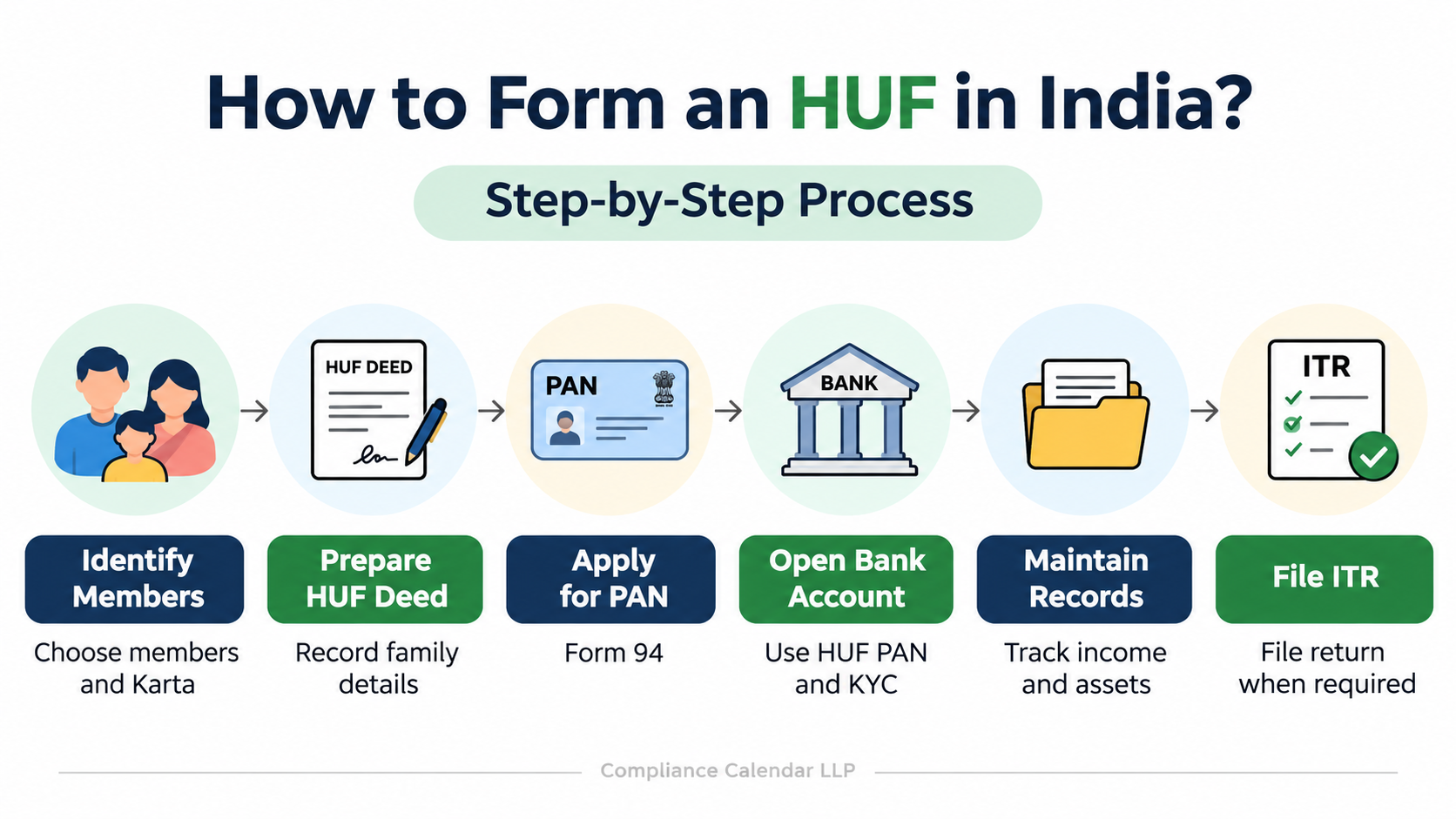
Many people search for the HUF Registration Process in India. However, there is no general compulsory government registration that creates an HUF. The practical process involves identifying the family, documenting its details and obtaining a separate PAN and bank account when required.
Step 1: Identify the HUF and Its Members
First, identify the family members who belong to the HUF under the applicable law. Also determine who will act as the Karta. For example, suppose Mohan belongs to a Hindu joint family with his spouse, son and daughter. The family's legal relationships determine its HUF status. If the family has joint property, the relevant ownership records should also be examined.
Step 2: Prepare an HUF Deed or Declaration
An HUF deed is a written document used to record important details about the family. It may contain:
-
Name of the HUF.
-
Name and address of the Karta.
-
Details of the family members.
-
Declaration of the family's HUF status.
-
Details of existing HUF assets, where applicable.
-
Date and signatures of the relevant persons.
An HUF deed is useful for documentation and banking purposes. However, signing an HUF deed is not mandatory for an HUF to exist under Hindu law.
Step 3: Apply for an HUF PAN Card
Once the necessary information is available, the HUF can apply for a separate Permanent Account Number (PAN). The HUF's PAN is different from the personal PAN of the Karta or other members. Under the Income-tax Rules, 2026, Form No. 94 is prescribed for PAN applications by Indian non-individual entities, including HUFs. This replaced the earlier Form 49A route for new applications from 1 April 2026. Applications can be submitted through authorised PAN service providers, such as Protean eGov or UTIITSL.
Step 4: Open an HUF Bank Account
After obtaining PAN, the family can approach a bank to open an account in the HUF's name. Banks generally require the HUF PAN, Karta's identity documents, an HUF declaration and other applicable KYC records. The account should be used for genuine HUF transactions rather than mixing personal income and family income without proper records.
Step 5: Maintain HUF Financial Records
The Karta should maintain appropriate records of HUF property, income, expenses and investments. If the family earns rent from HUF property, the rental agreements, ownership documents, receipts and related expenses should be properly recorded. Good recordkeeping becomes especially important when the HUF files income tax returns or deals with property ownership questions.
Step 6: File Income Tax Returns When Required
An HUF is assessed separately for income tax purposes. If it meets the applicable filing requirements, it must file its own income tax return. The correct return form depends on the nature of its income and the rules applicable to the relevant tax year. Documents Required for HUF Formation in India. There is no single document that creates an HUF in every case. However, certain documents are commonly needed for PAN applications, banking and recordkeeping.
To understand the important legal requirements after HUF Formation, including PAN application, income tax return filing and Karta responsibilities, read our detailed guide on HUF Compliance in India.
|
Document |
Purpose |
|---|---|
|
HUF deed or declaration |
Records family and management details |
|
Karta's PAN |
Identifies the Karta |
|
Karta's identity proof |
Supports KYC verification |
|
Address proof |
Verifies the relevant address |
|
Karta's affidavit |
Provides required details of coparceners |
|
HUF PAN |
Identifies the HUF for tax purposes |
|
Property documents, if applicable |
Establishes ownership of HUF assets |
|
Bank application and KYC documents |
Required for opening an HUF bank account |
Note: For an HUF PAN application, the Income Tax Department requires an affidavit containing details of the coparceners and the prescribed supporting documents. The exact documentation may vary depending on the applicable rules and the requirements of the bank or authority.
What is an HUF Deed, and Is It Mandatory?
An HUF deed is a written record that explains the family's HUF status and identifies its members and Karta. For example, suppose a family wants to open a bank account to manage income from its joint property. The bank may request an HUF declaration identifying the person authorised to operate the account. The deed helps establish these details and reduces confusion during financial transactions. However, an HUF deed does not itself create an HUF. An HUF arises under the applicable family law. Likewise, merely preparing a deed does not convert an individual's personal property into ancestral or HUF property. Stamp duty or notarisation requirements, where relevant, depend on the nature of the document and applicable local rules.
Income Tax Benefits of HUF in India in 2026
One important reason families explore HUF arrangements is the separate income tax treatment available to an HUF. The Income-tax Act, 2025, which came into force on 1 April 2026, continues to recognise HUFs for taxation. Under Section 202, the new tax regime applies to eligible taxpayers, including HUFs, unless a valid option is exercised for the alternative regime. An HUF can have its own taxable income and may be eligible for deductions and exemptions according to the applicable provisions.
To understand how an HUF's income is taxed separately, including applicable tax slabs, deductions and tax-saving benefits, read our detailed guide on HUF Taxation in India.
Separate Income Tax Assessment
Income that legally belongs to an HUF may be assessed separately from the personal income of family members. For example, suppose a family has:
-
Personal salary income of Rajesh: Rs.10 lakh annually.
-
Rental income from property legally belonging to the HUF: Rs.4 lakh annually.
Rajesh's salary would generally remain his personal income. The rental income may be assessed in the HUF's hands, subject to ownership and other applicable tax rules. This is not the same as dividing one person's salary among family members to reduce tax.
Tax Slabs Under the New Tax Regime
For the tax year 2026–27, the basic slab rates under the new regime for an HUF are:
|
Total Taxable Income |
Income Tax Rate |
|---|---|
|
Up to Rs.4,00,000 |
Nil |
|
Rs.4,00,001 – Rs.8,00,000 |
5% |
|
Rs.8,00,001 – Rs.12,00,000 |
10% |
|
Rs.12,00,001 – Rs.16,00,000 |
15% |
|
Rs.16,00,001 – Rs.20,00,000 |
20% |
|
Rs.20,00,001 – Rs.24,00,000 |
25% |
|
Above Rs.24,00,000 |
30% |
Applicable surcharge and cess may increase the final tax liability. An important point is that the income tax rebate available to eligible resident individuals is not automatically available to HUFs. Families should not assume that every HUF earning up to Rs.12 lakh pays no income tax.
Deductions and Exemptions
An HUF may claim deductions or exemptions where the law permits and the necessary conditions are satisfied. The availability of deductions depends on the chosen tax regime and the nature of the expense or investment. Therefore, an HUF should calculate its actual tax liability before making investments solely for tax-saving purposes.
Which Income Can Be Taxed Under an HUF?
Not every type of income earned by a family member can be shown as HUF income. The key question is whether the income legally belongs to the HUF. Common examples include:
| Income from HUF property | Rent earned from a property legally owned by the HUF may be taxable in its hands. |
| Investment income | Interest or other returns earned from investments made using genuine HUF funds may be treated as HUF income, subject to applicable tax provisions. |
| Business income | Income from a business genuinely carried on by the HUF may be taxable in the HUF's hands, depending on the business structure and legal facts. |
| Income from ancestral assets | Income generated from assets legally forming part of the HUF estate may be assessed separately. |
A member's personal salary, professional earnings or individually owned property income cannot automatically be shifted to an HUF simply because the person belongs to that family.
HUF vs Individual: What Is the Difference?
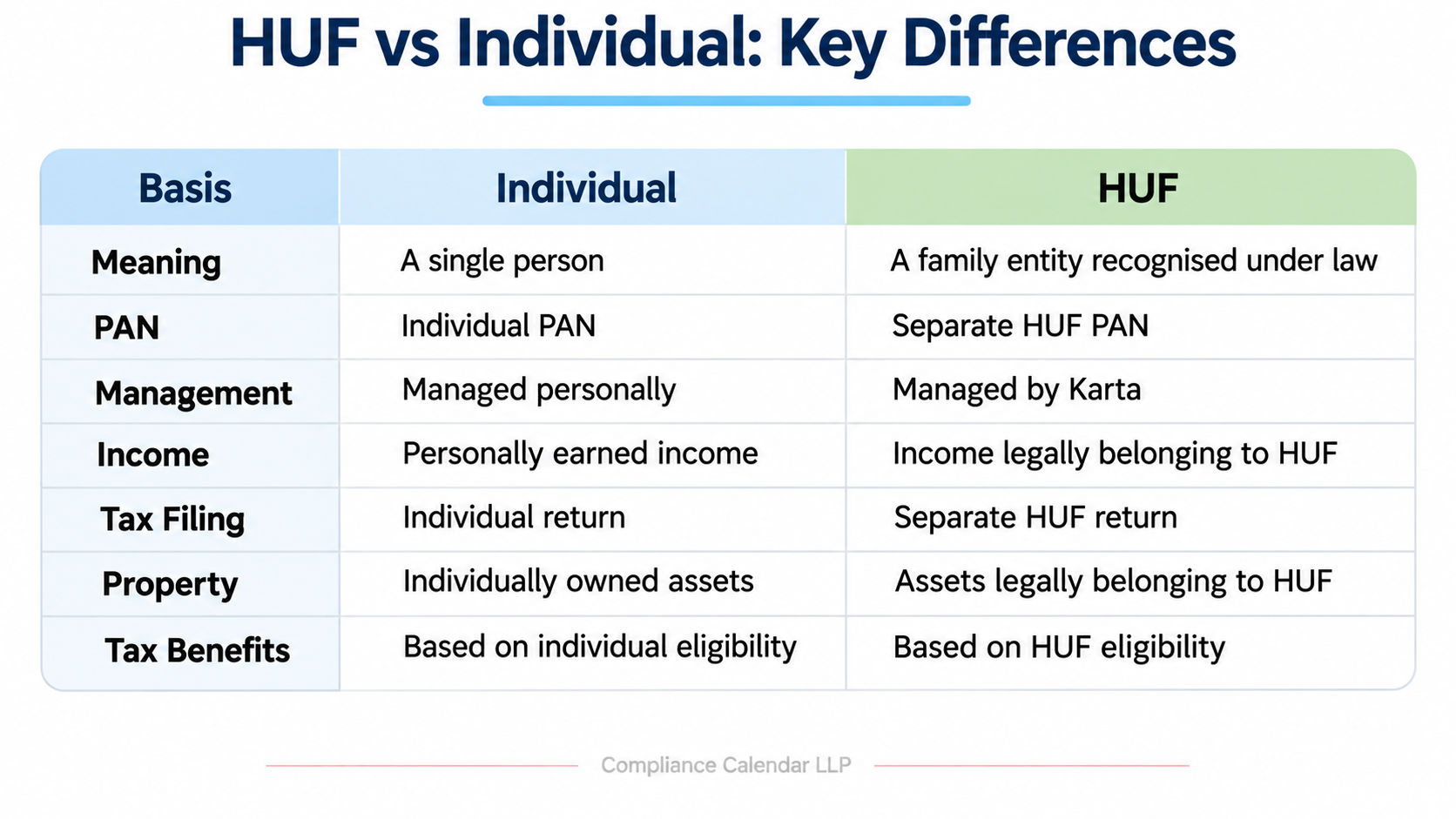
Although an individual and an HUF may both pay income tax, they are treated differently.
|
Basis |
Individual |
HUF |
|---|---|---|
|
Meaning |
A single person |
A family entity recognised under law |
|
PAN |
Individual PAN |
Separate HUF PAN |
|
Management |
Managed personally |
Managed by Karta |
|
Income |
Personally earned income |
Income legally belonging to HUF |
|
Tax Filing |
Individual return |
Separate HUF return |
|
Property |
Individually owned assets |
Assets legally belonging to HUF |
|
Tax Benefits |
Based on individual eligibility |
Based on HUF eligibility |
For example
If Rohan owns a shop personally, its rental income normally belongs to him. If another commercial property legally belongs to his family's HUF, income from that property may be assessed in the HUF's name. The difference depends on the actual ownership and source of income, not merely on the names used in the tax documents.
Can a Daughter Become the Karta of an HUF?
Yes. An eligible woman coparcener can act as the Karta of an HUF. The Hindu Succession (Amendment) Act, 2005 strengthened daughters' rights in coparcenary property. Under the amended Section 6 of the Hindu Succession Act, 1956, daughters have coparcenary rights by birth in the same manner as sons. The Supreme Court also clarified these rights in Vineeta Sharma v. Rakesh Sharma (2020). This means a daughter cannot be denied her coparcenary rights merely because she is female. Her rights are subject to the applicable legal provisions, including rules concerning earlier valid partitions and property transactions.
Can an HUF Be Dissolved or Partitioned?
An HUF may undergo partition when the coparceners divide the relevant joint family property according to the applicable law. Partition may involve distributing property and determining the rights of the family members. However, an informal arrangement among relatives does not necessarily end an HUF for income tax purposes. The tax treatment of HUF partition has specific rules, and partial partitions are subject to important restrictions. Families should obtain professional advice before transferring or distributing valuable property. Property transfers may also involve stamp duty, registration requirements, capital gains issues or other legal consequences.
Common Mistakes to Avoid During HUF Formation
Although HUF documentation may appear simple, misunderstanding the rules can lead to tax problems or property disputes.
|
Common Mistake |
Why It Can Create Problems |
|---|---|
|
Assuming an HUF deed creates the family |
An HUF arises under family law |
|
Transferring personal income to the HUF |
Income clubbing rules may apply |
|
Treating every inherited property as HUF property |
Ownership depends on succession and legal facts |
|
Mixing personal and HUF funds |
Makes income ownership difficult to establish |
|
Ignoring daughters' rights |
May lead to legal disputes |
|
Assuming every HUF gets the individual tax rebate |
Tax rebates have specific eligibility conditions |
|
Failing to maintain records |
Creates difficulties during tax filing and verification |
For example:
If Rajesh transfers his personally owned property to the HUF without adequate consideration, he cannot automatically escape tax on the income generated by that property. Under the applicable clubbing provisions, such income may continue to be taxable in Rajesh's hands. This is why proper legal and tax planning is important before making transfers.
Is HUF Formation Beneficial for Every Family?
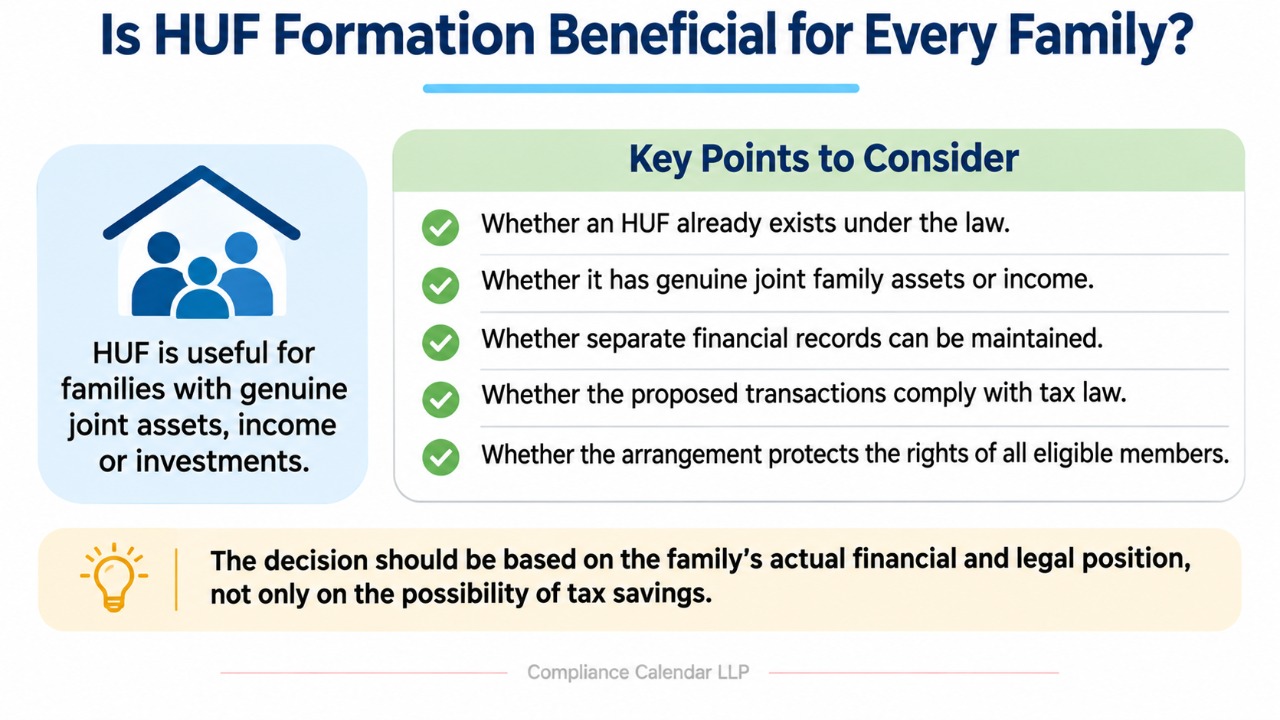
An HUF can be useful where a family has genuine joint family assets, income or investments requiring organised management. However, it may not provide meaningful tax advantages to every household. For example, if a husband and wife only earn salaries and have no HUF assets or income, obtaining an HUF PAN does not automatically reduce their personal tax liability. Before making an HUF arrangement, the family should examine:
-
Whether an HUF already exists under the applicable law.
-
Whether it has genuine joint family assets or income.
-
Whether separate financial records can be maintained.
-
Whether the proposed transactions comply with tax law.
-
Whether the arrangement protects the rights of all eligible members.
The decision should be based on the family's actual financial and legal position rather than only on the possibility of tax savings.
Why Choose Compliance Calendar LLP?
HUF Formation in India is an important legal concept for families who want to manage joint family property, investments and income in an organised manner. An HUF can have a separate PAN card, bank account and income tax assessment, but its existence and ownership rights depend on the applicable family law. Before applying for PAN or opening a bank account, families should understand the role of the Karta, identify genuine HUF assets and maintain proper records. They should also consider the current income tax rules and the rights of all eligible coparceners, including daughters. With proper documentation and professional guidance, an HUF can be a useful arrangement for managing family assets while meeting the applicable legal and tax requirements.
If you are planning to start a political party and need assistance with the registration process, you can contact Compliance Calendar on +91 9988424211 or info@ccoffice.in
Frequently Asked Questions (FAQs)
Q1. What is HUF formation in India?
Ans. HUF formation refers to recognising and documenting a Hindu Undivided Family under the applicable law. An HUF arises through family relationships and may obtain a separate PAN for financial and tax purposes.
Q2. Is HUF registration mandatory in India?
Ans. No. There is no general compulsory government registration required to create an HUF. However, an HUF may need a separate PAN and other documents for taxation, banking and financial transactions.
Q3. Can a husband and wife form an HUF?
Ans. Marriage creates a family relationship, but the legal and tax treatment of an HUF consisting only of spouses can be more complicated. Such an arrangement does not automatically qualify for separate assessment of the couple's personal income.
Q4. Is ancestral property necessary for an HUF?
Ans. An HUF can exist without ancestral property. However, separate income tax assessment requires examining whether there is genuine income or property belonging to the HUF.
Q5. Can a daughter become the Karta of an HUF?
Ans. Yes. An eligible daughter who is a coparcener may act as the Karta. Daughters have equal coparcenary rights under the amended Hindu Succession Act, subject to the applicable legal conditions.
Q6. How can I apply for an HUF PAN card in 2026?
Ans. An Indian HUF can apply for PAN using Form No. 94 through an authorised PAN service provider. The applicant must provide the required Karta affidavit and supporting documents under the Income-tax Rules, 2026.
Q7. Can an HUF run a business in India?
Ans. Yes. An HUF may carry on a business through its Karta, subject to applicable laws, licences and registrations. The income must genuinely belong to the HUF to be assessed in its hands.
Q8. Can I transfer my salary to an HUF to save tax?
Ans. No. Salary earned through personal employment is generally taxable in the employee's hands. Simply transferring the amount to an HUF account does not change its original tax treatment.
Q9. Does an HUF need to file an income tax return every year?
Ans. An HUF must file its income tax return when it meets the applicable filing requirements. Having an HUF PAN alone does not necessarily mean that a return must be filed every year.
Q10. Can an HUF be dissolved?
Ans. An HUF may come to an end through a legally effective complete partition or other applicable circumstances. The treatment of assets and tax liabilities depends on the relevant family and income tax rules.
Article last updated on : 12 Nov 2026.







































































_learn_crop10_thumb.jpg)