



One of our client Mr. Rajesh, a businessman living in Delhi, who earns Rs.12 lakh annually from his business. Apart from his personal earnings, his family also owns an ancestral property that generates Rs.5 lakh in rental income every year. While preparing his income tax return, Rajesh wonders whether the rental income must be included in his personal earnings or whether it can be taxed separately. Like Rajesh, many Indian families own properties, manage investments and earn income through family-owned assets, but they are not always aware of how the income tax rules apply to these arrangements.
This is where HUF Taxation in India becomes important. A Hindu Undivided Family (HUF) is recognised as a separate taxpayer under Indian income tax law, which means it can have its own PAN card, bank account and income tax return. When a family has genuine HUF assets or income, separate taxation may provide certain financial advantages. However, simply opening an HUF bank account or transferring money from a personal account does not automatically create tax benefits. Understanding the ownership of assets, applicable deductions and legal requirements is important before claiming any tax advantage.
In this article, we will explain how HUF taxation works in India, the income tax slabs applicable in 2026, available deductions, tax benefits, clubbing provisions and important rules that families should understand before filing their returns.
What is HUF Taxation in India?
HUF taxation refers to the process of calculating and paying income tax on income that legally belongs to a Hindu Undivided Family. An HUF is recognised under Hindu law and is treated as a separate taxable person under the Income-tax Act. It generally consists of family members connected through a common ancestor, including those who have rights under the applicable personal laws. The family is usually managed by a person called the Karta, who handles its financial affairs and represents the HUF in banking and taxation matters.
The main feature of HUF taxation is that the family's eligible income can be assessed separately from the personal income of its members. For example, if a family owns ancestral property that legally belongs to its HUF, the rent received from that property may be taxed in the HUF's name. Meanwhile, any salary or professional income earned personally by a family member continues to be assessed in that individual's name. This separation makes it possible to manage genuine family income independently, but it must be supported by proper ownership records and compliance with income tax rules.
How Does HUF Taxation Work in India?
The working of HUF taxation is based on a simple principle: income belonging to an HUF is taxed in the hands of the HUF, while personal income is generally taxed in the hands of the individual who earns it. Since both are treated as separate taxpayers, their tax liabilities are calculated independently according to the applicable provisions. However, this separation depends on the real source of the income rather than merely the name appearing on a bank account or financial document.
Consider Amit, who works in a private company and earns Rs.10 lakh annually. His family also owns a residential property that legally belongs to its HUF and generates Rs.4 lakh in annual rent. Amit's salary will generally be included in his individual income tax return, while the rental income may be reported in the HUF's return after applying the relevant house property provisions. The situation would be different if Amit personally owned the property and simply deposited the rent into the HUF account, because moving money between accounts does not automatically change the person liable to pay tax.
Who is Eligible for HUF Tax Benefits?
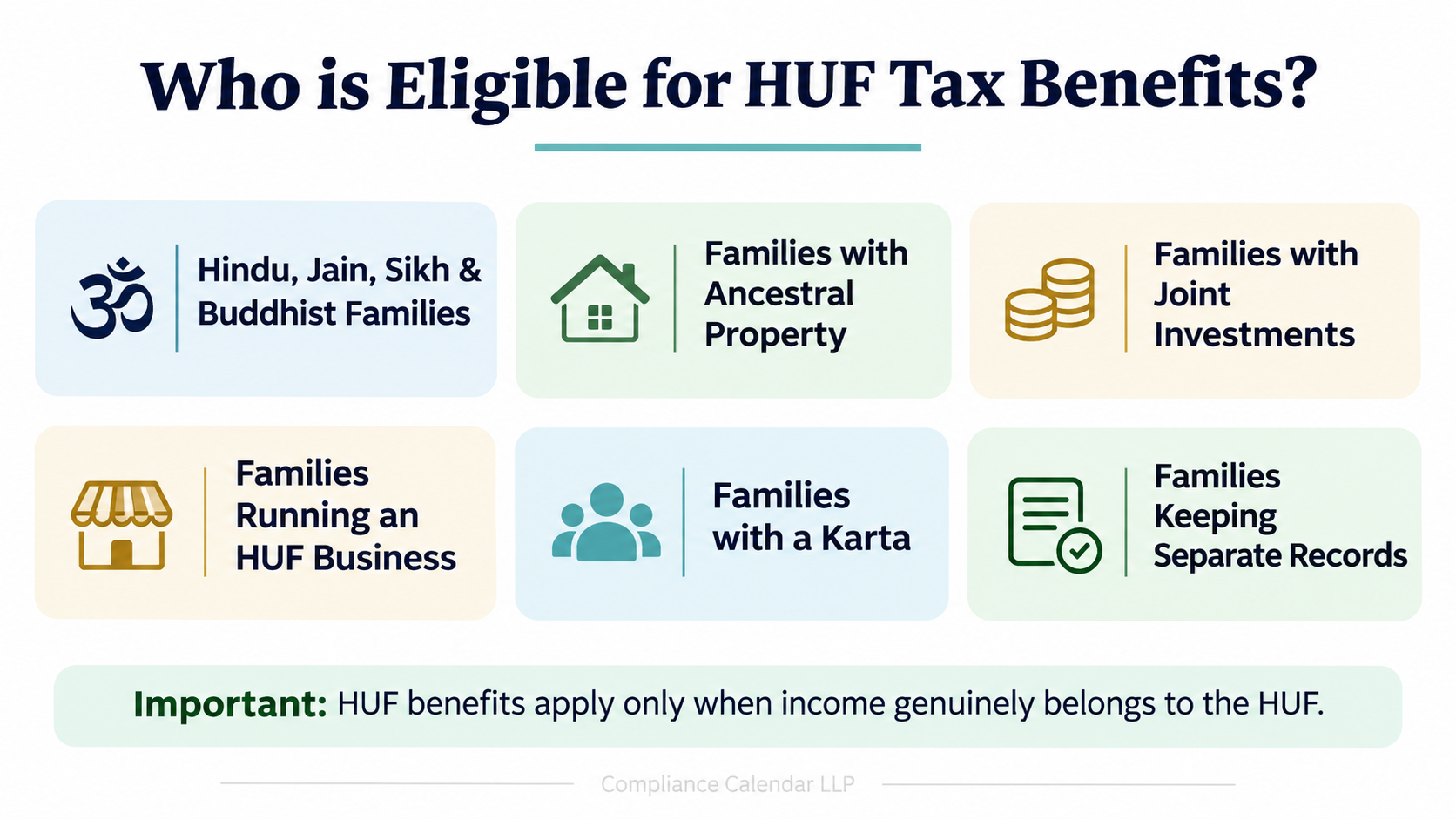
A Hindu Undivided Family (HUF) can enjoy certain tax benefits under Indian income tax law. However, not every family can claim these benefits simply by obtaining an HUF PAN card. The family must meet certain legal requirements, and the income should genuinely belong to the HUF. The following points explain who can claim HUF tax benefits in India.
Hindu, Jain, Sikh and Buddhist Families
HUF tax benefits are available to families recognised as Hindu Undivided Families under the applicable law. Hindu families, along with eligible Jain, Sikh and Buddhist families, can be recognised as HUFs for income tax purposes.
Families with Ancestral Property
Families owning ancestral property that legally belongs to an HUF may claim applicable tax benefits. For example, if a family owns an ancestral house and earns rental income from it, that income may be taxed separately in the HUF's name, subject to the relevant tax rules.
Families with Joint Investments
An HUF can invest its own funds in fixed deposits, mutual funds and other permitted investments. The income earned from these investments may be taxable in the HUF's hands, provided the funds genuinely belong to the HUF and the applicable clubbing rules do not apply.
Families Running an HUF Business
If a family operates a business that genuinely belongs to its HUF, the business income may be taxed separately. For example, a family running a trading business using HUF funds may report eligible profits in the HUF's income tax return.
Families with a Karta
An HUF is generally managed by a Karta, who looks after its property, financial transactions and tax-related responsibilities. An eligible woman coparcener can also become the Karta. The Karta manages the HUF on behalf of its members but does not personally own all its assets.
Families Maintaining Separate Financial Records
To claim tax benefits correctly, an HUF should maintain proper records of its income, investments, property and expenses. Having a separate PAN card and bank account helps distinguish HUF transactions from the personal financial activities of family members.
Families Eligible for Tax Deductions
An HUF may claim deductions for qualifying investments, health insurance premiums and other eligible expenses under the applicable tax regime. However, these deductions depend on the legal conditions and whether the HUF follows the old or new tax regime.
Important Note: An HUF does not necessarily need ancestral property to exist, but it must have genuine income or eligible transactions to receive a practical tax benefit. Personal salary, professional income or individually owned property income cannot automatically be treated as HUF income merely to save tax.
To understand the process of creating an HUF, including eligibility, required documents, PAN application and legal requirements, read our detailed guide on HUF Formation in India.
What Types of Income Are Taxable Under HUF?
An HUF may earn income from different sources, including property, investments, business activities and the sale of capital assets. The nature of the income determines which tax provisions apply, while ownership determines whether the income should be assessed in the HUF's hands. A family should therefore identify the source of every receipt before including it in the HUF's income tax return, particularly when personal and joint family assets are managed by the same person.
Rental income from residential or commercial property legally owned by an HUF may be taxed under the head Income from House Property, subject to the relevant deductions and adjustments. An HUF may also receive interest from fixed deposits, dividends or returns from investments made using genuine HUF funds. Where a business is genuinely owned and carried on by the HUF through its Karta, the business profits may be assessed as HUF income. Similarly, capital gains arising from the sale of property, shares or other assets belonging to the HUF may be taxable according to the applicable capital gains provisions.
HUF Income Tax Slabs for 2026–27
The Income-tax Act, 2025 came into force on 1 April 2026 and continues to recognise an HUF as a separate taxpayer. Under the new tax regime, which is generally the default regime, tax is calculated using progressive income slabs. This means the tax rate increases as taxable income moves into higher slabs, rather than applying the highest rate to the entire income. The following rates apply to ordinary taxable income under the new regime for tax year 2026–27.
|
Total Taxable Income |
Tax Rate |
|---|---|
|
Up to Rs.4,00,000 |
Nil |
|
Rs.4,00,001 to Rs.8,00,000 |
5% |
|
Rs.8,00,001 to Rs.12,00,000 |
10% |
|
Rs.12,00,001 to Rs.16,00,000 |
15% |
|
Rs.16,00,001 to Rs.20,00,000 |
20% |
|
Rs.20,00,001 to Rs.24,00,000 |
25% |
|
Above Rs.24,00,000 |
30% |
A Health and Education Cess of 4% is generally added to the calculated income tax and surcharge, where applicable. Families should also remember that the rebate available to eligible resident individuals with taxable income up to Rs.12 lakh under the new tax regime does not extend to HUFs. Therefore, an HUF should not assume that it will have zero tax liability merely because its taxable income falls below Rs.12 lakh. Income taxable at special rates, such as certain capital gains, may also require a separate calculation.
Old vs New Tax Regime for HUF
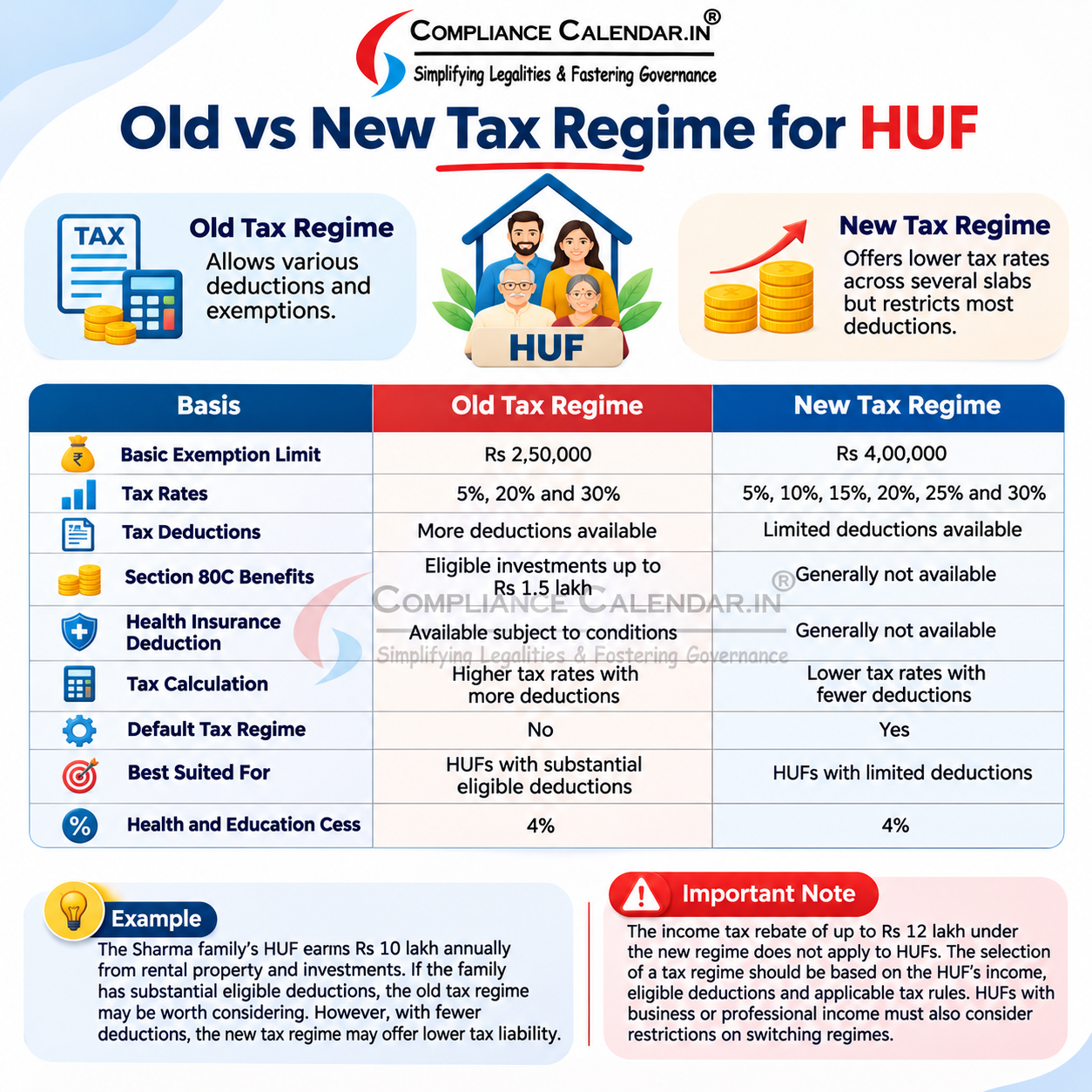
A Hindu Undivided Family (HUF) can choose between the old and new tax regimes depending on its total income, investments and eligible deductions. The old tax regime allows families to claim various deductions and exemptions, while the new tax regime offers lower tax rates across several income slabs but restricts most deductions. From 1 April 2026, the new tax regime is the default for HUFs under the Income-tax Act, 2025.
|
Basis |
Old Tax Regime |
New Tax Regime |
|---|---|---|
|
Basic Exemption Limit |
Rs 2,50,000 |
Rs 4,00,000 |
|
Tax Rates |
5%, 20% and 30% |
5%, 10%, 15%, 20%, 25% and 30% |
|
Tax Deductions |
More deductions available |
Limited deductions available |
|
Section 80C Benefits |
Eligible investments up to Rs 1.5 lakh |
Generally not available |
|
Health Insurance Deduction |
Available subject to conditions |
Generally not available |
|
Tax Calculation |
Higher tax rates with more deductions |
Lower tax rates with fewer deductions |
|
Default Tax Regime |
No |
Yes |
|
Best Suited For |
HUFs with substantial eligible deductions |
HUFs with limited deductions |
|
Health and Education Cess |
4% |
4% |
For example, suppose the Sharma family's HUF earns Rs 10 lakh annually from rental property and investments. If the family has substantial eligible deductions, the old tax regime may be worth considering. However, if the HUF has fewer deductions, the new tax regime may offer lower tax liability because of its revised income tax slabs.
Important Note: The income tax rebate available to eligible resident individuals with taxable income up to Rs. 12 lakh under the new regime does not apply to HUFs. The selection of a tax regime should be based on the HUF's actual income, eligible deductions and applicable tax rules. HUFs with business or professional income must also consider restrictions on switching regimes.
What Are the Major Tax Benefits of HUF in India?
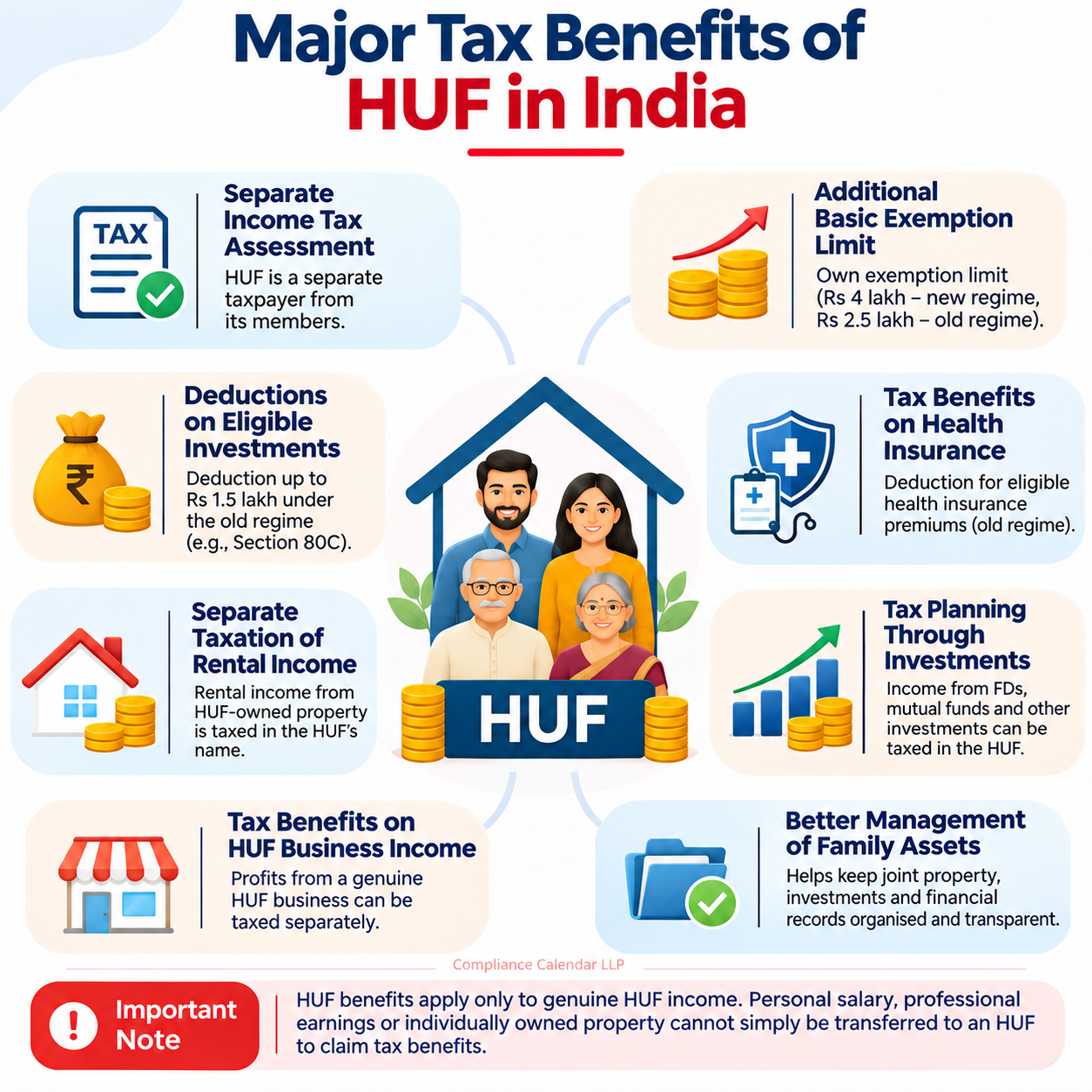
A Hindu Undivided Family (HUF) can offer several tax benefits to families who own joint property, make investments or run a family business. Since an HUF is treated as a separate taxpayer under Indian income tax law, it can calculate its income and pay taxes independently of its members. However, these benefits depend on the source of income, ownership of assets and applicable tax rules. Some of the major HUF tax benefits are explained below.
Separate Income Tax Assessment
One of the biggest advantages of an HUF is that it is treated as a separate taxpayer. This means income legally belonging to the HUF is calculated separately from the personal income of its family members. For example, if Rajesh earns Rs 12 lakh annually from his job and his family's HUF receives Rs 4 lakh as rent from its own property, both incomes may be assessed separately. This can help families manage their tax liabilities more effectively.
Additional Basic Exemption Limit
An HUF has its own basic income tax exemption limit, separate from its members. Under the new tax regime applicable for tax year 2026–27, ordinary taxable income up to Rs 4 lakh falls within the nil-rate slab. Under the old regime, the basic exemption limit is Rs 2.5 lakh. This can be beneficial when the HUF genuinely earns income from family property or investments.
Deductions on Eligible Investments
An HUF choosing the old tax regime may claim deductions for certain qualifying investments and payments. For example, eligible investments under the provisions corresponding to the earlier Section 80C may provide deductions up to Rs 1.5 lakh, subject to the prescribed conditions. These deductions can help reduce the HUF's taxable income when the investments are made in accordance with the applicable tax rules.
Tax Benefits on Health Insurance
An HUF may claim deductions for eligible health insurance premiums paid for its members under the old tax regime. For example, if the Sharma family's HUF pays health insurance premiums for eligible family members, it may claim the applicable deduction, subject to statutory limits. This benefit can help families manage healthcare expenses while reducing taxable income.
Separate Taxation of Rental Income
If an HUF owns residential or commercial property, the rental income earned from that property may be taxed separately in the HUF's hands. For example, suppose a family owns an ancestral house that legally belongs to its HUF and earns Rs 30,000 per month in rent. The rental income may be reported in the HUF's income tax return after considering the applicable deductions and adjustments.
Tax Planning Through Family Investments
An HUF can invest its genuine funds in fixed deposits, mutual funds and other permitted investment options. The interest, dividends or capital gains arising from these investments may be assessed in the HUF's hands, subject to applicable tax provisions. This allows families to maintain separate investment records and plan their finances without mixing personal and HUF income.
Tax Benefits on HUF Business Income:
An HUF can carry on business activities through its Karta, subject to applicable legal requirements. If the business genuinely belongs to the HUF, its profits may be taxed separately from the personal earnings of family members. For example, if a family operates a trading business using HUF funds, the income generated from that business may be assessed in the HUF's name.
Better Management of Family Assets
Apart from tax savings, an HUF helps families organise their joint property, investments and financial records. Maintaining a separate PAN card, bank account and income tax return makes it easier to identify income belonging to the HUF. This can also help families maintain transparency in financial matters and reduce confusion between personal and jointly owned assets.
Important Note: HUF taxation does not automatically reduce the tax liability of every family. Personal salary, professional earnings and individually owned property income cannot simply be transferred to an HUF to claim tax benefits. Certain transfers may attract clubbing of income provisions. Families should ensure that the income genuinely belongs to the HUF and that all deductions and exemptions are claimed according to the applicable tax rules.
Deductions Available to HUF Under Income Tax Law
Deductions can reduce taxable income when the HUF qualifies under the relevant statutory provisions. Their availability depends on the selected tax regime, the nature of the expenditure and the conditions attached to each deduction. Under the old regime, certain qualifying investments, insurance premiums, medical expenses and donations may be eligible for deductions. The commonly recognised deduction categories are explained below using their familiar references under the earlier Income-tax Act, 1961, with the corresponding provisions under the Income-tax Act, 2025 applying for the relevant tax year.
|
Deduction Category |
Tax Benefit and Conditions |
|---|---|
|
Section 80C |
Up to Rs.1.5 lakh for qualifying investments and payments |
|
Section 80D |
Deduction for eligible health insurance premiums and certain medical expenses |
|
Section 80DD |
Deduction for qualifying expenditure relating to a dependent member with a disability |
|
Section 80DDB |
Deduction for qualifying treatment expenses for specified diseases |
|
Section 80G |
Deduction for eligible donations to approved institutions |
For example, suppose an HUF pays a qualifying health insurance premium for its members and chooses the old tax regime. It may be able to claim the appropriate deduction, subject to the applicable limits and conditions. On the other hand, many of these deductions are not available under the new tax regime, which is why comparing both regimes is important. Families should also avoid assuming that every investment made by the Karta qualifies as an HUF deduction, because the payment must satisfy the legal requirements applicable to the HUF itself.
How to Calculate HUF Income Tax: Practical Example
Understanding HUF taxation becomes easier when we calculate tax using a practical example. Suppose the Mehta family's HUF receives income from rental property and fixed deposit interest, and its total taxable income after the applicable adjustments is Rs.8 lakh. The family chooses the new tax regime for tax year 2026–27. Since the new regime follows progressive tax slabs, the first Rs.4 lakh is not taxed, while the next Rs.4 lakh is taxed at 5%. The calculation below shows how the final liability is determined.
|
Income Slab |
Tax Calculation |
Tax Amount |
|---|---|---|
|
First Rs.4,00,000 |
Nil |
Rs.0 |
|
Next Rs.4,00,000 |
5% of Rs.4,00,000 |
Rs.20,000 |
|
Total Income Tax |
- |
Rs.20,000 |
|
Health and Education Cess |
4% of Rs.20,000 |
Rs.800 |
|
Total Tax Payable |
- |
Rs.20,800 |
This example assumes that the HUF earns only ordinary taxable income and that no surcharge, special-rate tax or other adjustment applies. The calculation also demonstrates why families should not confuse the tax treatment of an HUF with the rebate available to eligible individuals. Although the new regime provides a higher nil-rate slab, an HUF with taxable income of Rs.8 lakh generally has a tax liability under the illustrated conditions.
Clubbing of Income Rules for HUF
One of the biggest misunderstandings about HUF taxation is that a person can transfer personal property into an HUF and immediately stop paying tax on the income it generates. Indian income tax law contains clubbing provisions that prevent certain arrangements from being used to shift taxable income artificially. These provisions are particularly important when a family member transfers individually owned assets to an HUF without receiving adequate consideration.
Consider Rajesh, who personally owns a commercial property generating Rs.4 lakh in annual rent. He decides to transfer the property to his family's HUF without adequate consideration because he believes the rental income will then be taxed separately. However, the applicable clubbing provisions may require that income to continue being included in Rajesh's individual taxable income. This is why families should examine property ownership, the nature of any transfer and the relevant tax rules before making financial decisions.
How to File an HUF Income Tax Return?
An HUF is required to file an income tax return when it meets the applicable filing conditions. The process is similar to individual income tax filing, but the return is submitted using the separate PAN of the HUF. The Karta generally manages the filing process and should collect details of rental income, business profits, investment returns, capital gains and eligible deductions before calculating the final taxable income.
The appropriate income tax return form depends on the income earned by the HUF. For example, an HUF with eligible non-business income may use a different return form from an HUF carrying on business activities. After calculating its income, the HUF should compare the applicable tax regimes, complete the relevant return on the Income Tax e-Filing Portal and verify the submission within the prescribed period. Maintaining separate bank statements, property records and investment documents helps make this process easier and reduces the possibility of errors.
To understand the legal requirements for managing an HUF, including PAN registration, income tax return filing and Karta responsibilities, read our detailed guide on HUF Compliance in India.
Common HUF Taxation Mistakes to Avoid
Although an HUF can be useful for managing family income, incorrect assumptions about taxation may create unnecessary problems. One common mistake is treating personal salary or professional earnings as HUF income simply because the individual is the Karta. Another is transferring personally owned property into an HUF without understanding the clubbing provisions. Such transactions may not produce the expected tax benefit and can create complications when the taxpayer files returns or responds to departmental enquiries.
Families also sometimes claim deductions without checking whether they are permitted under the chosen regime. Other mistakes include mixing individual and HUF bank transactions, failing to maintain investment records and assuming that every inherited property automatically belongs to an HUF. In addition, the Rs.12 lakh rebate available to eligible resident individuals under the new tax regime should not be treated as an HUF benefit. Proper documentation and an annual review of the applicable provisions can help families avoid these errors.
Is HUF Taxation Beneficial for Every Family?
HUF taxation can be beneficial where a family already has genuine joint family assets, income-producing property or investments that legally belong to the HUF. It may help keep family finances separate, provide an organised way to manage assets and offer tax advantages where the statutory conditions are satisfied. For families receiving regular income from eligible joint family property, separate taxation may be worth examining as part of their overall financial planning.
However, an HUF is not necessarily useful for every household. If family members earn only personal salaries and do not have genuine HUF income or assets, obtaining a separate PAN may not reduce their tax liability. Before claiming any advantage, families should determine whether the HUF has legitimate income, compare both tax regimes and consider the cost of maintaining separate records and returns. A sensible decision should be based on the family's actual financial position rather than the assumption that an HUF always saves tax.
Why Choose Compliance Calendar LLP?
HUF Taxation in India provides a separate system of income tax assessment for eligible joint families, allowing genuine HUF income to be managed independently from the personal income of its members. Families may benefit from separate taxation, applicable deductions and organised management of assets, particularly where they own ancestral or other legally recognised HUF property. However, the benefits depend on the source of income, ownership of assets and compliance with the applicable income tax provisions.
The Income-tax Act, 2025 and the tax rules applicable in 2026 make it important for families to understand the current tax slabs, available deductions, clubbing provisions and filing requirements. Instead of treating an HUF as a quick tax-saving arrangement, families should focus on maintaining genuine financial records and following the correct legal procedures. With suitable planning and professional guidance when required, an HUF can provide an organised way to manage joint family income while meeting its tax responsibilities.
If you are planning to start a political party and need assistance with the registration process, you can contact Compliance Calendar on +91 9988424211 or info@ccoffice.in
Frequently Asked Questions (FAQs)
Q1. What is HUF taxation in India?
Ans. HUF taxation means calculating and paying income tax on income legally belonging to a Hindu Undivided Family. An HUF is treated as a separate taxpayer and may have its own PAN, financial records and income tax return.
Q2. What is the basic income tax exemption limit for HUF in 2026?
Ans. Under the new tax regime applicable to tax year 2026–27, ordinary taxable income up to ?4 lakh falls within the nil-rate slab. Income above this amount is taxed according to the applicable progressive rates.
Q3. Can an HUF claim the ?12 lakh income tax rebate?
Ans.No. The rebate available to eligible resident individuals under the new tax regime does not extend to HUFs. An HUF must calculate its tax liability using the applicable slabs and other relevant provisions.
Q4. Can an HUF claim deductions under Section 80C?
Ans. An HUF may claim qualifying deductions traditionally covered under Section 80C when using the old tax regime, subject to applicable conditions. Corresponding provisions under the Income-tax Act, 2025 apply for the relevant tax year.
Q5. Is rental income taxable under an HUF?
Ans. Yes, rental income from property legally owned by an HUF is generally taxable in the HUF's hands. The applicable house property deductions and adjustments must be considered while calculating taxable income.
Q6. Can salary income be transferred to an HUF to save tax?
Ans. Personal salary remains taxable in the hands of the employee who earns it. Simply depositing salary into an HUF bank account does not change the original tax treatment of that income.
Q7. Which income tax regime is better for an HUF?
Ans. The better tax regime depends on the HUF's total income, eligible deductions and applicable conditions. Families should calculate tax under both regimes before selecting the one that is legally available and financially suitable.
Q8. Is filing an income tax return mandatory for every HUF?
Ans. An HUF must file an income tax return when it meets the applicable statutory filing requirements. Merely obtaining an HUF PAN card does not necessarily make annual filing compulsory.
Q9. Can an HUF claim deductions for health insurance?
Ans. An HUF may claim eligible health insurance deductions under the old tax regime, subject to the prescribed limits and conditions. Such deductions are generally unavailable under the new tax regime.
Q10. What happens when personal property is transferred to an HUF?
Ans. If a family member transfers personal property to an HUF without adequate consideration, the applicable clubbing provisions may require the income to remain taxable in the transferor's hands. The tax treatment depends on the circumstances and legal requirements.
Q11. Can an HUF earn capital gains?
Ans. Yes, an HUF may earn capital gains when it sells property, shares or other capital assets legally belonging to it. The gains are taxed according to the applicable capital gains provisions and asset classification.
Q12. Is HUF taxation beneficial for every family?
Ans. No, HUF taxation is generally more relevant to families with genuine HUF assets or income. Its financial benefits depend on ownership, tax liability, eligible deductions and compliance with applicable law.
Article last updated on : 12 Nov 2026.









































































_learn_crop10_thumb.jpg)