


A lending startup finds a Non-Banking Financial Company (NBFC) whose owners are willing to sell. The company has an RBI Certificate of Registration, an existing loan portfolio and an experienced collections team. At first, the acquisition looks like a quick way to enter the lending market. During due diligence, however, the buyer discovers that a bank facility requires consent before a change of control and that several large loans have been restructured more than once. Both findings affect the price, the closing date and the protections the buyer needs in the agreement.
Buying an existing NBFC generally means acquiring shares or control of the company that holds the RBI Certificate of Registration. In a share purchase, the same company continues to own its assets and remains responsible for liabilities that arose before the acquisition. A buyer should therefore verify the registration, examine the loan book and financial position, and identify the necessary approvals before committing to the deal.
Buyers who need support with due diligence, regulatory approval and closing can explore our NBFC Acquisition and Takeover service.
Decide what you want to acquire
You can buy all the shares, acquire a controlling stake, take a minority position or subscribe to newly issued shares. In a purchase of existing shares, the consideration generally goes to the selling shareholders. In a fresh issue, the subscription proceeds go to the NBFC and can strengthen its capital position or fund its operations. A transaction can combine the two if the sellers want a partial exit and the company also needs fresh capital.
|
Acquisition structure |
What the buyer should examine |
|
Purchase of 100% of the shares |
The company’s existing liabilities, contracts, regulatory history and the terms of the seller’s exit |
|
Purchase of a controlling stake |
Board composition, voting rights and the rights of shareholders who remain invested |
|
Minority investment |
Whether the stake or any negotiated board, voting or management rights trigger prior RBI approval |
|
Fresh issue of shares |
Post-issue ownership, dilution, use of funds and whether the allotment triggers approval |
|
Purchase of a loan portfolio |
Applicable loan transfer rules and responsibility for servicing, collections and borrower records |
The NBFC’s registration category should match the business you intend to operate. If your plan is to lend, verify that the target’s category and registration conditions support the proposed activity. Specialised entities such as NBFC-P2P platforms and Account Aggregators operate under category-specific rules. A buyer interested only in a portfolio of loans should assess the rules governing the transfer of loan exposures separately.
For a closer look at how shareholding, control rights and board changes affect the transaction, read our guide to RBI Approval for NBFC Takeover.
Verify the RBI registration and financial position
Ask for the target’s RBI Certificate of Registration (CoR) and check it against the company’s current name, registered office, regulatory category and RBI correspondence. Confirm whether it is a deposit-taking or non-deposit-taking NBFC and whether the RBI has imposed any restrictions or conditions affecting its activities. If the seller describes the company as inactive or says it has a clean compliance history, review its audited accounts, regulatory returns and correspondence to verify that position.
Calculate the target’s Net Owned Funds (NOF) under the rules applicable to its category. The paid-up share capital shown in the balance sheet does not, by itself, establish the NOF position. Review whether the company meets its current requirement, whether a transition deadline applies and whether additional provisions or write-offs could reduce its capital. If the NBFC needs a capital infusion after closing, include that amount in the acquisition budget alongside the purchase price.
Conduct financial, legal and operational due diligence
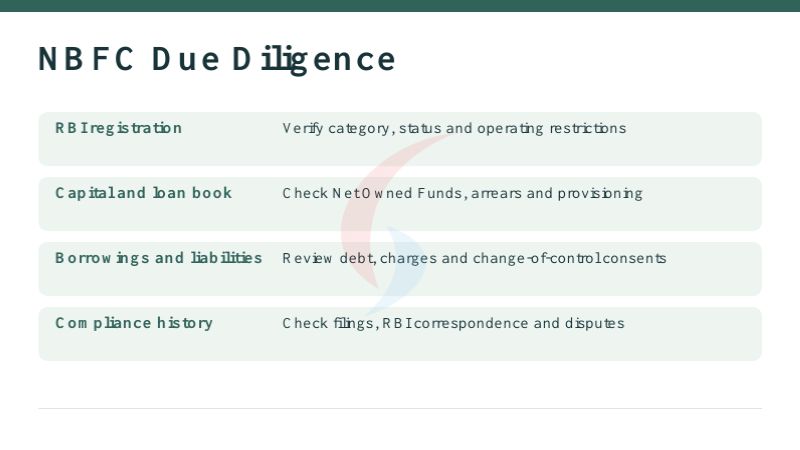
Due diligence should help you answer three questions. How much of the loan book is likely to be recovered? What liabilities will stay with the company? Can the incoming team keep the business running from the first day after closing? Compare the audited financial statements with loan-level data, bank records and regulatory submissions. Where the numbers differ, ask for the reconciliation and the supporting records.
|
Due diligence area |
What to review |
|
Loan portfolio |
Outstanding balances, overdue loans, restructurings, provisioning, write-offs and borrower concentration |
|
Borrowings and security |
Bank facilities, guarantees, charges, financial covenants and change-of-control consent clauses |
|
Regulatory compliance |
RBI correspondence, returns, audit observations, complaints and pending corrective actions |
|
Corporate records |
Share ownership, pledges, shareholder rights, board minutes and pending corporate filings |
|
Tax and litigation |
Tax assessments, disputed demands, recovery proceedings and contingent liabilities |
|
Technology and outsourcing |
Loan management systems, access to borrower data, vendor agreements and collections arrangements |
Suppose a seller values the company partly on a Rs 12 crore loan book. The buyer’s review shows that several large borrowers are connected and that some accounts have received repeated extensions. The buyer can use those findings to revise its recovery estimates, adjust the price or negotiate protection for specific exposures. The reported loan balance is only one input. Expected recoveries and the cost of collecting them determine what that portfolio is worth to the buyer.
Check whether prior RBI approval is required
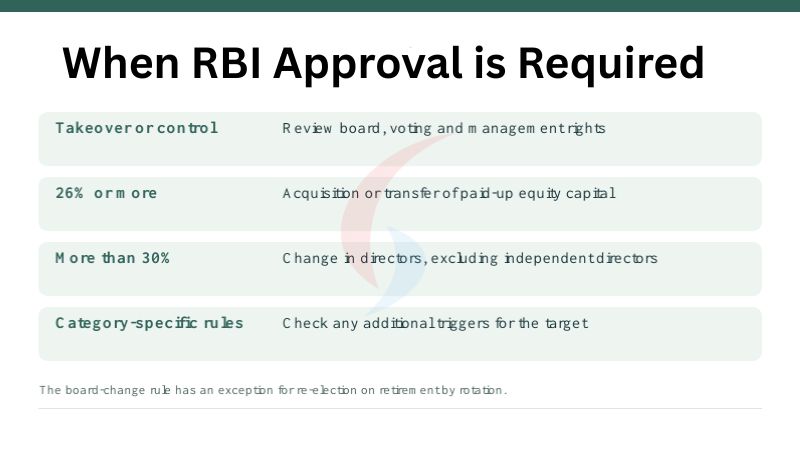
For NBFCs covered by the relevant provisions of the RBI NBFC Acquisition of Shareholding or Control Directions, 2025, prior written RBI approval is required for a takeover or acquisition of control. It is also required where a change in shareholding, including progressive increases over time, results in the acquisition or transfer of 26% or more of the NBFC’s paid-up equity capital.
The applicable RBI NBFC Governance Directions, 2025 separately address changes in directors and management. One acquisition can trigger approval under both sets of directions.
|
Proposed transaction |
What to check |
|
Takeover or acquisition of control |
Prior written RBI approval applies whether or not management changes. |
|
Acquisition or transfer of 26% or more of paid-up equity capital |
Prior approval is required. Include progressive increases when reviewing the transaction. |
|
Change in more than 30% of directors |
Check prior approval under the applicable Governance Directions. Independent directors are excluded from the calculation, and re-election on retirement by rotation is subject to an exception. |
|
Foreign investor transaction involving a housing finance company that accepts or holds public deposits |
A separate 10% threshold can apply to an acquisition or transfer by or to a foreign investor. |
|
Investment in a specialised NBFC |
Review the category-specific directions for additional approval triggers. |
A minority investment can also amount to an acquisition of control. For example, an investor acquiring 24% may receive the right to appoint a majority of the directors. That right can trigger prior approval even though the stake falls below 26%. Read the share purchase agreement, shareholders’ agreement, articles and side agreements together. For a staged transaction, check when shares, voting rights and management rights will change at each stage.
Negotiate the price and set the conditions for closing
The price should reflect the quality of the loan book, the NBFC’s net assets, its capital position, liabilities and the cost of addressing compliance gaps. Work out the total cash requirement before agreeing on the deal. An acquisition can involve payments to the seller, a capital infusion into the company, transaction costs and working capital to support the business after handover.
The Share Purchase Agreement (SPA) should set out what must happen before closing. Depending on the transaction, that can include prior RBI approval, completion of the public notice period, lender consents, release of pledged shares and delivery of updated financial records. Buyers can also negotiate warranties and indemnities covering historical tax claims, identified regulatory breaches or particular loan exposures. An indemnity may give the buyer a claim against the seller, while the NBFC may still have to deal with the underlying liability.
Pay close attention to the period between signing and closing. The seller may agree to seek consent before issuing shares or selling major assets. Any interim rights that let the buyer direct management or policy should be reviewed for their effect on control before they become exercisable.
Submit the acquisition application through RBI PRAVAAH
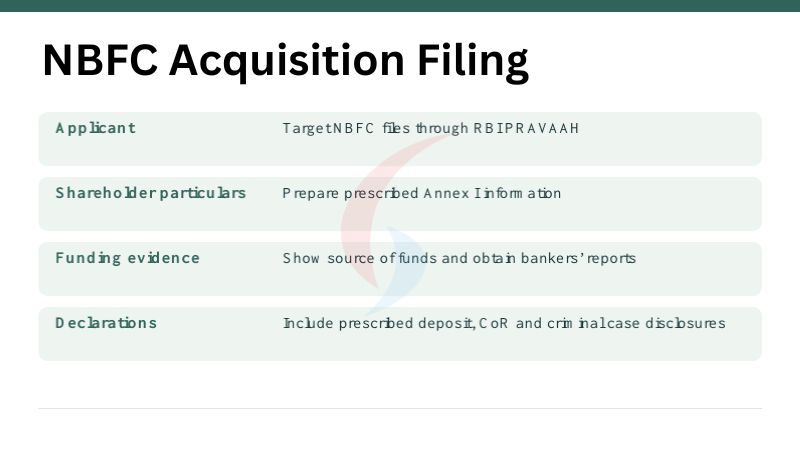
Under Paragraph 7 of the Acquisition Directions, the target NBFC submits the prior approval application on its company letterhead through PRAVAAH. The proposed shareholders provide their particulars and supporting information. Where the transaction also requires approval for a management change, the NBFC should check the corresponding PRAVAAH process and ensure both submissions describe the same proposed board and closing sequence.
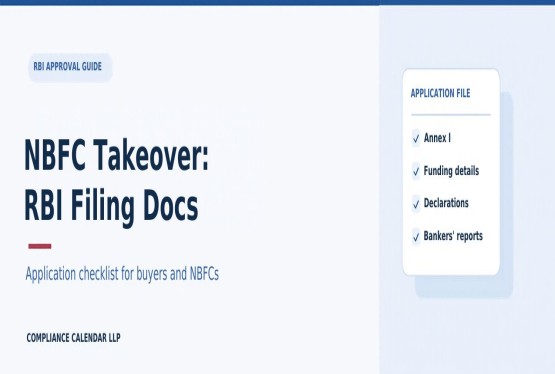
The acquisition filing generally includes the following:
-
Proposed shareholder information in the prescribed Annex I.
-
Details of the source of funds for acquiring the shares.
-
Prescribed declarations concerning association with unincorporated bodies accepting public deposits and companies whose RBI Certificate of Registration applications were rejected.
-
The prescribed declaration concerning criminal cases, including cases under Section 138 of the Negotiable Instruments Act, 1881.
-
Bankers’ reports on the proposed shareholders.
Keep the pre- and post-acquisition shareholding tables, ownership chart, draft transaction documents and evidence supporting the funding arrangements ready for the portal checklist or any RBI query. If a parent company will fund the buyer, explain how the money will reach the proposed shareholder. The figures in the application, funding documents and transaction agreements should reconcile.
The RBI’s Citizen’s Charter lists 90 days for approval of a change in shareholding or control of an NBFC. Use that as a planning reference and allow time for clarification requests, approval conditions and the applicable public notice period. If the parties change the buyer, funding source, stake or control rights during review, assess whether the filing needs to be updated before closing.
Before submitting the PRAVAAH application, review the Documents Required for RBI Approval of an NBFC Takeover.
Publish the public notice where required
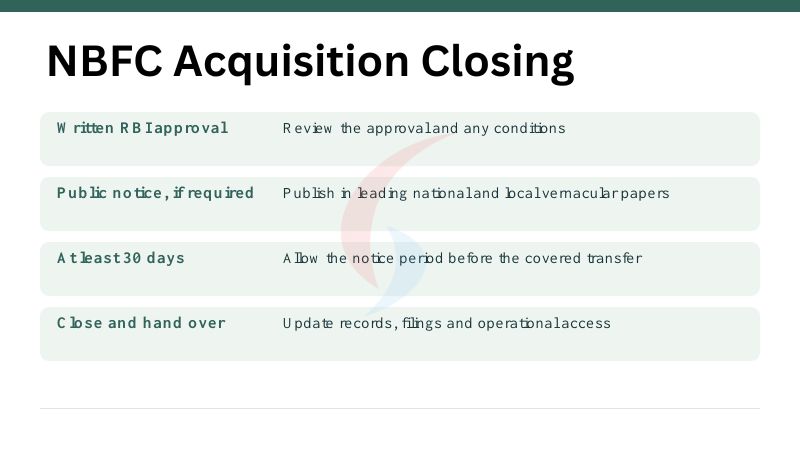
Under Paragraphs 8 to 10 of the Acquisition Directions, the parties must publish the applicable notice after obtaining prior RBI permission and at least 30 days before the covered transfer of ownership by sale of shares or transfer of control. The notice must appear in at least one leading national newspaper and one leading local vernacular newspaper covering the place of the NBFC’s registered office.
The notice should state the intention to transfer ownership or control, give the transferee’s particulars and explain the reasons for the transaction. The NBFC and the transferee may publish jointly or issue notices as prescribed. Keep copies of both publications and confirm when the notice period ends before effecting the transfer. Review the notice requirement separately from the approval requirement, particularly for an HFC transaction that may fall within a specific exception.
Complete the acquisition and hand over operations
At closing, check that the final transaction matches the structure the RBI approved. Verify the buyer, number of shares, consideration and timing of any board changes. Complete the transfer or allotment as applicable, update the corporate records and make the necessary filings or intimations. If a foreign investor is involved, check the applicable FEMA entry, pricing and reporting requirements, along with any restrictions concerning investment from or through jurisdictions identified by the Financial Action Task Force (FATF).
Plan the operational handover before the seller exits. The incoming team should know who can operate bank accounts, where borrower records are stored, how collections are recorded and which regulatory reports are due next. Assign responsibility for unresolved complaints, audit findings and pending lender consents. A missed handover can disrupt loan servicing even when the share transfer has been completed correctly.
Common mistakes when buying an existing NBFC
-
Pricing the deal mainly on the RBI registration: Assess the category, loan quality, liabilities and capital needs before agreeing on the price.
-
Checking only the 26% shareholding threshold: Review control rights, staged acquisitions and proposed management changes.
-
Overlooking consents in commercial agreements: Bank facilities and vendor contracts may impose their own change-of-control requirements.
-
Paying the full price before the closing conditions are met: Agree on payment timing and what happens to any deposit or escrow amount if the deal cannot proceed.
-
Setting a closing date without allowing for notice: Where publication is required, build the full 30-day notice period into the timetable after prior RBI approval.
Why Choose Compliance Calendar LLP?
Buying an existing NBFC in India starts with verifying that its RBI registration covers the business you intend to run. Review the loan book, liabilities, capital position and lender contracts before agreeing on a price. Use those findings to set the closing conditions, obtain prior RBI approval through PRAVAAH where required and complete the applicable public notice period before taking ownership or control.
Compliance Calendar LLP can assist with NBFC due diligence, the PRAVAAH application, public notice requirements and closing compliance. For assistance, email info@ccoffice.in or reach us at +91 9988424211.
Frequently Asked Questions (FAQ’s)
Q1. Can I buy an existing NBFC in India?
Ans. Yes. An investor can purchase shares in an existing NBFC, subscribe to newly issued shares or acquire control through an agreed transaction. The buyer should verify the target’s RBI registration and obtain any required prior approvals before closing.
Q2. Can I buy just the RBI licence of an NBFC?
Ans. The Certificate of Registration (CoR) belongs to the registered company. In a share acquisition, the buyer acquires an interest in that company, which continues to hold the registration and remains responsible for its existing liabilities.
Q3. When is prior RBI approval required for an NBFC acquisition?
Ans. For a covered NBFC, prior written RBI approval is required for a takeover or acquisition of control, or where a shareholding change results in the acquisition or transfer of 26% or more of paid-up equity capital, including progressive increases over time. A management change affecting more than 30% of directors, excluding independent directors, can trigger a separate approval requirement under the applicable governance rules.
Q4. Can buying less than 26% of an NBFC still require RBI approval?
Ans. Yes. A stake below 26% can require prior approval if the buyer acquires control, for example through rights to appoint a majority of directors or direct management or policy decisions. Category-specific rules can also create additional approval triggers.
Q5. What should I check before buying an existing NBFC?
Ans. Review the target’s RBI registration category, Net Owned Funds, loan quality, borrowings, regulatory filings and pending disputes. Check bank and vendor agreements for change-of-control consent clauses and verify whether the shares being purchased are pledged.
Q6. Who files the NBFC acquisition application on RBI PRAVAAH?
Ans. The target NBFC files the application on its company letterhead through PRAVAAH. The proposed shareholders provide their prescribed particulars, source-of-funds details, declarations and bankers’ reports.
Q7. How long does RBI approval for an NBFC acquisition take?
Ans. The RBI’s Citizen’s Charter lists 90 days for approval of a change in an NBFC’s shareholding or control. The overall acquisition timeline can also include due diligence, responses to RBI queries, contractual consents and the public notice period where applicable.
Q8. When must the parties publish the public notice for an NBFC takeover?
Ans. Where required, publish the notice after obtaining prior RBI permission and at least 30 days before the covered transfer. It must appear in at least one leading national newspaper and one leading local vernacular newspaper covering the location of the NBFC’s registered office.
Q9. Can a foreign investor buy an existing NBFC in India?
Ans. Yes, subject to the applicable RBI acquisition rules and FEMA requirements. Before agreeing to the deal, check the permitted entry route, ownership and funding structure, pricing and reporting requirements, and any restrictions on investment from or through FATF non-compliant jurisdictions.
Q10. What happens to the NBFC’s existing liabilities after a share purchase?
Ans. The NBFC remains responsible for its existing debts, contractual obligations, tax exposures and other liabilities. A seller indemnity can give the buyer a right to seek reimbursement for specified losses, while the NBFC remains responsible for dealing with the underlying claim.
Article last updated on : 13 Nov 2026.

































































_learn_crop10_thumb.jpg)