


A buyer agrees to acquire 70% of a non-banking financial company (NBFC) from its existing promoters. The parties sign the share purchase agreement and obtain written permission from the Reserve Bank of India (RBI). The buyer expects to take over the following week. However, the closing date must account for one more step. The parties have to publish a public notice in the prescribed newspapers and allow at least 30 days before transferring ownership or control.
The Reserve Bank of India (Non-Banking Financial Companies – Acquisition of Shareholding or Control) Directions, 2025 govern this process. Paragraph 6 sets out when prior written RBI permission is required. Paragraph 7 covers the approval application, while paragraphs 8 to 10 explain when a public notice applies, who issues it, where it must appear and what it must contain.
For the steps leading up to newspaper publication, read our guide to RBI approval for an NBFC takeover.
When Is a Public Notice Required for an NBFC Takeover?
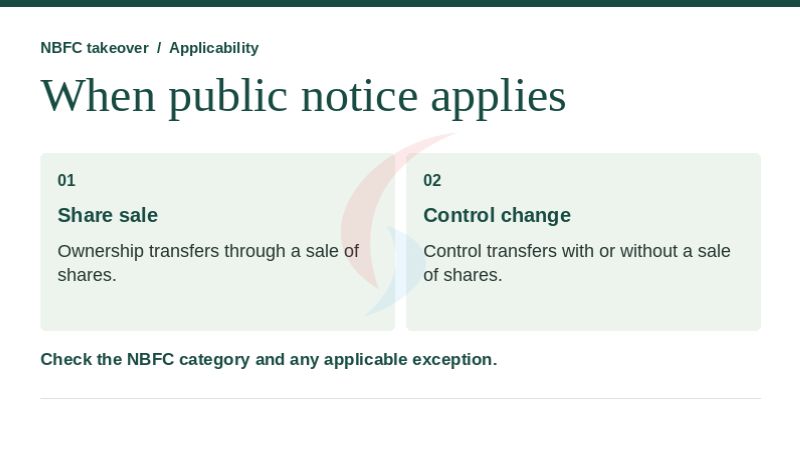
Paragraph 8 covers two types of transactions:
-
Transfer of ownership through a sale of shares: A common example is a buyer acquiring a controlling stake from the existing promoters of an NBFC.
-
Transfer of control, with or without a sale of shares: A buyer may gain control through board appointment rights, voting agreements or other contractual arrangements even when the existing shareholding stays the same.
The shareholding percentage tells only part of the story. Suppose an investor buys 20% of an NBFC and receives the right to appoint a majority of its directors. Although the shareholding is below 26%, the board appointment right can independently trigger the control provisions. The parties should review the share purchase agreement, shareholders’ agreement, articles of association and any side agreements together to determine who will control the NBFC and when those rights take effect.
If the buyer gains board appointment or voting rights, see how those arrangements can trigger an NBFC change in control.
How the 26% RBI Approval Threshold Relates to Public Notice
Paragraph 6 generally requires prior written RBI permission when a change in shareholding, including progressive acquisitions over time, results in an acquisition or transfer of 26% or more of the NBFC’s paid-up equity capital. A takeover or acquisition of control can require permission at any shareholding percentage. Paragraph 8 separately looks at whether the transaction transfers ownership through a sale of shares or transfers control. For a substantial minority investment, review both provisions and any conditions in the RBI approval letter.
|
Proposed transaction |
Prior written RBI permission |
Newspaper notice |
|
A buyer acquires 70% from existing promoters and takes control |
Required |
Required |
|
An investor acquires 20% and gains the right to appoint a majority of directors |
Required because control changes |
Required |
|
A party takes control through voting rights without purchasing shares |
Required |
Required |
|
An investor acquires 26% or more without an apparent change in control |
Generally required |
Assess whether the deal transfers ownership through a share sale or transfers control, and review the approval conditions |
|
A foreign investor acquires 15% in an HFC holding public deposits, with no separate transfer of control |
Generally required under the special HFC rule |
The specific paragraph 8 shareholding exception applies |
For investments made in stages, see how the 26% shareholding rule for NBFC acquisitions applies to progressive acquisitions.
Paragraph 6(2) also provides a specific prior-approval exception where a holding goes beyond 26% because of a court-approved buyback or reduction of capital. The resulting change must be reported to RBI or the National Housing Bank, as applicable, within one month. Any separate transfer of control should be assessed on its own terms.
Which NBFCs Are Covered?
The public notice provisions apply across regulatory layers to the categories specified in paragraph 3. These include deposit-taking NBFCs, NBFC Investment and Credit Companies, NBFC Factors, microfinance institutions, infrastructure finance companies, infrastructure debt fund NBFCs, housing finance companies, core investment companies, peer-to-peer lending platforms and account aggregators.
The Directions apply a narrower set of provisions to Standalone Primary Dealers and exclude Mortgage Guarantee Companies and Non-Operating Financial Holding Companies. Check the target’s registration category before applying the general notice rule to a specific deal.
Special Exception for Certain Foreign Investments in HFCs
A housing finance company (HFC) that accepts or holds public deposits is subject to a special prior-approval rule for qualifying shareholding changes of 10% or more of its paid-up equity capital by or to a foreign investor. Paragraph 8 provides a specific notice exception where the qualifying change is at least 10% and below 26%, including progressive increases. Prior RBI approval can still be required under paragraph 6(3). If the investor also receives rights that transfer control, review those rights separately before relying on the notice exception.
Who Must Issue the Public Notice?
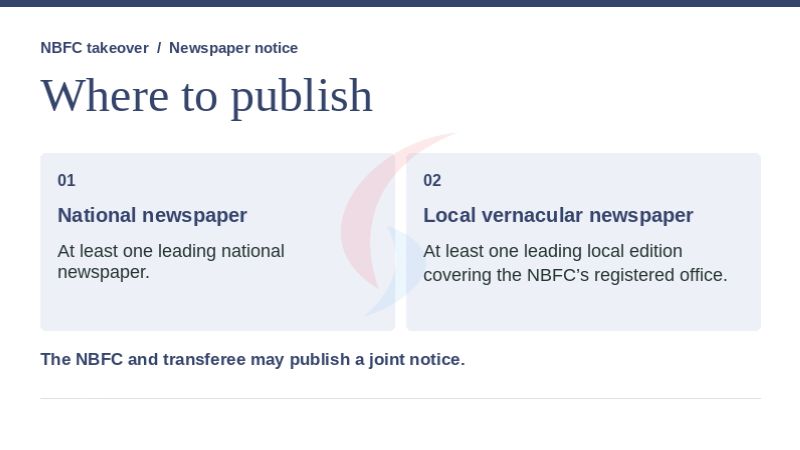
Under paragraph 9, the NBFC and the transferee must give the notice, or the parties concerned may publish it jointly. In a share acquisition, the transferee is the buyer. A joint notice gives the parties a single text to approve for both newspaper publications. Before releasing it, verify the legal names, signatories, proposed shareholding and description of control against the RBI permission and final deal documents.
Where Must the Notice Be Published?
The notice must appear in both of the following:
-
At least one leading national newspaper
-
At least one leading local vernacular newspaper covering the place of the NBFC’s registered office
For example, if the target NBFC’s registered office is in Jaipur and the buyer is based in Mumbai, choose a leading local-language newspaper edition that covers Jaipur. Confirm the edition when booking the advertisement because a newspaper can publish separate editions for different cities. Website announcements, social media posts and stock exchange disclosures can serve separate communication purposes. When paragraph 8 applies, both prescribed newspaper placements are required.
What Must the NBFC Takeover Public Notice Include?
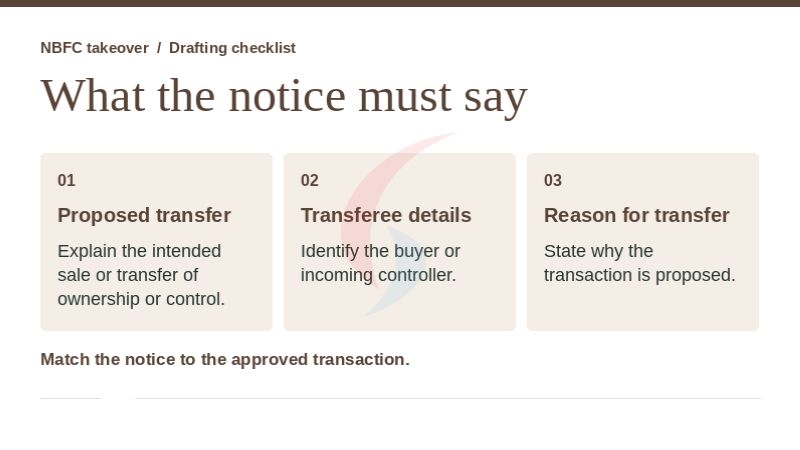
Paragraph 10 requires the notice to describe the proposed transfer, identify the transferee and explain the reason for the transaction. The description should tell readers what will change and who will acquire ownership or control.
|
Required disclosure |
What to include |
|
Intention to sell or transfer ownership or control |
Describe the proposed change. Identify the stake involved in a share sale or explain the rights through which control will pass. |
|
Particulars of the transferee |
Give the buyer’s or incoming controller’s full legal name and relevant identifying details. |
|
Reason for the proposed transfer |
State the actual reason, such as a strategic acquisition that allows existing promoters to exit, if that reflects the deal. |
The parties can also include the NBFC’s registered office address, the transferee’s address, the date and reference number of RBI’s written permission, and the details of authorised signatories. Check whether the approval letter specifies any additional wording, publication evidence or deadlines. The national and vernacular versions should use consistent names, percentages and descriptions of governance rights.
How to Calculate the 30-Day Public Notice Period
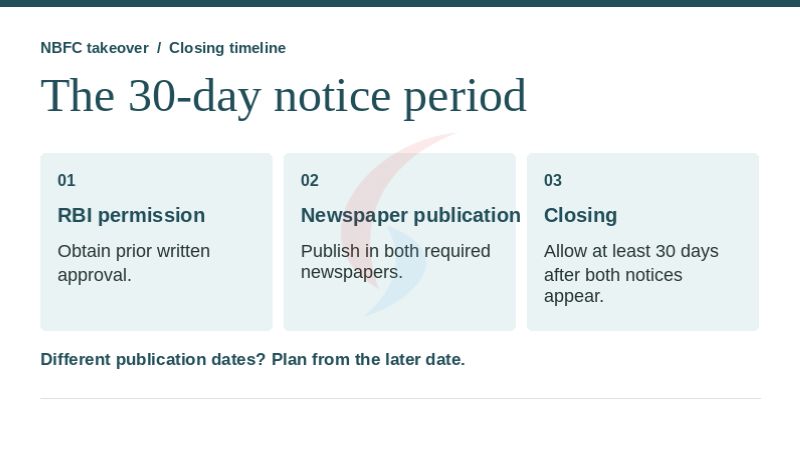
The notice must appear after prior RBI permission and at least 30 days before the transfer of ownership or control takes effect. If the newspapers publish on different dates, use the later qualifying publication date to schedule closing so that both placements have the full interval. Use the dates on which the notices actually appear in print when calculating the period.
|
Stage |
What the transaction team should do |
|
Before RBI approval |
Assess the proposed shareholding and control changes. Where required, the NBFC applies through RBI’s PRAVAAH portal. The parties can draft the notice and identify newspaper editions. |
|
After RBI approval |
Review the approval conditions, finalise the notice and arrange publication in both prescribed newspapers. |
|
After publication |
Verify the dates, editions and printed wording. If the dates differ, calculate the interval from the later qualifying publication. |
|
At closing |
Confirm that the full notice interval has elapsed and that the other closing conditions have been met. Record when shares, voting rights and board appointment rights take effect. |
Before scheduling publication, review the documents required for RBI approval of an NBFC takeover so the approval application can be prepared in advance.
Example of an NBFC Takeover Closing Timeline
Suppose RBI grants permission on 4 January 2027. The national newspaper publishes the notice on 7 January, and the local vernacular newspaper publishes it on 9 January. The parties use 9 January as the reference date and schedule closing for 9 February, allowing more than 30 days after both publications.
If the deal closes in stages, check when the buyer can exercise its governance rights. For example, if the final share transfer is scheduled for February but the buyer can appoint a majority of directors in January, control could pass before the planned closing date. The transaction documents should tie the effective dates of those rights to the applicable approval and notice conditions.
Sample Joint Public Notice for an NBFC Takeover
Public Notice of Proposed Transfer of Ownership and Control
[NBFC legal name], having its registered office at [full address], and [transferee legal name], having its office at [full address], jointly give notice of the proposed acquisition by [transferee legal name] of [number] equity shares representing [percentage]% of the paid-up equity capital of [NBFC legal name] from [seller names]. The proposed acquisition will result in the transfer of ownership and control of the NBFC to [transferee legal name].
The proposed transfer is being undertaken for [specific reason for the transfer]. The Reserve Bank of India granted prior written permission for the proposed transaction by its letter dated [date], bearing reference number [reference number].
The parties propose to complete the transfer after the applicable public notice period of at least 30 days has elapsed and the remaining closing conditions have been satisfied.
For [NBFC legal name]
[Name and designation of authorised signatory]
For [transferee legal name]
[Name and designation of authorised signatory]
Place [City]
Date [Date]
This sample assumes a share sale that transfers both ownership and control. If control changes without a share sale, describe the voting or governance arrangements through which control will pass. Adapt the wording to the actual transaction and RBI’s permission before publication.
Publication Errors and Records to Keep
Keep the full newspaper pages or authenticated copies showing the notice, publication date and edition. Retain the signed notice, final vernacular version, RBI permission, final shareholding table and closing-date calculation. These records show what appeared in print and help establish when the required interval elapsed.
If a notice names the wrong transferee, gives a materially incorrect shareholding percentage or appears in a local edition that fails to cover the registered office, pause closing and assess whether corrected publication and a fresh notice period are required. Review the notice again if the proposed deal changes materially after publication, particularly if the buyer or the rights being transferred change.
The separate prior-approval requirement also carries enforcement risk. In August 2026, RBI announced a penalty of Rs 1.80 lakh on Valuefin India Credit Services Private Limited for failing to obtain prior written permission for a substantial change in shareholding. The case illustrates the regulatory risk of completing a regulated transfer before securing the required permission.
Why Choose Compliance Calendar LLP?
At Compliance Calendar LLP, we help buyers and target NBFCs work out when prior RBI approval and a public notice are required. We review the proposed shareholding, voting rights and board appointment provisions alongside the transaction documents. That review helps identify the point at which ownership or control will pass and lets the parties build the approval and notice requirements into their closing timetable.
If you need help planning the transaction from approval through closing, explore our NBFC acquisition services.
Our team can assist with the PRAVAAH application checklist, joint public notice drafting, newspaper edition selection, publication records and closing compliance. If the two newspapers publish on different dates or the transaction closes in stages, we can help calculate the notice period and align it with the dates on which shares and control rights take effect.
For assistance with an NBFC takeover or public notice, contact Compliance Calendar LLP at 9988424211 or info@ccoffice.in.
Frequently Asked Questions (FAQ’s)
Q1. Can an NBFC publish the notice while its RBI application is pending?
Ans. Publication must follow prior RBI permission. While the application is under review, the parties can prepare the draft, arrange the vernacular translation and identify suitable newspaper editions.
Q2. Does the 30-day notice period mean working days?
Ans. Paragraph 8 specifies days without qualifying them as working days. For closing purposes, count calendar days and allow the full interval after both qualifying publications.
Q3. Does a change in directors alone require a public notice?
Ans. Assess whether the change transfers control. Giving an investor the right to appoint a board majority or direct management or policy decisions can bring the transaction within the control provisions.
Q4. Can the NBFC and the buyer publish a joint notice?
Ans. Yes. Paragraph 9 allows the parties concerned to give a joint notice. Publish the joint notice in both prescribed newspaper categories.
Q5. Does the notice create a formal procedure for objections?
Ans. Paragraphs 8 to 10 deal with timing, publication and content. They do not prescribe a general objection-filing procedure. Check the approval letter and any other rules applicable to the transaction for specific requirements.
Q6. Can other approvals affect the closing date?
Ans. Yes. Depending on the deal, foreign investment requirements, listed-company disclosures, other regulatory approvals and contractual lender consents can affect when the parties may close.
Q7. Must both newspapers publish the notice on the same day?
Ans. The Directions prescribe the minimum interval before the transfer. If the notices appear on different dates, use the later qualifying publication date to schedule closing so that both publications have the full interval.
Q8. Can the parties sign the share purchase agreement before publication?
Ans. The parties may sign a conditional agreement in advance. Draft it so that the share transfer and any rights that would transfer control take effect only after the applicable RBI approval, notice period and other closing conditions are satisfied.
Q9. What happens if the notice appears in the wrong local edition?
Ans. Check whether the edition covers the place of the NBFC’s registered office. If it fails that requirement, arrange publication in an appropriate edition and recalculate the closing date using the corrected publication.
Q10. Must the public notice disclose the purchase price?
Ans. Paragraph 10 requires the proposed transfer, particulars of the transferee and the reason for the transaction. It does not list the purchase price as a standard disclosure. Check whether the RBI permission letter or any other applicable disclosure requirement calls for it.
Article last updated on : 13 Nov 2026.

































































_learn_crop10_thumb.jpg)