


A fintech company wants to buy a 24% stake in an Indian non-banking financial company (NBFC). The existing promoters will keep most of the shares, but the buyer wants the right to appoint a majority of the board. The promoters assume the deal can close without Reserve Bank of India (RBI) approval because the stake is below 26%. That assumption could delay the transaction. The right to appoint a majority of directors can give the buyer control of the NBFC, and acquisition of control is a separate ground for prior RBI approval.
Now consider another investor who wants to acquire exactly 26% of the same NBFC and has no special voting or board appointment rights. The deal can still require prior written RBI permission because it meets the shareholding threshold. These two examples explain why an NBFC takeover in India has to be assessed from both an ownership and a control perspective. The percentage in the share purchase agreement tells only part of the story. The parties must also examine who can appoint directors, influence policy or direct management after the transaction.
For a closer look at the filing process and approval conditions, read our guide to RBI approval for an NBFC takeover.
What Are the RBI Directions on NBFC Takeovers?
The Reserve Bank of India (Non-Banking Financial Companies – Acquisition of Shareholding or Control) Directions, 2025 were issued on 28 November 2025 and took effect on the same date. The Directions specify when prior RBI permission is required, what information an NBFC must provide in its application, and when the parties must publish a public notice before completing the transfer. They also address investments from or through jurisdictions identified by the Financial Action Task Force (FATF) and set out separate provisions for certain regulated entities.
In a typical share purchase, the buyer acquires shares from the existing shareholders and the NBFC continues to operate as the same legal entity. Its loans, borrowings, contracts, regulatory history and pending disputes stay with the company. A takeover can also be structured through a fresh issue of shares or an arrangement that gives the incoming investor control. For that reason, the first step is to understand the legal effect of the deal, including any rights the buyer receives through documents signed alongside the share purchase or subscription agreement.
Which NBFCs Are Covered by the 2025 Directions?
The main provisions cover several categories of RBI-regulated entities across regulatory layers. These include deposit-taking NBFCs, Investment and Credit Companies, NBFC-Factors, Microfinance Institutions, Infrastructure Finance Companies, Infrastructure Debt Fund NBFCs, Housing Finance Companies (HFCs), Core Investment Companies, peer-to-peer lending platforms and Account Aggregators.
The target’s Certificate of Registration (CoR) is a good starting point because the regulatory category determines which approval rules apply. For example, an HFC that accepts or holds public deposits is subject to an additional approval threshold for shareholding changes involving a foreign investor. Standalone Primary Dealers (SPDs) are subject to a separate approval rule for changes in their shareholding pattern or capital structure. Mortgage Guarantee Companies and Non-Operative Financial Holding Companies fall outside these particular Directions, so their transactions must be assessed under the rules applicable to those entities.
When Is Prior RBI Approval Required for an NBFC Takeover?
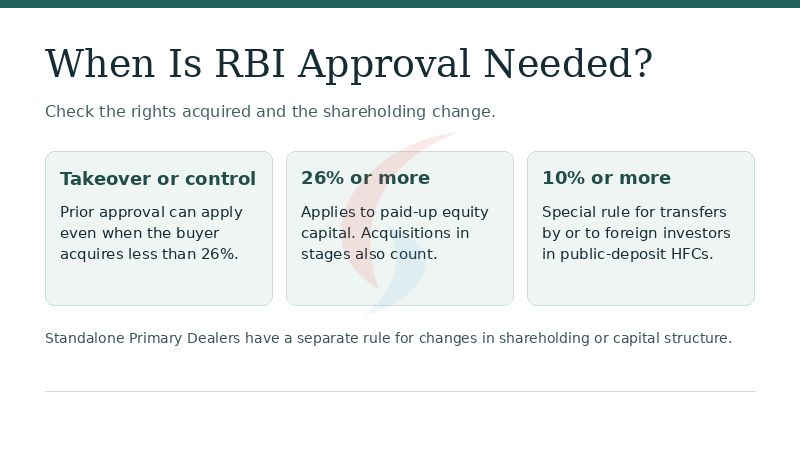
Paragraph 6 sets out the approval triggers. A single deal can meet more than one trigger. For instance, a buyer who acquires 40% of the paid-up equity capital and receives the right to appoint a majority of directors would need to explain both the shareholding change and the acquisition of control in the application.
|
Proposed transaction |
Prior RBI approval requirement |
|
Takeover or acquisition of control of a covered NBFC |
Prior written permission under paragraph 6(1), even if the existing management continues. |
|
Acquisition or transfer of 26% or more of the paid-up equity capital of a covered NBFC |
Prior written permission under paragraph 6(2). The threshold includes progressive increases over time. |
|
Acquisition or transfer of 10% or more of the paid-up equity capital of an HFC accepting or holding public deposits, by or to a foreign investor |
Prior written permission under paragraph 6(3). This also includes progressive increases over time. |
|
Change in the shareholding pattern or capital structure of a Standalone Primary Dealer |
Prior approval under paragraph 6(4). Other material changes that affect its licensing conditions must be reported to the RBI immediately. |
What Does Change in Control Mean for an NBFC?
The RBI Directions adopt the definition of control in regulation 2(1)(e) of the SEBI Takeover Regulations, 2011. Control includes the right to appoint a majority of directors or to control management or policy decisions. These rights can be exercised directly or indirectly and can arise from shareholding, management rights, shareholder or voting agreements, or other arrangements. A change in control can therefore occur even if the same managing director and senior management team remain in office.
Suppose an investor buys a 20% stake and receives consent rights over the NBFC’s annual budget, lending strategy and appointment of key executives. The question is whether the investor can use those rights, individually or together, to control management or policy decisions. The answer depends on the wording and operation of the rights. The parties should review the shareholders’ agreement, voting arrangements and articles of association together. Paragraph 6 of the final 2025 Directions does not list a standalone 30% director-change approval trigger, but board changes can still affect control or bring separate governance requirements into play.
The rights attached to an investment can determine whether it results in a change in control of an NBFC.
How Does the 26% Rule Apply to Acquisitions in Stages?
The 26% shareholding rule covers progressive increases over time. Suppose an investor acquires 18% in the first round and later agrees to acquire another 9%. The second purchase takes the cumulative stake to 27%, so the NBFC must obtain the required approval before implementing that round. The first round also requires a separate control assessment if it gives the investor rights that amount to control. This matters in transactions where the commercial agreement is negotiated as one deal but the shares are transferred in several tranches.
A limited exception applies when a shareholding goes above 26% due to a buyback or reduction of capital approved by a competent court. In that situation, prior approval is exempted under the shareholding provision, but the change must still be reported to the RBI or the National Housing Bank (NHB), as applicable, within one month. The 10% rule for a public-deposit HFC has a similar exception for a court-approved buyback or capital reduction, with reporting to the NHB within one month.
If the buyer plans to acquire shares in stages, review how the 26% shareholding rule for NBFC acquisitions applies to progressive increases.
Process for an NBFC Takeover in India
Review the NBFC’s registration, finances and compliance history
Start by checking the target’s CoR, permitted activities, deposit-taking status and any conditions imposed by the RBI. Review audited financial statements, capital adequacy, overdue loans, provisioning, related-party transactions and correspondence with the regulator. Buyers should also examine pending litigation, customer complaints and any past compliance defaults that could result in a cost or restriction after closing. In a share acquisition, these issues remain with the company and can affect the value of the buyer’s investment.
The same review should cover commercial agreements. For example, an NBFC’s lender may require prior consent if there is a change in ownership or control. A technology or loan servicing agreement might also have a change-of-control clause. Identifying these provisions before signing helps the parties work out which consents are needed, how long they may take and whether the purchase price reflects the company’s obligations.
Structure the transaction and document the approval conditions
Prepare a shareholding table showing who owns the NBFC before and after closing. For a staged deal, show the shareholding and governance rights after each round. Identify the proposed shareholders, ultimate owners, funding sources, board nomination rights and voting arrangements. This exercise often reveals that a right agreed during commercial negotiations, such as the ability to appoint additional directors after a future investment, needs closer review before it is included in the final documents.
If the parties sign the transaction documents before RBI approval, they can make completion conditional on receiving the required written permission, completing any applicable public notice period and obtaining other necessary consents. The agreement can also specify how the parties will handle RBI queries or conditions that affect the agreed structure. Any share transfer or governance right that would implement the transaction should take effect only after the relevant conditions are satisfied.
Submit the RBI application through PRAVAAH
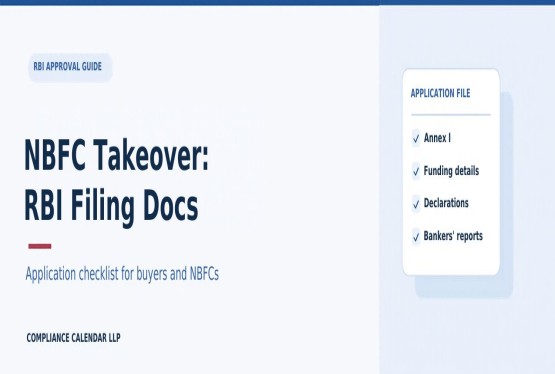
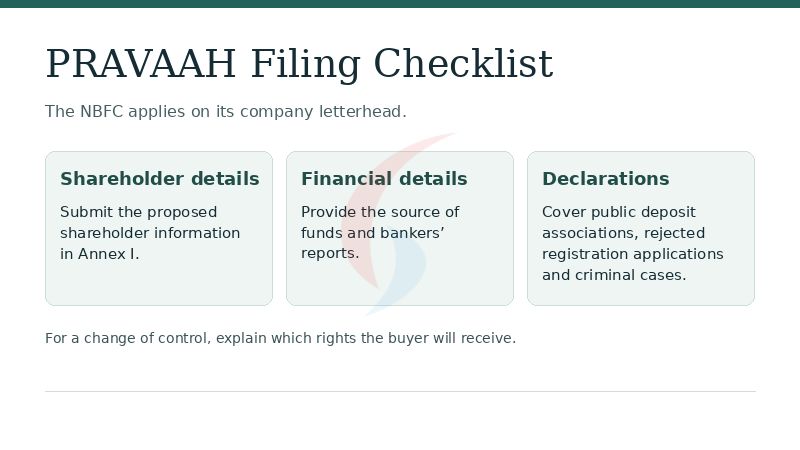
Under paragraph 7, the NBFC submits the prior approval application through PRAVAAH on its company letterhead. The buyer and proposed shareholders supply the information and declarations needed for the filing. Gathering these documents early helps, particularly when the investor is a corporate entity with multiple layers of ownership or the acquisition is funded from more than one source.
|
Document or information |
What the application should cover |
|
Annex I information |
Details of the proposed shareholders in the format prescribed by the RBI. |
|
Source of funds |
Information showing how the proposed shareholders will fund the acquisition. |
|
Bankers’ reports |
Reports from bankers concerning the proposed shareholders. |
|
Public deposit declaration |
Confirmation that the proposed shareholders are not associated with an unincorporated body accepting public deposits. |
|
CoR rejection declaration |
Confirmation that the proposed shareholders are not associated with a company whose CoR application the RBI rejected. |
|
Criminal case declaration |
Confirmation regarding the absence of criminal cases, including cases under section 138 of the Negotiable Instruments Act, 1881. |
Before filing, review the documents required for RBI approval of an NBFC takeover, including the proposed shareholders’ declarations and bankers’ reports.
A transaction note, pre- and post-transaction ownership chart and draft agreements can help explain how the proposed deal works. For a control transaction without a share sale, the application should explain which arrangements confer control and when those rights will take effect. The Directions do not prescribe a fixed processing time for RBI approval, so the transaction schedule should allow for the regulator’s review and any follow-up questions.
Publish the 30-day public notice where applicable
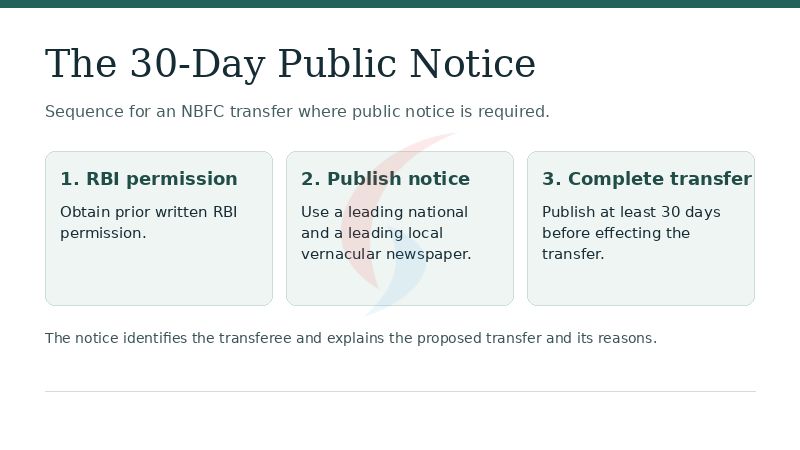
Paragraphs 8 to 10 require a public notice before a transfer of ownership by sale of shares or a transfer of control, with or without a share sale. Where applicable, the notice must be published after the RBI grants prior permission and at least 30 days before the transfer takes effect. It must appear in at least one leading national newspaper and one leading local vernacular newspaper covering the location of the NBFC’s registered office.
The NBFC and the transferee can publish the notice separately or jointly. The notice should identify the proposed transferee, state the intention to transfer ownership or control, and explain the reason for the transaction. The Directions provide an exception to paragraph 8 for specified shareholding changes of 10% or more but below 26% involving a foreign investor in an HFC accepting or holding public deposits. If the transaction also transfers control, assess that feature separately when determining the notice requirement.
Complete the transaction and post-closing formalities
Before closing, review the RBI approval letter against the final transaction structure. Confirm that the parties have met the relevant approval conditions, completed any applicable public notice period and obtained the necessary lender or contractual consents. The parties can then complete the approved share transfer or allotment and give effect to the agreed changes in the board or governance arrangements.
After closing, the company should update its statutory registers and ownership records. Corporate filings may be required for fresh allotments, director appointments or changes in beneficial ownership, depending on the deal. A cross-border transaction may also require FEMA reporting through an authorised dealer bank. The approval letter and the final transaction documents should guide who is responsible for each filing and when it is due.
Foreign Investment and FATF Restrictions
A foreign investment in an NBFC can involve RBI takeover approval, FEMA requirements and a separate FATF assessment. Under paragraphs 11 to 13, new investors investing from or through jurisdictions listed by the FATF as high-risk or under increased monitoring cannot acquire significant influence, directly or indirectly, as defined under the applicable accounting standards. The aggregate voting power of such new investors must remain below 20%, both on an existing voting-power basis and after accounting for potential voting rights.
Potential voting rights can arise through convertible securities, instruments with contingent voting rights or contractual arrangements. This means an investor’s position should be assessed after reviewing the entire investment structure, including rights that could become exercisable later. The Directions also allow qualifying existing investors whose source or intermediate jurisdiction was listed after their original investment to continue holding or bring in additional investment, subject to applicable regulations.
For an HFC accepting or holding public deposits, the separate 10% approval threshold for acquisitions or transfers by or to a foreign investor may also apply. The RBI can review the permission to accept public deposits when control of an HFC holding a valid deposit-taking CoR changes hands. The parties should account for this possibility if their valuation or business plan assumes the HFC will continue raising public deposits after closing.
Other Legal Requirements and Common Closing Mistakes
RBI approval can be one of several approvals needed for a takeover. A foreign investment may require a separate review of FEMA entry routes, pricing and reporting. A listed NBFC acquisition can bring SEBI takeover and disclosure requirements into play, and competition clearance may be necessary depending on the transaction. Where the deal is structured as a voluntary amalgamation, the parties should also examine the RBI’s separate 2025 Directions for that structure.
In practice, closing delays often arise when parties calculate the stake for one round in isolation, overlook board or voting rights, or start planning the public notice before obtaining RBI approval. Another common issue is a late change in the identity of the buyer, the source of funds or the post-closing shareholding. If the final deal differs materially from the proposal submitted to the RBI, the parties should assess whether they need to update the application or seek further regulatory clearance before completing the revised transaction.
Why Choose Compliance Calendar LLP for an NBFC Takeover?
Before you agree on a purchase price or closing date, Compliance Calendar LLP can help you assess whether the proposed shareholding or control rights require prior RBI approval. We review the transaction structure, identify the documents needed for the PRAVAAH application and help coordinate the newspaper notice and closing timeline where a public notice is required.
For assistance with an NBFC takeover, contact Compliance Calendar LLP at +91 9988424211 or email info@ccoffice.in.
Frequently Asked Questions (FAQ’s)
Q1. Is RBI approval mandatory for every purchase of NBFC shares?
Ans. Prior approval depends on the transaction. It is required for a covered takeover or acquisition of control, an acquisition or transfer meeting the 26% threshold, or a transaction that triggers a special rule for the relevant category of entity.
Q2. Does buying exactly 26% of an NBFC require prior approval?
Ans. Yes. Paragraph 6(2) covers an acquisition or transfer of 26% or more of the NBFC’s paid-up equity capital, including progressive increases over time. A transaction at exactly 26% meets the threshold.
Q3. Can a buyer acquiring less than 26% still need RBI approval?
Ans. Yes. A buyer acquiring a smaller stake can still obtain control through board appointment, management or voting rights. Special provisions for public-deposit HFCs and Standalone Primary Dealers can also apply independently of the ordinary 26% threshold.
Q4. Can there be a change in control without a share transfer?
Ans. Yes. A voting agreement, management arrangement or change in board appointment rights can confer control without a share sale. Where the arrangement transfers control, the prior approval and applicable public notice requirements should be assessed.
Q5. Who files the application for RBI approval?
Ans. The NBFC files the application on its company letterhead through PRAVAAH. The proposed shareholders provide their information, source-of-funds details, declarations and bankers’ reports for the filing.
Q6. Can the parties sign a share purchase agreement before RBI approval?
Ans. The parties can sign a conditional agreement that makes completion subject to the required RBI permission and any applicable notice period. The agreement should defer the share transfer and any rights that would confer control until those conditions are met.
Q7. When does the 30-day public notice period start?
Ans. Where public notice is required, it is published after prior RBI permission. The parties must give at least 30 days’ notice before effecting the transfer, so the publication dates should be checked before fixing the closing date.
Q8. How long does RBI approval for an NBFC takeover take?
Ans. The 2025 Directions do not specify a fixed processing period. The time can depend on the transaction structure, completeness of the application and any further information the RBI requests. The public notice period, where applicable, follows approval.
Q9. Does the buyer receive a fresh RBI licence after purchasing an NBFC?
Ans. In a share purchase, the NBFC remains the same legal entity and continues to hold its CoR, subject to applicable requirements and any conditions imposed by the RBI. The buyer acquires shares in the registered company.
Q10. Can a foreign investor acquire shares in an NBFC accepting public deposits?
Ans. The answer depends on the entity’s category, the proposed stake and rights, and the applicable RBI, FEMA and FATF requirements. For an HFC accepting or holding public deposits, the acquisition or transfer of 10% or more of paid-up equity capital by or to a foreign investor requires prior RBI permission under paragraph 6(3).
Article last updated on : 13 Nov 2026.







































































_learn_crop10_thumb.jpg)