


Imagine a manufacturing company in Maharashtra that has been operating successfully for more than fifteen years. Its annual turnover has reached Rs 150 crore, customers are placing regular orders, and management believes the business follows responsible environmental practices. However, during an investor review, the company is asked to provide evidence of its waste disposal arrangements, employee safety training, pollution control permissions and environmental performance.
The management discovers that some pollution-related records are outdated, employee safety information is maintained separately at different factories, and electricity consumption has never been properly analysed. Although the company has several sustainability policies, it cannot demonstrate whether those policies are being followed. This situation explains why ESG Audit in India has become important for businesses seeking to understand their actual compliance position.
What Is an ESG Audit in India?
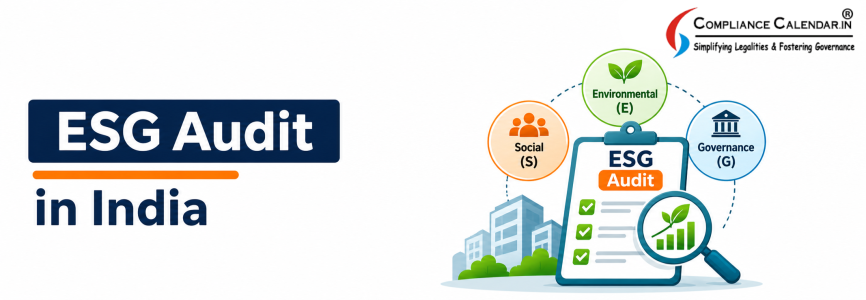
An ESG Audit is a systematic examination of a company's environmental responsibilities, employee and stakeholder practices, and corporate governance arrangements. It evaluates whether the business follows applicable laws, maintains reliable records and implements the policies it has adopted.
Unlike a financial audit, which primarily examines financial statements and accounting records, an ESG audit reviews matters such as carbon emissions, energy consumption, waste disposal, workplace safety, labour compliance, ethical conduct and governance controls. The exact scope depends on the company's industry, size, regulatory requirements and the purpose of the engagement.
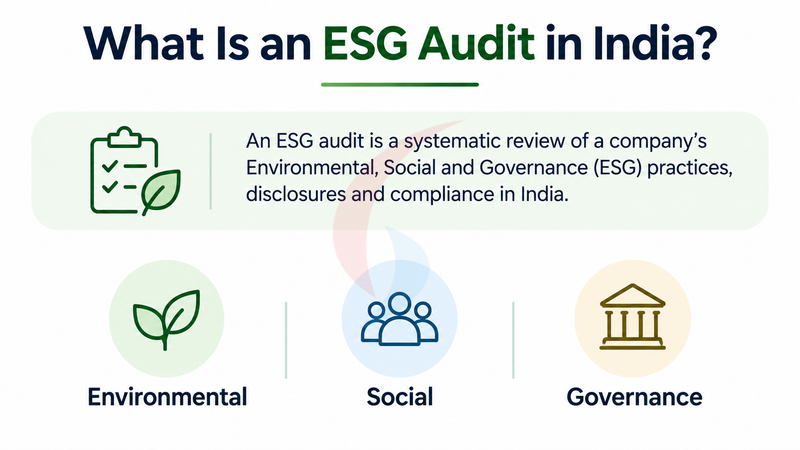
For example, a textile manufacturer may have a written environmental policy stating that wastewater is treated before discharge. During an ESG audit, the reviewer would examine the relevant pollution control consent, wastewater testing reports and treatment plant records to determine whether the company's practices support that statement.
It is important to understand that there is no single mandatory ESG audit applicable to every company registered in India. Certain listed entities have BRSR Core assessment or assurance obligations, while specified environmental activities may be subject to separate statutory audit requirements.
Businesses can explore ESG Compliance in India to understand the broader responsibilities involved in corporate sustainability.
Why Is ESG Audit Important for Indian Companies?
Many companies have environmental policies, employee welfare programmes and corporate governance procedures. However, having these policies does not automatically establish legal compliance. An ESG audit examines whether the relevant practices are supported by documents and implemented across business operations.
For investors, an audit or assessment can provide valuable information about regulatory exposure and operational risks. For management, the review may reveal unnecessary electricity consumption, incomplete employee records, weak grievance mechanisms or gaps in environmental approvals.
Consider a company that spends Rs 50 lakh annually on CSR activities but fails to maintain adequate hazardous waste disposal records. Its CSR expenditure does not eliminate its environmental obligations. An ESG audit helps identify such differences between individual sustainability initiatives and overall legal compliance.
A well-planned ESG audit can therefore support regulatory readiness, internal accountability, risk management and more reliable sustainability disclosures.
Is ESG Audit Mandatory for Companies in India?
ESG audit applicability depends on the legal requirement being examined. A general voluntary ESG review is different from a statutory environmental audit or mandatory BRSR Core assessment or assurance.
|
Company Category |
ESG Audit Applicability |
|
Top 1,000 listed entities |
Mandatory BRSR reporting, subject to applicable SEBI provisions. |
|
Top 1,000 listed entities in FY 2026–27 |
Phased BRSR Core assessment or assurance requirement applies, subject to transition provisions. |
|
No general mandatory SEBI ESG audit requirement. |
|
|
Unlisted Public Companies |
ESG reviews are generally voluntary, but other statutory audits may apply. |
|
Manufacturing Companies |
Environmental audits or statements may be required under applicable environmental rules. |
|
ESG audits are generally voluntary unless relevant legal or contractual obligations apply. |
For example, a private packaging company may not be required to obtain BRSR Core assurance. However, if it operates a regulated manufacturing facility, it may still be subject to pollution control, environmental statements and waste management requirements.
Legal Provisions Governing ESG Audit in India
India regulates different aspects of ESG compliance through several statutes and regulatory authorities. The relevant provisions depend on the nature of the audit and the company's business activities.
|
Law / Regulation |
Relevant Provision |
Audit and Compliance Requirements |
|
Regulation 34(2)(f) |
BRSR reporting and applicable BRSR Core verification. |
|
|
Nine ESG attributes |
Key sustainability indicators and phased independent verification. |
|
|
BRSR Core amendments |
Assessment or assurance and revised value chain reporting requirements. |
|
|
Sections 134, 135, 166, 177 and 188 |
Corporate disclosures, CSR, directors' duties and governance. |
|
|
Rule 14 |
Environmental statements in Form V for covered entities. |
|
|
Rules governing environment auditors |
Certification, registration and functions of environmental auditors. |
|
|
Applicable consent provisions |
Pollution control permissions and compliance monitoring. |
|
|
Applicable notified provisions |
Employment conditions, wages, social security and workplace safety. |
These requirements operate independently. A company that completes a voluntary ESG audit must still obtain necessary statutory approvals, file prescribed reports and comply with applicable environmental and employment laws.
Environmental Audit Requirements Under Indian Law
Environmental compliance is an important part of ESG audits, particularly for manufacturing, chemical, textile, construction and waste management businesses. The Environment (Protection) Act, 1986 and related rules prescribe various environmental obligations.
|
Particulars |
Environmental Statement – Rule 14 |
Environment Audit Rules, 2025 |
|---|---|---|
|
Legal Provision |
Rule 14 of the Environment (Protection) Rules, 1986 |
Environment Audit Rules, 2025 |
|
Main Requirement |
Submission of an environmental statement in Form V by covered entities. |
Certification and registration of environmental auditors. |
|
Applicability |
Industries and operations requiring specified pollution control consents or hazardous waste authorisations. |
Environmental auditors and applicable audit or verification assignments. |
|
Key Focus Areas |
Water consumption, raw materials, pollution discharge, waste management and conservation measures. |
Environmental compliance, pollution control systems and verification activities. |
|
Reporting Timeline |
Annually, by September 30 for the financial year ending March 31. |
As prescribed for the relevant audit or verification assignment. |
|
Relevant Authority |
State Pollution Control Board or Pollution Control Committee, as applicable. |
Environment Audit Designated Agency (National Productivity Council) and relevant regulatory authorities. |
Important Note: Form V reporting and audits under the Environment Audit Rules, 2025 are separate from SEBI's BRSR Core assessment or assurance requirements. Companies must identify which obligations apply to their operations rather than assuming that every business requires the same ESG audit.
ESG Audit Checklist for Indian Companies
An effective ESG audit should examine documents, operational practices and legal requirements across the environmental, social and governance areas.
|
ESG Area |
Key Audit Requirements |
Documents to Verify |
|
Environmental Compliance |
Pollution control permissions and environmental approvals |
CTE, CTO, clearances and inspection reports |
|
Energy and Emissions |
Electricity, fuel consumption and relevant emissions |
Energy bills, fuel records and calculations |
|
Waste Management |
Waste handling, disposal and applicable EPR obligations |
Authorisations, recycler records and EPR returns |
|
Employee Welfare |
Wages, social security and employment conditions |
Payroll, PF and ESI records |
|
Workplace Safety |
Safety procedures, training and incident reporting |
Safety registers and training records |
|
Corporate Governance |
Board approvals, statutory filings and related-party transactions |
Minutes, statutory registers and disclosures |
|
ESG Reporting |
BRSR and BRSR Core compliance, where applicable |
Published reports and verification records |
An auditor should also examine unresolved regulatory notices, legal proceedings and corrective actions taken against earlier compliance findings.
Step-by-Step ESG Audit Process in India
The ESG audit process generally begins with determining the company's applicable legal obligations and the purpose of the review. A voluntary internal compliance audit may have a different scope from BRSR Core assurance or a statutory environmental audit.
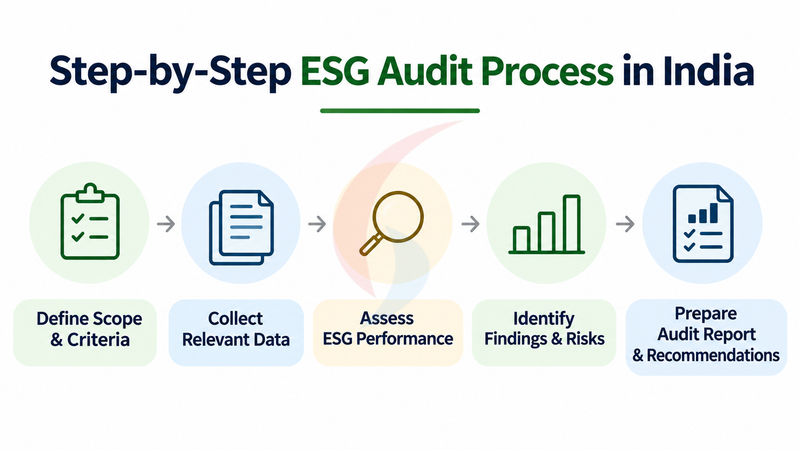
Step 1 – Determine Audit Scope: Identify the company's business activities, locations, industry-specific risks and applicable ESG requirements. Decide whether the engagement is a voluntary internal review, independent verification or a legally required audit.
Step 2 – Identify Relevant Laws: Review applicable SEBI requirements, environmental legislation, Companies Act provisions, labour laws and industry-specific regulations.
Step 3 – Collect Documents: Obtain pollution control permissions, utility records, waste management documents, employment records, corporate filings, ESG disclosures and relevant policies.
Step 4 – Examine Actual Practices: Review documentary evidence and, where necessary, conduct site inspections, employee discussions or technical testing. Written policies should be compared with actual operating practices.
Step 5 – Identify Compliance Gaps: Record expired permissions, incomplete records, reporting inconsistencies and weaknesses in internal controls. Findings should be classified according to their potential impact.
Step 6 – Prepare the Audit Report: Document the scope, applicable criteria, observations, supporting evidence, limitations and recommended corrective measures. Where the engagement is an assurance or assessment, the required reporting standards must be followed.
Step 7 – Implement Corrective Actions: Management should assign responsibilities and deadlines for resolving identified issues. A follow-up review can establish whether corrective measures have been properly implemented.
A complete ESG audit should therefore lead to practical improvement rather than ending with a checklist of observations.
BRSR Core Assessment and Assurance Under SEBI
For specified listed entities, BRSR Core assessment or assurance is a particularly important part of ESG verification.
SEBI introduced BRSR Core through its July 12, 2023 circular. It contains selected Key Performance Indicators covering nine ESG attributes, including greenhouse gas emissions, water consumption, energy usage, waste management, employee wellbeing, gender diversity, inclusive development and corporate transparency.
The original framework prescribed phased reasonable assurance. However, SEBI's March 28, 2025 amendments permit covered listed entities to choose between assessment and assurance, subject to applicable conditions.
BRSR Core Verification Timeline
|
Financial Year |
Listed Entities Covered |
|
FY 2023–24 |
Top 150 |
|
FY 2024–25 |
Top 250 |
|
FY 2025–26 |
Top 500 |
|
FY 2026–27 |
Top 1,000 |
Third-party assessment must follow the applicable standards developed by the Industry Standards Forum in consultation with SEBI. Assurance providers must use suitable recognised standards and satisfy the relevant competence and independence requirements. SEBI has clarified that a verification provider need not necessarily be a Chartered Accountant.
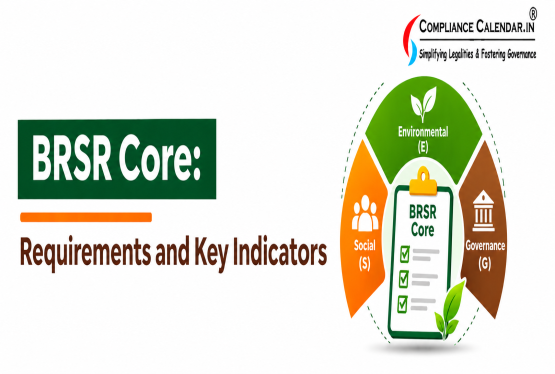
Companies can read BRSR Core: Requirements and Key Indicators and the SEBI BRSR Core FAQs for detailed guidance.
ESG Audit vs ESG Due Diligence
Although ESG audits and ESG due diligence examine similar business risks, their purposes are different.
|
Basis |
ESG Audit |
ESG Due Diligence |
|
Purpose |
Examine compliance and ESG performance against defined criteria. |
Identify ESG risks before investment or business transactions. |
|
When Conducted |
Periodically or when required by law or contract. |
Usually during acquisitions, fundraising or major transactions. |
|
Main Focus |
Policies, records, legal compliance and performance indicators. |
Existing liabilities, risks and transaction implications. |
|
Outcome |
Audit findings, verification conclusions or corrective actions. |
Risk assessment and transaction recommendations. |
For example, a company may conduct an annual ESG audit to review pollution control and employee safety. A prospective investor may separately conduct ESG due diligence before acquiring that company. Both exercises may involve similar documents, but one does not automatically replace the other.
Case Study: How an ESG Audit Helped Reduce Manufacturing Costs
Consider the fictional example of Sunrise Packaging Pvt. Ltd., a packaging manufacturer operating factories in Haryana and Maharashtra. The company had annual revenue of Rs 180 crore and was preparing to expand its business.
During an internal ESG audit, management discovered that the Haryana facility consumed more electricity than expected. Employee safety training records were also incomplete, and waste disposal documents were maintained across different departments.
Instead of treating the findings as routine paperwork issues, the company introduced monthly monitoring and improved its internal reporting system.
|
Audit Area |
Problem Identified |
Corrective Action and Result |
|
Energy Consumption |
Annual electricity use of 20 lakh units. |
Efficiency measures reduced consumption to 18 lakh units. |
|
Employee Safety |
Incomplete training documentation. |
Introduced standardised safety registers. |
|
Waste Management |
Scattered disposal records. |
Centralised waste documentation and verification. |
|
Cost Management |
Excessive electricity expenses. |
Potential annual savings of Rs 16 lakh at Rs 8 per unit. |
The electricity saving is an illustrative calculation based on a reduction of 2 lakh units. Actual financial savings would depend on tariffs, operating conditions and implementation expenses.
The company was not automatically required to obtain BRSR Core assurance because it was unlisted. Nevertheless, its internal ESG audit helped management identify operational inefficiencies and strengthen compliance documentation.
Latest ESG Audit Regulatory Updates in 2026
The regulatory position in November 2026 includes significant developments affecting sustainability verification and environmental compliance.
|
Regulatory Development |
Key Update |
|
BRSR Core Verification |
SEBI permits assessment or assurance under its March 28, 2025 amendments. |
|
FY 2026–27 Applicability |
BRSR Core verification extends to the top 1,000 listed entities. |
|
Value Chain ESG Disclosures |
Voluntary for the top 250 listed entities from FY 2025–26. |
|
Environment Audit Rules, 2025 |
Introduced certification and registration of environmental auditors. |
|
Environment Audit Designated Agency |
National Productivity Council supports the environmental auditor certification and registration system. |
|
Labour Codes |
Applicable provisions commenced from November 21, 2025, subject to relevant implementation and transition requirements. |
Under the revised SEBI requirements, value chain ESG disclosures are voluntary for the top 250 listed entities from FY 2025–26. Independent assessment or assurance of such disclosures is also voluntary from FY 2026–27.
Another important development is the implementation of the Environment Audit Rules, 2025. Companies should distinguish audits performed under these rules from BRSR Core assessment or assurance, as the legal requirements and responsibilities of auditors differ.
Official references include the SEBI Circular dated March 28, 2025 and the Environment Audit Designated Agency Portal.
Documents Required for an ESG Audit in India
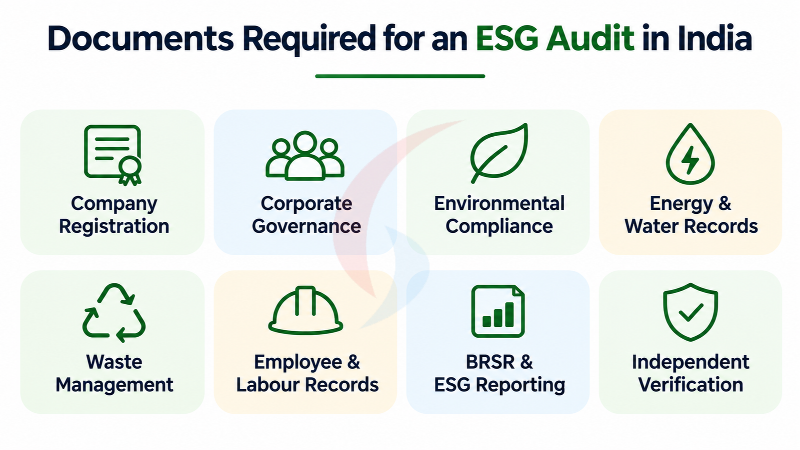
The documents required for an ESG audit depend on the company's business activities, industry and audit scope. Manufacturing companies generally require more environmental records, while service-based businesses may focus on employee welfare, governance and data protection.
|
Document Category |
Required Documents |
Purpose |
|---|---|---|
|
Company Registration |
Certificate of Incorporation and statutory registrations |
Verify legal identity and registration compliance. |
|
Corporate Governance |
Board minutes, statutory registers and corporate policies |
Review governance practices and legal compliance. |
|
Environmental Compliance |
Pollution control consents and environmental clearances |
Verify applicable environmental approvals. |
|
Energy and Water Records |
Electricity bills, energy reports and water consumption records |
Assess resource consumption and efficiency. |
|
Waste Management |
Waste disposal records, authorisations and recycling certificates |
Check waste management compliance. |
|
Employee and Labour Records |
Employee registers, wage records and safety training documents |
Review employee welfare and workplace safety. |
|
BRSR and ESG Reporting |
BRSR disclosures, BRSR Core calculations and supporting evidence |
Verify sustainability reporting accuracy. |
|
Independent Verification |
Assessment or assurance reports, where applicable |
Confirm compliance with relevant SEBI verification requirements. |
Important Note: All documents should be valid, updated and supported by actual business practices. Having a certificate or written policy alone does not establish complete ESG compliance.
Why Choose Compliance Calendar LLP for ESG Audit Support?
ESG audits involve several areas of regulatory compliance, including environmental legislation, SEBI reporting, employee welfare and corporate governance. Companies often need coordinated support to identify applicable obligations, review documents and address compliance gaps.
Compliance Calendar LLP provides professional assistance with ESG advisory, corporate compliance and regulatory requirements. Businesses can seek guidance in reviewing relevant legal obligations, organising documentation and preparing for applicable sustainability reporting requirements.
For professional assistance, contact Compliance Calendar LLP at 9988424211 or email info@ccoffice.in
Frequently Asked Questions (FAQ’S)
Q1. What is an ESG Audit in India?
Ans. An ESG audit is a systematic review of a company's environmental, social and governance practices. It examines compliance obligations, internal policies, operational records and sustainability performance against defined criteria.
Q2. Is ESG Audit mandatory for all companies in India?
Ans. No. There is no single compulsory ESG audit applicable to every Indian company. However, specified listed entities have BRSR Core verification obligations, and certain environmental laws prescribe separate audit or reporting requirements.
Q3. What is the difference between ESG Audit and BRSR Core Assurance?
Ans. An ESG audit may examine a wide range of sustainability practices and compliance requirements. BRSR Core assurance focuses on prescribed sustainability indicators and follows the applicable SEBI verification requirements.
Q4. Who can conduct an ESG Audit in India?
Ans. The answer depends on the engagement. Voluntary ESG reviews may involve suitably qualified professionals, while statutory environmental audits and BRSR Core verification require providers meeting the applicable legal and independence requirements.
Q5. What documents are required for an ESG Audit?
Ans. Common documents include pollution control permissions, utility records, waste disposal records, employee registers, wage details, safety reports, Board minutes, ESG policies and applicable BRSR disclosures.
Q6. What are the Environment Audit Rules, 2025?
Ans. The Environment Audit Rules, 2025 establish a system for the certification and registration of environmental auditors. They govern specified environmental auditing and verification functions under applicable regulations.
Q7. Is BRSR Core verification mandatory in FY 2026–27?
Ans. Yes. The phased assessment or assurance requirement extends to the top 1,000 listed entities by market capitalisation for FY 2026–27, subject to applicable SEBI provisions and transition requirements.
Q8. What is the ESG Audit process in India?
Ans. The process generally includes determining audit scope, identifying applicable laws, collecting documents, examining compliance, identifying risks, preparing findings and implementing corrective actions.
Q9. How often should a company conduct an ESG Audit?
Ans. The frequency depends on statutory obligations, business risks and contractual requirements. Companies may conduct voluntary reviews annually or periodically, while legally required audits must follow their prescribed schedules.
Q10. Can an ESG Audit help reduce business costs?
Ans. Yes, an ESG audit may identify inefficient energy use, excessive resource consumption and weak operating controls. Corrective measures can potentially reduce costs, although the financial outcome depends on the company's circumstances.
Article last updated on : 21 Nov 2026.





































































_learn_crop10_thumb.jpg)