


Employee ownership has become an important part of how Indian startups and growing companies attract talented professionals. A few years ago, employees mainly compared job opportunities based on salary, bonuses and promotions. Today, many professionals also want to know whether they can benefit financially when the company becomes more valuable. This is where Employee Stock Option Plans (ESOPs) and Phantom Stock Plans become relevant. Both arrangements allow companies to reward employees for contributing to business growth, but they work differently when it comes to ownership, taxation, financial benefits and legal compliance.
For founders, choosing between Phantom Stock vs ESOP is not simply about rewarding employees. The decision affects the company's shareholding structure, future fundraising, cash flow and long-term financial obligations. An ESOP can eventually make an employee an actual shareholder, while a phantom stock plan generally provides a cash benefit linked to the company's value without transferring ownership. Businesses considering these arrangements should understand the requirements of ESOP Scheme Compliance and Phantom Stock Plan before introducing an employee incentive scheme.
What Is Phantom Stock?
Phantom Stock is an employee incentive arrangement that rewards individuals based on the value or growth of a company's shares without providing actual equity ownership. The company grants notional or virtual share units to selected employees, and those units are used to calculate a future cash payment. Although the employee may receive an amount linked to the company's valuation, the employee does not become a shareholder merely because phantom units have been granted.
For example, imagine a technology company granting 1,000 phantom stock units to its senior developer when the company's notional share value is Rs 100. After three years, the company grows, and the value increases to Rs 250 per share. Under a plan that rewards only appreciation, the employee may receive Rs 1,50,000, calculated using the increase of Rs 150 multiplied by 1,000 units. The actual payout depends on the vesting requirements, settlement conditions and provisions mentioned in the phantom stock agreement.
An important point is that not every phantom stock plan pays only the increase in share value. Some arrangements provide a benefit based on the full value of the notional shares, while others provide only appreciation. Companies must clearly mention the calculation method in their agreements to avoid disputes over future payments.
Companies considering phantom equity should also understand how virtual units are granted, valued and settled. The article Phantom Stock Plans: An Innovative Tool for Employee Compensation and Retention explains the different phantom stock models, vesting conditions and methods used to calculate employee payouts.
What Is an Employee Stock Option Plan (ESOP)?
An Employee Stock Option Plan, commonly called an ESOP, is a scheme under which a company grants eligible employees the right to purchase or subscribe to its shares at a predetermined price after fulfilling specified conditions. These conditions usually involve completing a minimum period of employment, achieving performance targets or satisfying both requirements. Unlike phantom stock, a conventional ESOP creates an opportunity for employees to acquire genuine company shares.
Consider a private limited company that grants 2,000 stock options to an employee at an exercise price of Rs 50 per share. After the vesting period, the company is valued at Rs 200 per share. If the employee exercises all the vested options, the purchase cost would be Rs 1,00,000, while the shares would have an estimated value of Rs 4,00,000. However, the employee does not automatically receive Rs 3,00,000 in cash. The employee must first acquire the shares, and actual proceeds generally depend on finding a permitted exit opportunity, such as a share sale, buyback or company acquisition.
Phantom Stock vs ESOP: Understanding the Major Differences
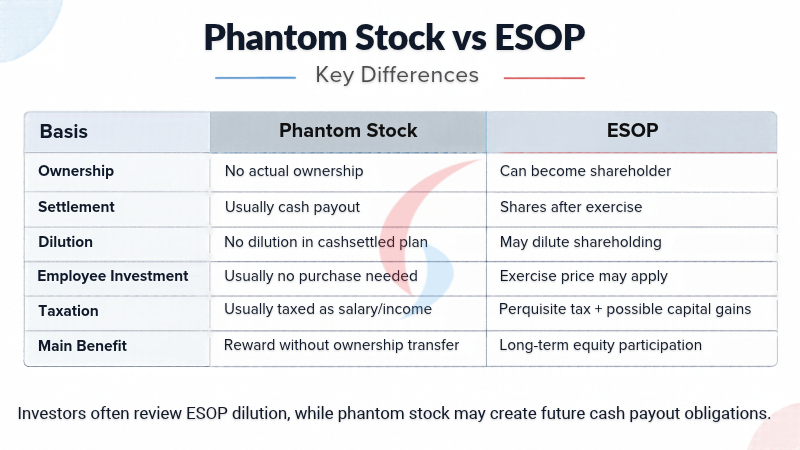
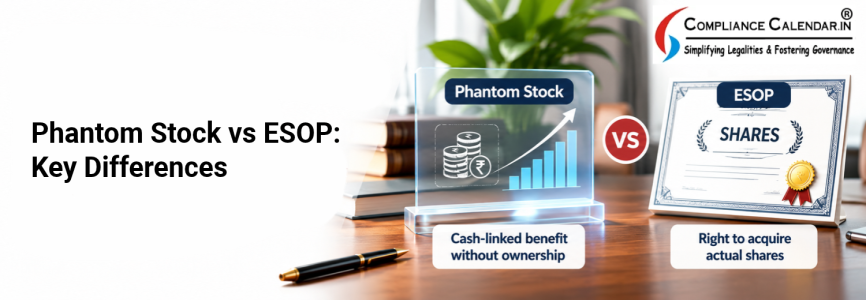
Although both schemes are designed to reward employees and encourage long-term commitment, their legal and financial structures are different. The most significant difference is that ESOPs provide an opportunity to become a shareholder, while phantom stock generally creates a contractual right to receive money.
|
Basis |
Phantom Stock |
ESOP |
|---|---|---|
|
Meaning |
Virtual share-linked incentive |
Right to acquire actual shares |
|
Ownership |
No actual share ownership |
Ownership arises after valid exercise and acquisition |
|
Voting rights |
Generally unavailable |
Available after becoming a shareholder, subject to share rights |
|
Settlement |
Usually cash |
Shares under a conventional ESOP |
|
Share dilution |
No dilution in a purely cash-settled plan |
May dilute existing shareholders |
|
Employee investment |
Usually no share purchase required |
Exercise price may be payable |
|
Taxation |
Generally employment income on cash payout |
Perquisite taxation and possible later capital gains |
|
Company cash flow |
Cash needed when payment becomes due |
Generally no equivalent cash settlement required |
|
Compliance |
Contractual, tax, accounting and employment requirements |
Companies Act, applicable SEBI rules and statutory compliance |
|
Main benefit |
Financial reward without ownership transfer |
Opportunity for long-term equity ownership |
The comparison becomes particularly important when a startup is raising investment. Investors generally examine the existing ESOP pool because future share allotments can reduce the percentage ownership of current shareholders. Phantom stock normally avoids this type of dilution, but it may create substantial future payment obligations that investors will also want to understand.
Apart from traditional ESOPs and phantom stock, businesses can explore other employee equity incentive arrangements based on their financial objectives. The article Different Types of ESOPs – Employee Stock Ownership Plans discusses various employee incentive structures and their implications for companies and employees.
How Do Phantom Stock and ESOP Work in Practice?
Both employee incentive arrangements commonly begin with the company identifying employees who should receive long-term rewards. However, the process changes after the initial grant. Under an ESOP, employees generally move through grant, vesting, exercise and eventual sale of shares. Under a phantom stock plan, the employee moves through grant, vesting and cash settlement when the agreed payment conditions are satisfied.
Suppose a startup promises an employee a reward after four years of service. Under an ESOP, that employee may become eligible to purchase shares after the vesting conditions are satisfied. The employee then decides whether to exercise the options within the permitted exercise period. Under a phantom stock plan, there may be no requirement to purchase any shares, but the cash reward may become payable only when the company reaches a specified valuation, completes a funding round, achieves a performance milestone or experiences an exit event.
Neither arrangement should be treated as a guaranteed financial benefit. If the company's value falls, options may become economically unattractive, while appreciation-only phantom units may produce little or no payout. Similarly, leaving employment before completing the vesting conditions may cause the employee to lose some or all of the expected benefit.
For startups, designing an effective employee incentive scheme requires careful consideration of vesting schedules, funding requirements and long-term retention strategies. The article Startup Funding and ESOPs: Leveraging Employee Stock Options for Growth explains how businesses can use employee stock options to support growth while considering their financial and ownership implications.
A Startup Story: Why Two Employees Received Different Rewards
Consider the fictional example of XYZ Private Company, a Bengaluru-based software startup established by two founders. During its early years, the company struggled to compete with larger technology businesses offering attractive salaries. Its founders wanted to retain two important employees, Rohan, who managed product development, and Priya, who handled business operations.
Rohan was interested in becoming a long-term shareholder because he believed the company could eventually attract a major investor. The founders offered him 2,000 ESOPs at an exercise price of Rs 100 per share. Priya, however, preferred a financial reward without investing her personal savings in company shares. The founders therefore granted her 2,000 appreciation-only phantom stock units using the same starting reference value of Rs 100.
Four years later, BrightPath completed a successful funding round that established a share valuation of Rs 400 for the purposes of both incentive arrangements. Rohan's options had an estimated spread of Rs 6,00,000, but he would need to pay Rs 2,00,000 to exercise them and consider the resulting tax liability. Priya's phantom stock arrangement, assuming all conditions were fulfilled and the funding round triggered settlement, provided a gross cash benefit of Rs 6,00,000 before applicable taxes.
Rohan could benefit further if the shares appreciated after he acquired them, but he also faced the risk of limited liquidity. Priya received a cash-linked benefit without acquiring shares, although she would not participate in future appreciation after settlement. This example demonstrates why the better choice depends on financial goals, company structure, employee expectations and the terms of the particular scheme.
ESOP Laws and Compliance Requirements in India
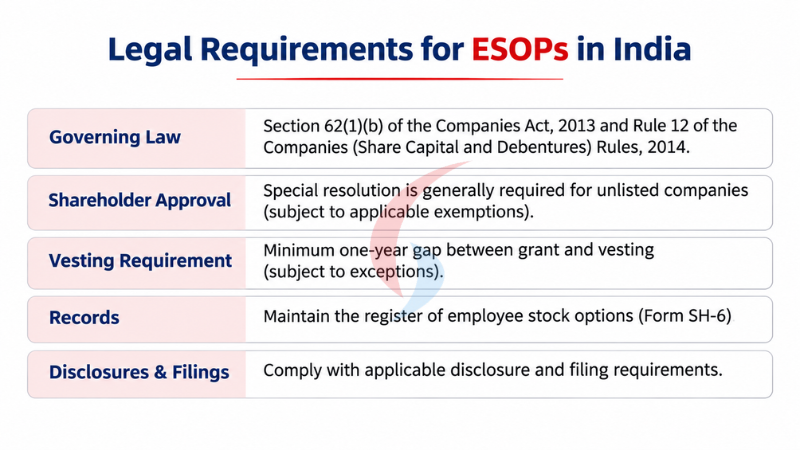
ESOPs in India operate under a defined statutory structure. Section 62(1)(b) of the Companies Act, 2013 permits companies to offer further shares to employees under an employee stock option scheme, subject to the required approvals and applicable conditions. Rule 12 of the Companies (Share Capital and Debentures) Rules, 2014 deals with matters including employee eligibility, shareholder approvals, minimum vesting periods, scheme disclosures, maintenance of records and treatment of employee options in different circumstances.
For an unlisted company, shareholder approval through a special resolution is generally required, subject to applicable exemptions. Rule 12 also ordinarily prescribes a minimum one-year period between grant and vesting, subject to relevant exceptions. The company must maintain the register of employee stock options in Form SH-6 and comply with applicable disclosure and filing requirements. These obligations make proper scheme documentation particularly important for growing private limited companies.
Startups introducing employee stock options should also understand the practical requirements of creating and administering an ESOP scheme. The article ESOP for Startups in India discusses important considerations relating to employee eligibility, vesting conditions, share valuation and the financial implications of issuing stock options.
Are Phantom Stock Plans Legal in India?
Phantom stock plans are generally permissible in India when they are properly structured as contractual cash-settled employee incentive arrangements and comply with applicable laws. Unlike conventional ESOPs, a purely cash-settled phantom stock plan does not involve the allotment or transfer of actual company shares. Consequently, the share issuance requirements under Section 62(1)(b) are not automatically triggered simply because an employee's reward is calculated with reference to company valuation.
The Securities and Exchange Board of India has clarified in its FAQs relating to the SEBI (Share Based Employee Benefits and Sweat Equity) Regulations, 2021 that phantom stock options settled in cash, without actual purchase or sale of listed-company equity shares, are not covered by those regulations. However, this does not mean every arrangement described as phantom stock is automatically exempt from securities regulation. Its actual structure, settlement mechanism and legal rights must be examined.
Companies should prepare a detailed phantom stock agreement explaining eligibility, vesting, valuation methods, payment events, treatment on resignation and forfeiture conditions. The agreement should also clarify that the employee does not receive shareholder rights under a cash-settled arrangement. Proper documentation through Phantom Stock Plan services can help businesses establish clear expectations and reduce future disputes.
Tax Implications of Phantom Stock and ESOPs in India
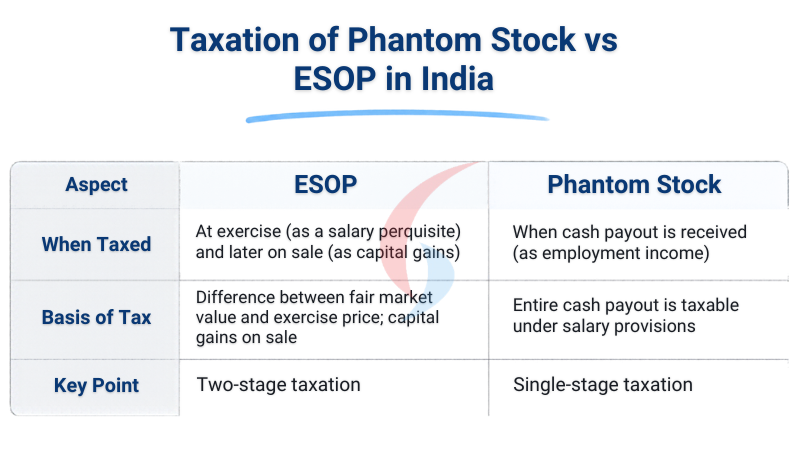
Taxation is one of the most important factors when comparing employee stock options with phantom stock. Even when two arrangements appear to provide the same financial value, the actual amount received by the employee and the timing of tax obligations may be different.
The Income-tax Act, 2025 came into force on 1 April 2026, replacing the earlier Income-tax Act, 1961 for the applicable periods, subject to transitional provisions. Therefore, employee incentive arrangements must be examined under the relevant provisions of the new law and the Income-tax Rules, 2026.
Taxation of ESOPs
Under a conventional ESOP arrangement, taxation generally arises at two separate stages. The first stage occurs when the employee exercises the option and shares are allotted or transferred. The difference between the fair market value of the shares determined under the applicable tax rules and the amount paid by the employee is generally treated as a taxable salary perquisite. The second stage occurs when the employee sells those shares, potentially resulting in capital gains or capital losses.
For example, if an employee exercises 1,000 ESOPs at Rs 100 per share when the applicable fair market value is Rs 300, the taxable perquisite would generally be Rs 2,00,000. If the employee subsequently sells the shares at Rs 450 each, the gain would ordinarily be calculated using the relevant tax cost basis, subject to applicable capital gains provisions. The tax rules also provide special withholding arrangements for eligible startups meeting prescribed conditions; this relief is not automatically available to every startup.
ESOP taxation can become particularly complicated when employees exercise their options before the company provides an opportunity to sell the underlying shares. For a more detailed explanation of taxable perquisites, capital gains and employer responsibilities, readers can refer to ESOP Taxation for Employees and Startups in India
Taxation of Phantom Stock
A conventional cash-settled phantom stock payout made to an employee is generally treated as employment-related income rather than capital gains. Since the employee does not acquire actual shares, there is normally no later share-sale event arising from that payout. The employer must examine the applicable salary taxation and tax deduction at source requirements when the benefit becomes taxable or payable under the relevant provisions.
For example, if an employee receives Rs 5,00,000 under a phantom stock arrangement, the taxable amount would generally form part of employment income, subject to the facts and the applicable tax rules. The employee's final tax liability depends on total taxable income and applicable rates. For consultants or non-employee recipients, classification and withholding treatment may differ because the recipient is not necessarily receiving salary.
Why Is Valuation Important for Both Arrangements?
Valuation plays an important role in determining whether employee incentives are fair and financially sustainable. In an ESOP arrangement, share valuation may influence the exercise-price policy, accounting treatment, taxation and employee expectations. For unlisted companies, determining fair market value requires particular attention because there is no continuously quoted stock exchange price.
In phantom stock arrangements, valuation directly influences the amount the company may eventually pay. For example, if a company grants 10,000 appreciation-only phantom units at a base value of Rs 100 and the future value becomes Rs 600, the company may face a gross payment obligation of Rs 50,00,000, assuming all units vest and the payment conditions are satisfied. Without proper planning, that liability could place pressure on the company's finances.
Companies should establish an objective valuation mechanism and clearly identify how and when the value will be calculated. Professional Valuation Services can assist businesses in assessing company value, documenting assumptions and supporting employee incentive calculations under the applicable requirements.
The valuation of employee stock options requires an understanding of share value, valuation methodologies and applicable regulatory requirements. Companies can explore ESOP Valuation in India: Methods and Compliance to understand how valuation affects employee incentives, taxation and corporate compliance.
Advantages and Disadvantages of Phantom Stock
The biggest advantage of phantom stock is that a company can financially reward employees without issuing actual equity shares. This allows founders to preserve their ownership percentages and maintain existing shareholder control. Phantom stock can also be useful when employees prefer cash-based rewards or when the company wants a relatively flexible incentive arrangement linked to particular business milestones.
However, phantom stock does not eliminate financial costs. Companies may need to make substantial cash payments when units become payable, particularly after significant business growth. The accounting treatment may also require recognition and subsequent remeasurement of liabilities under the applicable accounting standards. Employees should understand that phantom units are contractual rights rather than ownership interests, and their financial value depends on the agreed settlement provisions.
Advantages and Disadvantages of ESOPs
ESOPs offer employees the opportunity to participate in actual company ownership. This can create a stronger connection between employees and the company's long-term performance. For startups with limited immediate cash resources, ESOPs may help attract experienced professionals who believe in the future value of the business. Employees who eventually become shareholders may also benefit from further increases in share value, subject to liquidity and market conditions.
The disadvantages mainly arise from compliance requirements, potential dilution and taxation. An employee may have to pay the exercise price and applicable taxes before being able to sell the shares. In an unlisted company, finding a buyer may be difficult even when the business valuation has increased substantially. Companies must also consider the effect of ESOP pools on existing shareholders and future investment rounds.
Despite these challenges, ESOPs remain an important tool for businesses looking to retain employees and encourage long-term participation in company growth. The article ESOPs: A Powerful Incentive for Employee Retention and Business Growth discusses how employee ownership incentives can support workforce motivation and business expansion.
What Happens When an Employee Leaves the Company?
Employee resignation is a common source of confusion in both ESOP and phantom stock arrangements. Under an ESOP, vested and unvested options may receive different treatment. Rule 12 of the Companies (Share Capital and Debentures) Rules, 2014 provides that unvested options generally expire upon resignation or termination, while vested options may be exercised within the period and subject to the terms specified in the scheme. Death and permanent incapacity are governed by specific statutory provisions.
For phantom stock, the treatment of vested and unvested units primarily depends on the contractual terms of the plan and applicable employment law. The agreement may provide for forfeiture, continued eligibility, accelerated vesting or delayed settlement depending on the circumstances. Employers should avoid relying on vague clauses because disputes can arise when an employee resigns shortly before a funding round or business sale. For related guidance, see ESOPs on Resignation, Termination and Death.
Phantom Stock vs ESOP: Choosing the Right Option for Your Startup
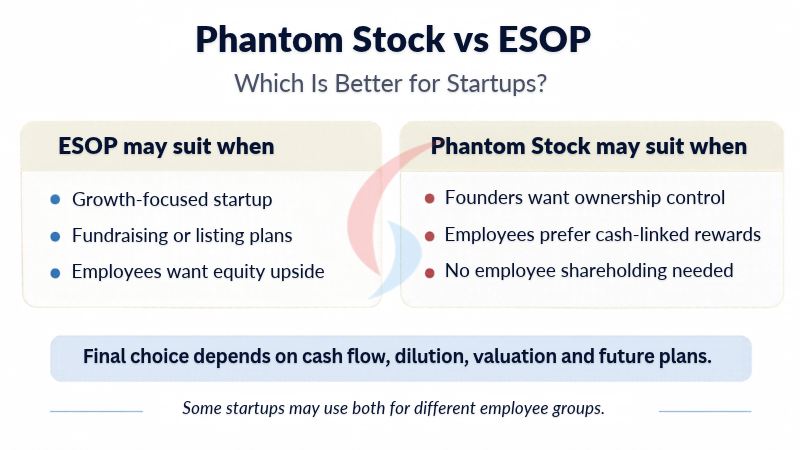
There is no single incentive arrangement that suits every startup. A business planning aggressive expansion, institutional fundraising or a potential public listing may consider ESOPs because they allow employees to participate in long-term equity value creation. However, the founders must carefully estimate dilution, maintain proper documentation and communicate liquidity-related risks to employees.
A founder-led company that wants to retain ownership control may find phantom stock more suitable, especially when selected employees want financial participation without becoming shareholders. Nevertheless, the company must forecast future cash settlement obligations and establish a transparent valuation process. Before introducing either scheme, businesses can undertake Startup Due Diligence to understand how existing shareholding, employee liabilities and future fundraising plans may be affected.
The decision should also consider the company's financial position. A startup with limited cash reserves but strong long-term growth potential may prefer equity-linked rewards. A profitable business with sufficient cash flow but no intention of bringing employees into its shareholder structure may prefer phantom stock. Some businesses may even combine carefully designed arrangements for different categories of employees, provided each scheme complies with applicable law.
Before finalising an employee incentive scheme, founders should also evaluate how shareholding arrangements may affect future fundraising and investment decisions. The article Startup Shareholding Changes and Tax Benefits provides additional insights into ownership changes and tax considerations that growing startups should understand.
Common Mistakes Companies Should Avoid
One common mistake is describing phantom stock as actual equity ownership. This can create unrealistic employee expectations about voting rights, dividends and participation in company decisions. Another mistake is granting ESOPs without explaining the exercise price, vesting conditions, tax treatment and available exit opportunities. Employees may assume that an increase in the company's valuation automatically means they can immediately withdraw money, which is not necessarily correct.
Companies also sometimes overlook the financial implications of their incentive schemes. A poorly structured phantom stock plan may create an unexpectedly large payment liability, while an excessively large ESOP pool may affect existing shareholders and future fundraising negotiations. Maintaining proper records, reviewing valuation assumptions and documenting approval procedures are important for preventing these problems.
Why Choose Compliance Calendar LLP?
The difference between Phantom Stock and ESOP ultimately comes down to financial participation versus actual ownership. ESOPs allow eligible employees to acquire company shares after satisfying the required conditions, while cash-settled phantom stock plans provide a monetary benefit calculated with reference to company value. Both can motivate employees and support long-term retention, but they create different consequences for founders, employees and investors.
For Indian startups and private limited companies, the right decision should depend on ownership goals, available cash, employee preferences, valuation requirements and applicable legal obligations. A well-designed employee incentive scheme can strengthen relationships between a business and its employees. A poorly documented arrangement, however, can create tax disputes, unexpected liabilities and disagreements over promised benefits.
If you are planning to introduce an ESOP or Phantom Stock Plan for your company and need professional assistance with scheme structuring, valuation, documentation, and regulatory compliance, contact Compliance Calendar at +91 9988424211 or info@ccoffice.in
Frequently Asked Questions (FAQs)
Q1. What is the main difference between Phantom Stock and ESOP?
Ans. The main difference is ownership. ESOPs provide employees with the right to acquire actual company shares after meeting specified conditions, while phantom stock provides a contractual financial benefit linked to the company's share value. A cash-settled phantom stock plan does not make the employee a shareholder.
Q2. Is phantom stock legal in India?
Ans. Yes, properly structured cash-settled phantom stock arrangements are generally permissible in India. Companies should document the scheme through appropriate agreements and comply with applicable employment, tax and accounting requirements. A plan involving actual securities may attract additional regulatory obligations depending on its structure.
Q3. Which is better for employees, ESOP or phantom stock?
Ans. ESOPs may be attractive to employees who want long-term ownership and are comfortable with valuation and liquidity risks. Phantom stock may suit employees who prefer cash-based incentives without purchasing shares. The actual financial outcome depends on vesting, settlement conditions, company performance and taxation.
Q4. Does phantom stock dilute company ownership?
Ans. A purely cash-settled phantom stock plan does not ordinarily dilute ownership because the company does not issue additional shares. However, it can create future payment obligations. Founders must assess whether the business can fund those obligations when employees become eligible to receive their benefits.
Q5. Are ESOPs taxable in India?
Ans. Yes. Conventional ESOPs generally involve taxation when shares are acquired through exercise, based on the applicable fair market value and exercise price. A subsequent share sale may also result in capital gains taxation. Special rules may apply to employees of qualifying eligible startups.
Q6. How is phantom stock taxed in India?
Ans. Cash payments made to employees under conventional phantom stock plans are generally taxable as employment income, subject to applicable tax provisions. Employers must examine the relevant TDS requirements. The tax classification may differ when the recipient is an independent consultant or another non-employee.
Q7. Can a private limited company issue phantom stock?
Ans. Yes. A private limited company can generally introduce a properly structured contractual phantom stock plan. The company should specify eligibility, grant value, vesting conditions, valuation methodology and settlement events. It should also assess future cash liabilities before promising substantial rewards to employees.
Q8. Do ESOP holders have voting rights?
Ans. An employee does not automatically receive voting rights merely because ESOPs have been granted or vested. Voting rights generally arise after the employee validly exercises the options, acquires shares and becomes entitled to the rights attached to those shares. The company's share structure and applicable law determine the precise rights.
Q9. What happens to phantom stock after resignation?
Ans. The outcome depends primarily on the terms of the phantom stock agreement and applicable law. Unvested units may be forfeited, while vested units may remain eligible for payment under specified conditions. Companies should clearly document resignation, termination, retirement and death-related provisions.
Q10. Can a company offer both ESOPs and phantom stock?
Ans. Yes, a company may introduce both types of incentive arrangements for different categories of eligible participants, subject to applicable laws and proper documentation. For example, it might use ESOPs for long-term leadership employees and cash-settled phantom incentives for selected professionals. The company should evaluate dilution, tax, accounting and financial implications before implementing both schemes.
Article last updated on : 19 Nov 2026.













































































_learn_crop10_thumb.jpg)