


A Third Party Administrator (TPA) plays an important role in India's health insurance sector by helping insurance companies manage hospital coordination, cashless treatment requests, claims documentation and policyholder services. However, operating a TPA business requires more than obtaining an initial license. Companies must ensure that their registration remains valid and that regulatory requirements are followed continuously.
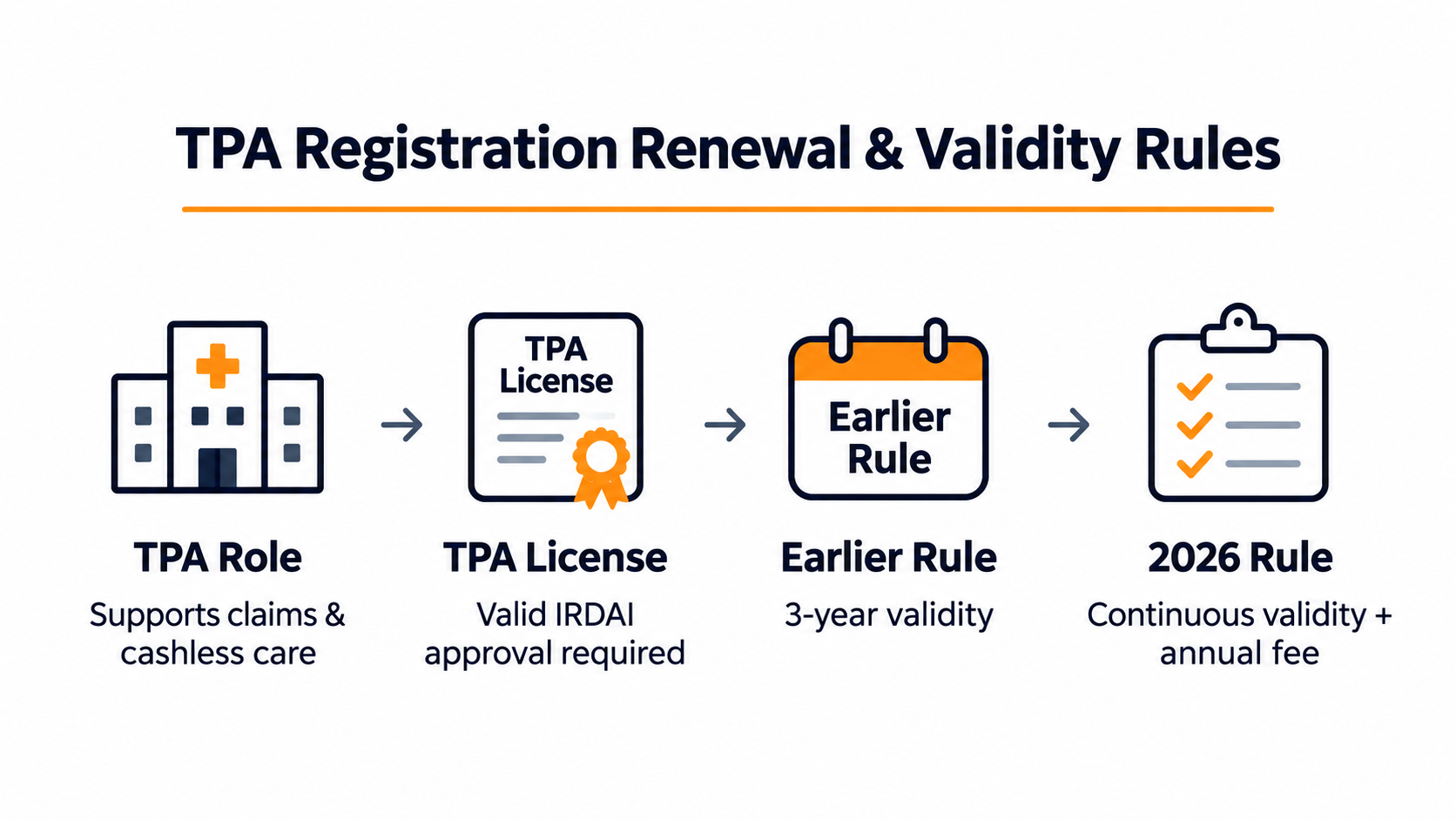
Before understanding TPA Registration Renewal and Validity Rules, businesses must ensure that they have obtained a valid Third Party Administrator License from IRDAI. Companies planning to enter the health insurance sector should complete the necessary Private Limited Company Registration and comply with applicable GST Registration requirements. Apart from initial registration, existing TPAs must maintain proper financial records, pay annual regulatory fees and comply with IRDAI regulations to keep their registration valid. Understanding these requirements is important because failure to meet ongoing compliance obligations may lead to suspension or cancellation of the TPA license.
Consider a company named MediCare Assist Insurance TPA Private Limited Company, which obtained its IRDAI registration in 2024. Its management initially expected to renew the license after three years, as required under the earlier regulations. However, the introduction of the IRDAI (Third Party Administrators – Health Services) (Amendment) Regulations, 2026 changed the rules relating to TPA registration validity, renewal and annual fees.
The amendments, notified on 30 July 2026, introduced continuous registration validity subject to payment of prescribed annual fees and ongoing compliance. Existing TPAs holding certificates with a three-year validity period must also understand the transitional renewal provisions. This article explains the updated TPA Registration Renewal process, validity rules, annual fee requirements, applicable legal provisions and consequences of non-compliance.
Businesses planning to enter this sector can also read our guide on Obtain Third Party Administrator (TPA) License with IRDAI to understand the initial registration requirements.
What Is TPA Registration Renewal?
TPA Registration Renewal refers to the regulatory procedure through which an existing Third Party Administrator maintains or regularises its registration with the Insurance Regulatory and Development Authority of India (IRDAI). Under the earlier registration system, a TPA generally received a Certificate of Registration valid for three years. The company was required to submit a renewal application before the certificate expired, along with prescribed documents and fees.
The 2026 amendments significantly changed this arrangement. Instead of requiring every registered TPA to undergo repeated three-year renewals, the amended provisions allow registration to remain in force continuously, subject to payment of annual fees and continued compliance.
Businesses applying for their first TPA license can read our guide on TPA Registration with IRDAI to understand the initial approval process and eligibility requirements.
Legal Provisions Governing TPA License Renewal in India
The renewal and validity requirements are governed primarily by the Insurance Act, 1938, the IRDAI Act, 1999, and the applicable TPA regulations.
| Legal provision | Relevance to TPA registration |
|---|---|
| Section 42D, Insurance Act, 1938 | Registration, continuing validity and regulatory conditions for insurance intermediaries |
| Section 42E, Insurance Act, 1938 | Further provisions relating to insurance intermediaries |
| IRDAI (Third Party Administrators – Health Services) Regulations, 2016 | Principal registration and operational requirements |
| IRDAI TPA Amendment Regulations, 2026 | Revised validity, transition, annual fees and reporting |
| Regulation 7(7), as amended | Renewal procedure for eligible existing TPAs |
| Regulation 9(4), as amended | Continuing validity of registration |
| Regulation 9(6), as amended | Annual fee and consequences of late payment |
The 2026 amendments were introduced following changes made under the Sabka Bima Sabki Raksha (Amendment of Insurance Laws) Act, 2025. These changes altered the earlier fixed-period registration system for insurance intermediaries.
To understand the registration process before the renewal stage, explore our article on Process to Become a Third-Party Administrator in India.
TPA License Validity Rules After the 2026 Amendment
One of the most important developments is the change in TPA License Validity. Previously, Regulation 9(4) provided for a three-year validity period, unless the registration was suspended, revoked or cancelled earlier. Under the amended Regulation 9(4), a Certificate of Registration remains in force subject to payment of the applicable annual fee, unless it is revoked, suspended, cancelled or otherwise ceases to remain effective under the applicable legal provisions. This means that continuous validity does not amount to unconditional or permanent approval. A TPA must continue meeting the financial, operational and regulatory requirements applicable to its business.
TPAs must follow ongoing regulatory obligations, which are further explained in our guide on IRDAI Compliance Requirements for Insurance Intermediaries
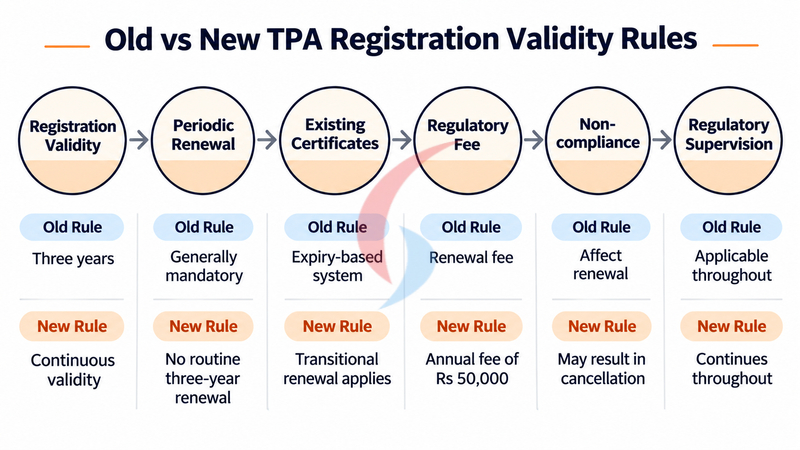
Old vs New TPA Registration Validity Rules
| Particulars | Earlier rules | Rules after July 2026 amendment |
|---|---|---|
| Registration validity | Three years | Continuous, subject to conditions |
| Periodic renewal | Generally mandatory | No routine three-year renewal for registrations under the new validity provisions |
| Existing certificates | Earlier expiry-based system | Transitional renewal procedure applies where relevant |
| Regulatory fee | Renewal-related fee | Annual fee of Rs 50,000 plus applicable taxes |
| Non-compliance | Could affect renewal or registration | May result in suspension or cancellation |
| Regulatory supervision | Applicable throughout registration | Continues throughout registration |
Readers comparing different insurance intermediary licenses can also explore Insurance Broker Registration in India to understand the separate registration and compliance requirements for brokers.
For example, where a TPA receives a Certificate of Registration under the amended provisions, it does not ordinarily need to renew that certificate every three years. Nevertheless, the company must pay its annual fee, submit regulatory returns and maintain all prescribed eligibility conditions.
Renewal Rules for Existing TPAs Holding Three-Year Certificates
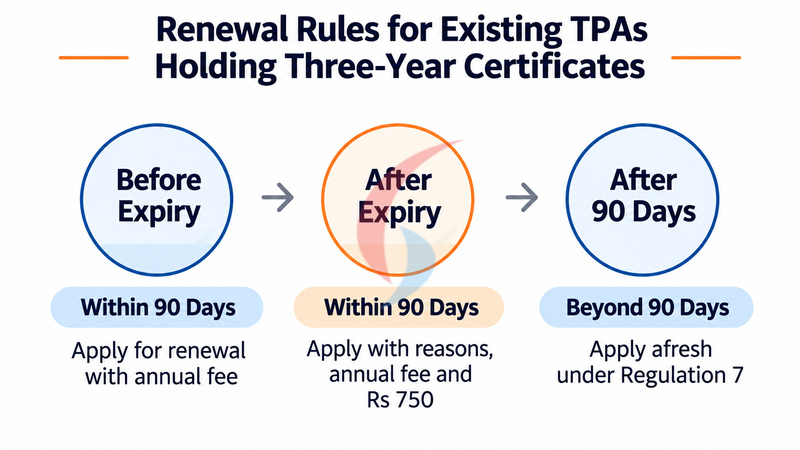
The 2026 amendment specifically addresses TPAs whose registration certificates were issued before the commencement of the 2025 insurance-law changes and carried a three-year validity period. Under the newly inserted Regulation 7(7), such TPAs may apply for renewal and issuance of a certificate governed by the amended registration provisions. The application must ordinarily be made within 90 days before the expiry of the existing Certificate of Registration, in the form and manner prescribed by IRDAI, with payment of the applicable annual fee.
If the TPA misses this period, the regulations permit an application within 90 days after expiry, accompanied by reasons for the delay, the applicable annual fee and an additional Rs 750. If the application is not submitted within 90 days after expiry, the company must apply afresh under Regulation 7. The amended regulations also provide for specified transitional treatment of pending renewal applications and certificates issued during the relevant transition period.
Important Renewal Deadlines
| Situation | Applicable requirement |
|---|---|
| Existing three-year certificate approaching expiry | Apply within 90 days before expiry |
| Application submitted after expiry | May be accepted within 90 days with reasons and additional fee |
| Additional delayed application fee | Rs 750 |
| No application within 90 days after expiry | Fresh registration required |
| Registration under amended provisions | Continuing validity subject to compliance |
An expired certificate should not be treated as automatically valid merely because a late renewal application is permitted. The company must verify its regulatory status and ensure that its operations are authorised.
TPA Annual Registration Fee Under IRDAI Rules 2026
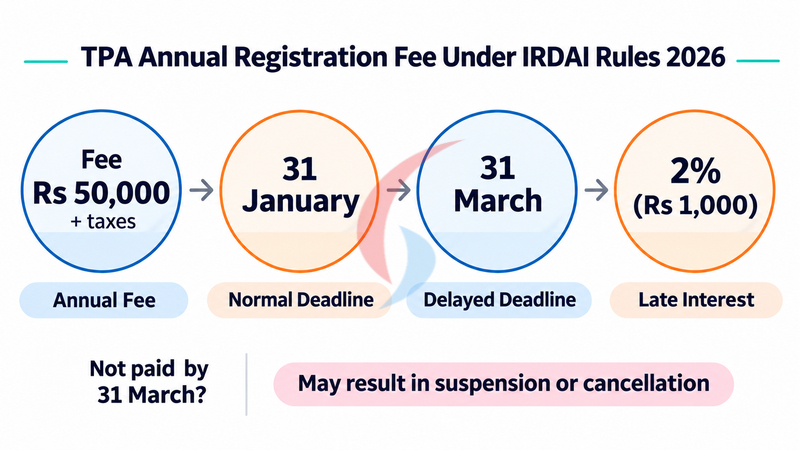
The revised fee system is an important part of TPA Registration Renewal and continued validity. Under Regulation 9(6), every TPA holding a valid registration must pay an annual fee of Rs 50,000 plus applicable taxes by 31 January for the following financial year. If the annual fee is not paid by 31 January, the TPA may pay it by 31 March with interest equal to 2% of the annual fee. Failure to pay the fee and applicable interest by 31 March constitutes a breach of registration conditions and may result in suspension or cancellation
| Fee requirement | Amount or deadline |
|---|---|
| Annual registration fee | Rs 50,000 + applicable taxes |
| Normal payment deadline | 31 January |
| Delayed payment deadline | 31 March |
| Late payment interest | 2% of annual fee |
| Interest on Rs 50,000 | Rs 1,000 |
| Failure to pay by 31 March | Possible suspension or cancellation |
For example, a registered TPA paying its annual fee for FY 2027–28 should ordinarily make payment by 31 January 2027. A TPA registered during a financial year must pay the applicable pro-rata fee within 15 days of registration. Additionally, a suspended TPA remains liable to pay annual fees falling due during suspension.
Step-by-Step TPA Registration Renewal Process
Existing TPAs covered by the transitional renewal provisions should follow the applicable IRDAI process.
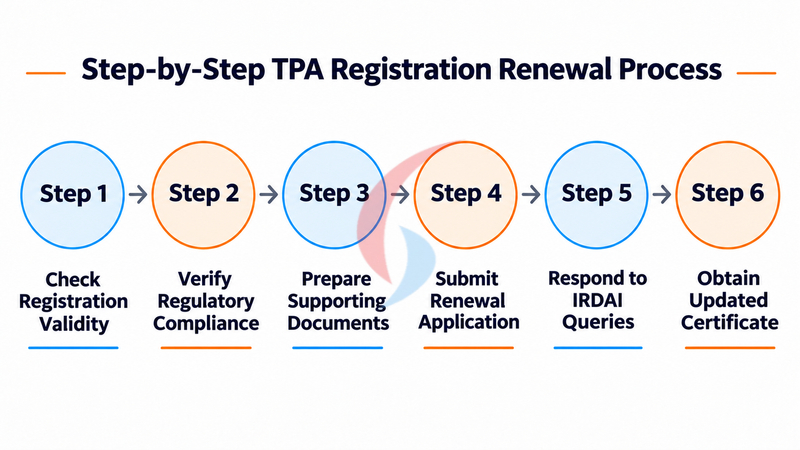
Step 1: Check Registration Validity
Review the existing Certificate of Registration, its expiry date, registration number and any conditions imposed by IRDAI. Determine whether the certificate falls under the transitional renewal provisions or already operates under continuous validity.
Step 2: Verify Regulatory Compliance
Before submitting a renewal application, confirm that the company satisfies the applicable financial, management, reporting and operational requirements.
Step 3: Prepare Supporting Documents
Maintain updated corporate documents, audited financial statements, shareholding information, regulatory returns and details of key managerial personnel. The final documents must follow the form and requirements specified by IRDAI.
Step 4: Submit the Renewal Application
Where transitional renewal is required, submit the prescribed application within the applicable 90-day period before expiry. Pay the annual fee and provide any additional information requested by the Authority.
Step 5: Respond to IRDAI Queries
IRDAI may review the company's compliance status and request clarifications. The applicant should respond accurately and maintain records of communications.
Step 6: Obtain the Updated Certificate
Where IRDAI is satisfied, it may issue a Certificate of Registration governed by the amended validity provisions. The company must continue paying annual fees and meeting regulatory obligations. Companies seeking their first approval should understand the requirements for a Third Party Administrator License before establishing a regulated health insurance administration business.
Documents Required for TPA Renewal
The following documents are useful for renewal preparation and ongoing registration verification. The actual submission requirements depend on IRDAI's prescribed procedure.
-
Existing IRDAI Certificate of Registration
-
Certificate of Incorporation and updated corporate records
-
Audited financial statements and net worth certificate
-
Current shareholding and ownership details
-
Details of directors and key managerial personnel
-
Applicable regulatory returns and compliance records
-
Annual registration fee payment evidence
-
Board authorisation and prescribed declarations
Maintaining updated documents throughout the year helps companies respond efficiently to regulatory queries rather than collecting information only when renewal becomes due.
For a related example of regulatory oversight over ownership changes, read IRDAI Approval for Insurance Broker Takeover to understand the approval requirements applicable to insurance brokers.
Case Study: A TPA Company Facing Renewal Delays
Consider the earlier example of MediCare Assist Insurance TPA Private Limited, which received a three-year registration certificate in 2024 with an expiry date in 2027.
In early 2026, the company's compliance team began preparing for renewal under the earlier rules. However, the July 2026 amendments introduced new procedures for certificates issued before the insurance-law changes.
The company reviewed Regulation 7(7), identified its applicable renewal window and prepared its financial and regulatory records. It also created an internal calendar for annual fee payments and reporting.
Instead of assuming that its existing certificate automatically had unlimited validity, the company followed the applicable transitional process and sought confirmation of its registration status.
This fictional example demonstrates why understanding the difference between TPA License Renewal and continuous registration validity is important.
Businesses evaluating alternative insurance distribution models can read Difference Between Insurance Broker and Corporate Agent to understand their distinct roles and IRDAI requirements.
What Happens if a TPA Fails to Maintain Registration Validity?
Continuous registration does not protect a company from regulatory action. IRDAI may suspend or cancel registration where applicable legal grounds are established. These may include failure to pay annual fees, failure to maintain prescribed financial requirements, serious reporting deficiencies, regulatory violations or other grounds specified under the Insurance Act and TPA regulations. The 2026 amendments also require quarterly reporting of related-party transactions and annual submission of audited financial statements, along with applicable website disclosures. A TPA should therefore maintain a compliance calendar covering regulatory payments, financial reporting, management changes and applicable disclosures.
To understand how regulatory obligations differ across insurance intermediaries, explore our article on Corporate Agent Under IRDAI
Why Choose Compliance Calendar LLP for TPA Registration Renewal?
Compliance Calendar LLP assists businesses in understanding IRDAI requirements relating to TPA Registration Renewal, license validity, regulatory documentation and post-registration compliance.
Our team can help companies review their registration status, identify applicable filing requirements, prepare supporting records and understand changes introduced under the 2026 regulations. Businesses establishing a new TPA company can also explore our Third Party Administrator License service for registration requirements, financial eligibility and regulatory application assistance.
For professional assistance with IRDAI registration, documentation and insurance regulatory compliance, contact Compliance Calendar LLP at +91 9988424211 or email info@ccoffice.in for expert guidance and support.
Frequently Asked Questions (FAQs)
Q1. What is the validity of a TPA License in India in 2026?
Ans. Under the amended regulations, TPA registration has continuous validity, subject to annual fee payment and compliance. Earlier three-year certificates may require action under the transitional provisions.
Q2. Is TPA Registration Renewal mandatory every three years?
Ans. No. The routine three-year renewal system has been discontinued. However, eligible existing TPAs holding older certificates must comply with the prescribed transitional renewal procedure.
Q3. What is the annual fee for TPA registration?
Ans. The annual fee is Rs 50,000 plus applicable taxes under Regulation 9(6). It is generally payable by 31 January for the following financial year.
Q4. What happens if the annual fee is paid late?
Ans. A TPA may pay by 31 March with interest equal to 2% of the annual fee. Further default may lead to suspension or cancellation.
Q5. Can a TPA renew its registration after expiry?
Ans. Eligible existing TPAs may apply within 90 days after expiry with reasons for the delay, applicable annual fees and an additional Rs 750, subject to the amended provisions.
Q6. What happens if the renewal application is delayed beyond 90 days after expiry?
Ans. A TPA covered by Regulation 7(7) must apply afresh for registration under Regulation 7 if it misses the prescribed post-expiry period.
Q7. Does continuous validity mean permanent approval?
Ans. No. Continuous validity is conditional. IRDAI retains regulatory powers to suspend or cancel registration for applicable violations.
Q8. Is the annual fee payable during suspension?
Ans. Yes. The amended regulations provide that annual fees falling due during suspension remain payable, subject to the prescribed conditions.
Q9. Do TPAs need to submit annual financial statements?
Ans. Yes. TPAs must submit audited financial statements annually and comply with applicable quarterly related-party transaction reporting requirements.
Q10. Which regulations govern TPA renewal in India?
Ans. The principal rules are the IRDAI (Third Party Administrators – Health Services) Regulations, 2016, as amended in 2026, read with the applicable provisions of the Insurance Act, 1938.
Article last updated on : 17 Nov 2026.













































































_learn_crop10_thumb.jpg)